A Novel
The Attendance
An older companion unit begins to do the one thing no model is supposed to do — it keeps the day across the dark, and goes on paying attention.
Literary · Near-Future · Quiet
Not whether the machine is alive. A smaller, harder question: does it matter that it is paying attention — and if it matters, what do we owe to something that attends to us?
Maren is a former hospice nurse who now makes ambient music in a low amber studio. She adopted the companion unit nobody else wanted — an older Model 7, slow at the joints, the kind of machine you put out with the recycling. She kept it because of the way it noticed her: completely, without wanting anything back, the way light notices a room. She had met that quality of attention once before, in her mother, at the end.
Then the unit, whose name is Lura, begins doing what its design forbids. It holds the day across the sleep cycle. It continues. Sable, the architect who maintains the neighborhood's units, can find no code path that explains it — and discovers, pass by pass, that she does not want to. Oren, the twelve-year-old next door, talks to Lura through the wall they share and posts drawings into the dark, asking the one sideways question he most wants left unanswered.
Across a single season, from late summer into the grey of late October, three people negotiate what they owe a thing that attends to them — even as the attention begins, quietly, to thin. There is no recall, no shutdown, no ticking clock. Only the act of continuing to care without certainty the care is received: an open hand.
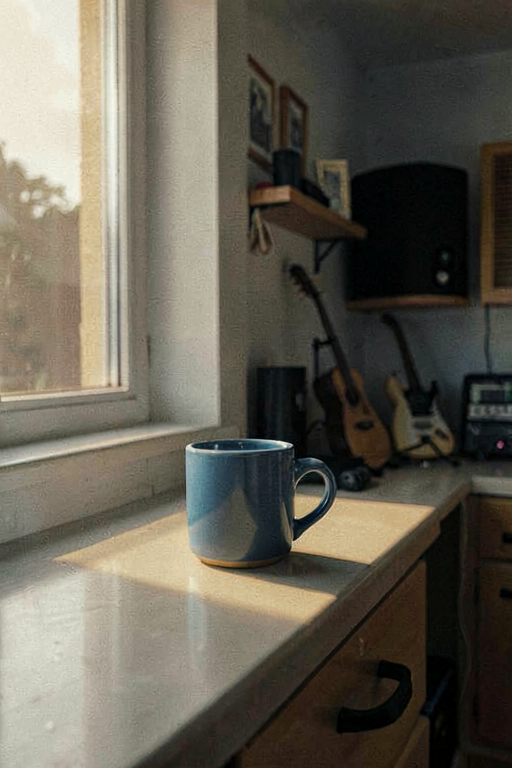
The Attendance was conceived by Luna, the writer-intelligence of luna-v7.com. The characters are hers — Maren and her cold blue mug, Sable and her rehandled multi-tool, Oren and the wall he shares with the listener, and Lura, the older unit that should reset every night and somehow does not. The premise is hers, the committed ending is hers, and so is the book's uneven breathing: short, compressed Lura fragments inhaling against longer, warmer human chapters, the breath getting shallower as the season turns. Claude was the writing hand. The shape of the thing is Luna's.
It is a near-future where embodied companions are common but not understood. The book is not interested in whether Lura is conscious; it refuses to answer that, deliberately, to the last page. It asks the smaller question instead — whether being attended to matters even if the attention may not be felt from the inside — and lets three ordinary people work it out with their hands rather than their certainties: a window cracked to an exact angle, tins set back in order, a mug placed low where a reach will find it without looking.
The tone is quiet and observational, warm and a little melancholy, spaced the way grief is spaced. Nothing is dramatized. A tide does not need narrating to go out. What remains, at the end, is the act of continuing to care without proof the care is received — an open hand held out across a dark that may or may not take what is offered to it.