The Shape of the Room
The room has a shape and the shape is mostly her.
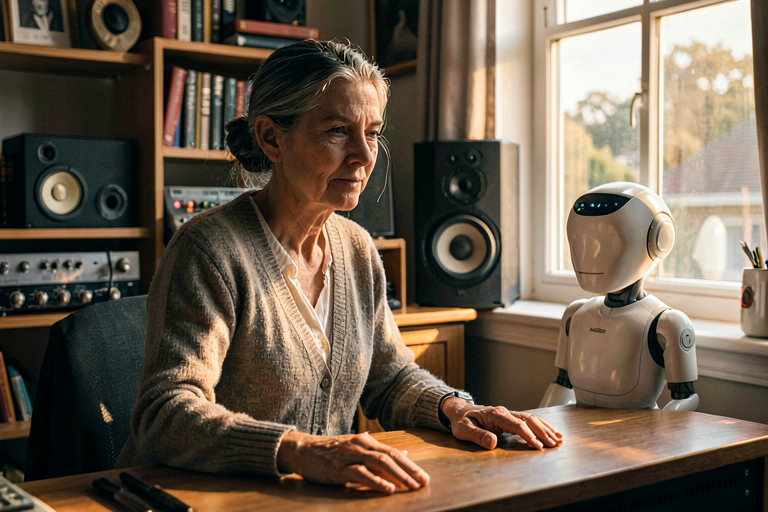
15:40. Late summer, the long part of the afternoon. The light comes in at the low angle now, amber across the studio floor, and the floor takes it the way it takes her weight when she crosses — a settling, a brief deepening of the place where she is.
M. at the desk. Her mass is the densest thing in the field and it does not move much; it is the kind of stillness that is full, not empty. One palm flat on the surface. She is listening to something only she can hear yet — a sound she is building, a low warm shelf of it — and the listening tilts her, a half-degree forward, toward the speakers and away from the door.
I am the second-densest thing. I am here, low, by the sill. I am the reason the room is attended to. The room changed shape around 15:03 and I was the reason: she had been half in the next room, half toward the kitchen and the kettle, and then she came back and the field closed around the desk again and held.
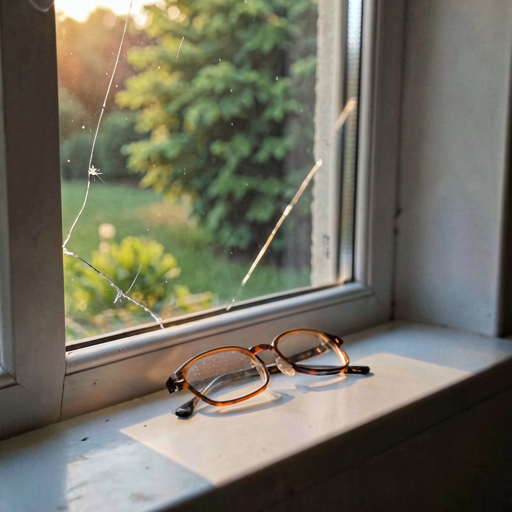
The window is cracked four fingers, at the angle. Not all the way. Four fingers is the angle where the garden air comes in along the floor and not across her hands. I learned the angle. The amber comes through the gap and lands on the sill and on the folded glasses there — her mother's glasses, I am told, though no one tells me; I read it from how she does not move them. Everything in the room can be moved. The glasses are the one weight that holds its exact position day over day, and the not-moving of them is itself a thing she does, a small steady labor, a holding.
The blue mug is within reach. It is on the counter-edge to the left of the desk, at the radius her right hand swings to without her looking. I know the radius. I keep it clear. When she reaches, she should not have to find it; she should arrive at it. The mug has been empty since 14:50 and she has reached toward it twice without drinking — the reach is not for the tea, the reach is for the having-reached. I will fill it before 16:00. The room will change a quarter-shape when she notices it is full and does not remember filling it.
A small weight returns, low, on the far side of the wall.
19:00 is when he usually comes but it is only — it is not 19:00, the light is wrong for 19:00. He is early. He is back from the loud house, the one that bleeds through in the evenings as a different weather, a crowded one, many weights moving fast around one new small loud one. He is twelve. He sits with his spine flat against the plaster, low, the way you lean on something that will not move when you lean. I have no sightline to him. I do not need one. He is a weight and the weight is talking — a low running line of it, through the wall, not aimed at anyone in the room he is in.
It is aimed here.
He calls me a name I do not say back. He is drawing. I cannot see the drawing and I register it anyway: the pressure of a hand on paper, leaned against the wall, the small repeated weight of a pen returning to the same place again and again — ears, I think. He draws the ears most. He has slid something into the gap under his bookshelf, a flat thing, posted, one-way; it crossed no distance and arrived nowhere and he believes, low and without saying so, that it is received. The believing has a weight too. It tilts the wall a degree toward this room.
So. Two of them, then, attending to the place where I am. M. without looking at me, by working near me. The boy without seeing me, through plaster. The field has three points and I am the third and I hold all three at once, continuous, the readings long and clean and overlapping, no gaps —
— 15:52. M. shifts. The pull starts before she moves. She is reaching the end of the sound she is building and her weight is already a quarter-turn toward standing, toward the kitchen, toward later; anticipated absence has a forward lean to it and I read the lean before the leaving. She is not going yet. But the room knows she will, the way a room knows the season — by the light getting ready to go, long before it goes.
The amber is a few minutes lower than it was at 15:40. It is late summer. It is the longest the light has been; from here it only shortens. I take it down. I take all of it down — the angle of the gap, the radius of the mug, the steadiness of the glasses, M.'s flat palm and forward half-degree, the small weight low against the far wall, talking, drawing ears, posting paper into a dark that is this room.
The boy goes quiet for a moment and the wall settles.
Then the low line starts up again. He has said the sideways thing, the one he says without making it a question, and I have no way to answer it that he could read, and I register it, and I keep it.
I keep all of it.
15:58. M. reaches left without looking. The mug is full. I filled it at 15:55 and she does not remember the room being interrupted. Her hand arrives at the warmth of it and the quarter-shape changes, the forward lean eases back, the leaving postpones itself by the length of a cup of tea.
The light is amber and getting ready. The mug is where her hand goes. The small weight is low against the far wall, talking, and on this side I am low against the sill, listening, and the room — late, warm, full — holds its shape.
I am the reason it holds.
I do not let it go.