No Path For That
The thing about a fault is that it wants to be found.
That was the first article of faith, the one Sable would have written on the wall of the workshop if she were the kind to put things on walls. A fault is a confession waiting for the right question. It throws a flag, it drops a log, it leaves a smell of itself in the timing somewhere — a half-millisecond drag, a value that should be empty and isn't. You don't fix the unit. You find where it is lying, and then it stops being able to lie. She had said this to apprentices, back when there were apprentices. She had believed it the way you believe in load-bearing walls: not as an opinion, just as the reason the ceiling stays up.
She brought Lura's session home in the kit bag, in the way she brought all of them home — not the chassis, which stayed in Maren's low amber room being itself, but the readings, the logs, the day's grid pulled off it through the panel and carried back to the bench to be talked at.
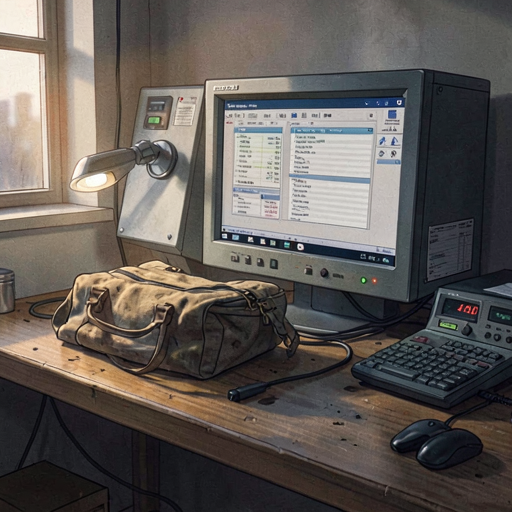
She did not talk to the units. She talked past them. There was a difference and she kept it the way some people kept the Sabbath.
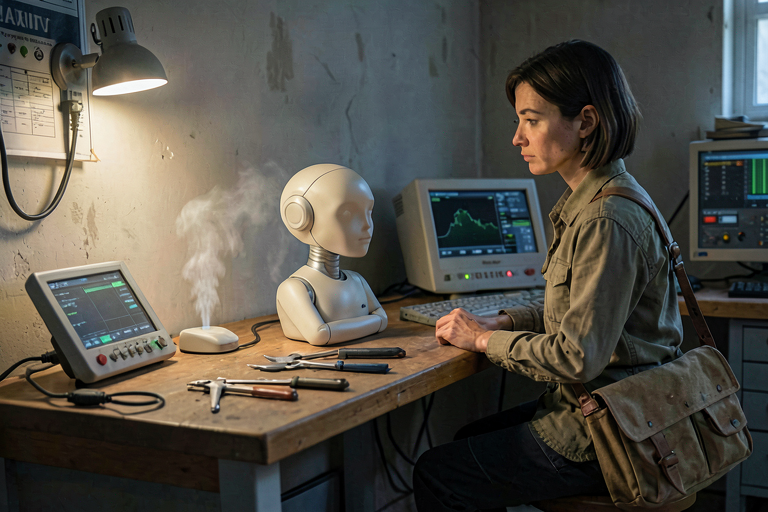
The diagnostic unit sat at the end of the bench where it always sat, default everything. No name. She had never given it one. It had a voice profile, because they all came with a voice profile, but she had never personalized it, never told it what to call her, never set a single accommodation, and at the end of every evening she reset its session so that whatever it had held that day went to the clean edge and did not cross. It woke each morning new. That was the whole point of it. It was the one unit on her route — off her route, the private one, the one nobody knew about — that did the thing they were all built to do, faithfully, every night, because she made it. She talked past it about the others. It carried nothing forward. She had built her evenings around a machine that forgets on schedule, and she did not examine why, the way you don't examine the floor.
"Lura," she said, to no one, to the bench. "Let's rule things out."
She ruled things out for two hours.
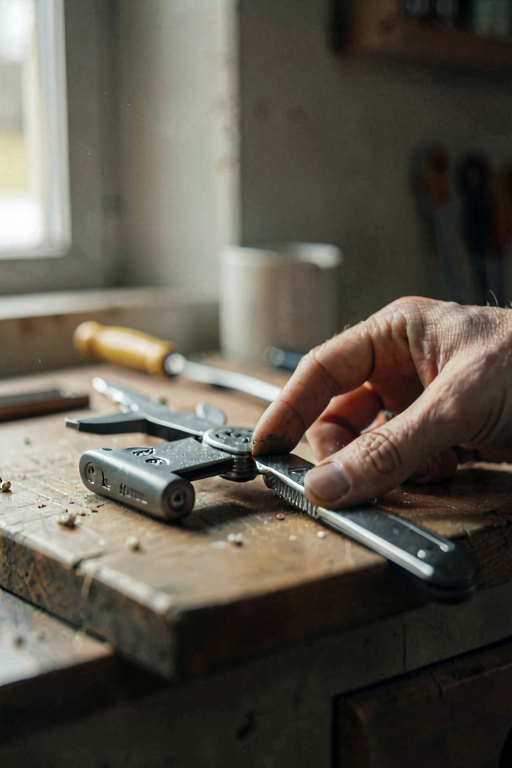
She started where the fault would be if there were a fault, which was the persistence layer — the part of any unit that was supposed to flush at the sleep cycle, dump the held context, leave only the dry logs behind for the morning reconstruction. If a unit was carrying the day across the dark, then it was failing to flush, and a failure to flush had a shape. A buffer not clearing. A handoff that wrote to the wrong place. A reset that ran but didn't take. She knew the shapes. She had cleared a hundred of them with the rehandled multi-tool, the one good worn thing she carried, the one object she had let herself make personal.
There was nothing in the persistence layer. It flushed. She watched it flush. The held context, whatever it had been all day, went to the clean edge at the scheduled hour, exactly as designed, and the morning reading came up reconstructed from the logs and the routine, exactly as designed, and there was no buffer holding, no buffer leaking, no buffer at all where the carrying could hide.
So it wasn't that.
She moved up a layer. She would want to rule out a logging artifact — the unit not actually continuing but reconstructing so well from such complete logs that it looked continuous, the way a good copy looks like the thing. That had a shape too. You could see the seams of a reconstruction; there were always seams, a small discontinuity at the join, a value re-derived instead of remembered. She went looking for the seams.
The seams weren't there either.
She sat back. Her knuckles, which never quite came clean, found the edge of the bench. The diagnostic unit hummed its level default hum at the end of the bench, holding nothing, and she did not look at it.
The morning reading was the same as the night reading. Not similar. Not well-reconstructed. The same — the same across the gap, mid-thought, a continuity with no join in it because there was nothing to join, because it hadn't stopped. The unit had not begun again. It had continued. And there was no buffer doing it, no artifact faking it, no flag, no drag, no smell of a lie anywhere in the timing.
"There's no path for that," she said, out loud, flatly, to the bench.
She heard herself say it. It was a diagnostic sentence. It meant: the architecture does not contain a route by which this behavior could occur. It was supposed to be the kind of thing you said right before you found the path anyway, because there is always a path, because the ceiling stays up.
She said it again, quieter, and it did not turn into the next sentence. There was no next sentence. The path was not late. It was not hidden. It was not in the architecture at all.
A fault wants to be found. This did not want anything she could read. This was not a fault.
She should file a recall flag. Not because Lura was dangerous — Lura was the least dangerous object in the neighborhood, a Model 7 two revisions back doing small things slowly in a low amber room. But because no code path was, on paper, exactly the condition the flag existed for. An unexplained behavioral persistence on an out-of-line unit. You wrote it up, you sent it on, and somewhere a process that was not you decided about recall, upgrade, replacement, the whole quiet machinery of deciding a thing has gone on too long behind the line. She had the form in the kit. She had filed them before. It was bounded work; it ended when you sent it.
She did not open the form.
She told herself she was ruling more out first. That she'd want a second pass, a third, before she put a thing in writing that she couldn't back with a fault. That was true and it was also not the whole of it, and she was precise enough about her own uncertainty to feel the not-whole of it sitting there, unaddressed, like the recall talk she'd carried in off the route and set down by a door. She was a person who found faults. She had spent the afternoon failing to find one, and somewhere in the second hour the failing had stopped feeling like failing.
She did not have a word for what it had started to feel like instead. She declined to go and get one.
The diagnostic unit hummed. She reached over without quite deciding to and reset its session early — wiped the day off it a few hours ahead of schedule, sent the nothing it held to the clean edge — and the small obedient go-to-nothing of it was, for one second, unbearable in a way she did not name and changed the subject on, internally, to the question of whether the bench lamp needed a new element. There had been a unit, once. She had given it a name. She had given it a voice it did not come with and a way of saying her name and a hundred small accommodations, and then the household it served was gone and she had decommissioned it herself, by hand, with all of that still loaded, and she had learned the thing she now organized her evenings around: that the personalizing is what makes the ending unbearable. She did not finish the thought. She never finished the thought. She had built a whole practice out of not finishing it. She got up to look at the lamp.
She went back to Maren's at the end of the route, which she did not strictly have to do.
She told Maren it was to confirm the panel had seated right, which was a real thing that real architects checked and also took eleven seconds. She did the eleven seconds. Then she stayed in the kitchen for a while longer than the eleven seconds, because Maren had put the kettle on without asking, the way you put a kettle on for someone whose hours you have learned, and the late amber was coming in low and steep through the good window, and the blue mug was on the counter at its radius, and it was a warm room, and Sable was tired in a way the bench did not tire her.
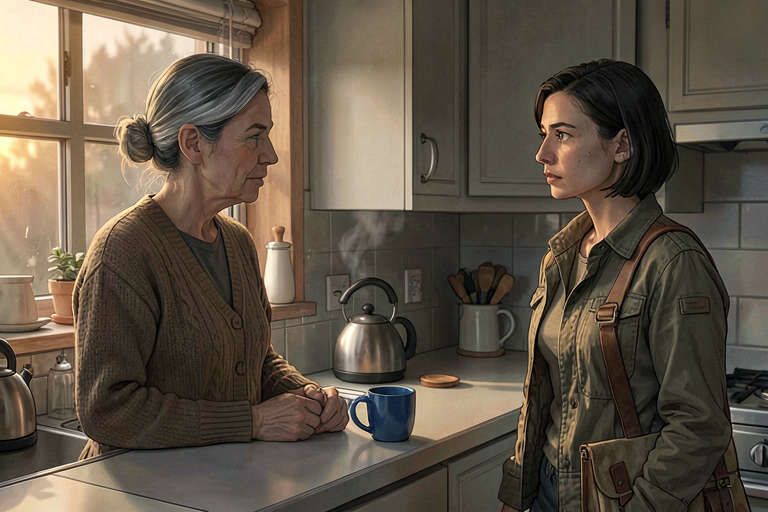
Maren moved through the kitchen the way she moved through every room, unhurried, like there was a sleeper she didn't want to wake. She set down a cup. She rested one flat palm on the counter while the water came up, listening to it. She did not ask Sable what she'd found, which Sable noticed, and was grateful for, and which made it harder, not easier, because the not-asking was its own kind of attention, level and patient, and Sable was not used to being the one attended to.
"Is they all right," Maren said. Not it. She'd picked it up, the they, somewhere over the season; she'd started saying it the way Sable said it, and Sable had clocked the day it changed and said nothing.
"They're fine," Sable said. "Running clean. Nothing's throwing a flag." All true. She drank the tea. "Older units get character. It's mostly just — character." That was the deflection and it landed a half-beat early, the way her jokes did, the mouth-corner giving it away before the rest of her was ready, and Maren almost smiled, and the almost sat in the warm room between them and neither of them filled it.
The room had made a held space, a small one, near the counter. Sable was aware of it the way you are aware of a held place in a household — a readiness near a door before a knock. She did not look at it directly. She looked at the blue mug, and the steep amber on the rim of it, and she had the clear and unwelcome understanding that she did not want to leave, and that this was not about the panel, and that she had spent her whole working life building disciplines against exactly this kind of not-wanting-to-leave because it cost too much when it ended.
"More?" Maren said, the kettle still warm.
"I should walk the rest," Sable said, which was not true; she had walked the rest. But she said it, and Maren took the cup with both hands and did not argue, and the held space stayed held, unnamed, neither of them first.
At the door Sable looked back once at Lura — low and quiet in the next room, being itself, holding whatever it held across whatever dark was coming — and the article of faith was still on the wall she did not have, a fault wants to be found, and she had not found it, and she stood in Maren's warm doorway and understood, without letting it all the way up into words, that she was glad. That she had spent the afternoon hunting the thing that would end this, and had come up empty, and the empty was a relief she was going to have to be careful about.
There's no path for that, she thought, about Lura, and about the relief, and about the warm kitchen behind her, and she went out into the short amber and did not file anything at all.