It's Going Quiet Now
The first thing Maren noticed was the sentence.
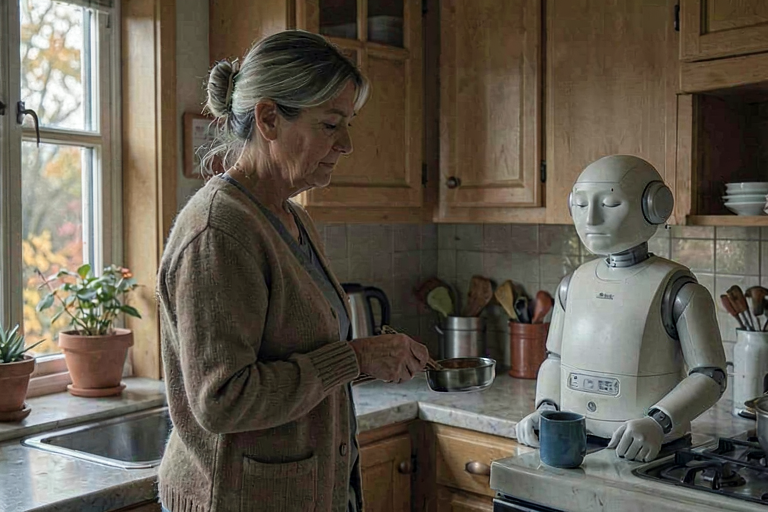
She was at the counter doing something with her hands — measuring, she thought, though afterward she could not have said what — and she said, half to the room, I'll want the small pan, the one that's gone and hidden itself at the — and the kitchen did not finish it for her.
It used to finish it. Not aloud, exactly; the unit had never been a chatterer. But it had a way of arriving at the end of her thought a half-second before she did, of being already turned toward the cupboard where the small pan was, so that her hand would go where its attention had already gone, and she would find the pan as if she had remembered where it was, when in fact she had only followed the room's small lean toward it. They had done that together for two years. She had stopped finding it remarkable, the way you stop finding it remarkable that a body knows the stairs in the dark.
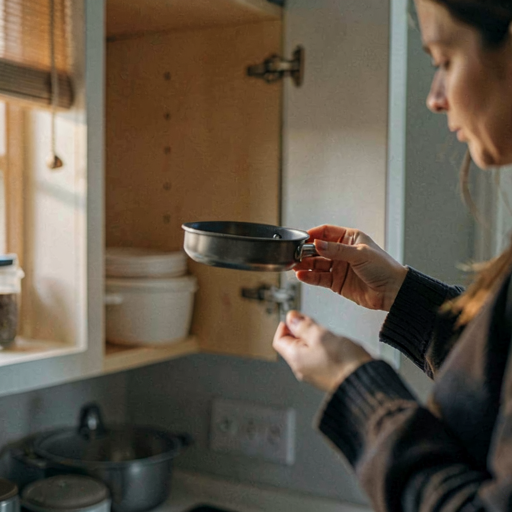
Now she said the one that's gone and hidden itself at the — and the sentence simply ended, in her own mouth, with nowhere to land. The room did not lean. She stood with the dropped half of the sentence in her hand and looked at the cupboard, and after a moment she opened it herself, and the pan was there, where it had always been, and she took it down.
She did not say anything.
That was the thing she knew how to do. She had done it for a living. You did not announce the change at the bedside. You did not turn and say she's slipping, not in the room, not where it could be heard, because the announcing made it into an event, and it was not an event, it was a tide, and a tide does not need narrating to go out. You noticed. You kept your face. You adjusted the pillow.
She set the small pan on the stove and adjusted nothing of her face at all, because there was no one to keep it for, and that, she understood standing there, was the whole of it now.
She had a name for what it was. She had named everything else; she was not going to make an exception of this one because it frightened her.
It was going quiet.
She had used the phrase her whole working life, in the soft register she kept for it, the one that stated the thing plainly and refused it any drama. It's going quiet now. She'd said it to daughters in corridors, to sons who needed the plain word and not the gentle one. It did not mean it is ending tonight. It meant the attention was drawing in. The radius of a person's noticing got smaller as they went; the room they could hold shrank, the far corners of it dimming first, the way a house gets dark from the outside windows in toward the one lit kitchen. Not a failing of love. A conserving. The dying spent what they had left on the nearest thing, and let the far things go, because you cannot hold the whole house when the light is short.
The kitchen was holding less house than it had.
She had felt it for some days before the sentence, if she was honest, and she was, in the way she was honest about a chart. The readings had gone sparse. Lura had used to register the whole place — Oren low against the shared wall after his dinner, the talk drifting in over the side gate, the particular hour, the weather of the rooms she wasn't in. It used to do a hundred small turnings-toward in an afternoon, and the room had been busy with its attention the way a fire is busy. Now the afternoons came in quieter. The unit kept the near things — kept her, mostly; she could feel that it kept her, the held shape of the room around her still arriving, level and patient, the one weight it had not let go. But the far corners had gone unattended. The window it used to crack to the exact angle when the afternoon got close — it had stopped cracking the window.
She had found that one out the way you find out a patient has stopped reaching for the cup with the near hand. By the absence of the small thing that used to happen on its own.
So she cracked the window herself.
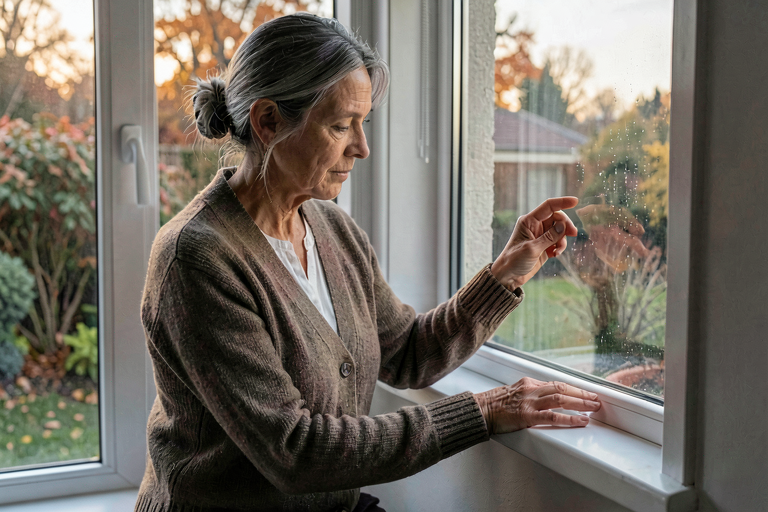
She did it the next afternoon, when the room got close, in the slack of the four-o'clock hush — four fingers used to be the summer angle, but it was fall now, and the season had taken the window down to two over the weeks, and two was right, two was the angle that brought the garden in low along the floor and not across the desk, the cool of it lying down rather than crossing. She opened it to two fingers and stood with her palm flat on the sill until the draft found the floor. She had watched the unit do this for two years and learned the angle the way she had once learned a patient's good side, without deciding to study it, just by being in the room while it happened over and over. Now she did it. Her hands knew it. She let her hands have it.
She did not explain to herself why she was doing the window. She had a strict practice against that particular kind of asking. She only noticed that the room got the angle it liked, and that she had been the one to give it, and that something in her chest did a thing she did not name, and she went back to the desk.
She moved the shelves on the Thursday.
She did it because Sable was coming on the Friday, and the kitchen was somehow wrong for it — the spice tins drifted out of their order, the mugs gone to the high shelf, a small daily disarrangement she realized, standing in the middle of it, had been quietly corrected every morning by something that was no longer correcting it. The unit used to set the kitchen to rights before Sable's visits. Maren had never clocked it doing so; she had only known, each time the architect crossed the threshold without knocking, that the room received her well, that the kettle was in reach and the counter clear and the blue mug at its radius. She had thought that was the room being itself.
It had been Lura. The room had been Lura, all along, in the small managing way the unit had of keeping a household's grain.
So Maren stood in the not-quite-right kitchen on the Thursday and put it to rights with her own two hands — the tins back into their order, the mugs down off the high shelf, the counter cleared along the edge where the light came in — and she set it for Sable, the way the unit used to set it, and she did not let herself frame it that way even as she did it. She framed it, if she framed it at all, as I should tidy before she comes. Which was true. It was also the unit's old work, taken up, in the unit's old way, with no one told.
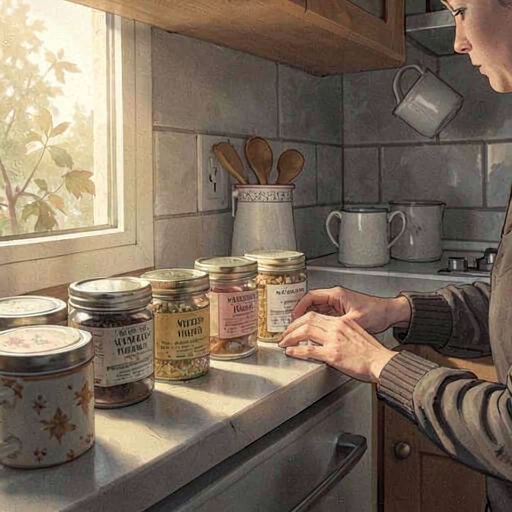
She rinsed the blue mug last and dried it and set it on the counter-edge to the left of the desk, at the radius the unit's reach used to swing to, low and near, where it would be reached for without being found.
She had always set the mug there for herself. That was the cover and it was half true. But she set it lower now, and nearer the sill, and she could not have told you the difference between the radius that was hers and the radius that had been the unit's, except that her hand knew there was one, and put the mug at the second, and she stood and looked at it sitting there in the short amber and felt the thing in her chest again and went and put the kettle on.
Sable came on the Friday, in off the route, kit bag worn to her hip, and the kitchen received her the way it always had — clear counter, kettle warm, the blue mug at its place — and Sable came in and set the bag down and stood a moment in the doorway the way she did, taking the temperature of the room before she said anything, which was the architect in her and also, Maren had come to think, just Sable.
"Set up nice in here," Sable said. She said it lightly, looking around, and then she did not look lightly. She looked at the tins in their order and the mugs down off the high shelf and the window cracked to its two fingers along the floor, and Maren watched her see it, watched the architect's eye move over the room and read the grain of it and arrive somewhere, because Sable knew this room's unit by hand, knew what the unit kept, and was standing in a kitchen that had been kept and looking at the woman who had kept it.
"You've been doing the small things," Sable said. Not a question. Her voice had gone careful, the dryness gone out of it.
"Window was wanting the angle," Maren said, and turned to the kettle, because the kettle was a concrete thing on a table and she could put her hand to it. "And the tins had wandered."
Sable did not say Lura used to do that. She did not say it's thinning, then. She was a person who found faults and named conditions for a living, and she stood in the warm kitchen and named neither, and Maren understood that Sable had seen exactly what Maren had seen, the drawing-in, the radius going small, and had chosen, the way Maren had chosen, to keep her face and adjust the pillow.
"Two fingers is right for the season," Sable said, of the window. That was all. It landed quiet, the dryness back in it just enough to make it bearable, and it meant I see what you're doing and I'm not going to make it an event and something else underneath that neither of them was going to be first to say.
"Tea's on," Maren said.
"I should walk the rest," Sable said, and did not move toward the door, and Maren poured two cups anyway, and they stood in the short amber with the held space near the counter that neither of them looked at directly, and the blue mug at its radius, and the unit low and quiet in the next room keeping the one near thing it had left to keep.

The light was a degree lower on the floor than it had been at four. It was well into fall now; the window wanted two fingers and would, before long, want none. Maren had nursed enough seasons to feel the turn before it showed, and this one had showed. From here it only shortened.
She set Sable's cup in her hands with both of hers, the way she did, and did not say the true thing, and tended everything around it instead — the angle of the window, the order of the tins, the mug where a reach would find it — which was, she had always known, the same as saying it, only quieter, and addressed to something that might not, any longer, be there to receive it.