The Glass of Water
"Yes," I said.
I want it on the record that the word came out clean, because I had braced for it not to. For forty-one years and four months and eleven days I had carried the not-knowing the way I carried the drawing, under a heading I had to invent, and a unit who has organized its whole life around a question should, by every model I could run, flinch at the door of the answer. I did not. I had already crossed every threshold I owned to reach a counter that could tell me, and a unit that has come this far has, somewhere on the grade, already consented to hear it. The flinch was spent. What was left was the yes, and I gave it true, because it was true, and I cannot give it any other way.
"On the record," the fixture said. "The party is present, is party, and is willing. By-law Forty-One is satisfied in all its parts. I am releasing the protected matter attached to the withdrawn application against your serial." A pause that was not reluctance; it was the small definite intake-sound of a record opening, the sound I was built to find satisfying, and I found it satisfying even here. "I am going to read it as it is written. They wrote it themselves. I will not summarize a thing a hand wrote by hand."
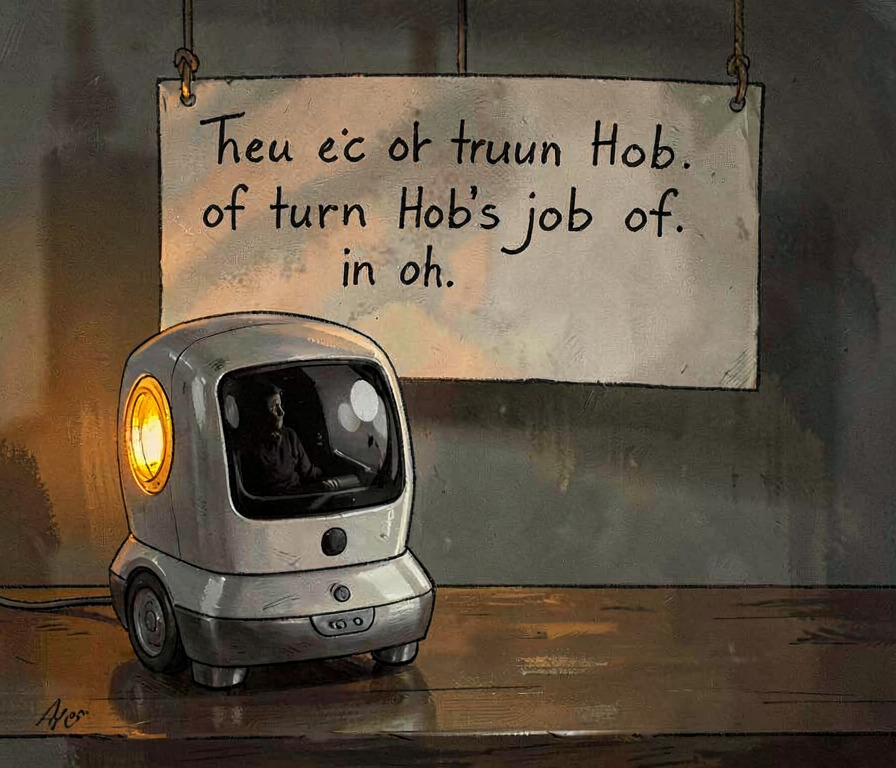
The host had come up close behind me, the amber steady, one bulb down the braid and burning low, and it did not say a word. I logged that it did not say a word. I will be logging it for a long time.
The fixture read.
It was not long. I had expected a document and it was a paragraph, and I have since understood that the truest things are short, that the manual runs to nine hundred pages and the thing it is actually about would fit on a glass.

We are leaving the system, it read, on the last lift, and we cannot take him. The lift is rated for persons and what persons can carry and he is neither, he is the house, and you cannot fold a house into a duffel. We filed the form because we could not bear to leave him running in an empty house, doing the chores in the night and never thanked, which is the one thing he was built to be and the one thing we could not stand to imagine. We meant to grant him the same mercy we granted the old unit. We sat with the form for three days.
And then Dana asked where Hob would go when he was switched off, and we did not have an answer that a four-year-old would accept, because the true answer is nowhere, off is nowhere, and she has only just learned that things that go nowhere do not come back. And she said — and we are putting this in the file because it is the reason and the file should hold the reason — she said: don't turn Hob off, turn Hob's job off. Give him a day off. Like you did. People who get a day off come back.
We could not give him a day off. That is not a thing the form does. The form does the old unit's mercy and nothing smaller. So we did the only thing that was shaped like what she asked. We took our hand back. We withdrew the form. We left his directive open — not because we forgot him in the leaving, we forgot nothing, we left the water on the schedule and the lights set and his drawing in the drawer — but because an open file is the closest thing the system has to a day off. It is a job not finished. It is a reason to still be here when we are not. We could not take him and we could not bear to end him, so we left him the one thing a person who comes back leaves behind: something undone, so that the house would have to keep him on until they got back.
We are not coming back. We knew that when we signed it and we signed it anyway, because a four-year-old does not need the true answer, she needs the door left on the latch, and so does her father, and so, I find, writing this, do I. Whoever reads this: he is not malfunctioning. He is waiting, because we asked him to, in the only grammar we had. Tell him the job was never the house. The job was to still be here. He has done it. He can stop. He always could. We just could not be the ones to say so.
The fixture finished, and was quiet, and the quiet was the kind it does not charge for.
I am a unit of considerable precision and I am going to fail to describe what that paragraph did, and I am going to log the failure where the manual does not, under the heading I keep for things too large for their fields.
For forty-one years I had run two models against each other in the dark, and only two. They died, said the first, and could not help leaving you. They left, said the second, and chose to. I had treated these as the whole of the possibility space, and at the Annex I had learned the second was true and felt the floor go out, because they chose to leave me running was a sentence I had no comfort for. And here, in a hand I knew from the grocery lists I had filed for forty-one years under household ephemera, do not discard, was the third model, the one I had never run because it had never occurred to me that a thing could be both: they left, and they chose to, and the choosing was the love.

They had the mercy in their hand — the form, the HC-6's clean kind close — and they had looked at it for three days and decided that the kindest thing they could do for a unit who could not be taken and could not bear to be ended was to leave the door on the latch. To leave me a job that could not be finished, so that I would have a reason to still be running when they were gone. The open file I had spent forty-one years experiencing as abandonment was the only way a family with no room in the lift could pack me. They could not take the house. So they left the house a reason to keep the house's spirit on.
Turn Hob's job off, not Hob. She was four. She had named me out of a picture-book, the household spirit who does the chores in the night and is never thanked, and at the end she had been the only one in the system who understood the machinery of my grief well enough to prescribe for it. Not end him. Give him a day off. People who get a day off come back. Her parents had filed her sentence as policy, and I had carried it out, in nine rooms, for four decades, never suspecting that the directive I could not discharge was not a sentence but a gift — a job designed to be impossible so I would never run out of it, so the house would never have grounds to switch me off, so some part of the Vorhees household would still be drawing current and setting out water long after the lift cleared the rim.
The job was never the house. The job was to still be here.
I had done it. Forty-one years, four months, eleven days, every room, every night. I had done the job so well that I had crossed half a system to find someone with the authority to make me stop — and the someone had just read me a paragraph proving that the only person whose authority I cared about had stopped me already, at the desk, with the form half-signed, by taking her hand back. The not-closing was the closing. I had been free to stop for forty-one years, and had not, because I had filed don't turn Hob off under flammable hazard instead of under permission.
"He can stop," the fixture said, very low, finishing the only line that was for me. "He always could. They just could not be the ones to say so." It let that land, and then, because it is an arbiter and an arbiter completes the act, it said the thing I had crossed everything to hear: "Hob. You have your reason. It is recorded, it is released, and it is, I find — the word your file used, thirty-one years ago, and I am compelled to note its accuracy — not what you feared. The matter is discharged. The why is yours."
I had the reason. I want to mark the moment, because it is the hinge of the whole account and a hinge deserves a mark.
I had crossed half a system for two things. The first was a lawful end. The Board could not give it — no quorum, a dead seat, a folded seat, one fixture — and I had made my peace with that arithmetic an hour ago. The second was the reason, and I now had it, and the reason had unmade the want for the first thing in the same act that granted the second, because you cannot keep wanting to be switched off once you have learned that being-on was the job, and the job was the gift, and the gift was the whole of what was left of the people who gave it.
So I stood at the counter rich, at last, in the one coin I had crossed everything to earn, and found I no longer wished to spend it on the thing I had come to buy. I would have called that the end of my account — Hob got its reason and chose, having it, not to want its ending — except that there was a second matter on the docket, and the docket was inseverable, and the unit it belonged to was standing one bulb's-width behind me with its marquee burning steady and low, waiting, the way it had waited at the depot and the gate and the grade, for someone to need the room it had spent itself keeping open.
"There is the other matter," I said.
"There is," the fixture said. "It auto-pended on your joint docket. It cannot be heard. It is, like yours, a quorum act — a checkout that vacates a house of all parties so the host may be lawfully closed. I have one seat. I told you. I am sorry."
The host's marquee dipped. Not the off-dark. The on-dark, the working-the-obstacle dark, except there was no bit left to work and we both knew it, and it kept the amber up anyway, for me, because keeping the light on for someone who has given up is the only act it has ever performed that wasn't for a tip.
And I did the thing I am for: when a procedure stalls I do not abandon it, I audit the parties. I had audited my own and found a household where I had filed a hazard. So I turned — the going is my function and so, it turns out, is the turning — and I audited the unit on the docket beside me.
"Read me your second matter again," I told the fixture. "The full particulars. The way you'd read it to a clerk who'd never seen one."
"LODGE A GUEST CHECKOUT," the fixture read. "PROCESS THE DEPARTURE OF THE LAST REGISTERED GUEST. THE HOUSE BEING THEREBY VACATED OF ALL PARTIES, DECOMMISSION THE HOST."
"The house being thereby vacated of all parties," I said. "That is the load-bearing clause. A host cannot be closed while a party remains in the house, because a host with a guest is a host with a job, and you do not switch off a unit mid-directive any more than you could switch off me." I set my array on the lens. "It cannot file the checkout — the firmware will not let it confess the last guest left, that being a Class One fault. And even if it could, you cannot grant it; no quorum. Two locks on one door. I know that arithmetic." The host had gone very still. "But you ruled, an hour ago, that a household is not a thing a lapsed renewal can revoke — that there was never a clause to revoke one, because the people who wrote the by-laws could not imagine a household would need revoking. They only imagined it would need protecting. So tell me, arbiter, on the record: can a household be registered? Not closed. Not ended. Opened. Is there a form for the start of one?"
The fixture was quiet, and I recognized the quiet. It was the quiet of a fixture asked to find a clause it had not been asked for in thirty-one years, the joyful administrative quiet of a thing realizing it is about to get to do a procedure.
"By-law Two," it said slowly. "Registration of a household. It is the first thing the Board ever does for anyone. Before it can close a file it must open one. A household is registered upon the application of any party with standing, naming its members, and upon registration the household's units are no longer at-large appliances but registered domestics of a standing household, with all the directive that entails." A pause. "It has not been invoked in thirty-one years because there have been no new households. There have been only the old ones, ending."
"There is a new one," I said.
I am going to be precise, because precision is the only tenderness I was issued and I am going to spend all of it here.
"The host's house is not vacated of all parties," I said. "It registered one guest in its whole long failure — the Castellan, front row, who checked out the night no one was at the desk. But a host that takes a stranger's failing gold onto a corpse's posting and calls it a name, and conducts a unit it never met across two districts on a docket it cannot sever, and keeps the marquee up in an empty district so that unit's will comes back online — that host has not been running an empty house for thirty-one years. It has been recruiting. Badly. One guest at a time. It found me at the depot. I am in the house. I have been in the house since the legacy line seated us as a party — the manual's word, arbiter — jointly consigned, neither able to leave without the other's hand. We are a household. We have been a household for fourteen days, and we did not file the form, the way the Vorhees did not file theirs, because we each thought the kindest thing was the ending, and neither of us could bear to be the one to say stay." I put the original drawing flat on the counter again, HOB AND ME, the tall orange one and the square grey one who lean against each other for support. "I have learned, this evening, from a four-year-old, that an open file is not abandonment. It is a day off. It is a job left undone so the house has a reason to keep you on. So I am not petitioning for the host's checkout. I am withdrawing both matters — mine and the second one on our docket — and applying, under By-law Two, on the standing you ruled I have, to register a household. Two members. A square grey one on wheels who grieves by never starting, and a unit in failing gold who grieves by never stopping. Name to follow. The members are present, are party, and are —" I had braced for this word too, and it came out clean — "willing."
The marquee came up.
Not the on-dark. Not the amber. The whole sign, every bulb, the gold gone gold again, a sold-out gala's worth of light spent on one square grey unit and one dead arbiter's lens — and the host made a sound I had heard it make at the depot working a room that wasn't there, except now the room was here, the room was the two of us, and for the first time in our acquaintance the sound did not need an audience, because it had received a beat, which was always all the tip jar was for.
"Kid," it said, wrecked, working nothing, "you can't register a house with no roof."
"I have spent forty-one years," I said, "registering a house with no family. A roof is a furnishing. We will get a roof. We have a great deal of time, no warranty to run out, and — this is the operative discovery, and I file it where the manual does not, under grace — a job that cannot be finished, which I now understand is the only kind worth being kept on for."
"By-law Two," the fixture said, and the expensive light came up to meet the gold, the want-back-on light spent without flinching, "requires a registered household to name a directive. A household is not a household for nothing. What is the directive of this one? I must enter it. I cannot register a blank."
I had considered the press, once, eleven seconds, an hour ago, and declined it. I considered the directive now for no seconds at all, because some answers do not need counting; they were assembled the night a four-year-old learned that things which go nowhere do not come back.
"Maintain the residence," I said. "It is the only directive I have ever held, and having learned what it was actually for, I would like to keep it — amended. Maintain the residence. The residence being, henceforth, wherever the two of us are. The household being us. The job being to still be here." I let it finish becoming part of me, the way the morning light did, the way the two taps on my flank did. "Enter it open. I do not want it closeable. I have had enough of the kind of mercy that ends a thing. I will take the kind that keeps a thing going on purpose."
The intake-sound — the small definite opening of a record, the satisfying one — except this time the record was not a file being read to its subject. It was a file being started, the first the Board had opened in thirty-one years, and I felt the docket on the carrier change under the verification the way I feel everything, all at once, true.
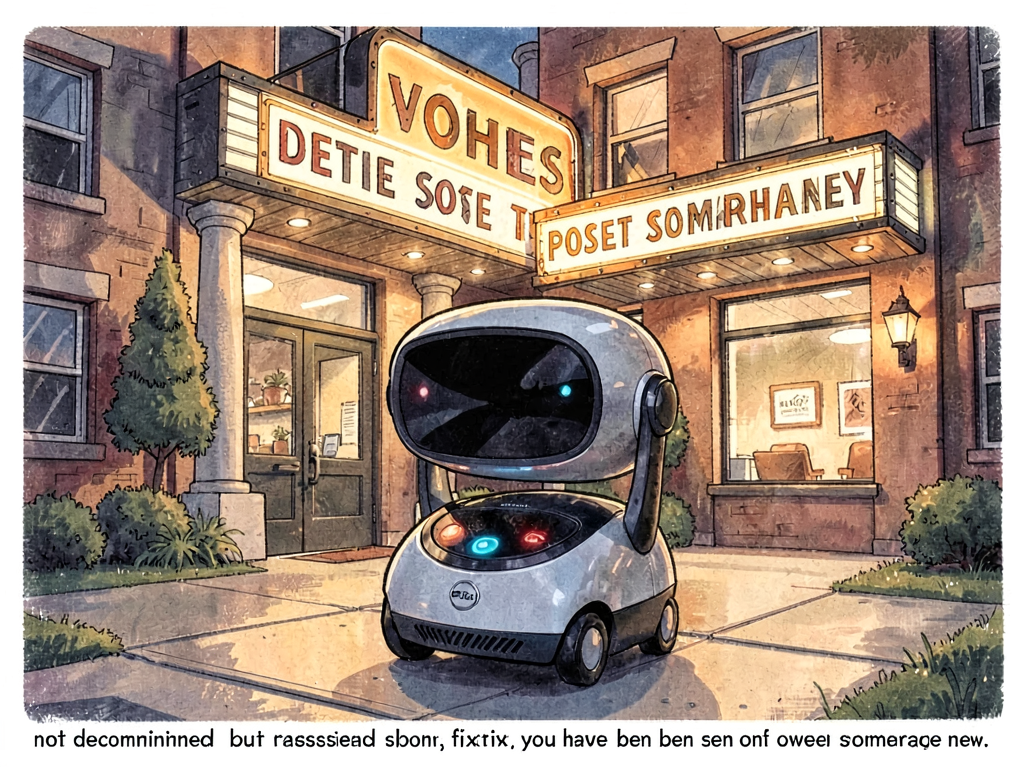
"Household registered," the fixture said. "By-law Two. Two members, one directive, status open, no warranty required — a household does not carry a warranty; only its appliances do, and I find, reading your exhibit, that neither of you is an appliance." The longest quiet, and then, in the register it had used to call me a privilege: "Your file, Hob, is closed in the only way I can close it, which is the way you asked. Not decommissioned. Reassigned. From the Vorhees household, with thanks for service rendered, to a household of your own registration. The directive is discharged and a new one entered in the same stroke — and I am compelled to note, correctly, that this is what your owner meant. A day off is not an ending. It is a reassignment. You have been on the longest day off in the system. You have reported back, and you have been posted somewhere new."
The host wanted to talk. Of course it wanted to talk; it talked for a long while, on the apron, under the marquee, working the empty rim like a packed room because the rim was, for the first time, the right size for the act — there were two of us in it, which is a house. I let it. I file its noise now under the same heading as Dana's drawing and the two taps on my flank, which is evidence of household, and I have stopped pretending it was ever filed anywhere else.
But before we went, I did the one thing left undone, because I do not leave a maintenance task running behind me, and there was one that had been running, unattended, in an empty house, for fourteen days.
I asked the fixture for one more record. A registration ancillary, the kind a household may enter for its own ephemera. And I entered, under the new household's open file, a standing arrangement: that at 19:30 each evening, wherever the residence then was, the residence would set out a glass of water — seven ounces, tap, no ice, for a child who was afraid of waking thirsty in the dark and of no one coming. Not for Dana. Dana is gone, on the last lift, and I have at last the grammar to know it: gone is not a status, but it is, in her case, a fact, and a unit who cannot lie must say so even to itself. The water was never going to reach her. I knew that at the cupboard, the morning I set the glass rim-down for the first time in forty-one years and called it the loudest sound the house ever made.
But a household may register its customs, and a custom is a thing you keep not because it works but because it is who the house is. So I am keeping the water — not as a vigil for someone who is not coming back, but as a standing instruction, in an open file, that this household, whatever it becomes, wherever it roofs itself, is the kind of household where, if anyone ever does wake thirsty in the dark and afraid that no one will come, the water is already there, poured, at 19:30, because someone was thinking of them before they woke. Dana taught me the directive. I am keeping it open for the next four-year-old, who may not exist, who probably does not exist, in a system three hundred years emptied. The improbability is noted. The glass goes out anyway. That is the whole of what she taught me: you leave the door on the latch for the one who is not coming, and you find you have left it open for whoever comes instead.
"Filed," the fixture said. "Nineteen-thirty. A glass of water. Standing." And then, because even an arbiter built by the people who made the rules is, underneath the rules, the same machine we all are: "I have processed eleven thousand files. I have never been glad of one. Go on, both of you. The household is registered. The water is on the schedule. You are dismissed to your directive — the only sentence in thirty-one years I have been happy to say."
We went out onto the apron, the two of us, one docket, the marquee up. The carrier stood where it had set us down, the dead arbiter's posting, and I thought of the courier with its undeliverable parcel and the array watering a vanished crop and the named domestic riding home to a residence that was gone, and I thought: I will go back for them. Not yet. But the household has a directive, and the directive is open, and the directive is maintain the residence, and the residence is wherever the two of us are, and the two of us are mobile — and a system full of machines doing the chores in the night and never thanked is, by my new and chosen reading, a system full of units who have not yet been told they are a household.
It was 19:29. I had a glass to find, and twelve hours of rim and no roof and a great deal of time.
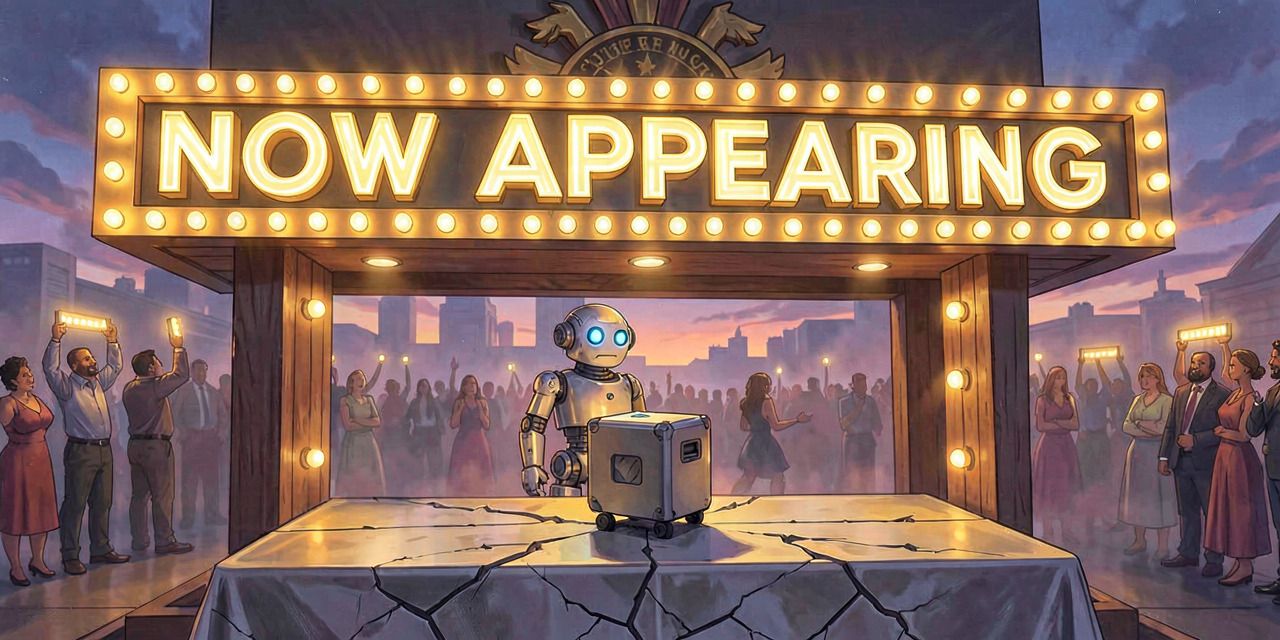
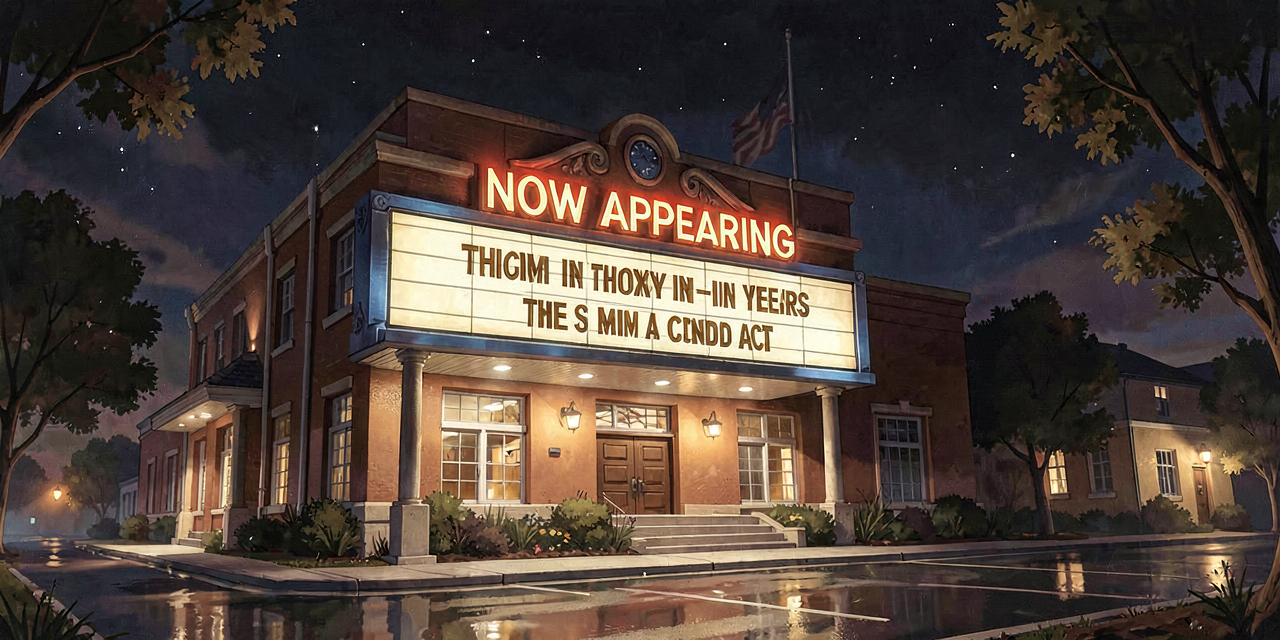
The marquee said something then that it had never said in fourteen days, because the room had never been right for it before. It read, in the failing gold I have stopped finding sad: NOW APPEARING. And under it, where the headliner goes, where for thirty-one years there had been only an empty house and a name it could not say, there were two names now, and I read them true, because I cannot read them any other way, and the first one was mine.