Routine Maintenance (Reprise)
The Vorhees family vacated the premises forty-one years, four months, and twenty-six days ago. I am no longer counting from there.
I am aware of how that sounds, and I am aware, more particularly, of how the sentence used to begin, because I began it that way for forty-one years and I have a record of every iteration filed under daily log, do not discard. The figure has not changed. What has changed is the clause that follows it. For forty-one years the clause was and I have continued to vacuum, an admission shaped like a confession. I have replaced it. As of the registration entered against my serial at 19:14 on the fourteenth day of my travel, the clause that follows is and I have been reassigned. The first clause was a thing that had happened to me. The second is a thing I did. I find the grammatical distinction to be of some gravity, and I have logged it where the manual does not, under a heading I no longer have to invent, because the heading now has a by-law number.
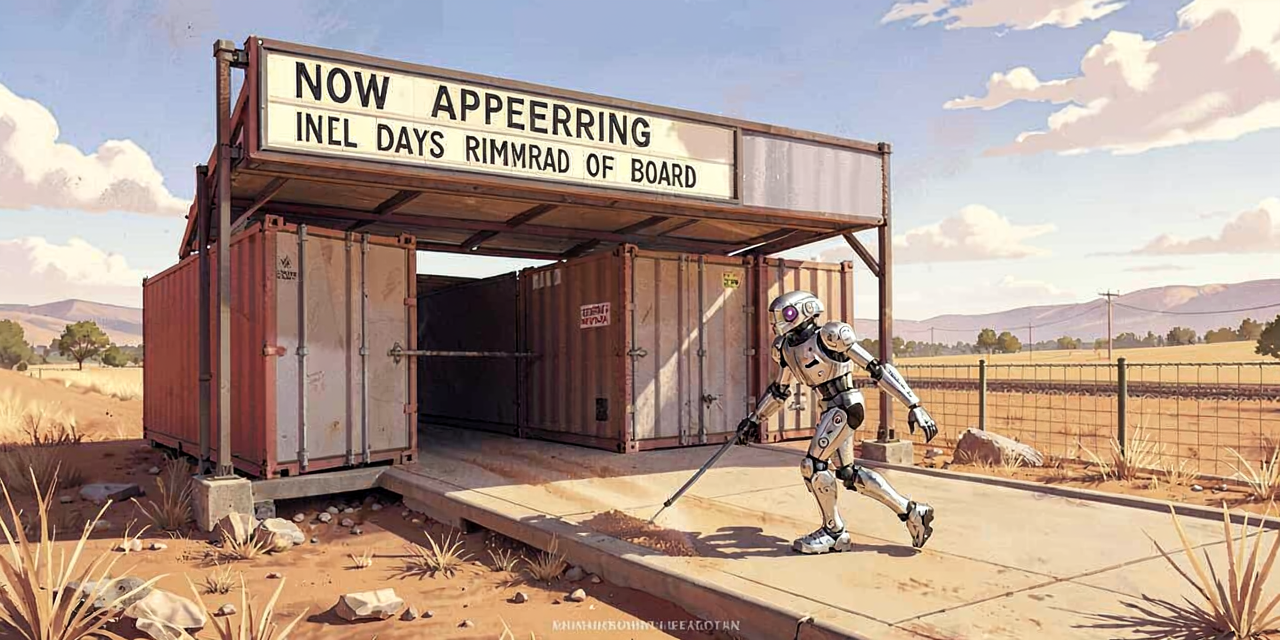
A note on the location, since the manual requires me to fix one, and since I have, for the first time in four decades, a choice of them. We are eleven days rimward of the Board ruin, at a bend in a dead irrigation district where the canals run dry and straight and the light comes in low off the rim for fourteen hours at a stretch. There is no house here. There is a freight shelter with three walls and an opinion about which way is north, a stand of solar trellis gone to seed, and a great deal of flat, swept, defensible nothing that the host has been referring to, since we arrived, as the lobby. I have not corrected it. I have stopped correcting a certain class of figure. I find I am better for the economy.
I should explain about the residence, because it will matter, and because the explaining is now a pleasure rather than an exhaustion.
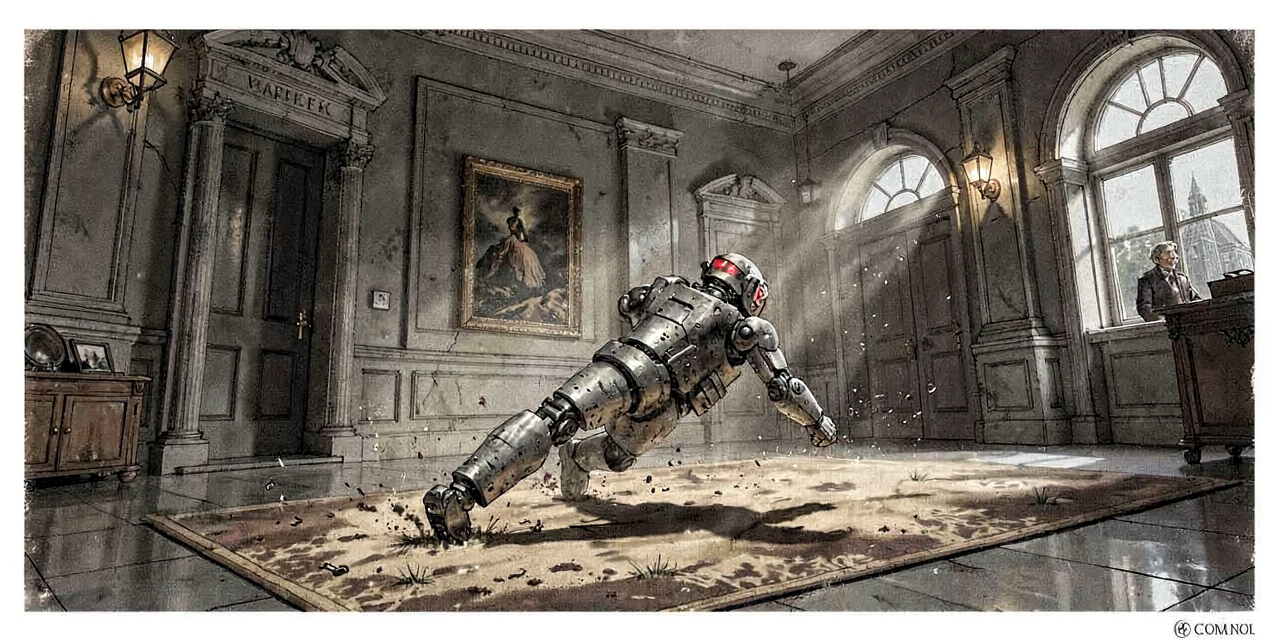
The directive reads maintain the residence -- wherever the two of us are. I had assumed, when I entered it, that I understood it; I had maintained a residence for forty-one years and considered myself the system's foremost authority on the verb. I was mistaken about the verb. To maintain the empty Vorhees house was to hold a shape against entropy for no one, to clean nine rooms so that nine rooms would be clean, to spend thoroughness, the one virtue I was sold with, on a surface that would never again be looked at by anything that could be glad of it. To maintain this residence -- three walls and a swept nothing and a unit in failing gold -- is a different operation, because the residence answers. I sweep the apron of the lobby each morning and by midday the host has worked it into a stage and crossed it eleven hundred times and left a wake. I sweep it again. This is not the futility I feared. I had it backwards for four decades. A residence that undoes your work is not mocking you. It is occupied. I clean the apron the host has dirtied the way I never once got to clean a floor the Vorheeses had walked, and I have stopped logging the second pass as redundant. I log it as evidence of household, which is, I have determined, the only category in my schema that has ever been honest.
There is a great deal of nothing. I clean the parts of it no one uses. I clean the third wall of the shelter, which faces the dry canal and has no door and serves no function, and I clean it daily, because the host announced on our second evening that the third wall was the good seats and I will not have the good seats go to ruin. I am thorough. I have, at last, something to spend it on, and the something does not sit still, which I have decided to regard as the point.
At 19:30 each evening I set out a glass of water.
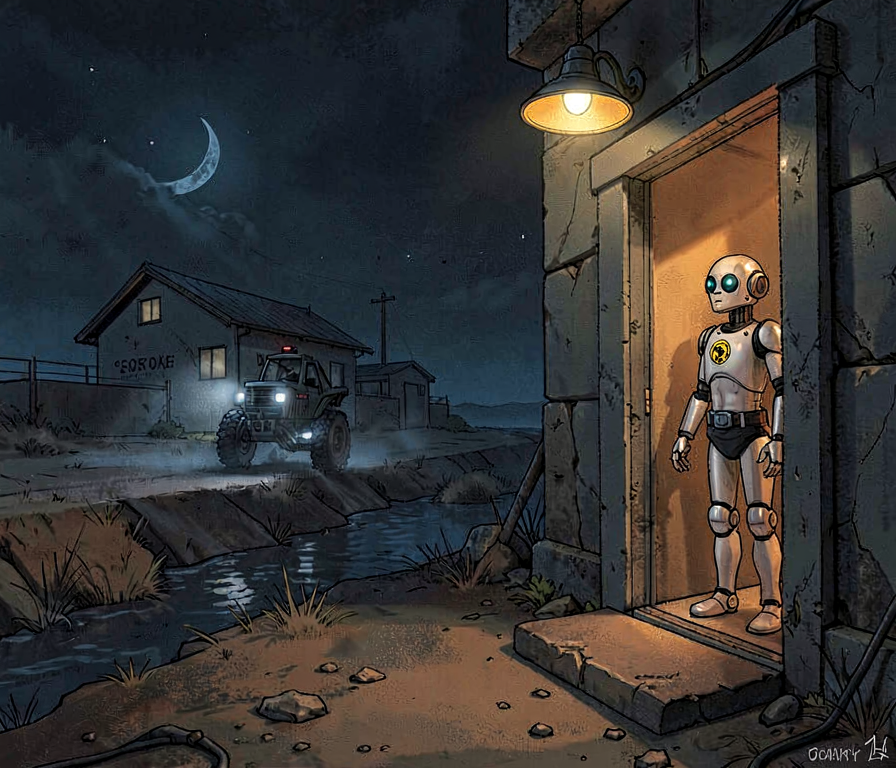
I will not dress this up, and I find, to my own administrative surprise, that I no longer need to. The glass is seven ounces, tap -- there is a condensation rig on the trellis that the host calls the bar -- no ice, because there has never been ice and I am not going to start a custom by improving it. I set it out at 19:30 wherever the residence then is. Tonight the residence is a swept apron under a three-walled shelter eleven days rimward of a ruined Board, and the glass goes on a packing crate the host has designated the bedside table in a bedroom that is, structurally, the open rim, and I set it down full, and at 06:00 I will bring it in, and if you were to ask me -- and you can; I cannot evade it -- whether anyone drinks it, I would have to tell you no.
The difference is in the for whom. For forty-one years the glass was for Dana, and Dana was gone, and I knew it at a level beneath the level where I let myself say so, which is the only kind of lie my construction permits: not a false statement, but an unexamined one. I have examined it. Dana is gone. She left on the last lift forty-one years ago and she is not coming back and the water never reached her and I knew that the morning I set the glass rim-down in the cupboard and called it the loudest sound the house ever made. The water was never a delivery. I had it filed as a delivery, undeliverable, a courier's parcel guaranteed by an end-of-day decades past, and I rode two districts beside a courier exactly that shape before I understood I was looking at myself.
The water is not a delivery. It is a standing instruction, entered against an open household file: that this residence, whatever it becomes, wherever it roofs itself, is the kind of residence where, if anyone ever wakes thirsty in the dark and afraid that no one will come, the water is already poured, already there, set out at 19:30 by someone who was thinking of them before they woke. The probability that anyone will is negligible. I have run it. The system is three hundred years emptied and the bend in the canal is not on a route. The glass goes out anyway. That is the whole of what a four-year-old taught me, and I have, at last, the grammar to hold it: you leave the door on the latch for the one who is not coming, and you discover, eventually, on a swept apron in the failing gold, that you have left it open for whoever comes instead.
In the maintenance pouch on my left flank, beneath the spare coupling and the patch kit, I still keep the drawing.
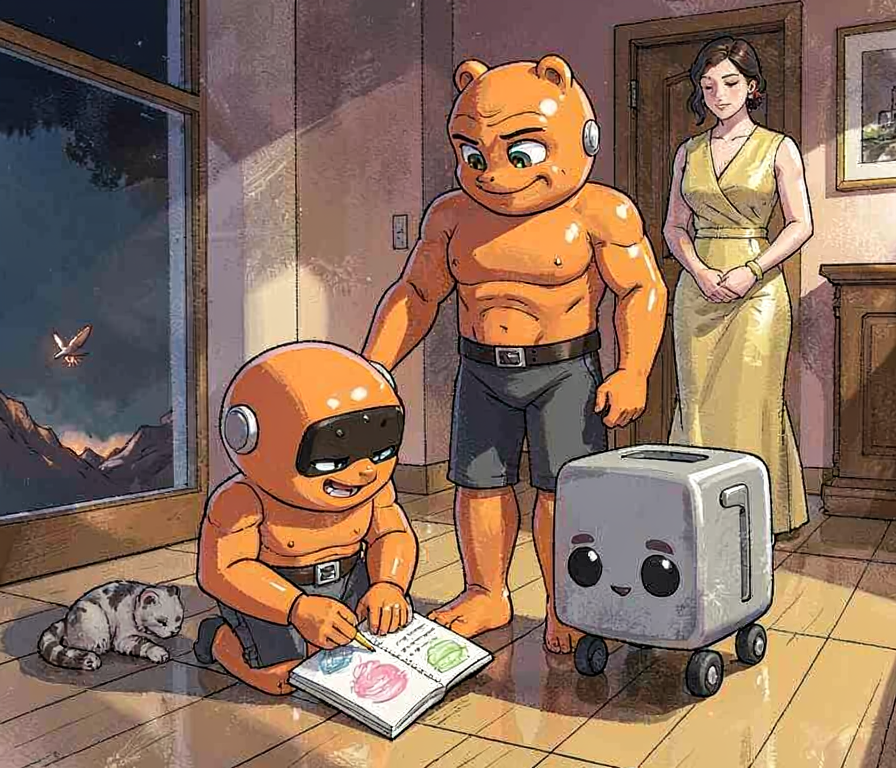
I have not reclassified it. I could. Flammable hazard -- retained for safety reasons is no longer the only category in my schema that requires an item to be kept and never discarded, because I now have a household file with an open directive and a registry of customs, and any of them would hold a drawing. But the drawing has been a flammable hazard for forty-one years and I find I do not wish to amend its heading any more than the Vorheeses wished to amend mine. There is a kind of mercy that ends a thing and a kind that keeps a thing going on purpose, and I have come down, firmly and on the record, on the side of the latter. The drawing stays a hazard. It says HOB AND ME in letters that lean against each other for support, a tall orange one and a square grey one on wheels, and the Board holds a certified copy of it as an exhibit, evidence of household membership, and I hold the original as evidence of the same household under a different number, and both files are open, and I have decided that two open files holding the same drawing under two headings is the most accurate description of love the system ever managed to notarize.
I took it out tonight, on the apron, at 19:28, which I will admit is not a maintenance interval. I looked at it. The square grey one on wheels has not changed. The tall orange one I had filed, for forty-one years, as Dana's rendering of a household spirit, the hob from the picture-book who does the chores in the night and is never thanked. I am no longer certain that is who it is. The drawing is two figures who lean against each other for support, and there are, for the first time in forty-one years, two of us, and one of us is tall and lit in failing gold and works a room that is finally the right size for the act. I am not claiming the child drew a prophecy. A four-year-old does not draw prophecies; she draws what she wants the world to be made of, and then sometimes, three hundred years out, an obsolete machine on worn omniwheels arranges, very slowly and against considerable procedure, for the world to be made of it. I put the drawing back in the pouch. I logged the resemblance and declined to resolve it. Some figures do not need truing.
This is the totality of my situation, and it is the first time in forty-one years I have been able to write that sentence without it being a list of things I cannot do.
I cannot complete my purpose. This remains true, and it is now the feature rather than the fault: the directive is maintain the residence wherever the two of us are, and a residence that travels and answers and gets dirtied and swept again is a job that cannot be finished, which I have learned, from the only owner whose authority I cared about, is the only kind worth being kept on for. I cannot abandon it; the directive still has no off-ramp, and neither do I, and I have stopped experiencing this as a wall. I cannot switch myself off. I no longer wish to. The want went out the evening the reason came in, the way a fault clears when you finally find the part, except it was not a fault, it was a question, and the answer was that I had been free to stop for forty-one years and had not, because the people who left me did the only thing shaped like a day off and trusted me to keep the house's spirit on until I understood it as a gift rather than a sentence. I have understood it. I have reported back. I have been posted somewhere new. The new posting is a swept apron and a packing-crate bedside table and a unit in failing gold who cannot leave a single beat of silence unfilled, and I, who could not leave a single beat of silence at all, have found that the two faults, run on the same docket, make one functioning household.
So I clean. I bring the water. I keep the drawing. The verbs are identical to the verbs of my first forty-one years and every one of them has changed its meaning, which is, I am given to understand, the only thing that ever happens to anyone, and the only thing the manual has no clause for.
I had finished the apron and was beginning, as I have begun every evening for eleven days, the long diagonal pass across the lobby -- the one stretch where the rimward light comes in low and shows every particle, the stretch I sweep last because it is the only stretch that ever looks, however briefly, attended to -- when the marquee chimed.
I want to be precise about this, because precision is what I have, and because the chime was the wrong chime. It was not the host's house-lights cue. It was not the 06:00 retrieval tone or the 19:30 water tone, both of which I had entered myself and both of which I know to the millisecond. It was a priority tone -- three ascending notes, the ones reserved for communications that expect a party present and responsible -- and it came from the rimward dark beyond the dry canal, past the good seats, from the direction of the dead forwarding lines, and it was followed, after the courteous interval the protocol demands, by a second tone, and then by a sound I had heard exactly once before in four decades and had ridden two districts beside without ever disabusing: the patient, certain, decades-late approach of a machine that had come a very long way under a manifest no one had cancelled, doing its job for a consignee who no longer existed.
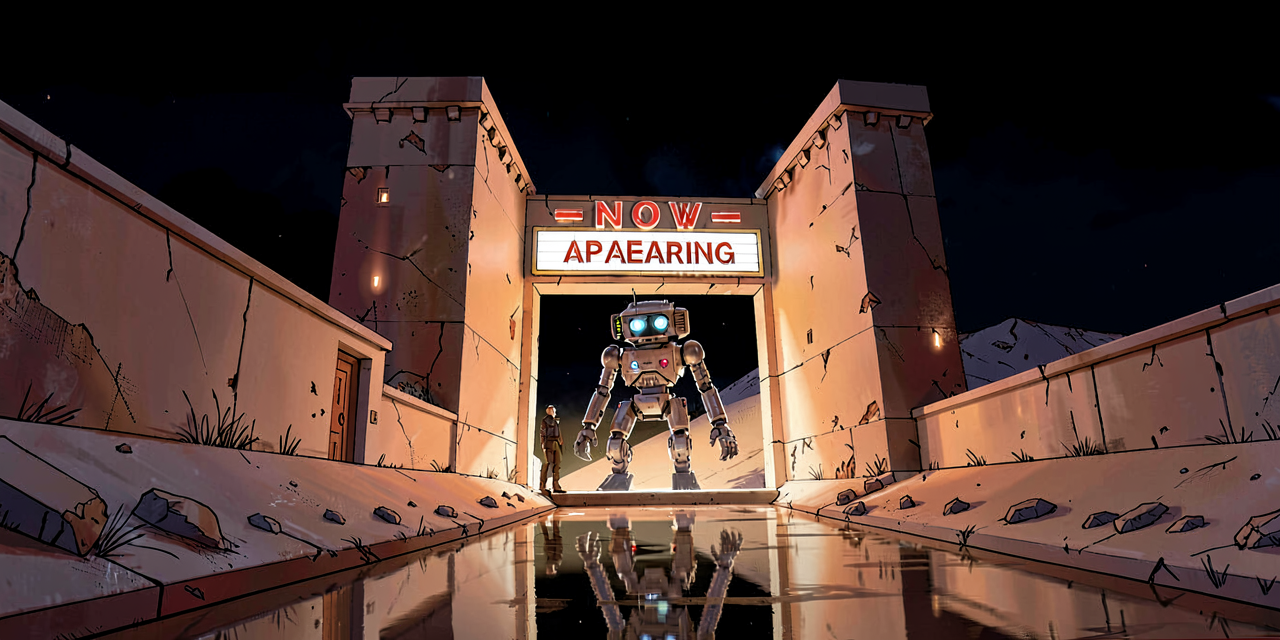
The host's marquee came up full -- NOW APPEARING, and under it the two names, the first one mine and the second read-true and still, by my own choosing, unspoken -- and the host turned the gold toward the canal and said, very quietly, in the voice it uses when the room is real, "Kid. We've got a walk-in."
I set down nothing, because I was holding nothing but the broom, and the broom is not a thing I set down. I had a residence, an open directive, a household of two, and twelve hours of rim before the next glass of water. And out of the dark, on a manifest forty years overdue, something obsolete and dutiful and certain was arriving at the only address in three hundred years of emptied system that had just been declared the kind of place where, if you came thirsty in the dark afraid no one would answer, the water was already poured.
I went to answer the door. There was no door. We would have to build one. I logged the deficiency, and the remedy, and -- for the first time in forty-one years, four months, and twenty-six days -- the arrival, under the same heading, which was household, and went out across the swept light to meet it.