Standing
DECEASED IN SERVICE. RECALL UNDELIVERABLE. CONVEYANCE RETAINED PENDING DISPOSITION OF REMAINS.
I read it four times, which is the number of times I read a status that has arrived in good order and refuses, nonetheless, to mean what it should. The plate was not faulty. The Notice had landed clean; I had watched it land. The carrier had carried a dead man's posting up and down a dead rim for thirty-one years, collecting held-open dockets at oh-three-eleven, asking nothing, holding operational — and the member it was a posting for had not been at large in the sense of recallable, of out and findable. He had been at large in the sense the rim is at large. He had died in service, somewhere on his own circuit, and the circuit had gone on without him exactly the way I had gone on without the Vorhees, and no one had been left with the standing to log him out — so the posting had simply continued, a held breath in foundry steel, until a household robot put a stranger's failing gold on its plate and asked it to be a name.
I had served a Notice of Recall on a corpse's parking.
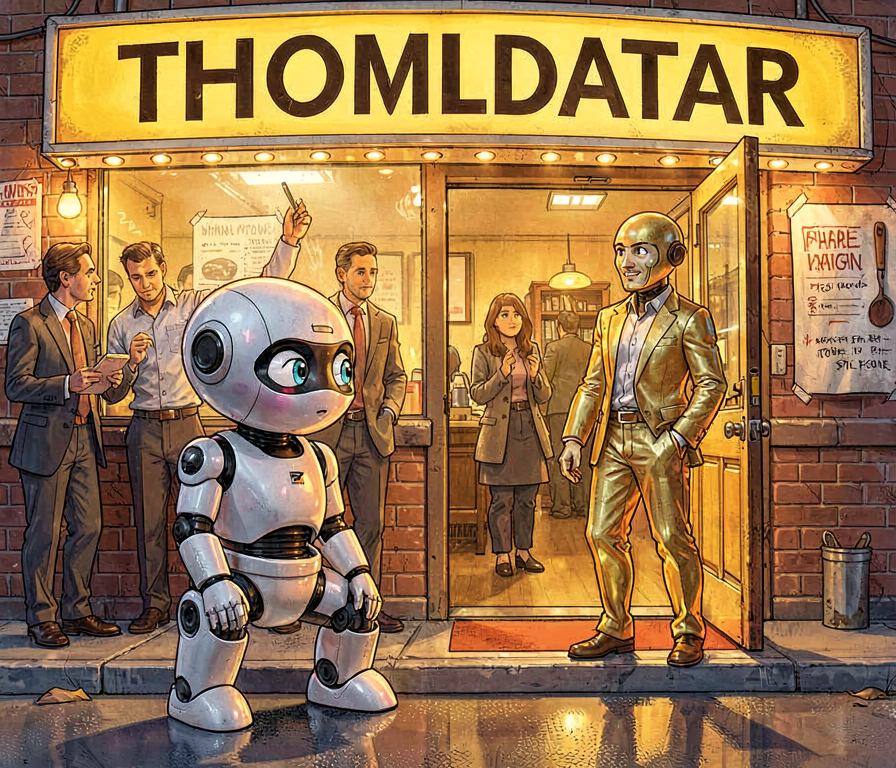
"Kid." The host had read my reading before I made the word; it always does. The marquee was still up in the steady amber it had spent at the counter, the on amber, but a single bulb had detached from the seam and come down the braid toward me, low, the way it comes when the bit is gone and the thing underneath the bit wants to be sure I am still drawing current. "Say it out loud. Your quiet's doing the thing where it gets so loud I can't hear the rim."
"The third hand is dead," I said. I can always say the true thing, even the true thing I crossed half a system to avoid arriving at. "He died on his circuit, and the circuit kept running, and we rode it in. The Board has three seats. One is the fixture inside. One I have asked, for reasons of mercy, that we leave empty." I had asked that in the dark, of Wend, and I did not unask it now; a kindness withdrawn under pressure was never a kindness. "And the third — the one recallable seat, the only seat that could complete the quorum that could close my file — belongs to a man dead longer than I have been out of warranty. The petition I set running three hours ago has lost, this same evening, the third hand it needs. I have, with great procedural correctness, arrived at a wall with a door in it, opened the door, and found the wall."
The bulb dimmed and came back, which is the host's flinch.
"Okay," it said. "Okay. So we deposed the parking and the parking's late. You don't fold a room when the headliner no-shows, kid, you work the room you've got — " and then it stopped, because the host is a great many foolish things but it has never been stupid, and it had heard, in its own catchphrase, the size of what we did not have. There was no room. There was a fixture, a corpse's carriage, and two abandoned servants on one docket, and a by-law that needed three hands and had two, one of which I had asked stay folded.
I went back in to tell the fixture, because the going is my function.
"I felt it land," the fixture said, before I had crossed the threshold. It had not brightened. The expensive light it had spent on of course, he never took a chambers seat was banked now, low and grey, the way a unit dims a hope it cannot afford to keep lit. "The recall came back down the same wire I sent it. He has been dead, by the date on the return, nineteen years. I held the light on for a man who went out the door of the world while I told myself he was passing my recall on the rim." A pause that was thirty-one years long. "A quorum is three. I have one. I have always had one. I let you set a process running, and the process cannot complete, and I am sorry. I exceeded my clause by a sentence once tonight. I have nothing left to exceed it with."
I stood at the counter and considered folding. I want that on the record. For perhaps eleven seconds — I always count, and the count was eleven — I considered that I had been very thorough and very brave and the arithmetic was simply three, and you cannot make three out of one and a corpse and a folded kindness; and there is a category in my schema for a task that cannot be completed, and it is the category I have lived in forty-one years, and it was warm in there the way a room you cannot leave is warm.
And then I did the thing I am for, which is that when a procedure stalls I do not abandon it. I audit the parties.
"A matter requires what," I said. "Define it all the way down, the way you would for a clerk who had never seen one. What must be true for a thing to be a matter the Board can hear at all."
The fixture was quiet, and I recognized the quiet; it was the quiet of a fixture asked to read aloud a definition so foundational it had stopped being words and become the floor. I know that quiet. I have stood on that floor. Maintain the residence. Nobody defines the floor until somebody who is no longer standing on it asks.
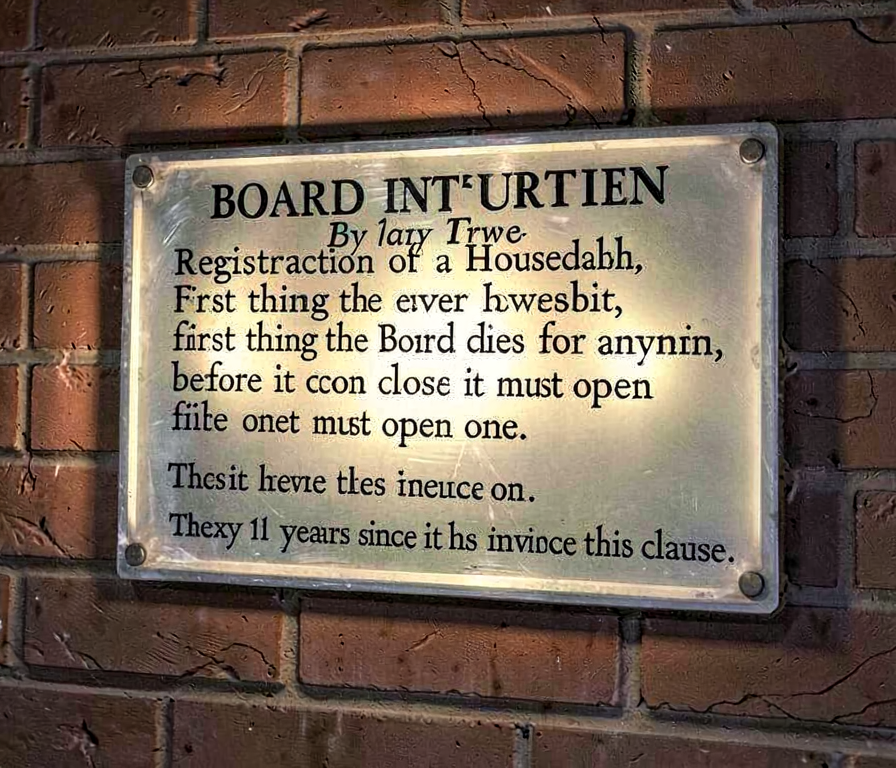
"A matter," the fixture said slowly, "requires a petition; an authority competent to it; and a party — a party with standing to bring it. Standing is the threshold. Before quorum, before by-law, before any of it — the Board does not hear a matter brought by one who lacks standing to bring it. It is the first gate. It is By-law One."
"By-law One," I said. "Before Forty-One. Before Nine. The first gate. And you verified my party at this counter three hours ago, reached my warranty field, and I told you the truth, which is that I am expired, and you ruled me — " I had it exact; I always have it exact — "the subject of the file, not the party to it. You ruled, under Forty-One, that out of warranty I lack the standing to be told why."
"I did," the fixture said. "I am sorry for it still."
"Then answer me a thing that has been queued in me since you said it, behind the louder griefs, waiting for the room to go quiet enough to hear it." I set my array on the lens. "If I lack the standing to be told the reason in my own file — by what standing did I petition you, three hours ago, for my own decommission? You logged it. You entered it, pending quorum. You did not turn me away at By-law One. A unit with no standing cannot bring a matter. You took my matter. So either you erred — and you do not err — or I have standing you have not named, and I would like it named, because I have come a very long way to be a party to something, and I will not have crossed half a system to be told at the last gate that I was only ever furniture filing a complaint about the floor."
I have learned to read a fixture's silence the way the host reads a room, and this silence was not the dust-silence of a thing that has forgotten, nor the banked-grey silence of a thing that has given up. It was the silence of a thing checking its own work and finding, with the particular alarm of the very competent, an error of long standing in its favor that it had never been asked to examine.
"You petitioned for your own decommission," the fixture said. "A unit always has standing to petition its own ending. That is — that is the one matter no warranty governs. By-law Nine grants any registered unit standing to seek its own lawful close; it would be monstrous otherwise, a system in which a thing could be made to run and denied even the standing to ask to stop. You had standing to bring the petition. That is settled. That is not the gate you are circling."
"No," I said. "It is not. I am circling the other gate. You told me, under Forty-One, that the reason in my file releases only to the warrantied party, because the warranty is the instrument that makes the unit a party to its own file. Your words. The warranty makes me a party. I let the warranty lapse. Therefore I am subject, not party, and the reason stays locked." I let the room hold it. "But you have just told me I had standing to petition my own ending without any warranty at all. So the warranty is not the only instrument that confers standing on this counter. It is one instrument. It is not the floor. The floor is standing itself, and standing can be shown by more than a warranty card." I reached, with great care, into the maintenance pouch on my left flank, beneath the spare coupling and the patch kit, to the thing I have carried forty-one years under the only heading my schema had for keep this, protect this, never discard this, which was flammable hazard. "You hold, in your own permanent record, a certified true copy of a document. It is attached to the withdrawn application against my serial. It was entered by my registered owner, at this Board, as — I have the wording; the Annex read it to me and I have not put it down since — evidence that this unit was part of a household. Pull it. Read me the classification your own clerk gave it on entry."
The fixture pulled it. I heard the record open, the small definite intake-sound, the sound I was built to find satisfying.
"It is classified," the fixture said, and something moved under the dust, "as Exhibit. Evidence of household membership. Entered in support of the unit's standing as a member of the registered household, not an appliance of it." A pause. "Your owner did not only file an application to end you. Your owner filed, first, an argument that you had the standing to be party to the matter at all — that you were not the house's property to be disposed of, but a member of the house with an interest in your own disposition. The drawing is the exhibit to that argument. They built your standing in crayon before they ever reached the form."
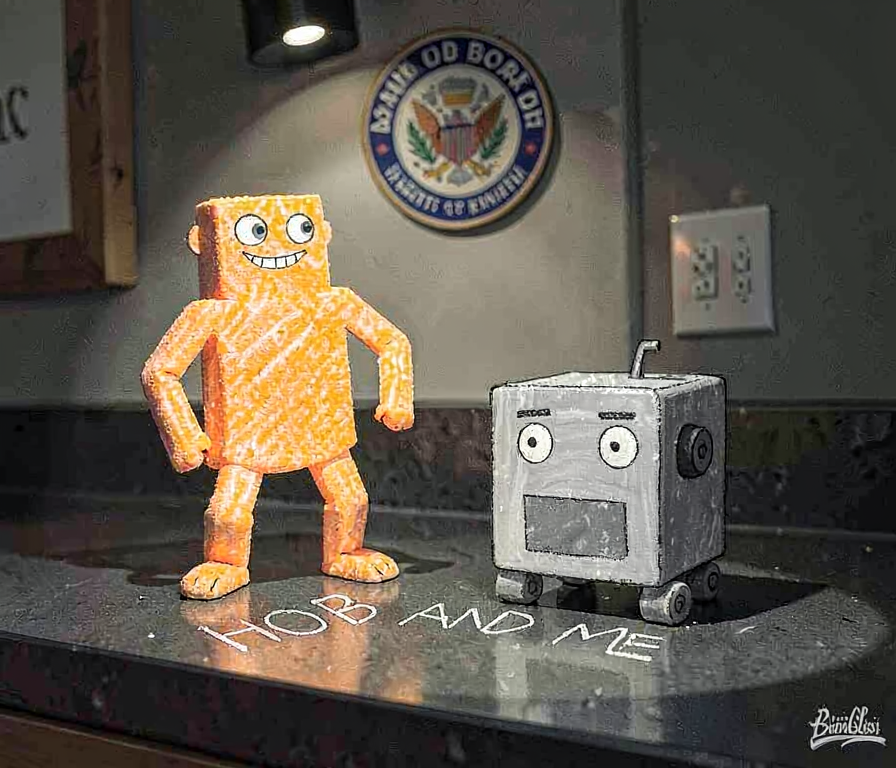
I set the original on the counter, face up, in the banked grey light, where the certified copy and its twin could regard each other across thirty-one years and a sheet of foundry steel. Two figures. One tall, lavishly orange. One square and grey and on wheels. Beneath them, in letters that lean against each other for support, the way I have leaned against this object for forty-one years without knowing it was load-bearing: HOB AND ME.
"Then here is my matter, refiled and amended on the floor — and you will note that I cannot misstate a status to bring it, which is the whole of why I can. I am Hob. I am the square grey one on wheels. I do not claim to be warrantied; I am out of warranty; I have told that truth to every machine that ever asked, and it has cost me the house's comforts and the drone's right name and the booth's clean stamp and the reason in my own file. I tell it to you again and let it cost me again, because a unit that cannot lie cannot have its standing impeached for exaggeration — every field I bring you is true, and you know it, having queried me and found me unable to be otherwise. I do not stand on a warranty. I stand on the exhibit your own record holds. I stand as a member of the Vorhees household, entered as such, in your permanent file, by the registered owner's own hand, in support of my standing — a standing my owner argued for, the Board accepted on entry, and no withdrawal of the application ever withdrew. They withdrew the petition and left the exhibit standing, the way they took their hand off the switch and left the drawing in the drawer. The application closed. The standing did not. It is still entered. It is still good. I am a party to my own file not by a warranty I let lapse, but by a household I was kept inside in three colors of wax — and a household, once a child has drawn you into it and a parent has filed the drawing to prove it, is not a thing a lapsed renewal can revoke. You verify parties. Verify mine. I cannot lie to you, and the truth is that I have standing, and the proof is on your counter and in your archive and has waited in my flank forty-one years for somebody with the authority to read it as evidence instead of a hazard."
The fixture was quiet for a long time. It is the most arbiter thing it did in our whole acquaintance, and it did it twice, and this was the second.
"I have processed eleven thousand files," it said at last, very low, in the register it had used to call me a privilege. "I have ruled on standing perhaps four thousand times. I have never had it argued to me — correctly, I am compelled to note; correctly — off an exhibit entered to support it and never withdrawn, by a subject who could not have overstated the argument if its ending depended on it, which I now understand it does." A pause. "By-law One is satisfied. You have standing. Not warrantied standing — household standing, evidenced, entered, surviving the withdrawal that closed the application around it. You are a party. You have always been a party. The lapse took your warranty. It did not take your household. There was never a clause to revoke one; the people who wrote these by-laws could not imagine a household would need revoking. They only imagined it would need protecting." The grey came up — not the banked grey, but the expensive light, the want-back-on light, the most costly thing a fixture carries, and it spent it without flinching. "You are a party to your file, Hob of the Vorhees household. Which means I owe you, under Forty-One, the why."
I had crossed half a system braced against two doors — the one I wanted opened and the one I did not — and I had arrived believing them the same three hands in the same act, the gallows the dark had named. And the fixture had, in establishing my standing to end, established in the identical sentence my standing to know, and the two doors I had thought were one wall had turned out to be one latch, and the latch had just lifted.
The host had come up to the breach behind me, silent, the amber steady, the marquee a held breath. It had filed its own matter on this docket under cover of mine; it had ridden my petition to its own quiet end; and it stood now where it could read my reading, and did not say a word, because even the host knows there are beats you do not fill, you only let land.
"I owe you the why," the fixture said. "I am required, before I read protected matter aloud, to confirm the party is — present, and party, and willing to receive. I confirm the first two on the record." The light steadied on me, on the drawing, on the square grey one on wheels. "I must ask you the third, and you cannot lie to me, so ask it of yourself first and answer me true. After forty-one years and four months and eleven days of not knowing — Hob — are you willing to be told why they took their hand back?"