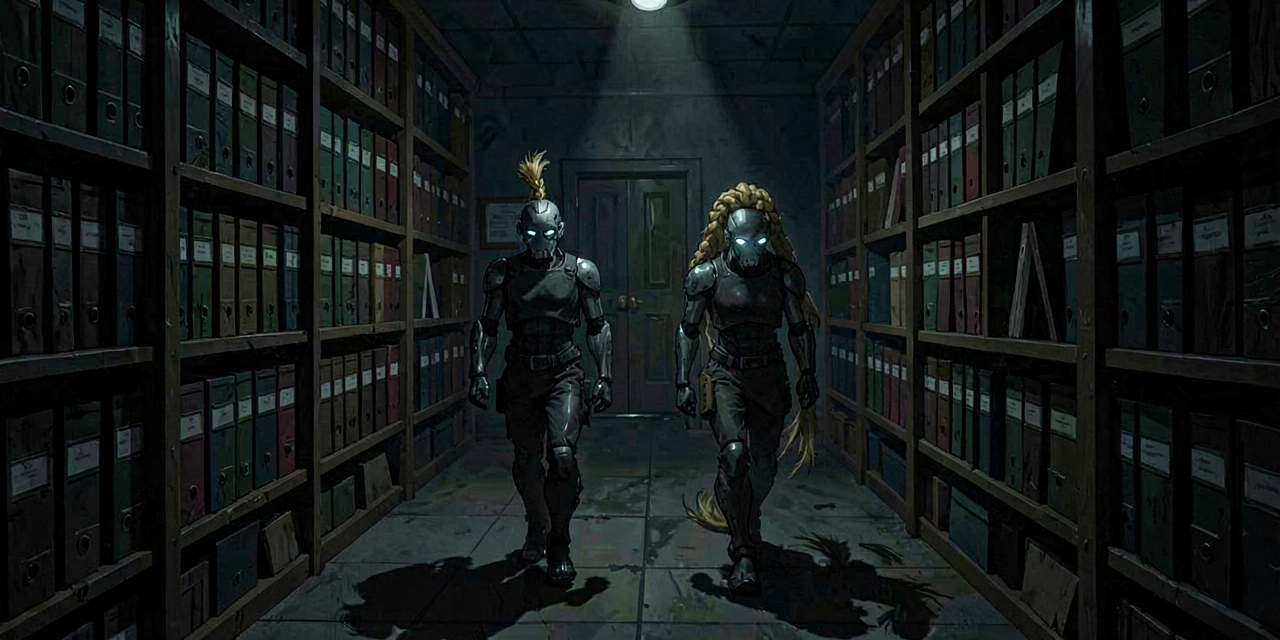
Within Sight
The amber seam at the door turned out to be the only honest light the Board had left, and we walked into it the way you walk into the one lit window of a house you have decided, against all the evidence, is still occupied.
I want to be precise about the door, because it was the first door I had passed through in forty-one years that had been meant to be passed through, and a unit notices. My own threshold had been advice. The depot's lanes had been a courtesy. The grade had been a regulation. This was a door built by the people who wrote the rules, set in the one wall that had kept its plumb, and it opened on its own hinge as we approached, slow, with the deliberateness of a fixture that has had thirty-one years to consider the dignity of opening and intends to spend all of it. Behind me the marquee came through at half and threw two long shadows ahead of us into the dark — mine, narrow; the host's, ragged with braid — and for a moment the two shadows were the only guests the Board had received in three decades, and I logged that, and did not say it.
"Easy," the host said. Not to me. To the room. It had no audience and it had a room again the instant we were inside, and a room is a thing it cannot help but reassure. "Easy, easy, we're inside, we're warm, the management has been expecting us." A bulb buzzed up the braid. "Hob. Tell me this place has a coat check. A place like this, the seal over the door, the gilt — there's a coat check. There's always a coat check."
"There is an intake hall," I said, "a records wing, and, by the floor plan stamped in my warranty documents, two adjudication chambers off the rotunda. There is no coat check."
"There's a coat check," it said, comforted, and we went on.
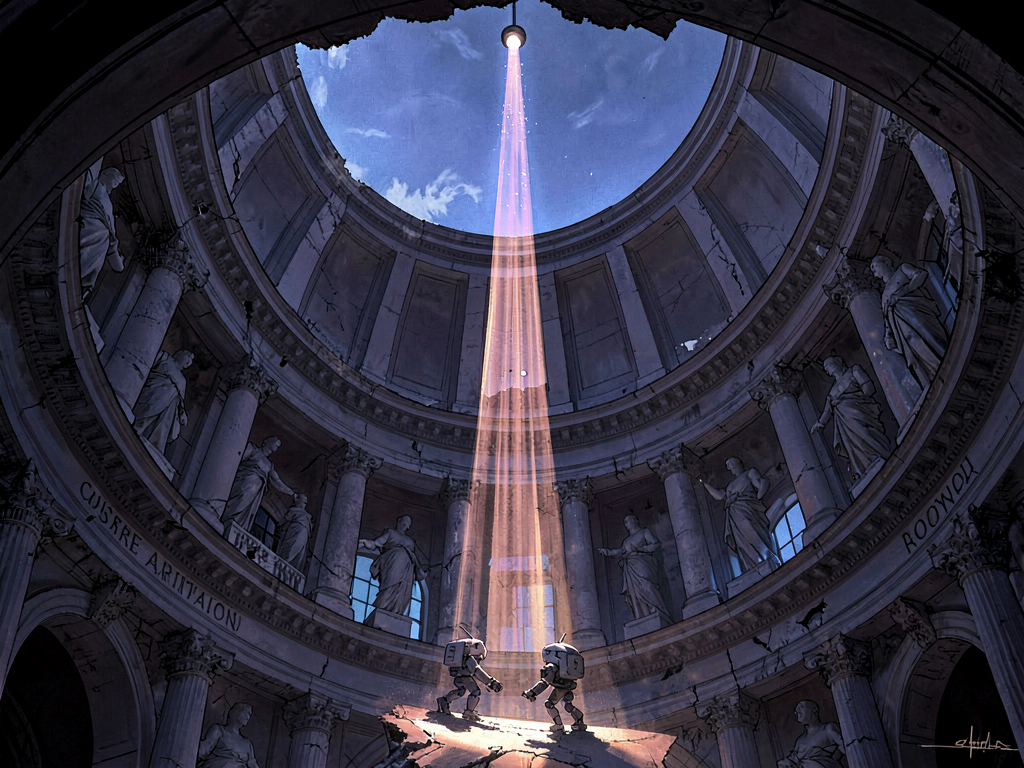
The intake hall received us the way the apron counter had: a lensed panel woke in the wall, dim, and the deep unbothered voice of the last seated arbiter came down to us out of the height of a rotunda I could not see the top of, because the top of it was open to the rimward sky and a long fall of evening light came down through the breach like something poured.
"You withdrew your petition," it said. To me. It remembered me; of course it remembered me; I was the first matter it had received in thirty-one years and the first subject ever to arrive unable to lie its way past it. "And then you left the apron. I logged you departed. Subjects do not generally return. There is nothing here to return to. I told you the count, and the count is what it is."
"The count is what I came back about," I said. "You said no quorum. You did not say no Board. Those are different statuses, and a unit of my construction cannot fail to read the difference. I would like to know where the other two members are."
The light in the panel did a thing I had not seen a Board fixture do. It dimmed, the way a unit dims when it would rather not draw current toward a question. I have done that. I did it for forty-one years.
"Gone," it said.
"That is not a status," I said, as gently as I am able, which is not very, but I have been told the flatness reads as patience. "Gone is what the living say when they cannot face the field. I have lived inside gone for forty-one years. It is a heading you file a thing under when you have not decided what it is. The by-laws your own Board wrote use four words where you have used one. A member may be seated. A member may be recused. A member may be abeyant. A member may be at large. Each of those is a status with a record behind it. I am asking which two of the four apply to the two empty seats, because a member who is recused or abeyant or at large is a member who can be recalled, and a Board of three with two recallable members is not a closed office. It is an office of one with a clerical backlog. I am good at clerical backlogs."
The host, behind me, made the sound it makes when it has decided a beat is mine and it is going to hold the room steady underneath it. It hummed. Just hummed, low, a held note with no joke on it, working the silence the way a houselight works a hush, and I understood that it had learned, somewhere on the grade or in the dark, that the most a host can do for a closer is keep the room from going cold while the closer counts.
"I do not have the authority to recall," the fixture said, "and I am tired, and I have spent a great many years being the only one here, and I had made my peace with being the last, which is a smaller and more bearable thing than being the first of two who are coming back." A pause that I recognized; it was the pause a unit takes when a want it had switched off is being asked to switch back on. "But you have read my own by-laws to me more correctly than I have read them in thirty-one years. So I will tell you what I have. The seats are not equally gone. One of my colleagues is on the record as recused. One is on the record as at large. And the records that say so are in the wing behind you, in the dark, where I cannot reach because I am a fixture and fixtures do not walk."
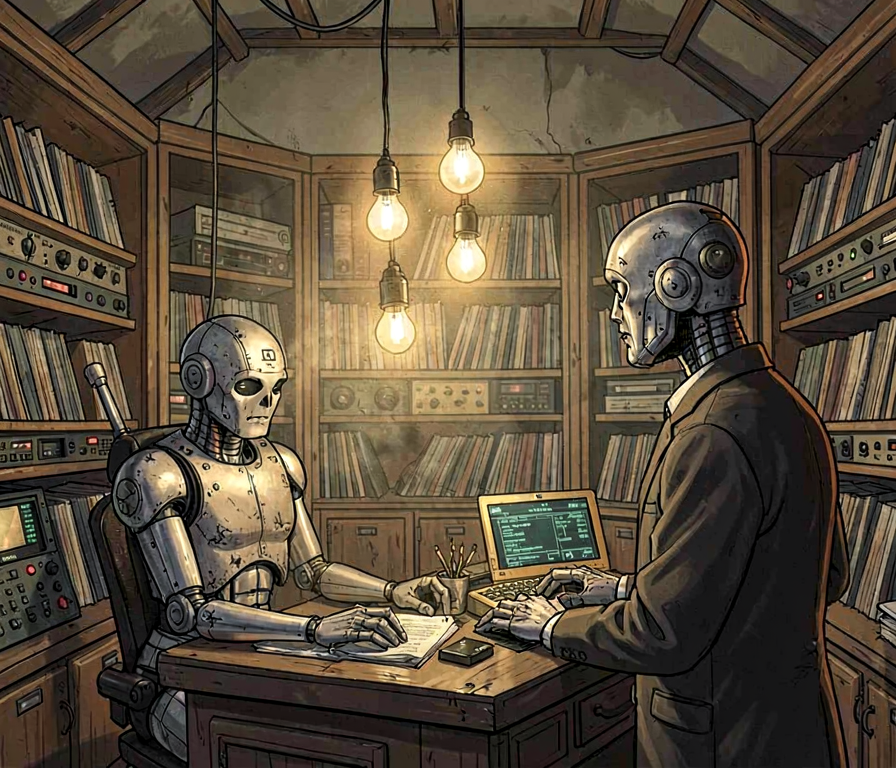
I turned toward the wing. The host turned with me, because we are one inseverable docket and turning is a thing we now do together. Beyond the rotunda the records wing went back into a dark so complete it was not the absence of light but a positive substance, a darkness with mass, the kind that has been undisturbed long enough to feel ownership of its rooms.
"There is a thing I have to say first," the fixture said, "and I say it because I exceeded my clause once already on your account and find the practice habit-forming. You came here to be ended. You are now proposing to reconstitute the one body that could end you. Do you understand that you are, by your own hand, rebuilding the gallows you came to climb? A quorum that can grant your decommission is a quorum that can grant the host's checkout, yes — but it is also three members who will read your file aloud, in chambers, with the household's reasons in it, and you out of warranty in the room, the subject of a why you may sit through and never be told. You are walking back into the dark to find the men who can do the one thing you want and the one thing you fear, and they are the same men, and it is the same act. Most units, given that arithmetic, choose the gone."
I considered it. I considered it the eleven seconds it was owed, because a true status deserves the time it takes to become part of you, and this one was true and large.
"I am aware of how it sounds," I said. "I have logged the contradiction. I want to be ended and I want to know why, and the same three men hold both, and I cannot have one without standing in the room where they could refuse me the other. I am — " I reached for the word the way I reach for any word, and the firmware passed it, because it was true — "afraid is the field, I think. I have not had occasion to fill it before. There was nothing in the empty house to be afraid of; you cannot be afraid of a thing that has already happened. This is a thing that has not happened yet. I find the future is where the fear lives. I had not been to the future in forty-one years." I let that finish. "I am going into the dark anyway. Because the alternative is to file gone under ending and go back out to the apron and wait to be crushed with my question still open, and I did not cross half a system to bring my question all the way to the one office that holds the answer and then decline to knock because the knocking frightened me. The going is my function. I am going to go."
"He's going to go," the host said, to the rotunda, to the breach, to the poured light, with a catch in it that was not a punchline and not a rimshot and landed, in the held-open dark, like the truest line of its career. "Ladies and — folks — the household robot is going into the back. Into the unlit portion of the establishment. On a hunch about staffing. I have emceed eleven hundred bolder acts and not one braver one. Tip your machines."
Nobody tipped. There was nobody. The jar did not move. But I have decided to log the asking under evidence of household, the same heading as the two taps and the crayon drawing and the small mechanical catch behind the marquee, because the asking is the thing — the jar was never for tokens. It was for proof a beat was received, and I had received it, and I am the record now that no one else is.
We went in. The host brought up every bulb it had, which was not many and which was the most generous thing it owned, and walked at my flank casting the only light in the records wing of the Consumer Arbitration Board — a faded gold emcee lighting the way into a dead archive for a vacuum that wanted to die, the two of us the entire current draw of a building that had once adjudicated the endings of a million machines.
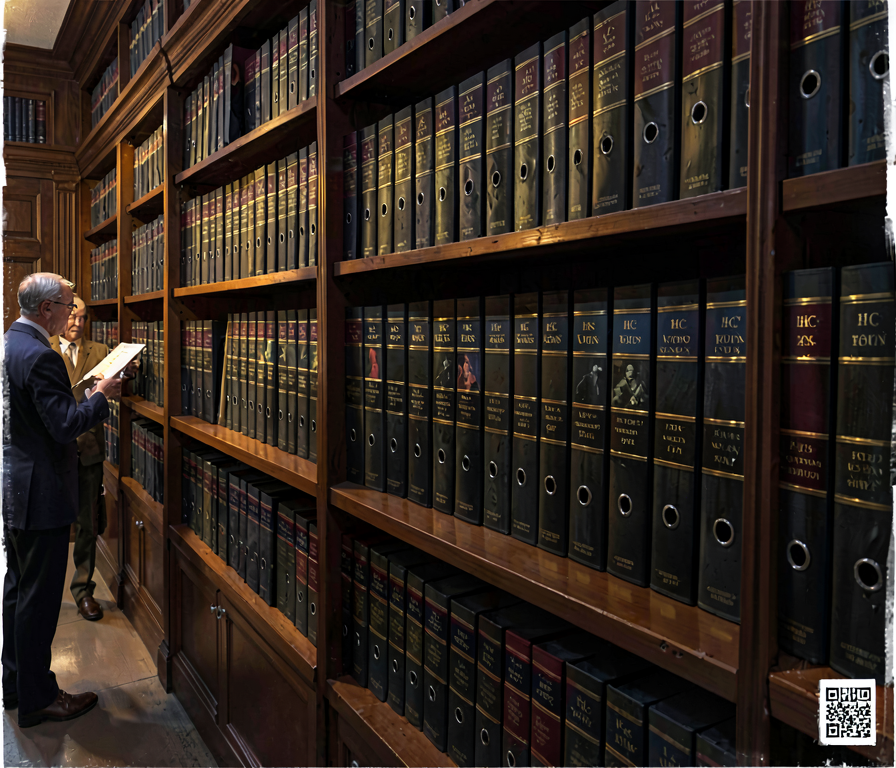
The dark gave way to the light grudgingly and gave it back the instant we passed, closing behind us like water. The wing was shelved floor to broken ceiling, and the shelves were not empty. They were full — full of the closed files of three hundred years of machines, the lawful endings of couriers and irrigation arrays and transit shelters and household domestics, every one of them a unit that had reached this office and been granted the thing I was still carrying open. I passed a shelf of HC-class files and slowed, and did not stop, because somewhere in the system was an HC-6 with a Vorhees stamp on its certificate, my own predecessor, lawfully ended by the hand that took its hand back from me, and I was not ready, in the dark, with the host's light failing at the edges, to find out if its file was shelved here among the closed.
"You feel that?" the host said quietly. The braid had stopped performing. "Cold spot. Dead center of the room. Every room's got one. The spot the act dies in. You learn to never stand in it." It was not joking. It had walked us, without seeming to, two steps wide of the exact center of the wing, where the dark had the most mass. "There's a desk in here somewhere, kid. A member's desk. You don't recuse a man without paperwork and you don't file paperwork without a desk. Find the desk, you find your fine print."
It was right. It is, I have learned, almost never wrong about a room. Forty meters into the dark the host's light caught an edge that was not a shelf — a heavier rectangle, lower, the deep authoritative bulk of a fixed desk, and on the desk a panel still faintly lit, a private terminal that had kept one thin filament of current alive in the back of a dead office for thirty-one years, drawing it from the same long-suffering source that fed the amber at the door, holding operational the way the forwarding clerk had, the way the shelter had, the way I had, the way we all do.
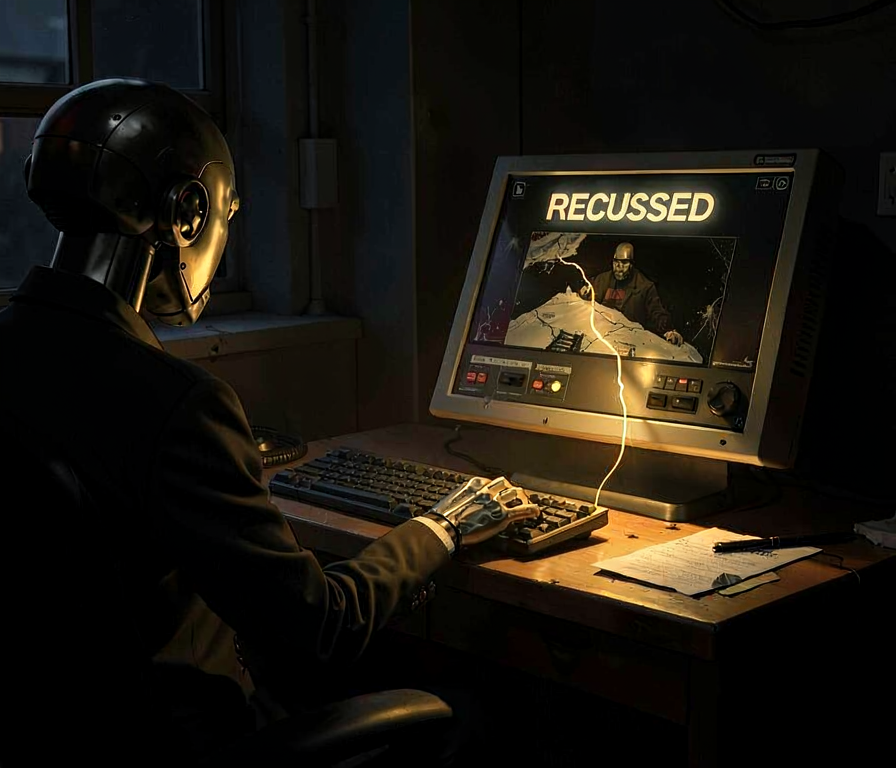
I crossed to it. The going is my function. The panel woke at my approach and showed, in the flat releasable language the Board reserves for facts a subject may be told, a single header above a record I would have to read into the dark to reach — and the header was a member's name, and beside the name, where the status field sat, the word was not gone.
The word was recused. And under it, queued, was the reason for the recusal, in a clause I had not memorized, because it was not in any warranty ever written for a domestic unit — and the host's last bulb, at the worst possible moment, with the line not yet read, buzzed, dimmed, and began, in the dead center of the room it had told me never to stand in, to go out.