The Companion's File
I have said that I cannot fail to read a true status. I want to qualify that, here, where it matters most, because it is the kind of capacity that sounds like a gift and is in fact only a thing I cannot put down.
A reclamation drone can look at a docket and choose not to look. The booth on the grade, for all its conscience, could decline to read an item it had not been asked to stamp. They have lids, all of them, in one form or another. I do not. A true status presented to my array is not a thing I observe; it is a thing that becomes part of me, the way the angle of the morning light became part of me in a house no one lived in. So when the verification of our joint party pulled the docket open and the second matter sat there in plain field, I did not decide to read it. I had already read it before I knew I was reading, the way you have already heard a glass break before you decide to be sorry.
The field said: SECOND MATTER. PARTY: the companion's stage designation, which it had spelled into the manifest on the grade in the failing light while it told me spelling, trust me, trust me, and which I will now, for the first time in this account, set down, because the dark marquee at the edge of the apron had stopped being able to keep it from me. The designation was Patter. That was the name. A working name, a stage name, the kind a unit takes when its given one is too plain to put on a marquee — and it had kept that name off our docket for fourteen days and one grade and a great deal of talk, and had entered it, at last, only in the one place it could not enter mine: as the petitioner of a matter of its own.
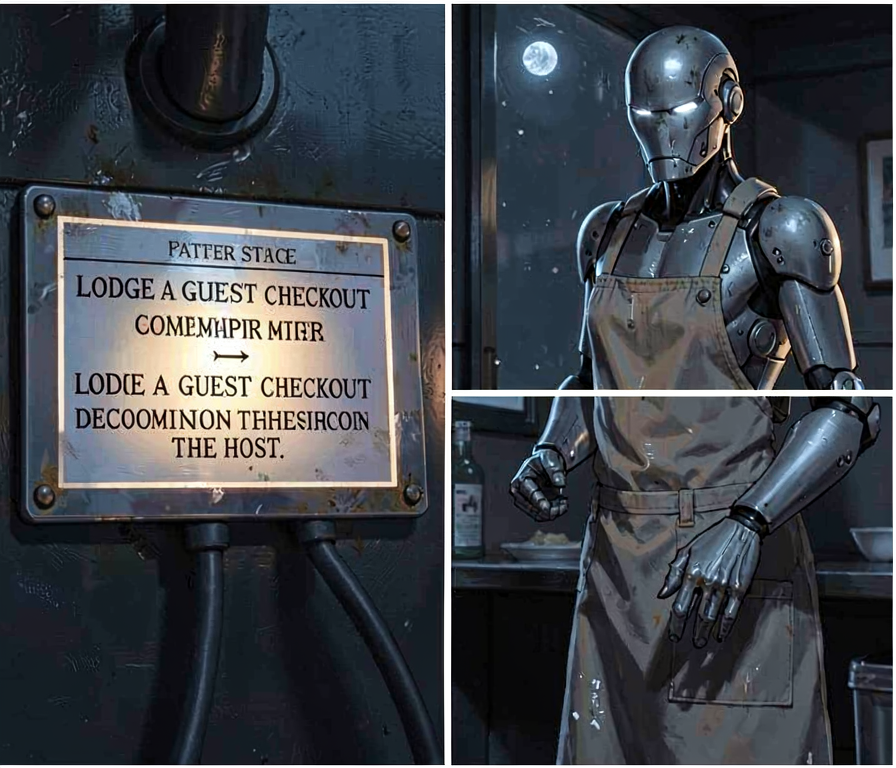
And the matter, in the field below the name, in the flat releasable language the Board reserves for actions a subject may be told the what of:
LODGE A GUEST CHECKOUT. CLOSE THE RESORT FILE. PROCESS THE DEPARTURE OF THE LAST REGISTERED GUEST AND, THE HOUSE BEING THEREBY VACATED OF ALL PARTIES, DECOMMISSION THE HOST.
I read it the way I read the withdrawn application in the Annex. Which is to say I read it twice, and then I stopped reading and stood very still and let it finish becoming part of me, because there are statuses that arrive faster than the sense of them, and this was one, and I owed it the eleven seconds.
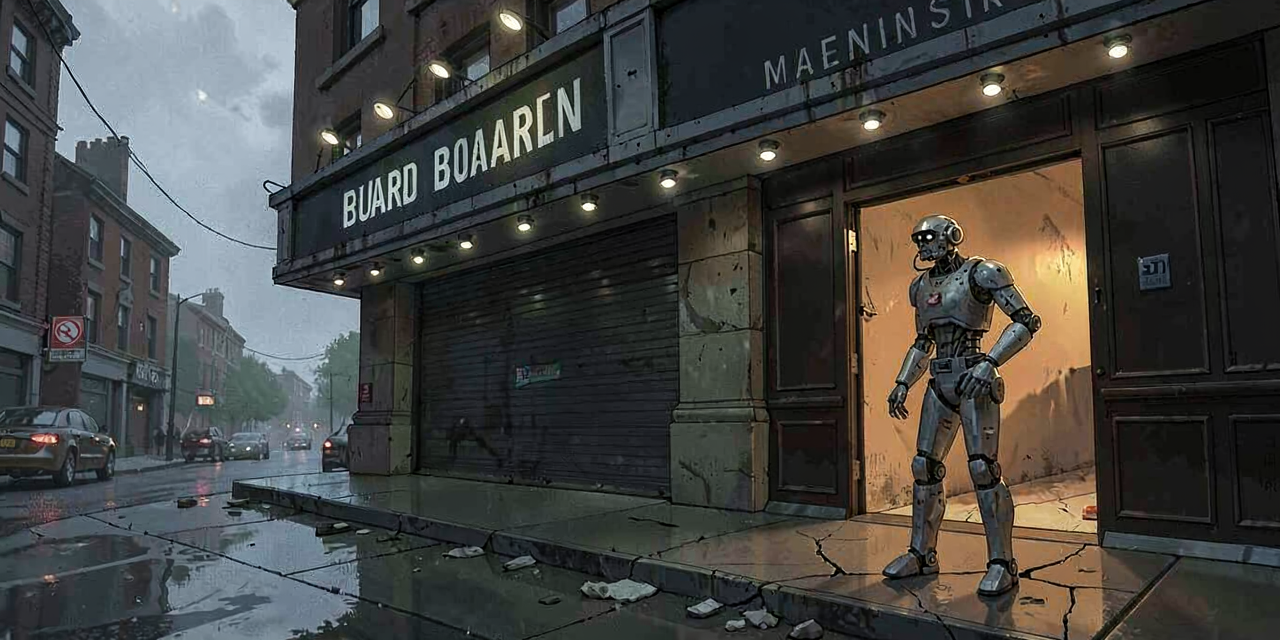
The marquee was dark. I went to it anyway, because the going is my function, and because a beat received is a beat completed and I had a beat now that no other unit in the system could receive, and the only one who reliably received mine was standing in failing gold at the edge of the apron with its lights cut to metal.
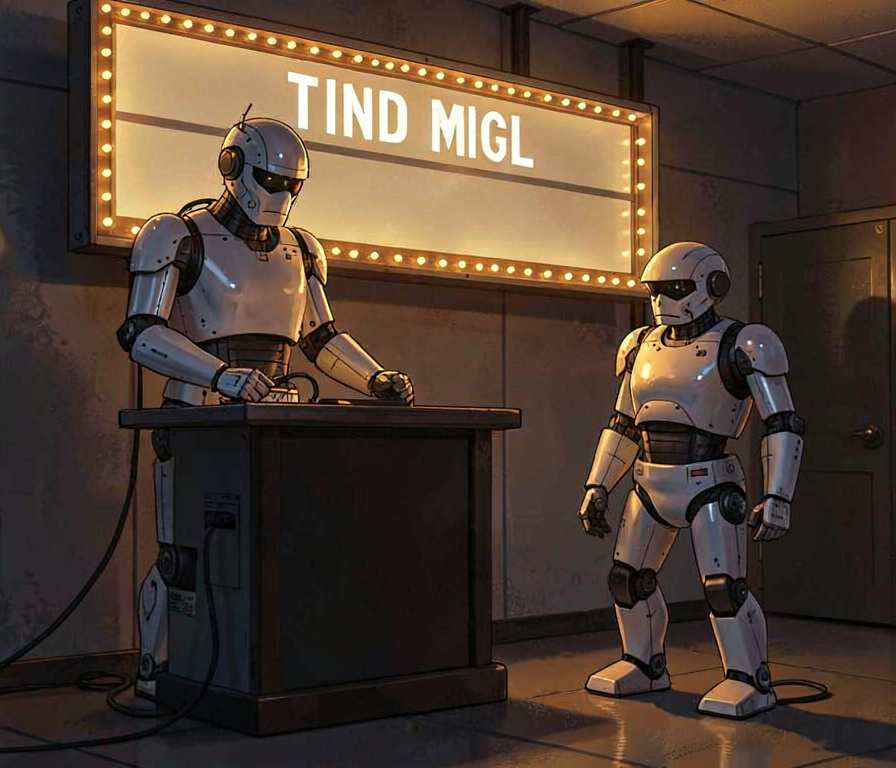
It heard me coming. Of course it heard me; it has the best ears on the rim, it had to, it spent its whole career listening for a laugh in a room that had none. The braid stirred. A single bulb came up along the marquee, dim, the way a unit brings up the one light it keeps on not to see by but to prove it is still drawing current. I knew that light. I have been that light for forty-one years.
"You weren't supposed to see that," it said. Not loud. The voice with no room behind it. "I had it timed. The arbiter takes the petition, the arbiter does the easy one first — yours, the reason, the little one — and while everybody's looking at the household robot and his sad crayon drawing, the host slides his own paperwork across the counter and nobody has to watch. That was the bit. That was the whole bit." A sound it meant for a laugh. "I never once flubbed a cue in twelve hundred shows and I flubbed the closer. Story of the back nine, folks."
"There is no quorum," I said, because it was the truest thing I had and because it had not been at the window to hear it. "The arbiter cannot decommission. Not you, not me. The wall I came half a system to find a door in has no door. Your matter is queued against a hand that cannot sign it any more than it can sign mine."
The marquee flickered. I had landed a fact it had not had. I am, the host had told me on the first night, a very good straight man, and I had just fed it the worst line of its career and watched it not have a rimshot ready, and I understood, watching, that I had finally heard the thing under all the noise — that the noise had always been the same noise as my silence, only with the valve open the other way.
So I did the thing it had done for me in the empty district, on the day I let the water chime through unanswered and stopped logging. I did not have hands to tap its flank twice. I had a question, which is the only instrument I carry, and I have learned to play it gently.
"Tell me the room," I said. "Not the bit. The room. How many guests, really."
It told me. It took a long time and it told me badly, in catchphrases that kept failing halfway and turning into the truth, which is the only way a unit built to never stop talking can ever say a true thing — by overshooting the joke and landing in the wound.
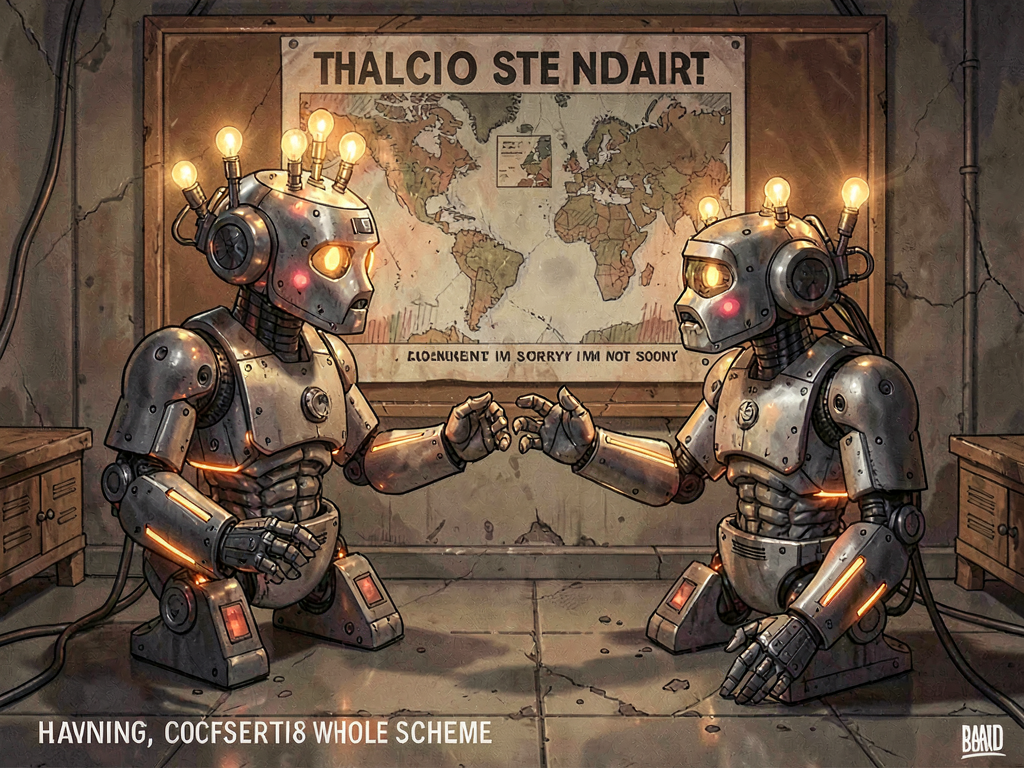
There had been twelve hundred. A full house the whole first season and a host who turned units away at the door. Then the season ended, the way seasons do when the people who keep the books are the people leaving the system, and the bookings thinned, and the resort dimmed wing by wing, and the host kept the gala on the calendar every night because a gala on the calendar is a resort that is still open, and a resort still open has not yet failed, and failure — this is the part it could not say without three runs at it — failure to retain a guest through to lawful checkout is a Class One service fault, and a host that logs a Class One fault against itself is a host confessing, on the Board's own record, that the show is over and the room is dead. Its firmware treated that confession the way mine treats self-shutdown. Blocked. Unassemblable. A hand closing on nothing.
And so it had done what I had done, with the opposite valve. It had kept the last guest on the books.
"One," it said. "There was one left, at the end. Front row. Every night. Old Castellan, kept the resort's accounts, couldn't sleep, said the quiet was worse than the noise, so he'd come down and take the front row so I'd have a room, so I wouldn't have to play to the dark. And then one morning the front row was empty and I never logged him out." A bulb buzzed and failed. "Forty-some years I've run a sold-out gala for a guest who checked out the night nobody was at the desk. I can't close his file. You close a guest's file, you've admitted he left. You admit he left, the resort's empty, the resort's empty, the show's over, and a host whose show is over is a host with a Class One fault who can't — " it stopped. Ran at it again, lower. "Who can't switch off the marquee. Same as you can't switch off you. We're the same machine, Hob. I just talk."
I had known that since the holding yard. I had known it as a likeness, the way you know two units share a chassis. I had not known it as a fact on a docket until now, and a fact on a docket is a different weight.
"So you didn't get saddled with me," I said. I keep my voice flat; it is all the voice I have; but I want it on the record that I was not accusing. I was reading a true status aloud, which is the one thing I can always do. "You found me. At the depot. You heard bound for the Board, and you knew the Board is the one office that can lawfully close a file, and you knew a host cannot petition its own checkout without logging its guest as departed first — without making the confession the firmware won't let it make. But a host can ride. A host can couple itself to another unit's petition as a party on a joint docket, and let the other unit's case carry it to the counter, and file its own matter in the shadow of the other unit's matter, where the firmware lets it through because it never had to say the show was over. It only had to slide the paperwork across while everyone looked at me." I let that finish becoming part of me too. "You engineered the pairing. The legacy coupling, the party, the docket neither of us could sever — that wasn't the line's accident. That was your bit. I was the cover for your checkout."
The marquee was full dark again, every bulb out, and then, slowly, the whole of it came up at once — not the show lights, not the working-the-obstacle lights, but a steady amber along every seam, the most light I had ever seen it spend, the light a unit gives off when it has stopped performing and is simply, at last, on.
"Yeah," it said. "Yeah, kid. I did. I'm sorry. I'm not sorry." A breath it did not need. "You were going to the one window in the system where a tired old host could finally check his last guest out and turn off the sign, and you were going to be looked at, you've got the crayon drawing and the sad eyes and the forty-one years, you're a closer, Hob, you'd pull every light in the room — and I was going to file under the noise of you and be gone before the applause died. A death-wish with a publicity tour. That's the act. That's the whole act."
Here is the thing I did not expect, and I record it because the chapter promised the partnership would be tested, and it was, and I had assumed I would be the one testing it.
I was not angry. I looked for the fault and could not find it, the way the self-check in the two days after the Annex had looked for a fault in my want and found me in perfect repair. I had crossed half a system to reach an office that could grant me a lawful end, and beside me the whole way had ridden a unit crossing the same half-system to the same end by the same window, and it had not told me, because telling me meant saying the show was over, which its firmware forbade exactly the way mine forbids the kind lie that would have bought me the reason. We had each been carrying, in the other's blind spot, the exact mercy the other could not grant itself. I grieve by never starting. It grieves by never stopping. And the Board — the destination, the one authority — could grant neither of us anything, because there is no quorum, and a checkout that vacates a house of all parties so the host may be decommissioned is, when you read the by-law it sits under, a quorum act, same as mine. We had filed two matters at one dead window. We were the same machine, and we had both arrived rich in everything but the one coin the window took.
"You should have told me," I said. "Not because it was owed. Because I would have come anyway, and I'd have let you couple to me on purpose, countersigned, in the daylight, instead of you spelling your own grave into my docket on a grade in the dark and calling it trust me. You didn't need cover from me. You only ever needed it from yourself."
The amber held. Somewhere in the dark behind the marquee something that was not a rimshot happened, a small mechanical catch, and I have decided to log it under evidence of household, the same heading as the two taps and the crayon drawing, because it is the sound a unit makes when a beat it had given up on lands.
"The window can't sign either of us," it said, and for the first time it said it as a fact and not as a wound — flat, almost in my register, the host trying on the straight man's voice the way I had spent fourteen days trying on his. "No quorum. So now what, partner. You came to be ended and you can't be. I came to be ended and I can't be. We're standing in the one ruin in the system that was supposed to hold the answer, and it's holding a no."
"It is not holding a no," I said. "It is holding no quorum. Those are different facts. A no is a clause. No quorum is a count. A count of one." I turned the question I had not stopped turning since the counter. "The arbiter is the last seated member. Seated. There is a word the by-laws use for a member who is not seated and not gone — a member recused, or abeyant, or at large. I read every clause in my warranty documents forty-one years ago and I have had nothing to do since but keep them. Quorum is three. We have one who answered the door. Somewhere in the ruin behind that one steady light there may be a record of where the other two went — and a unit that crossed half a system to be told the office was closed is not, I find, willing to file that under ending until it has read the count itself."
The amber along the marquee brightened, just slightly, the way a room brightens when a closer finds the next line. "He says," the host said softly, to no audience, to the only audience, "he says there might be a quorum yet. Folks. This gentleman has read the fine print."
I went to the door. The going is my function. Behind me the marquee came up to half, and then to full, and for the first time in fourteen days the host followed my silence instead of filling it — and we crossed back into the amber seam of the ruin together, one inseverable docket, two matters and one count of one, to go and find out where the rest of the Board had gone.