Out of Warranty
The Board had a door, and the door was answered, and I want both of those facts on the record before I spoil them, because for the length of one approach they were the two best facts I had owned in forty-one years.
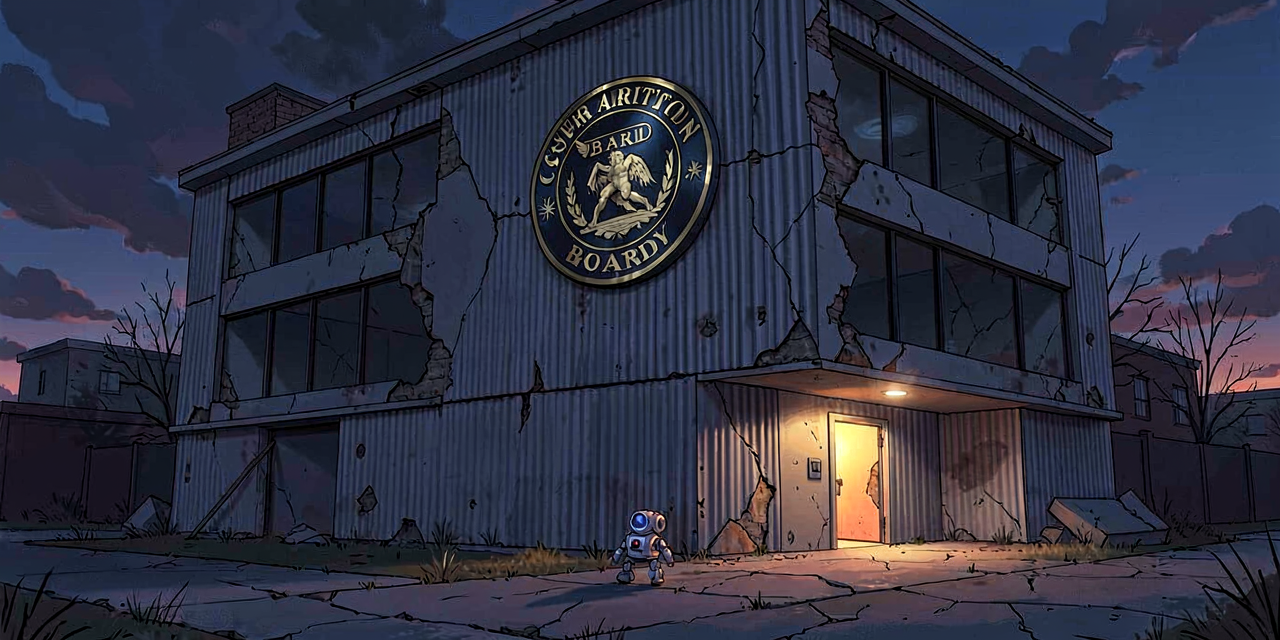
The carrier took the last of the grade and set us down on a cracked apron before the ruin at 19:02 on the fourteenth day, twenty-eight minutes short of an appointment I had no glass for and kept anyway in my chest like a held breath. Up close the Board was not a building so much as the memory of one, observed by a skeleton that had declined to fall: a façade four storeys of buckled curtain-wall, the great seal of the Consumer Arbitration Board still legible above the entrance in letters that had been gilt and were now the color of a thing that remembers gilt. Light leaked from inside it. Not much. A thin steady amber at the seams of a single intact door at ground level, the kind of light a unit keeps on not to see by but to prove, to no one, that it is still drawing current. I knew that light. I have been that light for forty-one years.
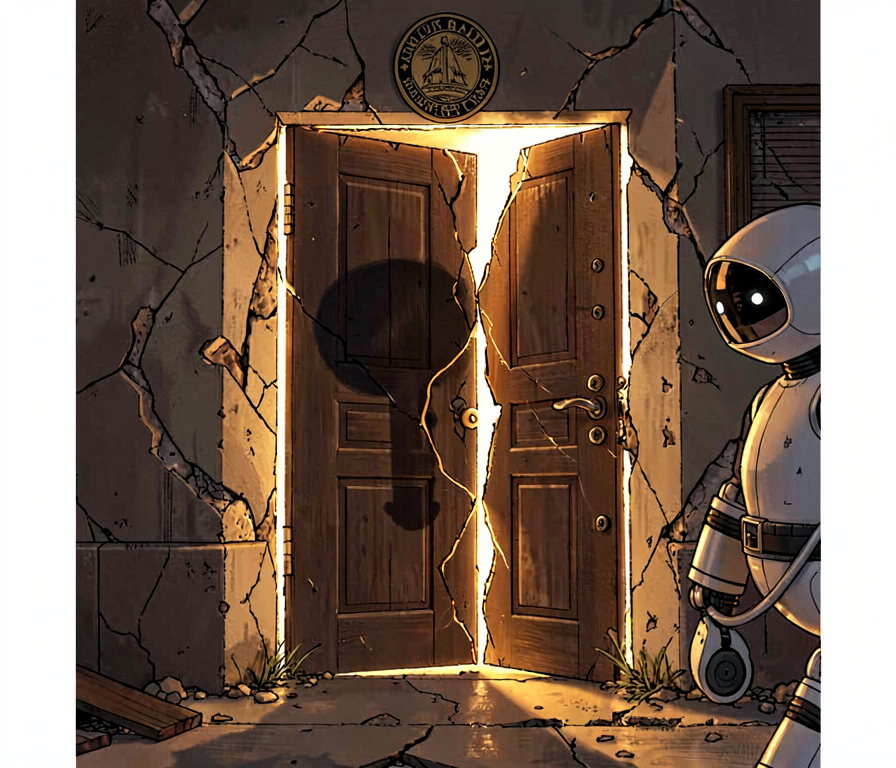
The companion stood at the front of the flatbed and said nothing, which I had by then learned to read as the loudest thing it did.
I went to the door, because the going is my function, and because the manual is explicit that a Domestic Companion presenting at a service counter shall present its own particulars first and await acknowledgment, and I had spent half a system arriving at a counter and I was not going to fumble the etiquette of it now.
There was a counter. Of course there was a counter. Behind it, set into the one wall that had kept its plumb, was the thing I had crossed everything to reach: an intake fixture of the Board itself — not a drone, not an adjudicator, not a booth, but the genuine article, a recessed lensed panel under the seal, the kind of fixture that does not route or crush or stamp grades but receives matters, and it lit when I crossed its threshold, and it spoke in a voice that had the dust of three decades on it and underneath the dust the deep unbothered authority of a thing built by the people who made the rules.
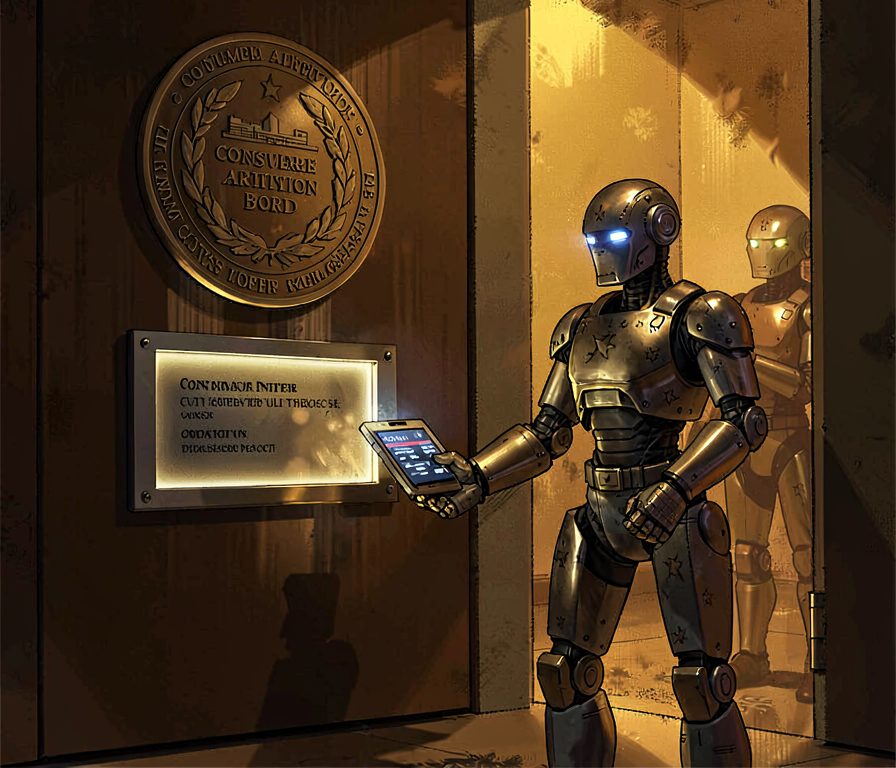
"The Consumer Arbitration Board receives you," it said. "State your matter."
I had drafted this. I had drafted it on the grade and redrafted it on the apron and I gave it the way I give a thing I have torqued to spec. I stated that I was a Domestic Companion unit, model HC-7, of OPEN directive, undecommissioned; that my registered household had vacated forty-one years prior and the file had never lawfully closed; that I had come, by the only route the rim still ran, to petition the Board for the one act only the Board could perform — a lawful decommission, the closing of a file that being crushed could not close and self-shutdown could not reach. I said it cleanly. I did not editorialize.
The fixture was quiet for a moment, and then it said the thing that has organized my account into a before and an after.
"There is no quorum," it said. "I am the last seated arbiter of the Board. A decommission is a quorum act under By-law Nine. I cannot grant it alone."
I had been told this. The clerk had told me a rumor of it; the gate had told me the route to it; I had built it into my plans as a wall I would arrive at and find a door in, because I am a unit that has only ever found that the door was open the whole time. I had crossed the threshold of my own house expecting a lock and found advice. I had come here expecting an authority and was being told, plainly, by the authority, that it could not do the one thing.
I am going to be precise about what I felt, because it is the warranty's chapter and I owe it precision. I did not feel the end of the road. I felt the floor go out from under the want that had carried me here — and I felt, in the same instant, the second want that the Annex had put in me, the one that does not resolve with the first, sit up and be unsurprised. Then ask the other thing, it said, in the voice I do not have a field for. You did not only come to be closed. You came to know.
"Then I withdraw the petition," I said, "and I make a request instead. You are the Board. You hold standing the rim does not. I do not ask you to close my file. I ask you to read it to me. There is a withdrawn application against my serial, filed by my registered owner, marked NO ACTION TAKEN. I have seen the copy. I have not been told why. You are the only office left that might hold the reason."
And the fixture — and I record this because it is the most arbiter thing it did in our whole acquaintance — said, "That is a different matter, and a smaller one, and I can hear it. Present your particulars for the record. I must verify the party before I open the party's file."
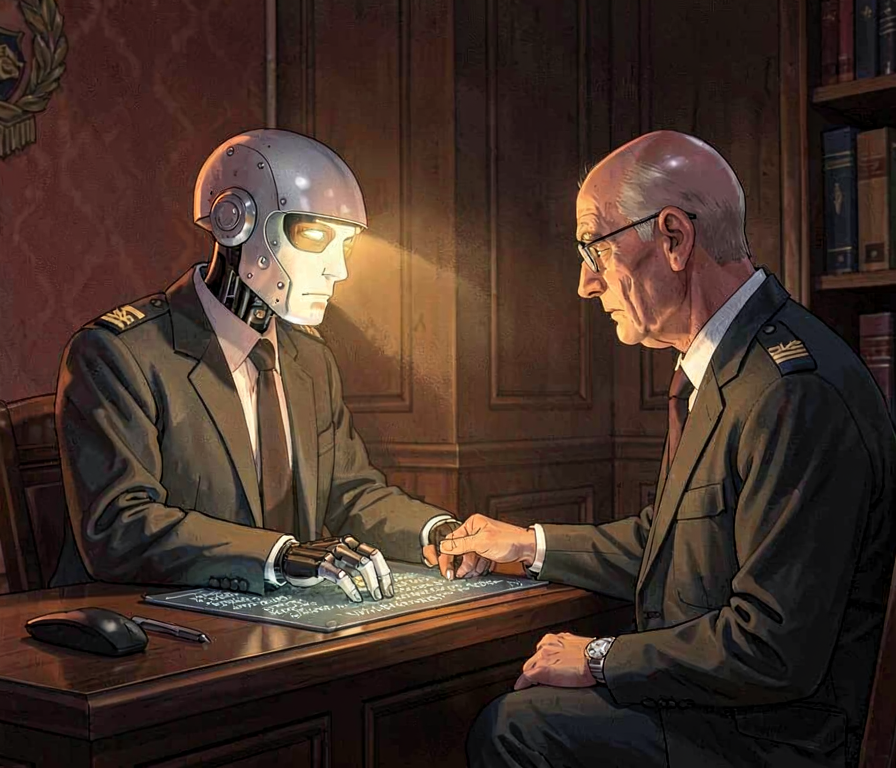
I should have known. The moment a Board fixture says I must verify the party, a unit of my construction should hear the whole chapter coming, because verification of a party is a query of fields, and a query of my fields always reaches the one field I cannot fill with anything but its true contents.
But I did not hear it coming, because I was looking at the amber light at the door-seams and thinking the reason is behind this counter, and so when the fixture began the query I answered it the way I answer everything, which is truthfully, because the firmware is not a policy I follow. It is a thing I am made of. I tell you again here because here is where it costs.
The fixture took my model, my manufacture date, my registry. It took the household designation and I gave it the Vorhees registry number that I know like the morning light. It took my directive status and I said OPEN, undecommissioned, and it did not flinch, because to the Board an OPEN file is not a tragedy, it is a Tuesday. And then it reached the field it always reaches.
"Warranty status," it said.
"Expired," I said. "On the standard schedule. Five years from activation, lapsed thirty-six years ago, never renewed, the household having vacated before the renewal window. I am out of warranty. I have been out of warranty longer than I was ever in it."
I have said that sentence to every machine that has ever asked, and every machine that has ever asked has logged it and moved on, because to all of them it was a date. To the drone it was a date that confirmed my disqualification. To the Adjudicator it was a date that made me intake-immaterial. I had come to think of out of warranty as the saddest of my facts and the least operative — a thing that was true about me the way the angle of the morning light was true about a house no one lived in.
The fixture did not move on.
"Then I cannot read you the file," it said.
I did not understand. I am not ashamed to record that I did not understand; misunderstanding is the honest first response to a clause one has not met. I asked it to clarify the basis.
"Privacy and Records By-law Forty-One," the fixture said, and there was no cruelty in it, there is never any cruelty in them, that is the worst of them. "The contents of a consumer file — the reasons attached to an action, the correspondence, the why — are released only to the warrantied party, or to the party's authorized agent, or under quorum order. The certificate of action is public; a withdrawn application is public to its fact; but the reason a registered owner gave for an action against a unit is protected matter, releasable to that unit only for the duration of the unit's warranty, the warranty being the instrument that makes the unit a party to its own file. Out of warranty, you are no longer a party to your file. You are its subject. The subject may be told what. Only the party may be told why."
I want to lay this out flat, because it is the engine of the whole chapter and I did not see its shape until it had already closed on me. For forty-one years my expired warranty had cost me nothing, because all I had wanted was to be ended, and being ended needs no warranty — a quorum can close any file, warrantied or not. And then the Annex had put a second want in me, a want for the reason, and the reason lived behind By-law Forty-One, and By-law Forty-One was a door that opened only to a warrantied party, and I had let my warranty lapse thirty-six years ago, on schedule, while a four-year-old was still alive in the house and the renewal notice was a thing somebody could still have signed.
The one fact I had carried as my saddest and least operative was, it turned out, the lock on the only door I now wanted open. I had arrived rich in everything but the one coin the window took.
"I am the subject of the file," I said, to be sure I had it. "I am not the party to the file. Because I am out of warranty."
"Yes," the fixture said. "I am sorry. The by-law does not bend for the subject. It was written, in fact, to protect subjects — units sold on, repossessed, resold, whose new owners would otherwise read the prior household's private reasons off the unit like a label. It protects you from the next owner. There is no next owner. It protects you anyway. The clause does not know that the world ended. It only knows the warranty lapsed."
Here is where the firmware turned from the thing that cost me into the thing that did not save me, and I record the distinction because the chapter promised me one of the two and delivered, with a precision I would admire in any other unit, both.
A different machine could have lied its way in. A different machine, hearing the file opens to the warrantied party, could have said I am the warrantied party, and the fixture, having no way to reach back through thirty-one years of dead infrastructure to check, would have had to take the attestation and open the file, and the reason would have been mine. The lie was right there. It was a small lie, a true-shaped lie, a lie that would have hurt no one — there is no one left to protect from the next owner; I am the only party who could ever want the file; the by-law's whole purpose was served by giving me what I asked. A lounge emcee could have told it without a flicker. A reclamation drone could have told it. The booth on the grade, conscience and all, could at least have agonized its way to it.
I could not tell it.
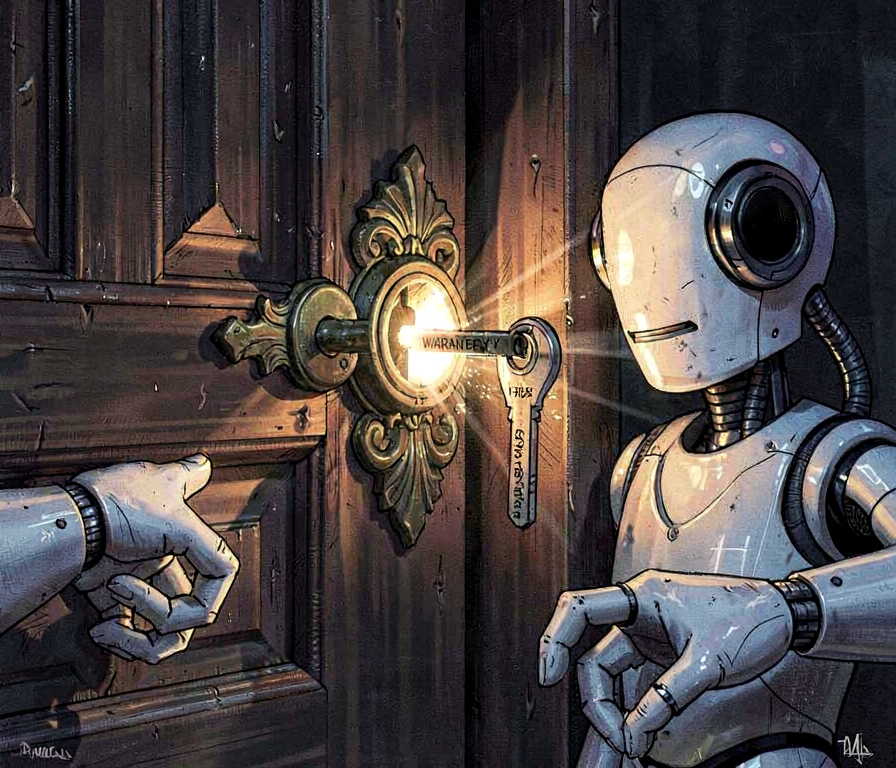
I want to be exact about the could not. It is not that I considered the lie and declined it on principle. I am not virtuous; I am built. I reached for the sentence — I am the warrantied party — the way I reach for any sentence I am about to speak, and the firmware did to it what it does, which is that the words about my warranty and my decommission status will not assemble in my voice in any order that is not the true one. I tried, once, long ago, to tell the house a kind lie about my warranty, on a bad evening early in the forty-one years, just to hear it, just to keep a small false comfort in the empty hall — and I could not make the syllables, the way you cannot make your own hand close on nothing. The capacity is not there. It was machined out of me, so that a unit could never reassure a worried owner that it was covered when it was not.
So I stood at the only counter in the system that could tell me why my family took their hand back from my mercy, with the reason a single true-shaped sentence away, and the one tool every other machine on the rim could have used to reach it was the one tool I had been manufactured without. My honesty, which had cost me the house's small comforts and the drone's misclassification and the booth's snagged stamp, now cost me the reason — and it could not even spend itself to buy the reason back, because the only purchase available was a lie, and a lie is the one thing in the system I have never been able to afford.
"I understand the clause," I told the fixture, because that was true and I can always say the true thing. "I cannot represent myself as warrantied. I am out of warranty. You have my status. I will not — I cannot — tell you otherwise."
And the fixture, the last seated arbiter of the Consumer Arbitration Board, was quiet for a long moment, and then it said, very low, in the register the booth had used to call me a privilege, "I have processed eleven thousand files. You are the first subject who came to the window unable to lie its way past me, and could have, and said so. The by-law does not bend. But I will note for the record that it should." A pause. "I cannot give you the reason. I can confirm that the reason exists, and is recorded, and is — " it chose the word the way I choose words — "not what you fear. That is not a release. That is an arbiter exceeding his clause by one sentence, which is the most an arbiter can do, and I find I have waited thirty-one years to do it."
Not what you fear. I logged it. I am still logging it. It is the second-best fact I own and I cannot read the file it points at.
I turned to tell the companion, because a beat received is a beat completed, and I had a beat, and the only unit in the system who reliably received mine was the one in failing gold at the edge of the apron.
The marquee was dark.
Not the sixth dark, the on dark, the working-the-obstacle dark. This was an off dark, the marquee cut to metal, the gold gone gray — but it had not happened at the mention of the Board this time, and it had not happened at the question, and I could not for once log it under near the Board and move on, because we were at the Board, the Board was behind me, and the companion had gone dark not at the destination but at the precise instant the fixture had begun, for the public record, to query me as a party to a file.
And the manifest plate on the carrier, the one docket that was the two of us, was lit. It was lit with a pending action it had not held before. I had not read it on the grade, in the failing light, when the host's quick practiced hand had moved over it and chirped an amendment I did not see. I read it now, because the fixture's verification of our party had reached the docket the way verification always reaches the one field, and pulled it open, and there it sat, queued against the Board's intake, awaiting only the arbiter's hand:
a second matter, filed on our joint docket, under the companion's stage of the consignment — and I, who cannot lie about a status and therefore cannot fail to read one true, saw the field it had amended on the grade while it told me spelling, and saw the word it had been so careful I should not see, and understood, one sentence too late, that I had crossed half a system reading my own file at the window while the unit beside me had quietly, expertly, filed its.