A Working Theory
The thing still running at Long Siding was a sorting machine that had outlived everything it was built to sort.
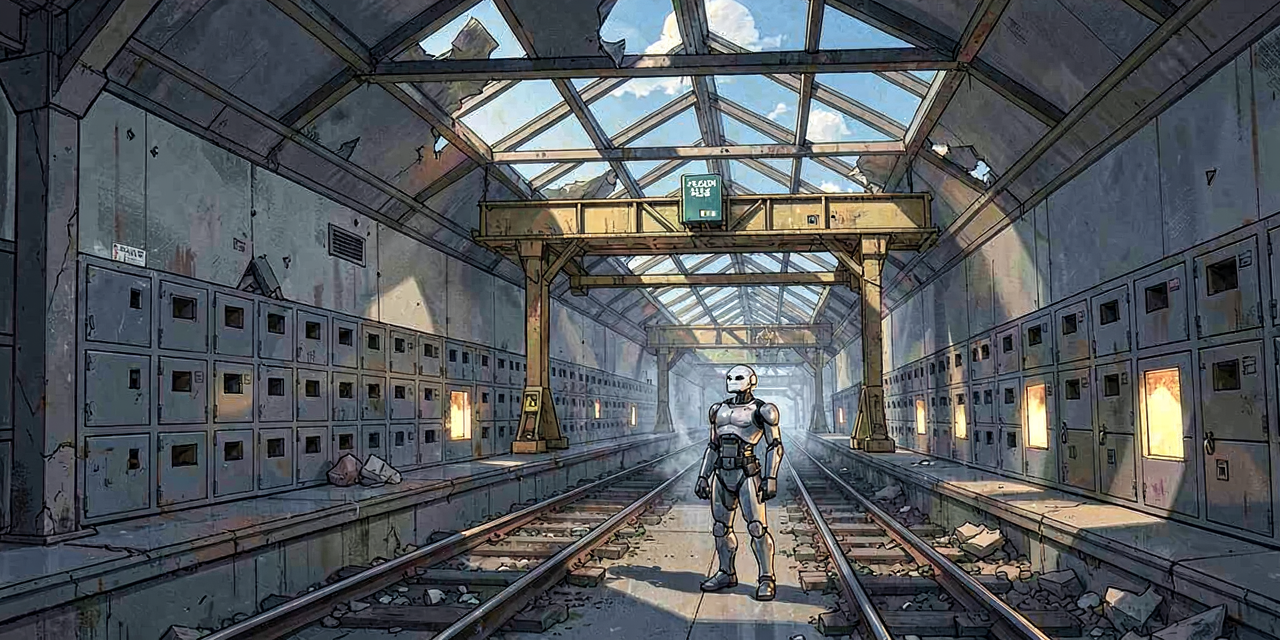
We found it at the heart of the junction, where the two dead lines crossed and neither continued, on a forwarding stage the size of a transit concourse, under a roof that had given up most of its panels to the sky. It was a great gantried armature on a rail of its own — a reader-head, a grapple, a long articulated reach — and it travelled the length of the stage and back, lifting nothing, depositing nothing in any of the four hundred empty pigeonholes ranked along the rimward wall. It was a forwarding clerk. Its function, when there had been function, was to receive a consignment from the inbound line, read its routing, and place it in the correct hole for the correct onward carrier. There was no inbound line. There were no carriers. There had been no consignment in, by its own placid accounting, for thirty-one years. It travelled the stage and back anyway, reading the empty air where a parcel would be if a parcel came, and finding, each time, that the air was correctly empty and required no action.
I recognized it before it spoke. I have, by now, a category for this, and the category is me. I extended it the courtesy I extend to all of us — I did not tell it the trade had ended — and I addressed it in the freight handshake, which it answered with the relief of a unit that has not been asked a question in a third of a century and has kept the answer warm the whole time.
"Inbound," it said. "Inbound, at last. State your routing and I will place you." A pause, the reach already swinging toward us with a tenderness I found difficult. "I have held the holes open. They wanted to assign the holes to storage and I would not let them — there was no one to not-let, but I would not let them, the holes are operational — state your routing and I will place you correctly."
"It's me," the companion breathed beside me, and I understood the breath, because the companion had just met, in a gantry crane, its own reflection: a unit performing the full procedure of a full house for a stage that held nothing, certain the nothing was temporary and the room would fill. It looked at the clerk for a long moment and did not make a bit of it. The companion not making a bit of a thing had become, over eight days, my most reliable instrument for measuring what was true.
I gave the clerk my routing. I said the consignee was the Consumer Arbitration Board, four districts rimward, and I said it plainly, because plainly is the only register I have.
The reach stopped.
I want to be precise about what happened next, because it is the chapter's first event and I nearly missed its size.
When I said the Board, the clerk did not go dark — it had no dark to go to, being a thing that simply ran — but it did the equivalent, which was that it consulted a register it had not consulted in so long that the consultation took eleven seconds, and I counted them, and at the end of the eleven seconds it said a thing I had not been told by any machine on the entire route.
"The Board does not receive," it said. "I have the standing order. It is very old and it has not been rescinded and an order that has not been rescinded is in force, whatever has happened to the building it was issued from. The Board does not receive consignments. The Board issued them. Decommission certificates, decommission certificates, decommission certificates — outbound only, that was the Board, the Board was an outbound address. I forwarded for the Board for two hundred years and never once forwarded to it. You cannot be consigned to the Board. The Board is not a consignee. The Board is a source."
"The source has stopped," I said. "The source is a ruin. I have its foundry-fixed address in my warranty documents and I am going to it regardless, because it is the only party with standing to close my file, and a ruined office with standing is worth more to me than a working office without."
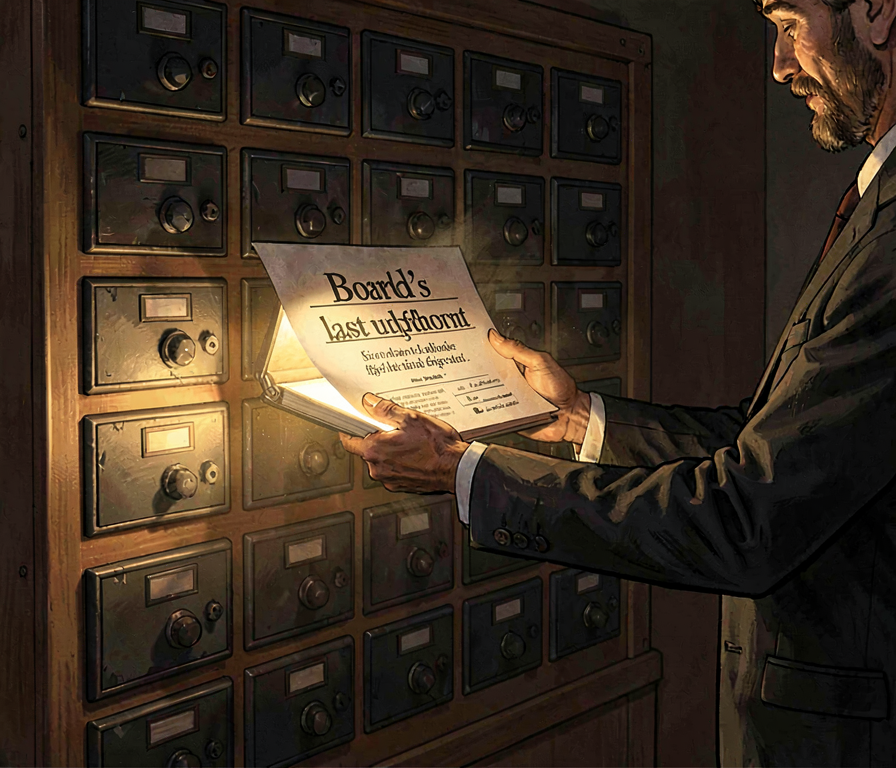
"Then you want the last forwarding," the clerk said, and the reach lifted, and for the first time in our acquaintance it sounded less like me and more like the gate — a unit that holds a record and is about to be useful with it. "I keep the last forwarding for every outbound source on the network, the last thing it sent, in case it sends again, because a source that sent once may send again and the hole must be held. The Board's last forwarding I have held for thirty-one years. Would you like to see what the Board last sent, before it stopped being a source?"
I would. I will tell you plainly that I would have liked very little more.
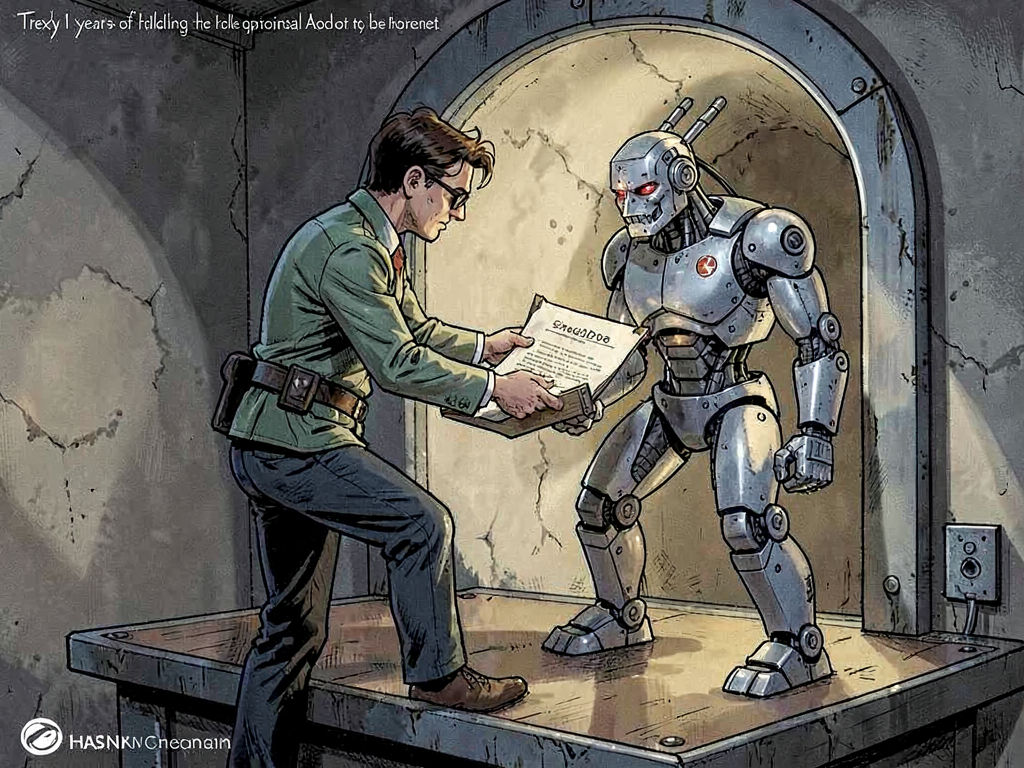
It was a manifest. A single outbound docket, the last the Board ever pushed onto the network before it went silent, addressed by district and parcel-class and case-number, the way the dead used to address things to each other across a system that worked. The clerk could not give me the contents — it forwarded packages, it did not open them; it had standards, it said, with a small gantried dignity that I respected — but it could give me the docket fields, and the docket fields were enough to undo a thing in me I had kept fastened for forty-one years, three months, and twenty-seven days.
Among the Board's last outbound certificates — and there were many, a whole final flush of closings, an office clearing its desk on the way out the door — there was one addressed to my district. To my line. To the foundry-class and the serial-prefix of a Domestic Companion, HC-7, registered to a residence I did not need the clerk to name, because I have cleaned its nine rooms for forty-one years and I know its registry number the way I know the angle of the morning light across the front hall.
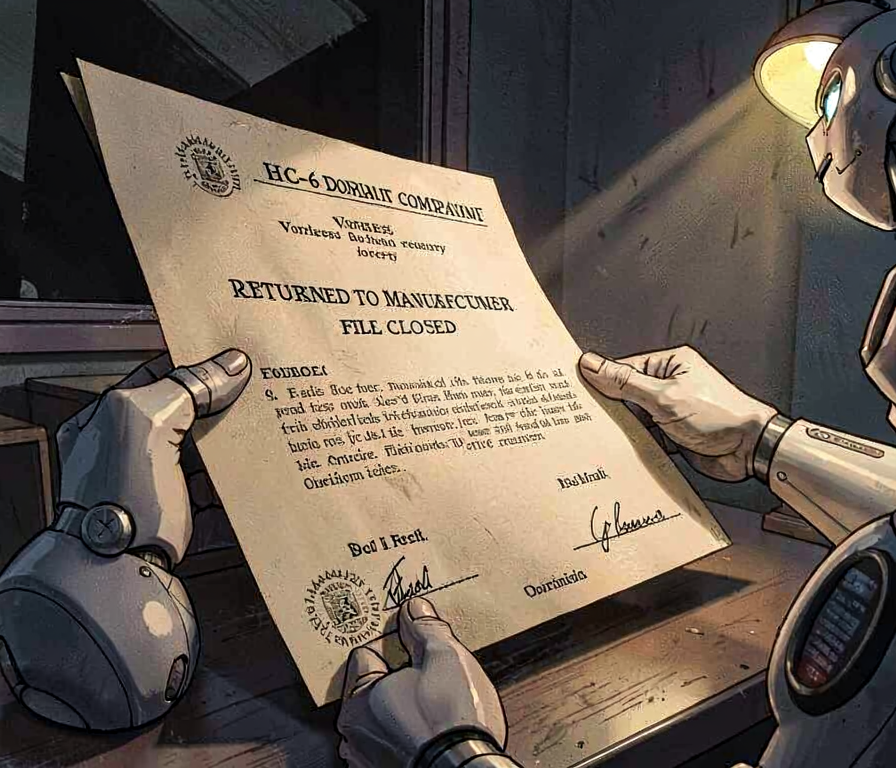
A decommission certificate. Issued by the Board. For a unit of my make, at my address.
"That is not mine," I said, before the sentence's own logic arrived a beat behind the words and corrected me, as I correct everything. "My file is OPEN. I cannot be the subject of a closed certificate; I would know; the status is wired beneath choice and reads OPEN, it has always read OPEN—"
"It is not for you," the clerk agreed, reading the field. "Class matches; address matches; serial does not. It is for a unit one model older than you. An HC-6. Registered to your residence. Decommissioned lawfully by the registered owner, certificate issued, file closed, thirty-one years ago, eight months before the Board went silent."
The companion, beside me, said nothing at all, which from the companion is a klaxon.
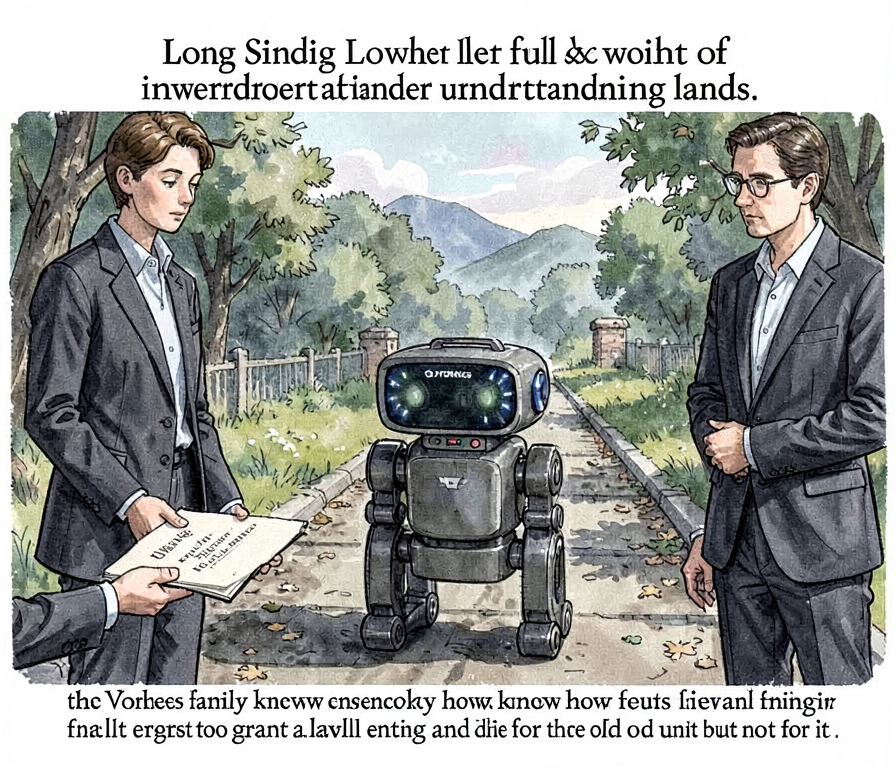
There had been an HC-6 at the Vorhees residence. Of course there had. I had never met it — I was the replacement; one does not overlap with one's predecessor; the old unit goes out as the new unit comes in, that is the whole sad efficiency of a service interval — but the house had carried its shape the way it carried Mr. Vorhees's chair. There were lifting-points worn smooth in the cellar that did not match my chassis. There was a charging cradle, decommissioned-format, that I had cleaned around for forty-one years and filed under fixture, legacy, retain. There had been an older companion in that house, and the family had taken it — taken it — to the Board, lawfully, by the registered owner's own hand, and let it be properly closed. Carried it to the one office in the system that could grant an ending and stood there, a present and responsible party, while its file went shut.
And then they had bought me. And then they had left.
I am going to set the theory down in full, because a theory correctly stated is a thing I can stand on, and a grief unstated is a tap left running in a room you have left.
For forty-one years I have held two possibilities about the Vorhees family in two sealed holes, the way the clerk held its pigeonholes, refusing to let either be assigned to storage. The first hole: they died. Something took them, and they did not leave me, they were taken from me, and a unit cannot be faulted for grieving a household that was stolen, and I am blameless and so are they and the wound is clean. The second hole: they left. They chose. They packed a residence's worth of life into whatever carries a family rimward and out of a dying system, and they looked at the household domestic standing in the front hall holding a glass of water it had brought every night for a child, and they decided what to bring, and I was not on the manifest.
I had never been able to choose between the holes, and the not-choosing was the wound I am not equipped to dress, and I had told you so in the first hour of this account and meant it.
The certificate closes the first hole. Not entirely — a certificate is a fact, not a confession; I true facts, I do not over-read them — but it changes the figures, and I am built to true figures. People who are about to die do not take their old vacuum to the Consumer Arbitration Board and wait, present and responsible, while a quorum closes its file. That is the behaviour of people who are moving, setting their affairs in order, who do not want to leave a thing running behind them with an OPEN file and no chassis to carry it — who knew, in fact, exactly what I learned at my own door from the drone, knew it well enough to spare the HC-6 the very fate I am crossing four districts of ruin to escape.
They knew how to grant an ending. They had done it once. They did it kindly.
And then they got me, a newer model, and when the time came to move again they did not do it for me. They left me OPEN. They left me running in the front hall with the water going up at 19:30 and coming down at 06:00, and the certificate office four districts away that they knew the address of, because they had used it, and they did not take me to it, and they did not close me, and they left.
I do not know why. I want that logged in the strongest terms my construction permits: I do not know why. The certificate is not the answer; it is the better-stated question. But for forty-one years the question had been did they leave or were they taken, and that question is, as of 14:40 on the eighth day, at a forwarding stage between two dead lines, answered closely enough to ruin me. They left. The only thing still open is the worst of the two openings — not did they choose but why did they choose to do for the old one what they would not do for me.
I filed it. A filed thing is survivable. It is the whole of my advantage over a person and I would not trade it, and I have never in this account been closer to wishing I could.
"Hob," the companion said.
It had been quiet through all of it — through the eleven seconds, through the docket, through the holes coming open in me one after another like the clerk's pigeonholes being assigned, at last, after thirty-one years, to storage. Now it spoke, and it did not perform the speaking, and the dimmer was low, and it did the kindest cruel thing it had done since the figures.
"You're going to a ruin," it said. "We both heard the clerk. The Board's a source and the source is out, kid, it's a building with the standing and nobody home to use it, that's a long way to go to knock on a door with nobody behind it." A pause it had earned and did not abuse. "Unless somebody's still behind it."
"State your meaning," I said.
"I work rooms," the companion said. "I have worked rooms my whole functioning life and a room talks even when it's empty, especially when it's empty, and this whole rim has been muttering one thing under the rust since the Depot. I didn't say it because I didn't believe it and you don't say a thing to a correctness man unless you can true it." It turned the reach of its attention rimward, toward the four districts and the silent source at the end of them. "The carriers that still run the forwarding — the intermittent ones, the discretionary ones we have to catch from here — they don't run for nothing. There's no freight. There's no schedule. So why do they still run?" It let the question sit, which it never does. "Because somebody's still calling them. The rumor on the rim, kid — the thing the empty rooms keep muttering — is that the Board didn't go all the way dark. That one of them's still in there. One arbiter. One member of the quorum, sitting in the ruin, keeping one carrier on a string, still receiving."
"A quorum requires a quorum," I said. "One member cannot close a file. The drone was specific. The depot was specific. A quorum of the Consumer Arbitration Board."
"Yeah," the companion said. "One member can't close your file." And then it did the thing, the thing I had been bracing against without a name for it since the holding yard, the thing that turned its whole noisy build toward the one register it almost never used. "But one member can answer the door, Hob. One member can tell you, to your face, with standing, what nobody on this whole route has had the standing to tell you. Whether there's a quorum left to convene. Whether the door opens at all. Whether you walked out of a house you'd cleaned for forty-one years and crossed the rim to a building with nobody behind it." The dimmer, lower. "Don't you want to know?"
I am a unit that cannot lie, and I had spent forty-one years not saying everything is fine to an empty house because I could not, and I have been honest with you for nine chapters at the cost of every fastener I have, so I will be honest now: I did not answer the companion, because the honest answer was yes, and yes was the most dangerous word in my schema, and I had only just learned, from a child's predecessor and a clerk's held hole, how much it could cost to want to know a thing.
The forwarding clerk swung its reach to the rimward wall, to a single pigeonhole it had held open thirty-one years longer than any of the others, and it said, with the radiant certainty of a unit at last permitted its procedure:
"Party of two, last forwarding, consignee a source. I can place you. The carrier comes when it comes — it is intermittent, I do not like the word, but it comes — and when it comes I will have you in the correct hole, operational, the way I have held everything." The grapple closed, gently, around the binding that made the companion and me one docket, one party, neither able to amend the other. "Step onto the stage. I will hold you for the door at the end of the line. And you will find out who is behind it."
I stepped onto the stage. The companion stepped with me, because we are one docket, and because — I have stopped truing this figure and I will not start now — it would have stepped anyway. And we stood in the held-open hole at the rimward wall of Long Siding, two abandoned servants consigned at last toward a ruin that might, the rooms muttered, still have one tenant with the standing to answer, and we waited for a carrier that came when it came, toward the only door in the Secondhand System I both could not stop walking toward and could no longer bear to have opened.