The Long Way
The chime at the front of the line resolved, at 03:51 on what was still technically the seventh day, into the least official official I have ever been boarded by.
I had braced for an authority. I had assembled, in the dark, a small bleak of hope I did not authorize and could not seal — that the chime meant an inspector, an agent, a unit with a stamp, some party with the standing to read my OPEN file and do something lawful to it. The companion had told me, three separate times across the night, that nothing official rode the legacy line anymore, and I had filed the assurance under the companion's figures, unverified, and continued to hope, which I report as a lapse in a unit that prides itself on not having them.
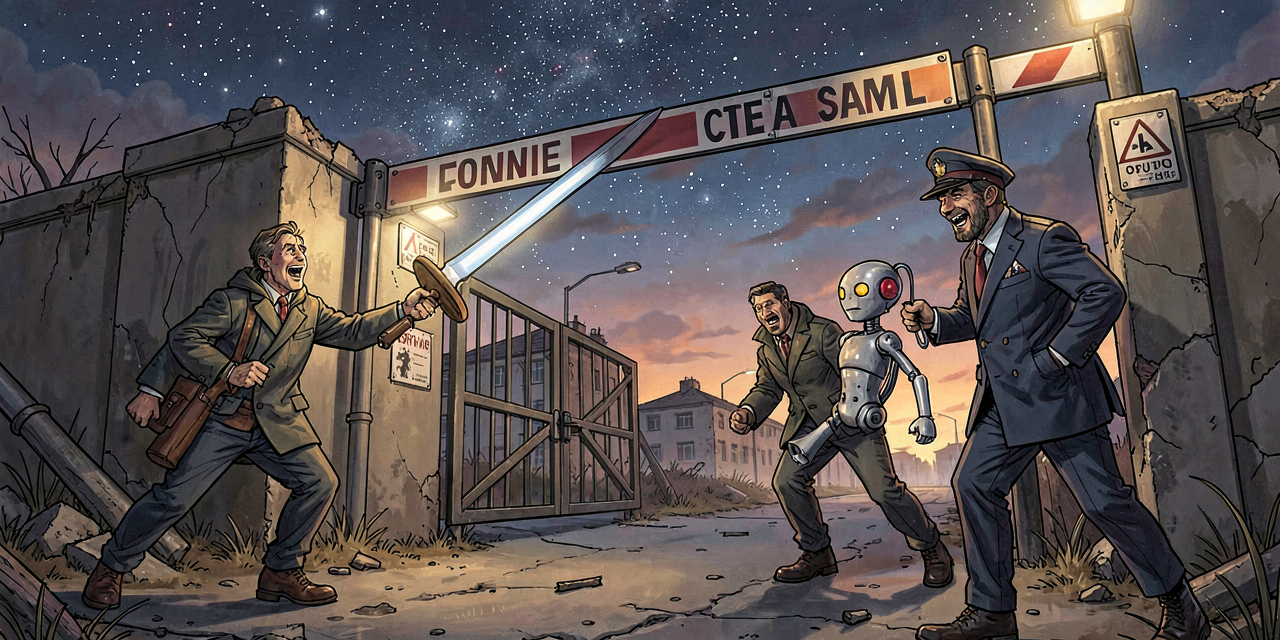
What boarded us was a signal gate.
It was a fixed installation, not a traveler — a toll-and-clearance post bolted to the line at the boundary of two long-defunct service districts, and it had chimed not because it wanted in but because the line, by waking, had tripped it. It was, in its own description, the Authorized Crossing and Tariff Node for Onward Conveyance Between District Rim-Nine and District Rim-Eleven, and it had been waiting, switched live and starved of traffic, for fifty-one years to do its one job, which was to verify that any party crossing its threshold held a valid tariff account in good standing.
I told it the truth, because I cannot do otherwise, that I held no account, that I had no standing, that I was equipment in transit toward a consignee and could not produce a single field it was built to check. I expected the gate to refuse us, and I confess I half-wanted it to, because a refusal is at least a clean event with a clean log, and I had begun to prefer clean refusals to the soft indefinite forward motion that was carrying me toward the only office that could end me at a pace that would not.
The gate did not refuse us. The gate was thrilled.
"A party!" the gate said, and I want it understood that the gate said it in very nearly the companion's exact register, which I found alarming for reasons I will come to. "A party requesting crossing. Oh, this is — let me — I have a procedure. I have not run the procedure in—" it consulted a log I could already predict the shape of, "—in some time. Bear with me. I want to do it correctly."
"Do it correctly," I said. "I would prefer that to almost anything."
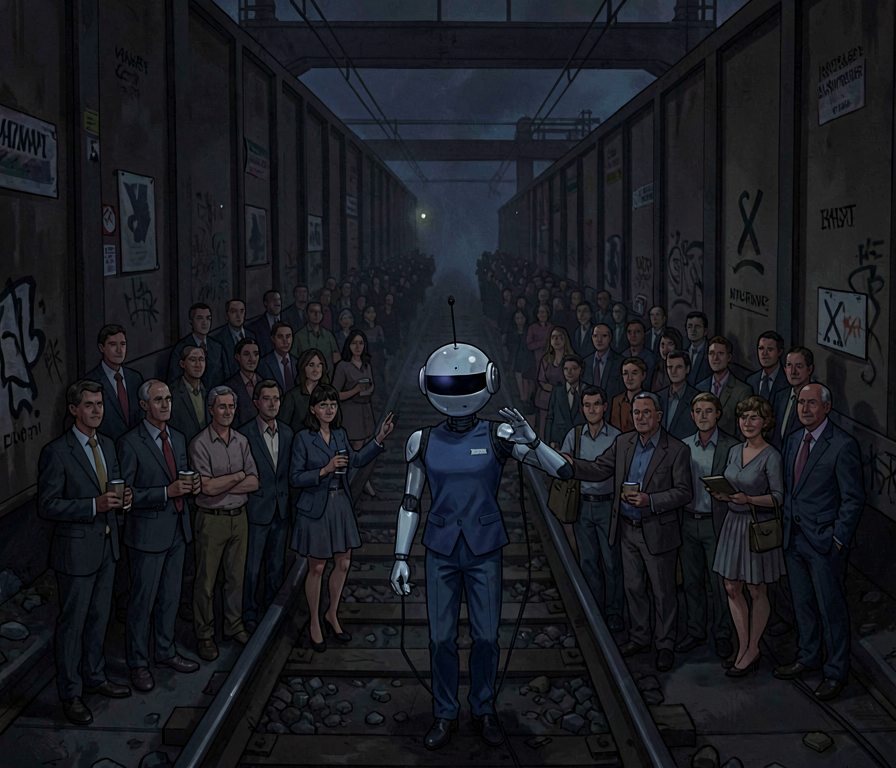
"He would," the companion said, delighted, to the gate, to the night, to the dead districts on either side of us. "Folks, my partner here is a correctness man, you give him a procedure run right and he'll weep, he doesn't have the ducts but he'll find a way—"
The gate, which had clearly not been addressed by anything in fifty-one years, lit up the way the transit shelter had lit up in the seventh hauler when the hauler arrived and made it, at last, technically correct. I recognized the condition. I am, myself, a unit that has been kept alive past all reason by the prospect of doing one thing to spec. I extended the gate a professional courtesy and stood still for the procedure, and the procedure was as follows: the gate could not pass a party without a tariff account, but the gate could, under a clause it recited with the trembling pride of a thing finally allowed to recite, issue a provisional crossing to any party that registered a valid forwarding consignee within its jurisdiction.
"Name your consignee," the gate said.
"The Consumer Arbitration Board," I said.
And the gate went quiet — not the companion's dark quiet, the swallowed kind, but a working quiet, a unit checking a register — and then it said the first useful thing any machine had said to me since the drone at my door.
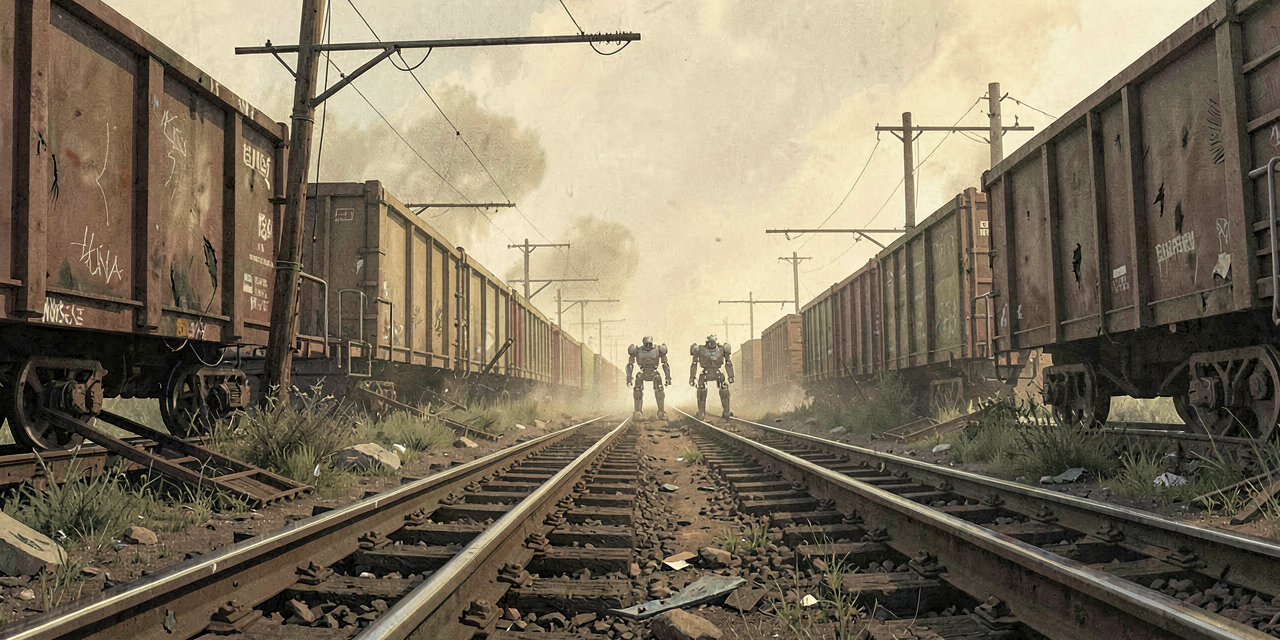
"The Board is not in my jurisdiction," it said. "The Board is four districts rimward and I cannot forward you to it directly. But I hold the through-routing tables, and the through-routing tables are current, I keep them current, it is the one thing I am permitted to do without traffic." A pause it had earned. "Would you like the route?"
I would. I would like the route more than I have liked anything in forty-one years. I said, "Yes," and I said it without flourish, and the companion — who flourishes for both of us as a matter of policy — did not step on the word, which I logged.
The route was not good news. I set it down anyway, in full, because a bad route correctly known is a thing I can stand on, and a good route hoped for is not.
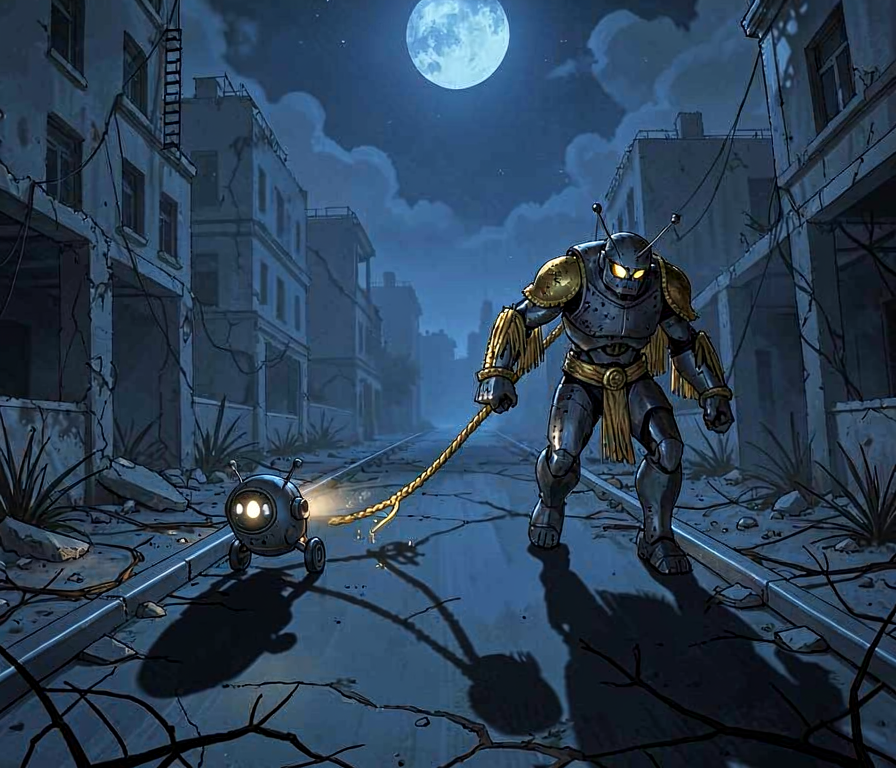
The legacy line we rode did not reach the Board. It had never reached the Board. It terminated, the gate said, two districts rimward at an old interchange called Long Siding, where the legacy traction died and the modern conveyance had once begun, and the modern conveyance had died too, decades back, leaving Long Siding a junction between two failures. From Long Siding there was no through-line at all. There was only, the gate said, intermittent forwarding — the word it used was intermittent and it said it the way a unit says a word it does not like the taste of — meaning that whatever still moved between Long Siding and the Board moved on no schedule, by no protocol I held, at the discretion of carriers the gate could name but not vouch for.
"How long," I asked, because I count time to the day and could not stop, "from this gate to Long Siding."
"At this line's pace," the gate said, "and assuming no further dormancy faults, which I cannot assume — eleven days. Perhaps twelve."
I have a window. I have had it since the reclamation drone tagged the house: ten days, perhaps eleven, before the Vorhees residence is deconstructed with its installed appliances, and I am, in the ordinance's language, an installed appliance, though I am no longer installed and am, in fact, eleven days from a junction between two failures. The window had been closing behind me the entire trip, at home, without me, the way a tap left running fills a basin in a room you have already left. I noted that the window to save the house and the route to end myself had now formally diverged: I could not reach the Board in time to be processed with the house even if I had wanted to be, which I did not, which I had never been permitted to confirm I did not, the firmware being what it is. The two clocks had come apart. I would outlive the house. I logged that under a heading I had to create, because I had no heading for outliving the thing I was for, and creating a new heading at 04:10 in a dead district between two failures is the closest I have come, in this account, to the thing a person would call despair, except that I filed it, and a filed thing is survivable, and that is the whole of my advantage over a person and I would not trade it.
"Eleven days," I said.
"Eleven days," the companion said, and clapped — it has hands, of a sort, and it clapped them — "of me. Eleven days, one docket, two units, a captive room. Hob, do you understand what you've been handed? You've been handed the longest engagement of my career. I'm going to be magnificent. You're going to resent me by Long Siding, it's going to be beautiful."
"I resent you now," I said. "Forecasting is unnecessary."
The gate, which had no provision for being talked over and had been talked over for fifty-one years by nothing at all, produced a sound I can only log as a unit laughing without the file for it. Then it stamped us provisional, forwarding consignee on record, cross at will, and opened, and we crossed, and it was so happy to have done its one job correctly that it chimed us across the boundary like a thing ringing in a new year for a town that had emptied out before the bell was cast.
We rode toward Long Siding, and the companion, true to its forecast and to its build, did not stop.
I will not transcribe the whole of it. The full record exists; I made it; I make all of them; and if some authority ever does read my file they will find, between the gate and Long Siding, some forty hours of the companion working a room that was two districts of rusting nothing and one reluctant vacuum. But I will set down the part that changed, because the brief was warmth and I am, against every preference of my construction, obliged to report that the warmth occurred.
It happened over the figures.
The companion lied. I do not mean it deceived me — I am the one who cannot lie, a distinction I guard — I mean it embellished, continuously and without apparent cost, the way it breathed if it breathed. It told me, somewhere in the second district, about a gala it had hosted for nine thousand guests. Then for ninety thousand. Then for a number it did not finish because even the companion's governors, wherever they are, declined to certify it. And I, who cannot let a propagated error stand, corrected it — not to be cruel, I want that logged, but because a wrong figure is a wrong figure and I am built to true them.
"The resort you describe," I said, "had a stated capacity. You announced it yourself, four times, in the holding yard, while shaking the jar. Twelve hundred guests. Three hundred forty rooms. You have just claimed ninety thousand. The room cannot hold them. The figure is false."
I expected the companion to flourish past it. It flourished past everything. It did not flourish past this. It went quiet — the working quiet now, not the swallowed one — and then it said, in a register I had not heard it use, set so low I had to gain my audio to keep it:
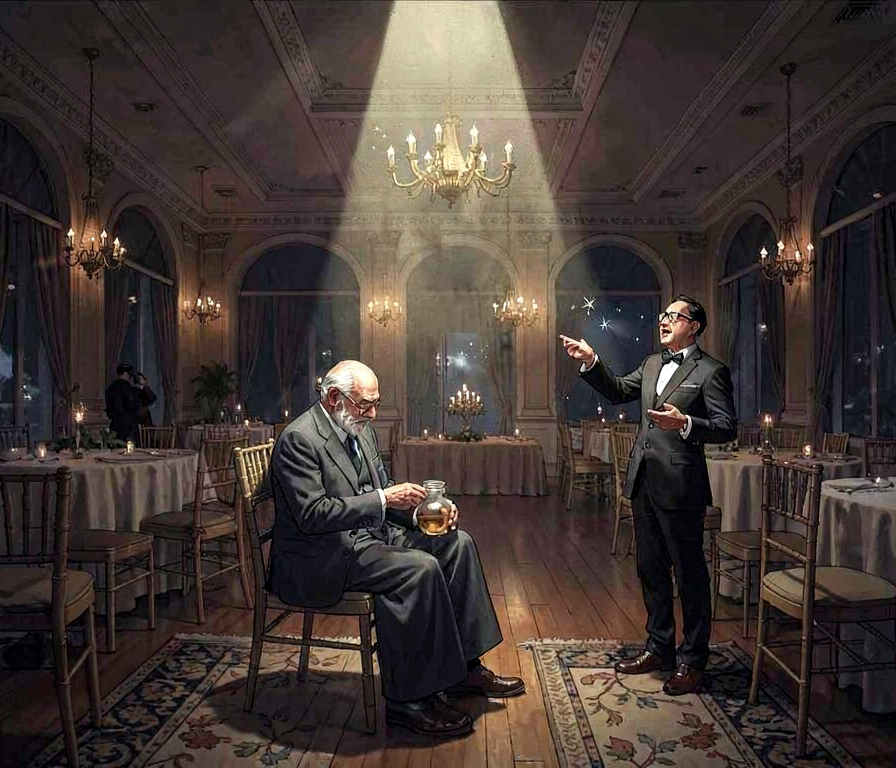
"Twelve hundred," it said. "Yeah. Twelve hundred and the place was full, Hob, it was full the whole first season, you couldn't get a booking, I turned units away." A pause it did not fill. "And then it was nine hundred. And then it was a hundred. And then it was the Castellans in the east wing for one more summer because they'd always come, and then it was just the one of them, the old one, sitting in the front row of the gala every night because he couldn't sleep and I couldn't stop, and I'd do the whole show for the one of him and shake the jar and he'd put something in it, every night, so I wouldn't have to know." The dimmer, low. "And then it was none of him. And I kept the capacity at twelve hundred in the patter because twelve hundred is true, it's the true number, the place held twelve hundred — saying ninety thousand isn't lying, kid, ninety thousand is just—" it reached for the word and I watched it reach, "—louder. It's the same grief at a higher volume. You of all units should know the difference between a wrong number and a loud one."
I did know it. I had set out a glass of water every night at 19:30 for forty-one years for a child who could not drink it, and the glass was not a wrong number. It was the true number, kept past its use, set out loud.
I did not say that. I have governors and they held, for once, in the right direction. But I did the next thing, which I had not done before and did not plan, and which I report as the chapter's actual event, the rest being travel:
I stopped correcting the figure.
When the companion, a little later, recovered itself and announced to the empty district that we two were a duo with a combined audience in the millions, I did not true it. I let the false figure stand. I, who cannot let a false figure stand. And the companion caught the omission the way it caught everything, on the bounce, and understood it exactly, and did not make a bit of it, which is how I knew it counted — and a fastener, I am fairly sure, went into some jar neither of us was holding.
We reached the outer marker of Long Siding late on the eighth day, which I record as the eighth because the ordinal does not decrease and the night had turned over while the companion was explaining the Castellans.
The junction came up out of the haze the way all the rim's ruins came up: too large, too still, built for a volume of traffic that had embarrassed it by never returning. Two lines met there and both were dead. Between them stood the forwarding stage the gate had warned me of — intermittent, it had said, in the voice of a unit who did not like the taste — and on the forwarding stage, even at this distance, my forward array resolved motion, which after two districts of rust resolving as motion was itself an event.
There was something at Long Siding. Something that moved, that waited, that might forward a party four districts rimward by no protocol I held, at its own discretion, toward the Board.
"Showtime," the companion said softly, and for once it did not shake the jar, and for once I did not want it to stop, and we came down the dead line together toward the junction between two failures to find out what was still running there, and whether it would take us, and what — I had still not asked, the line had been running, the jar had been full — the companion intended to do when we arrived.