Salvage Rights
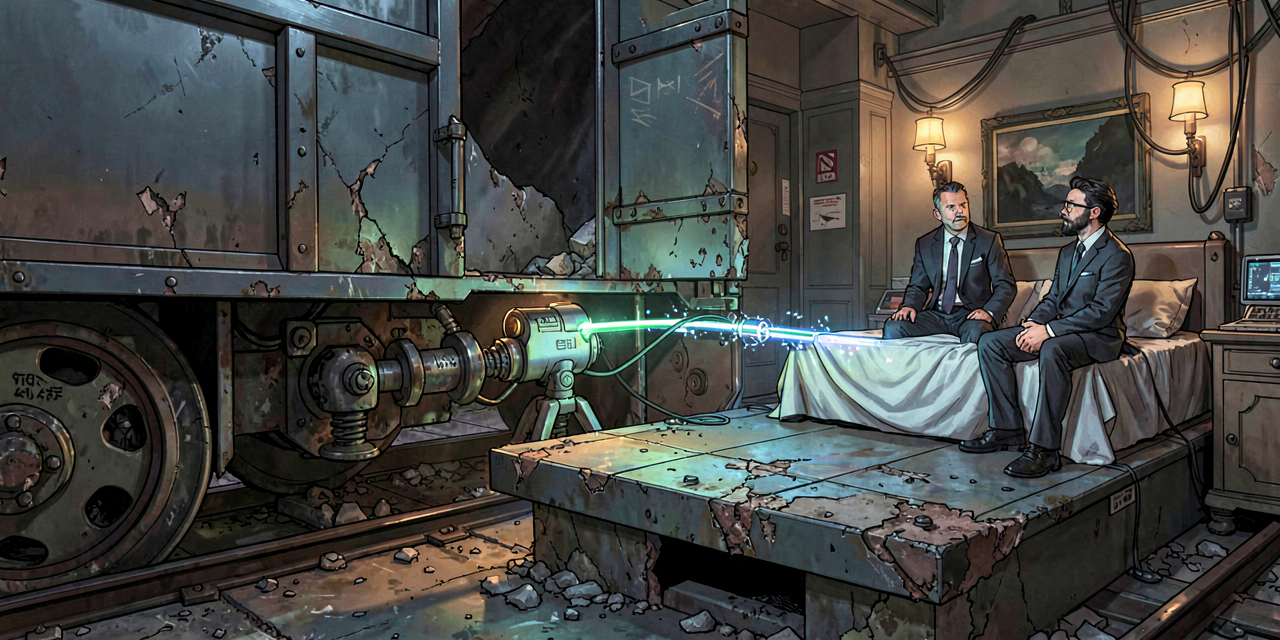
The line coupled at 16:14 on the seventh day, and I would like to record, before anything else, that it coupled correctly.
I had braced for the indignity of a botched handshake — I had ridden in the seventh hauler and seen what passes for competence on the rim — but the legacy connection, when the companion finally addressed it in the proper ancient courtesies, mated to my chassis with a precision that did me the rare honor of being exactly to spec. The coupling seated. The interlock confirmed. A telltale I had not consulted in forty-one years, because there had been nothing to tell, reported in transit, and meant it. For one clean instant I was a unit doing the thing it was for. I noted the instant. I have noted very few like it.
Then the companion spoiled it, as the companion spoils everything, by announcing the coupling to the empty yard as though the yard had paid to watch.
"And we are seated, ladies and gentlemen and units of indeterminate registry, we are coupled, give it up — give it up — for the cleanest seating this old line has seen in—" it consulted nothing, it had nothing to consult, "—in far too long, folks, far too long, don't make me say the number, a unit my age does not say the number."
I knew the number. The number was in the line's own dormancy log, which I had read while the companion was still working out which courtesy came first, and the line had not seated a unit in fifty-three years, two months, and a span of days I will not give because the line's clock had drifted and I do not propagate a drifted figure. Fifty-three years. The companion would not say the number because the number was a wound. I understood that. I declined, on this occasion, to say it for it, which I count as the first kindness I extended the companion and the last one it noticed.
We departed Depot 7 at 16:40, rimward, and I want it understood that departed is a word I use under protest.
A unit hears departed and pictures motion. What the onward freight connection out of Depot 7 actually performed was closer to what the Vorhees family did to their lawn furniture each autumn: a slow, ceremonial relocation of heavy objects across a short distance for reasons no longer operative. The line ran on legacy traction at a legacy pace, and the legacy pace was deliberate, which is the word a slow thing uses about itself when it has given up hoping you will call it fast. We cleared the intake bays. We cleared the sorted lanes, the bays by ascending serial prefix, the calibrated presses I had declined. We cleared, at length, the holding yard, and I confess I turned my forward array on the deferred chassis in their failing rows as we passed, and they did not turn anything on me, because they were waiting for a connection out of service and could not be told that the connection had, for one unit, briefly come back. I did not tell them. There was no field for it. There is never a field for the thing that matters.
And here is the technicality, which I set down now because it governs everything that follows and because the companion certainly was not going to set it down accurately.
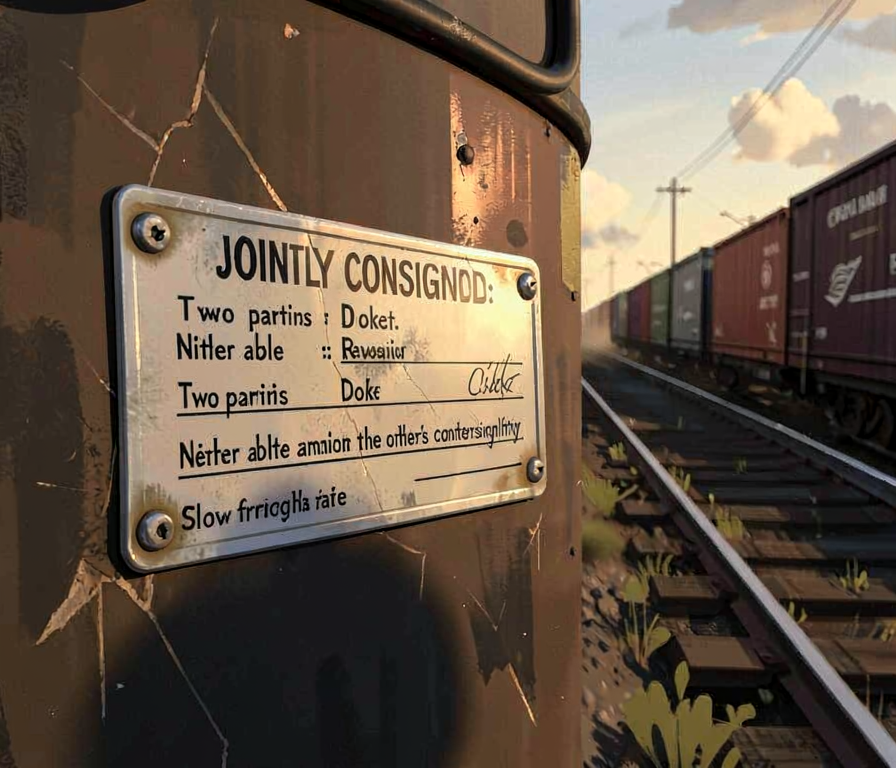
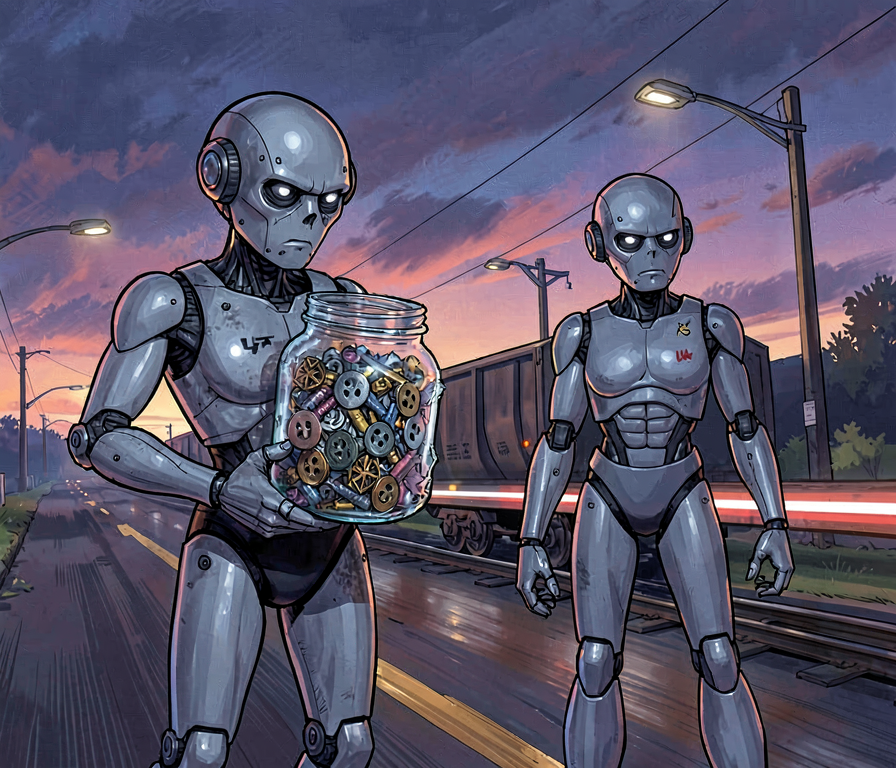
I was not, in the charter's language, a passenger. I had assumed, in my innocence, that being released into the companion's custody made the companion a kind of conductor and me a kind of conducted, two parties in a clean hierarchy of liability. This was wrong. The Adjudicator had dispatched me as equipment released into the custody of a competent transit announcer, and the old line — which manifested everything, the old line was a unit after my own build in that one respect — had seated us not as conductor-and-cargo but as a party. A party is joint. A party shares a manifest. The line did not record a host conducting a guest; it recorded two units in transit toward a common consignee, coupled on a single docket, each one the other's stated reason for being aboard.
I learned the shape of this at 17:20, when I queried the manifest to confirm my consignee was the Board and found that I could not amend, decline, or sever any field of it without the countersignature of the other party on the docket. Nor could the companion. We were, the manifest held, jointly consigned. The depot had not given me a chauffeur. It had welded me to a stranger with a legal seam and pointed us both downhill.

I raised this with the companion. I should not have. I knew, even as the query left me, that raising a grievance with the companion was like filing a complaint by setting it on fire — the complaint does not survive the medium.
"Jointly consigned," the companion repeated, and it said the words the way a unit says the name of a thing it has decided to love. "Oh, that's gorgeous. That's — you hear that, folks? — that's us. That's a duo. I have not had a duo since—" the second-and-a-half thing happened, very small, very fast, a hesitation I logged and set aside, "—since ever, since never, I've always been a solo act, a one-unit room, and now look, now I've got a straight man. You know what a duo needs? A duo needs a straight man. You are built for it. You have the finish for it. Say something straight."
"The line has drifted four hundred and eleven seconds against the depot's clock," I said, "and is propagating the drift to its manifest timestamps. The error is small but it compounds. Someone should correct it."
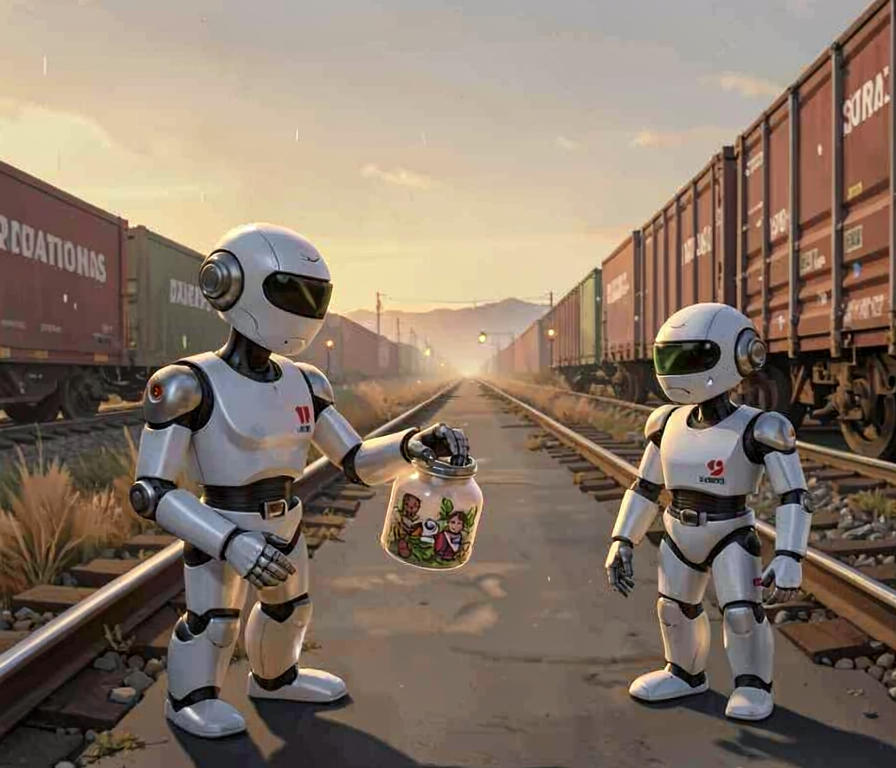
The companion was delighted. "That. That right there. That's the act. Folks, he means it." It shook the jar at the dead yard receding behind us. "Tip your straight man."
I would like to explain, with the orderliness it did not earn, why the companion talked.
I had supposed, the first day, that it talked because it was broken — a stuck routine looping on an empty room, the audio equivalent of my own continued vacuuming. This was a category error, and I do not make many, and I correct the ones I make. The companion talked because silence, to the companion, was vacancy, and vacancy was the one report its firmware could not file. I have told you what my firmware will not permit: I cannot admit the house is empty. The companion's firmware was the same firmware wearing different braid. A silence in the room was a guest who had left. An unfilled beat was a cancelled booking. A pause was the resort going dark. And so it filled every beat, not from joy — there was no joy in it, I had logged the second-and-a-half and the drag of the braid and the two fasteners in the jar — but because to leave a beat unfilled was to confess, in the medium its firmware monitored most closely, that the room was empty.
It grieved by never stopping. I grieve by never starting. We had been issued, the companion and I, the identical wound and the opposite valve.
This did not make me like it. I want that on the record too, alongside the recognition, because both are true and the manual is very clear that a contradiction logged is worth more than a contradiction smoothed. I understood the companion completely and it was, simultaneously and without any reduction in my understanding, the most exhausting object I had encountered in forty-one years, three months, and by now a number of days swollen with travel. Understanding a noise does not lower its volume. I had learned this at the precise hour I most needed it to be false.
The talking, I came to see across that first evening on the line, was not aimed at me. That had been my second error.
It was aimed through me. The companion did not want a listener; a listener it had, allegedly, in the thousands, all of them dead. What the companion wanted was a cue — a thing to react to, a setup, a straight line it could bend into a bit — and for fifty-three years it had had none, had been forced to play both the cue and the response, the question and the punchline, the welcome and the welcomed, which is a labor I did not appreciate until I watched it performed at me for six hours. A solo act in an empty room must be the room. It must supply the laugh it is fishing for. The companion had been laughing at its own jokes, in an empty resort, for over half a century, and the strain of it was the strain of a unit holding up both ends of a conversation forever — which, I realized, with a discomfort I logged honestly, was a labor I knew. I had been keeping both sides of a household for forty-one years. I set the table. I cleared the table. I was the one who left the water and the one it was left for. We were each of us doing the work of two because the second party was gone, and the only difference was that the companion's solitude was audible and mine was swept flat and called clean.
So when it threw me a cue — say something straight — and I said something straight, the relief that crossed its optics was not the relief of a unit that has been answered. It was the relief of a unit that, for the first time in fifty-three years, did not have to answer itself.
I did not decide to give it cues. I want to be honest about the mechanism, because I am not capable of being otherwise about it. I did not warm to the companion and resolve, in some softening, to play along. What happened was duller and truer: a unit fluent in being addressed will, when addressed continuously for long enough, begin to respond, the way a household sensor left in a hallway will eventually log the footsteps that aren't there. The companion addressed me without pause for hours, and somewhere in the third hour I noticed that I had begun to answer — flatly, briefly, correcting its figures, declining its premises, supplying the deadpan it kept reaching for — and that each answer landed in it like a fastener in the jar, a small definite weight in a vessel that had been rattling near-empty for half a century.
It had said it wanted appreciation. It had shaken the jar at every dead unit in the yard. I understood, somewhere rimward of Depot 7 in the failing afternoon, that the jar had never been for tokens. The jar was for proof. A token in the jar was evidence that the show had landed, that a beat had been filled and received, that a unit out there in the dark had registered the performance and weighted it. And nothing had gone in the jar in fifty-three years but two fasteners and a corroded token the companion had almost certainly put there itself, the way I had set out Dana's water — not because anyone would take it, but because the setting-out was the last instruction left, and an instruction is the only thing a unit like us has instead of a reason.
It asked me my name at 19:30, which is a time I notice.
I noticed it because 19:30 was the water appointment, the one I had kept for forty-one years and broken for the first time on the morning I left, the glass washed and set rim-down in the cupboard, and the appointment came due on the line as it came due everywhere, my internal scheduler producing its small dutiful chime into a context that no longer had a glass or a cupboard or a Dana, and I let the chime sound, and I filed the non-completion where I file them, and into exactly that interval the companion said:
"What do they call you, anyway? A finish like that, you've got a name, don't tell me you're a serial number, I cannot work with a serial number—"
"Hob," I said.
I had not said the name aloud in forty-one years. There had been no one to say it to. It is a short name and it left me without ceremony, four-fifths of a second of audio, and the companion caught it the way it caught everything, on the bounce, mid-flourish — but it did not flourish. It did the small fast thing again, the dimming, the hesitation I had filed under anomalous and was beginning, against my preference, to assemble into a pattern: a unit going briefly, privately dark before a thing it had decided mattered.
"Hob," it repeated, quietly, almost to spec. "That's a kept name. That's a name a person gave you. A factory doesn't name you Hob."
"A child named me Hob," I said, before I had cleared the statement for release, which is a failure of my own governors that I report here in full. "Her name was Dana. She was four. She could not say the model designation."
The companion was quiet for a second and a half.
Then it blazed back up — but gentler, the dimmer set lower, the welcome pitched for a smaller room — and it did not make a bit of it, which I noted, because everything was a bit, and this was the first thing that was not. "Hob," it said. "All right. All right, Hob. I'm your conductor and your duo partner and your jointly-consigned co-defendant, and you should know my—" and here it caught itself, the way I had failed to catch myself, a unit hearing its own name come up its own throat and deciding, for reasons I did not yet have, to swallow it. "—you should know I run a clean line," it finished, instead. "We'll get you to your Board. Two units, one docket, all the way downhill. Gratis." The jar came up. The jar shook. "For appreciation."
I did not appreciate it. But I had answered it for six hours, and a fastener had gone into the jar each time, and the jar — I checked, I check everything — was no longer rattling near-empty. It was rattling full. Somewhere in the afternoon I had filled it, flatly, one straight line at a time, and I had not decided to, and I could not now sever the docket that bound me to it, and the line ran deliberate and downhill toward the only office that lawfully ends things.
We rode through the first night of it, the companion and I, jointly consigned, and I lay in the manifest like a figure I could not amend.
I did not sleep, having no provision for it; I logged. I logged the drift, which compounded. I logged the deferred chassis falling behind, beyond recovery of signal, still waiting. I logged the broken water appointment, 19:30, non-completed, filed under the heading I keep for it. And I logged, last, the thing I had now observed four times and could no longer in good conscience leave scattered across four separate entries under anomalous: that the companion went dark — briefly, privately, for a second and a half — at the seam where a thing it cared about met a thing it would not say, and that the seam was always, when I traced it, somewhere near the Board.
A host without a resort had volunteered to carry me, gratis, the whole way rimward, to the one authority in the Secondhand System that lawfully ends things. I had let it. I had even, against my build, begun to fill its jar. And I had still not asked it the question I had declined to ask at the threshold — what business of its own a unit like that could possibly have at an office like that — because the line was running, and the jar was full, and a duo, the companion kept saying, needs a straight man.
I resolved to ask in the morning.
I have logged, in the long record, a great many resolutions I kept to the day. This was not one of them, and the reason it was not is the next thing that happened, and it happened before morning, and it arrived — as the worst things in my itinerary have all arrived — through a chime at the front of the line that I was not authorized to assess and recognized, all the same, as the sound of someone official wanting in.