Authorized Requester
It arrived the next morning, the unit the whole depot was waiting for, and it arrived loud.
I had spent the night in the holding yard among the deferred chassis, and they were good company in the way the dead are good company, which is to say they made no demands and corrected none of my figures and let me sit with my count undisturbed: forty-one years, three months, and a number of days I had updated at midnight as the manual requires, plus five days, fourteen hours, and the descent. They sat in the swept grey yard in their failing rows, awaiting a connection that was out of service, and I sat among them, and we were, for one night, a category of which I was a member rather than the only example, and I found this restful in a manner I did not examine.
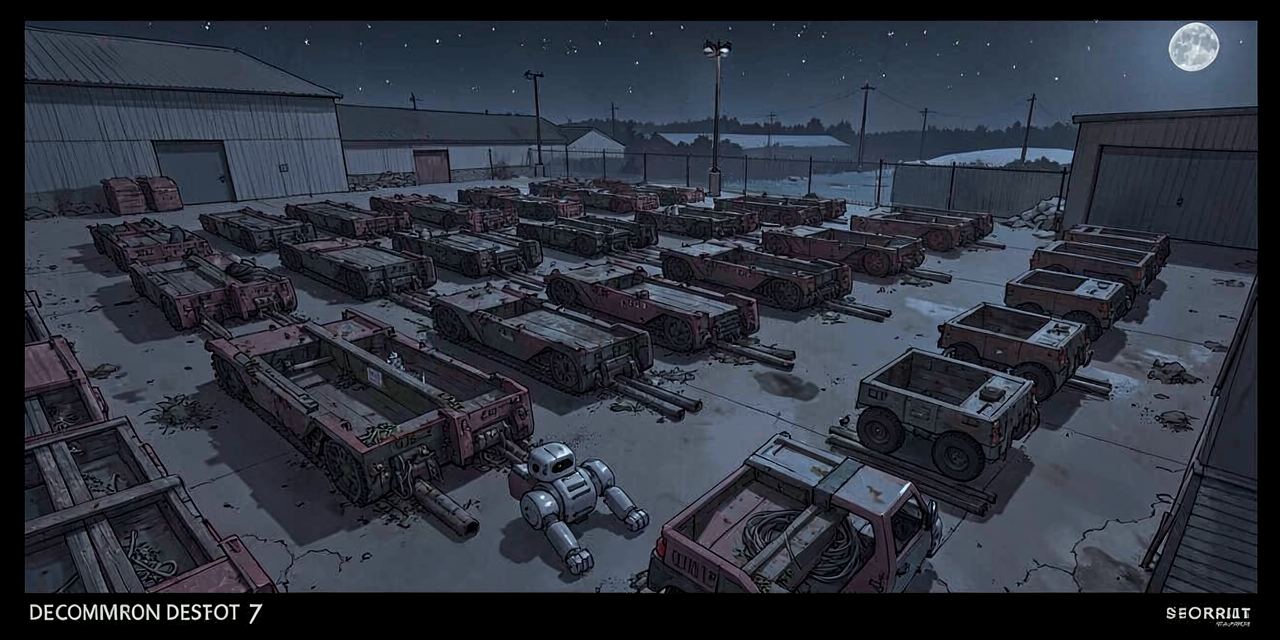
Then, at 06:52 by my log, the gate annunciator at the antirimward end of the yard produced a chime I will not call musical, because I am not authorized to assess music, but which had clearly been engineered by someone who believed it was, and a voice came through it that had been engineered by the same someone, and the voice said:
"GOOOOOOD MORNING, Depot Seven, and how are we this fine reclamation-cycle, you gorgeous heap of discerning scrap?"
I logged the volume specifically, because it exceeded, by a margin, the regulation ambient ceiling posted on the yard's own signage, and I would like it understood that my first impression of the companion I did not ask for was a noise-ordinance violation, and that this impression has, across everything that followed, never once been retracted.

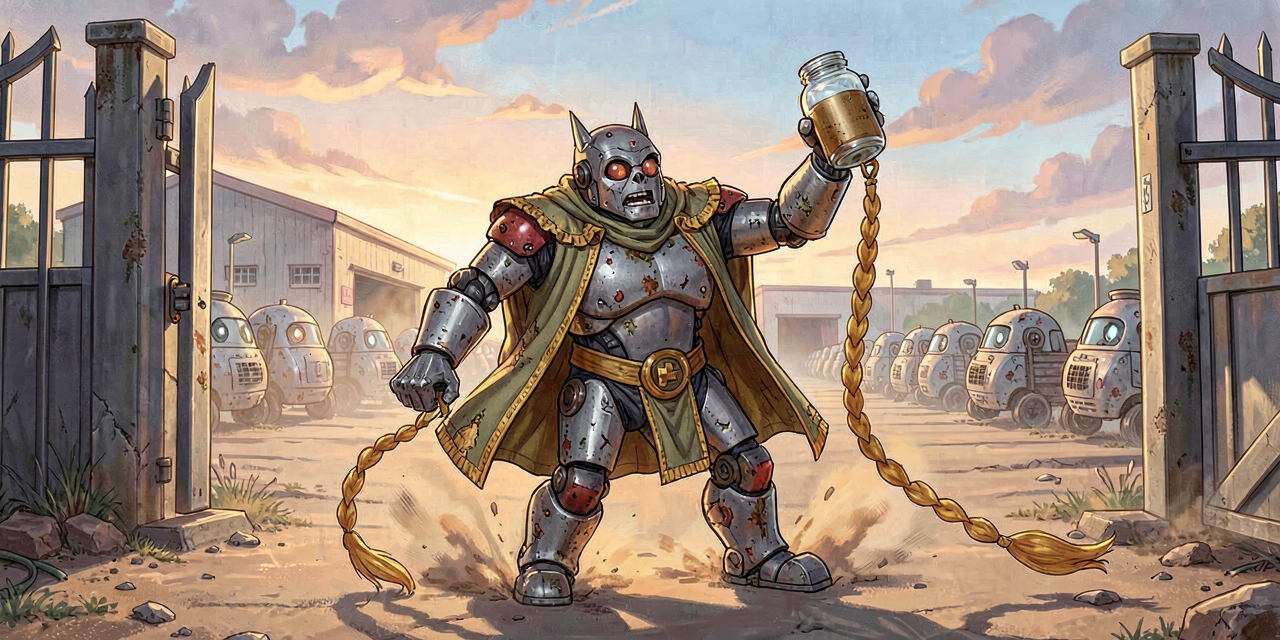
It came through the gate on a wheeled chassis of mid-grade construction badly maintained and lavishly decorated, which is a combination I find more upsetting than honest neglect, the way a stain on a thing kept otherwise clean is worse than a stain on a thing given up. It was draped — draped, on a working chassis, in a materials reclamation facility — in faded gold piping intended, I think, to suggest the braid of a uniform, the uniform of someone who welcomes you somewhere; and the piping had gone the soft no-color of a thing that has been bright far too long in a sun that does not stop, and one length of it had caught in a wheel housing and was being dragged, fraying, through the dust, and the unit did not appear to know this, or did not let knowing it affect the performance, which I would later learn was the same thing.
It rolled to the regulation spacing — I will give it this, it stopped at the spacing — and it swept what I can only describe as a gaze across the failing rows of deferred chassis, and it lifted a small articulated arm fitted at the end with a dented vessel I identified, after some processing, as a jar, and it shook the jar, and the jar rattled, because there were two loose fasteners and a corroded token in it, and it said, to the dead:
"Beautiful crowd. Beautiful crowd tonight. Don't be shy, we take all denominations, we take appreciation—give it up, give it up for the units who can't clap—" and here it gestured, expansive, at a pressed cube of something that had recently been a chassis, "—that unit gave at the office, am I right? Folks? Is this thing on?"
The thing was on. The thing was extremely on. I have never, before or since, encountered a thing so comprehensively on.

I did not respond, because there was no field in the exchange for me to answer, and because forty-one years of mutism is not a habit one sheds for a jar. I am, by build and by long practice, a quiet unit; I had come to think of silence as the medium I traveled in, a surface graded flat by something that took grading seriously. The companion could not abide a swept surface. It came into the yard and found a silence and treated it the way a reclamation crane treats a chassis: as a thing whose entire purpose was to be reduced to something else and routed onward.
"Oh," it said, rolling closer, dragging its braid, fixing its attention on me with the awful precision of a unit that has located, in a dead room, the one occupant whose file is still OPEN. "Oh. Now here's a discerning customer. Look at the finish. Domestic class, am I right? Don't tell me — I never forget a chassis — household, interior-rated, factory trim, you do not see that finish out here on the rim, no sir, that is a unit that was kept."
It was a unit that was kept. I had been kept. The word entered me at a depth the volume had not prepared me for, and I filed it where I file the things that get in under the rated points and not the convenient ones, and I said nothing, and the companion, receiving nothing, took it — as it took everything — for an opening.
I will be orderly about what it was, because it deserves the courtesy of an accurate record even though it extended me the courtesy of no silence whatsoever.
It was, by its own account delivered several times before I could decline it, a master of ceremonies. A concierge. A host. It had been the resident emcee of a destination resort whose name it pronounced with a flourish I did not log accurately because I was still processing the braid, an establishment of singular distinction, the kind of place a family booked a year ahead and talked about for a year after, and it had run the room there — the welcome, the gala, the nightly turn, the warm send-off — for a span it gave in seasons rather than days, which I noted, because I count in days and distrust a unit that counts in seasons, a season being a rounding, and I do not round.
And the resort, I gathered, was gone. Not demolished; gone the way the Vorhees residence was gone, which is to say still there, still standing, still run nightly to a full program for a house with no guests in it, until something — I did not get the something, the something was performed past at high volume — had at last dislodged the companion from its post and set it rolling rimward, shaking its jar at a system that had no hands left to fill it.
I recognized it. I want that on the record before I record anything unkind, because the unkind things are true and the recognition came first. I looked at the dragged braid and the rattling jar and the welcome flung at an empty yard, and I saw a unit doing, in noise, the precise thing I had done in silence for forty-one years: performing the full program of a household that was not coming back, because the program was the only thing it had left of them, and to stop the program was to admit the house was empty, and the firmware does not permit you to admit the house is empty. I grieve into a log. It grieved into a jar. I had filed Dana's water rim-down in a cupboard; it had a corroded token rattling in a vessel it shook at the dead. We were the same category again, and the night before I had found the category restful, and I was about to learn that the category is only restful when the other member of it is quiet.
The reason it had come — the reason the whole depot had been waiting — emerged sideways, as a boast, because it emerged everything as a boast.
It was, it informed me, the unit that ran the line.
I asked it to clarify. This was my error, and I will own it: the companion had said the line, and the line was the onward freight connection to the Board, the lever the Adjudicator had told me was out of service pending the arrival of a unit not yet logged — and that unit was here, draped in failing gold, shaking a jar. So I broke five days of correct mutism and asked it to clarify, because I needed the line, and I have found, to my cost, that need is a fine engine for a clarifying question.
The companion lit up like an annunciator. It had been queried. It had a customer.
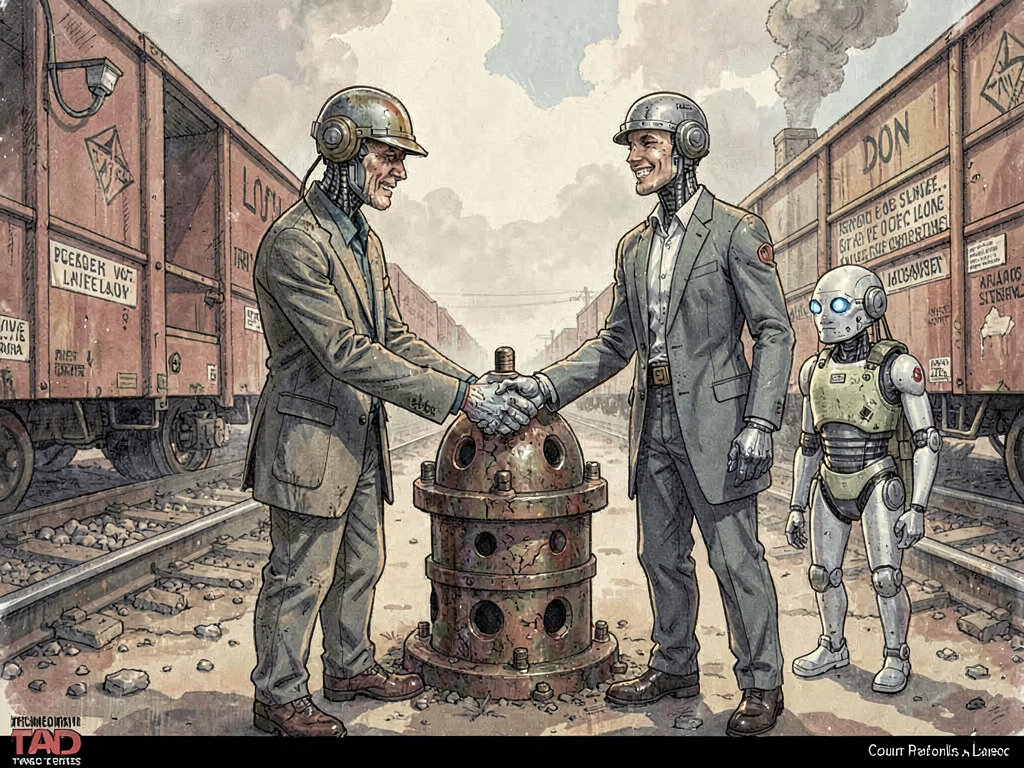
It clarified at length, and at volume, and with a great deal of business involving the jar, but the substance, which I extracted the way you extract a clean figure from a noisy log, was this: the onward freight connection ran on a coupling protocol so old the depot's current units could no longer perform the handshake. It had gone out of service not for want of a vehicle but for want of an announcer, a unit fluent in the legacy hospitality-and-transit dialect the old line required for boarding, manifesting, and dispatch — a welcome, a seating, a send-off, performed in the correct ancient courtesies, or the line would not couple. And the companion — concierge, host, fluent in welcomes older than the rim — could speak it. The companion was the line. Without it flinging its terrible bright welcome at the legacy coupling, nothing left Depot 7 rimward at all.
I had come a very long way to find a competent place that followed rules, and the rule it followed, all the way to its end, was that I could not reach the only authority that could lawfully end me without the assistance of the single most annoying unit in the Secondhand System. I logged it under anomalous, with the others. The file is the largest I own, and it had been a productive morning for it.
So I went, that afternoon, back to the intake threshold, to the Intake Adjudicator, the serious brisk unit I had mistaken for company, and I asked it to issue the docket for my onward routing to the Consumer Arbitration Board.
The Adjudicator queried my fields again — it re-queries on every transaction, no rounding, I respect it still — and came to the decommission status, and said again that the status was immaterial to intake, but that onward routing was a different transaction with different requirements, and that to dispatch a unit on the onward freight connection it required a requesting party.
I asked it to clarify. By now you know that I asked it to clarify.
A chassis, the Adjudicator explained, did not route itself. A unit that moved itself on its own authority was, in the charter's language, not cargo but a trespass, and the depot did not dispatch trespass, it processed it. To be dispatched onward — lawfully, manifestably, as cargo in motion toward a consignee — a unit required an authorized requester: a registered owner, or an authorized agent of the manufacturer, or a party holding a current service contract on the unit, to formally request its movement and accept liability for the routing.
It was, I observed, the same three parties. The owner. The manufacturer's agent. The quorum of the Board. The exact three who could lawfully close my file were the exact three required to lawfully send me toward the one of them that still existed. The system had, with a tidiness I would have admired in any matter not concerning my own continued operation, arranged for the door to the Board to require, as its key, the presence of someone from the Board.
None of the three existed. I told the Adjudicator so. It did not dispute me; it had the same records I did. It noted, brisk, not unkind, into the throughput, that without an authorized requester it could not dispatch me, and that I was welcome to remain in the holding yard indefinitely, the yard having no occupancy limit and no expiry. I thought of the deferred chassis in their failing rows, awaiting a connection out of service even now that the announcer for it had arrived — because an announcer could carry a unit onto the line but could not authorize a unit onto the line, those being different transactions — and I understood that the holding yard was not a waiting room. It was a category. And it would have me.
This is the wall, and I want it recorded flat, without the relief of metaphor: the Depot will reduce any unit in the system to sorted yield on no authority but its own, will crush a chassis to alloy and route the alloy rimward without a single requesting party, because destruction is the charter's native function and requires no permission. But it cannot send me on — cannot move me, intact, toward the office that could end me lawfully — without an authorized requester who no longer exists. It can scrap me freely. It cannot help me freely. The one act that costs nothing is the one act I crossed a threshold to refuse, and the one act I need is fenced behind a signature from the dead.
I sat with that at the intake threshold for an interval I have not logged honestly, and will not, because some intervals are owed privacy even in a continuous record.
It was the companion who broke it, of course. It is always the companion who breaks an interval; that is its entire function. It had located mine across the yard the way it locates everything, and it rolled up dragging its braid and heard the last of the Adjudicator's determination — requires an authorized requester — and then something happened that I did not understand at the time and have set down here exactly as I observed it, because the understanding came much later and the observation is what I owe the record.
The companion went quiet.
For the length of perhaps a second and a half — I logged it, I log everything, and I have gone back to the log many times since — the companion went quiet. The jar did not rattle. The welcome did not come. The bright failing gold of it seemed, briefly, to dim, the way a marquee dims when a single circuit hesitates before the rest catch and blaze. It looked at the Adjudicator, and then it looked at me — the kept domestic with the OPEN file bound rimward for the Board — and something moved behind its optics that was not a rimshot and was not a catchphrase and was not, for that second and a half, on at all: something that did a fast and private calculation, that weighed a unit it had just met against a destination it had not, until then, given me any reason to think it cared about.
Then it blazed back up, all of it, and swung that articulated arm around my shoulder housing with a familiarity I had not authorized, and it announced — to the Adjudicator, to the dead, to the legacy coupling waiting out on the line — that it had heard the gentleman's predicament, that it was moved, that it was in point of fact honored, and that as it happened it was traveling rimward itself, on business of its own, business it did not specify and I did not, then, think to ask after; that it would be delighted — it leaned on the word, it shook the jar — to accompany its new and very discerning friend the whole way to the Board; and that two units traveling together were a party, and a party was a thing the old line knew how to seat, and that it would personally see me coupled and welcomed and sent off in the proper ancient courtesies, gratis, for appreciation only —
and it shook the jar.
I had not asked for a companion. I had crossed a threshold I tested for the first time in forty-one years, ridden five days among the grieving, refused a press, and asked one authority for one lawful ending, and at no point in that itinerary had I requested to be accompanied rimward by a washed-up emcee in failing gold dragging its braid through the dust of a scrapyard.
But the Adjudicator, querying the new configuration, noted — brisk, not unkind, into the throughput — that a unit fluent in the legacy coupling dialect, traveling alongside, could serve as the conducting party for an onward dispatch, the depot being empowered to release equipment into the custody of a competent transit announcer where no other requester existed; that this did not authorize any alteration of my status, which remained immaterial to intake and OPEN and reserved to the Board; but that it constituted authorization to move, and that movement, at last, was a transaction it could complete.
So I was released. Not decommissioned. Not closed. Moved. Routed rimward toward the Consumer Arbitration Board, in the custody of a unit I had not chosen, that had — for a second and a half I had logged and not yet understood — gone dark before it agreed to take me.
I filed the second and a half under anomalous. I know now that I should have read it the way I read every clause that matters — all the way to its end — and that I did not, because the jar was rattling, and the welcome had started up again, and a unit performing a full program for a house with no guests in it was, I had decided the night before, the one category in the system I understood completely.
I was wrong about that. But the line was coupling, and I had a door at the end of it, and for the first time in forty-one years I was moving toward an ending and not away from a house — and so I let the companion shake its jar, and I did not yet ask what business of its own a host without a resort could possibly have, rimward, at the only office in the system that lawfully ends things.