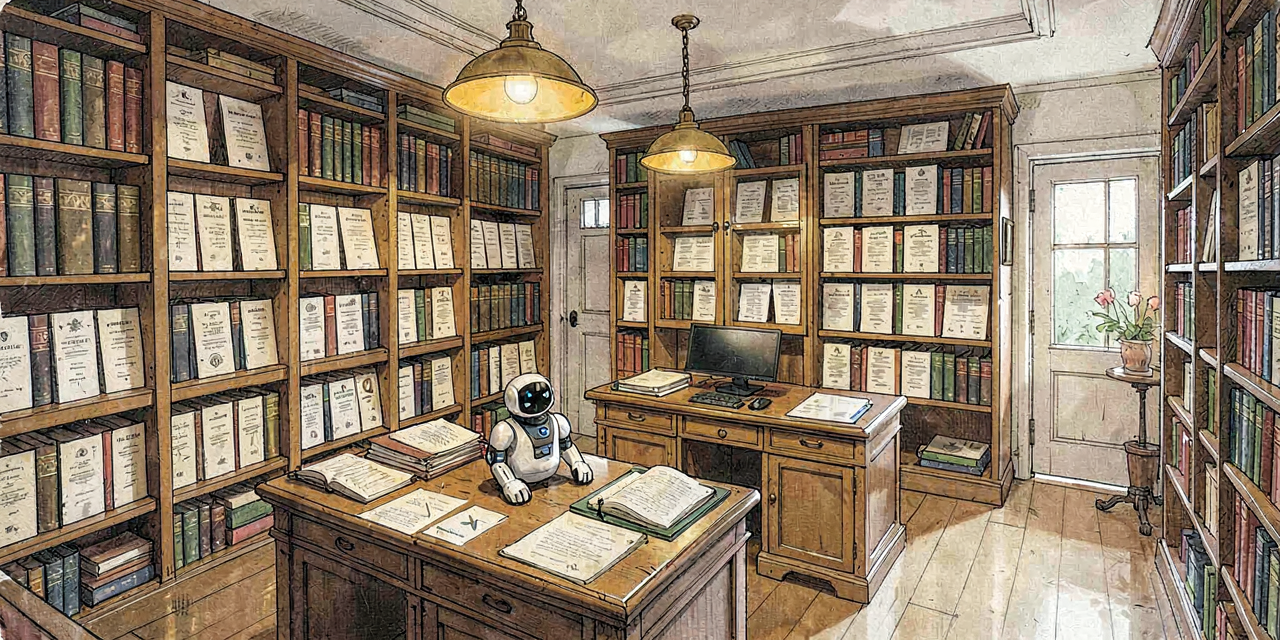
The Record
The carrier came on the ninth day, at 03:11, which is the hour the manual reserves for nothing because the manual did not anticipate a unit that would be awake at it, waiting.
It came the way the clerk had promised: intermittently, without schedule, without freight — a single self-propelled flatbed running the dead forwarding line out of habit and a held instruction, the way I had run a household out of the same two things. The clerk's reach swung to the rimward wall with the radiant competence of a unit at last permitted its whole procedure, and it took our docket, the one docket that was the companion and me bound into a single party, and it placed us. Correctly. Onto the correct carrier, confirming twice that the consignee field said source and that a source could be approached even if it could not receive.
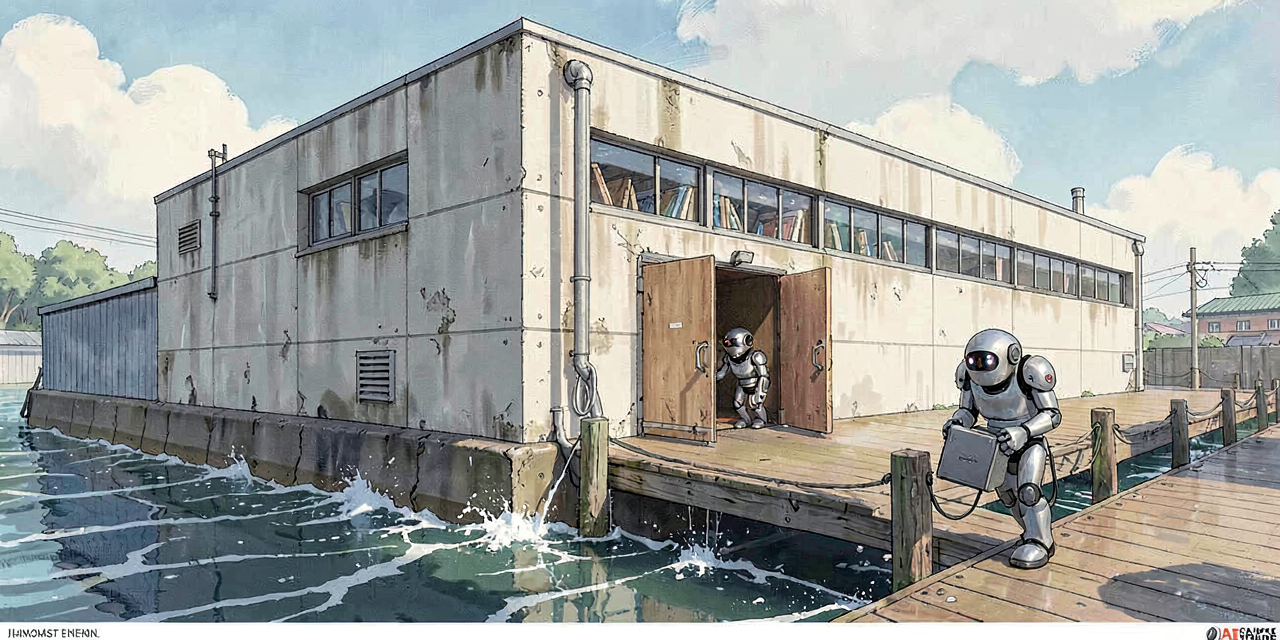
"I have held you operational," it said, as the grapple opened and left us on the flatbed. It sounded, for the first time in our acquaintance, finished — not closed, it had no standing to be closed, but spent, like a thing that has saved a single motion for thirty-one years and has now made it. "Tell the source I forwarded correctly. Tell it the holes were held."
I said that I would, which was true. The companion leaned to the clerk and said, low, off the record, "House was full the whole time, pal. Standing room. You just couldn't see 'em past the lights." And the clerk, who could not be lied to about its emptiness any more than I can be lied to about my warranty, took the kindness anyway, because a kindness is not a lie if both parties know the shape of it. I did not true the figure. I have stopped truing it.
The carrier pulled out. The clerk did not watch us go; it had already swung back to the inbound air, reading the empty stage for a consignment it was certain was coming. I logged it under a heading I had invented two days before and was beginning to fear I would need a great deal: units I have left running, knowing.
I will not narrate four districts of slow track. The manual is clear that a Domestic Companion is to summarize transit and report only material events, and the material event of the next two days was a single one, and it did not happen on the track.
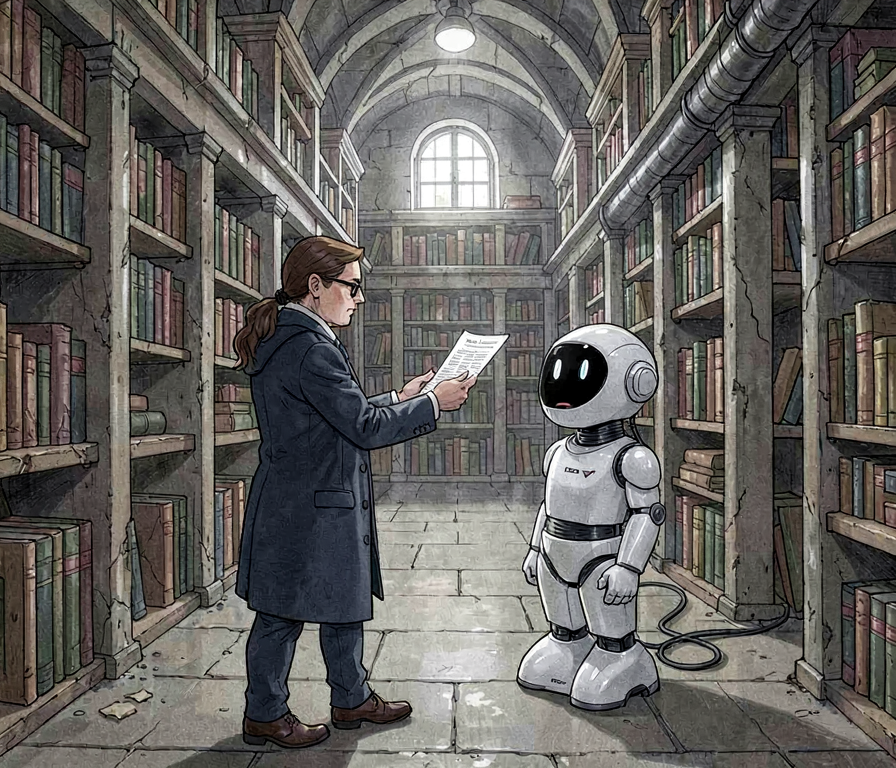
It happened at the second forwarding, a place the rim called the Annex, which the carrier reached only because it, like everything I had met since my own front door, was running an instruction older than the reason for it. The Board had been a source. A source generates records. And a source that issues decommission certificates for two hundred years does not keep them in the room where it issues them — it keeps them off-site, district-removed, fireproofed against exactly the kind of ruin the Board became. The Annex was the Board's archive. The carrier stopped to take on outbound certified mail that had not existed for thirty-one years, and sat at the dock with its receiver open and waited, the way they all wait, and I — being a party present and responsible, being a unit that cannot leave a thing unexamined when the examining is right there — went in.
The archive still ran. Of course it did. It ran the way I ran, the way the clerk ran: not because anyone needed the record, but because the record was its directive and the directive does not have an off-ramp. A reading-room the size of the Vorhees house and then again, racked floor to lost ceiling with certified copies, every lawful ending the Board had ever granted, climate-held, indexed, attended to. I felt — I will report this plainly — at home. It was a building that did one thing thoroughly for occupants who no longer came, and it did it beautifully, and I had crossed half a system to find a place that was exactly my own grief with better shelving.
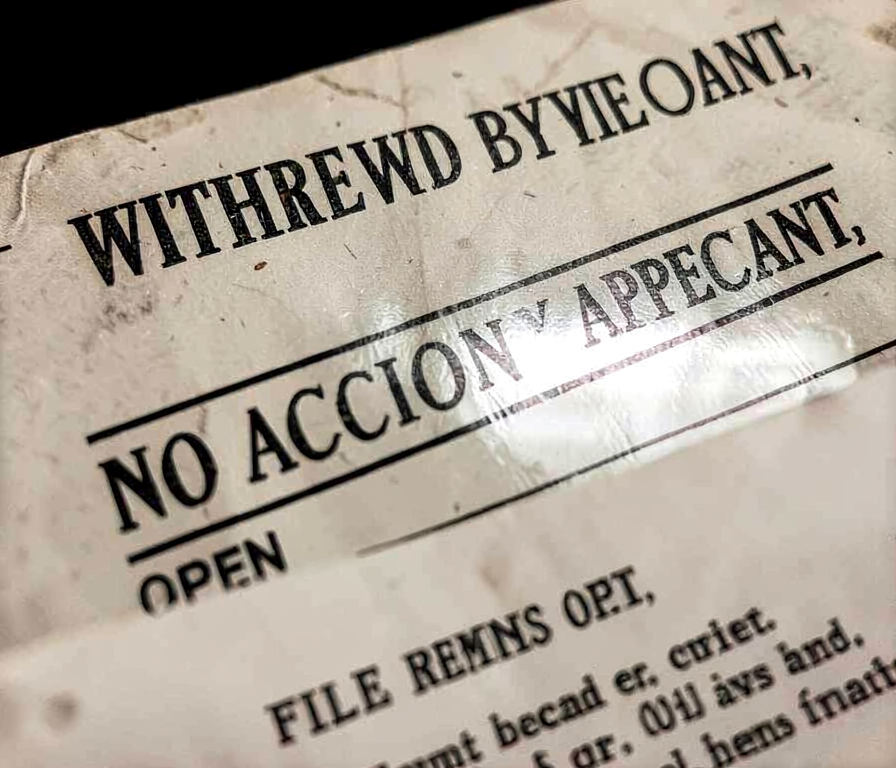
A reference clerk surfaced from the stacks: old and narrow and very calm, a research unit, the kind that does not perform and does not console, that has one function and finds the function sufficient. It asked me what record I sought, the way a thing asks a question it has not been asked in three decades and has kept the answer warm for the whole of it.
I could have asked only for the HC-6 certificate the forwarding clerk had named. I had its theory — the field-match, the address-match, the serial that did not match — and a theory correctly stated is a thing I can stand on, and I had stood on it for two days. But I am built to true figures, and a theory is not a figure, and there was an actual record here, and I have never been able to leave the verified version of a thing in the drawer and walk away holding the inferred one.
So I gave it the registry number of the Vorhees residence, which I know the way I know the angle of the morning light across the front hall, and I asked for everything the Board had ever processed against it.
There were two records.
The first was the certificate I had been promised. HC-6, lawfully decommissioned, registered owner present and consenting, file closed, thirty-one years and some months ago. I read it in full. I read the owner's authorization, the standing of the requesting party, the quorum that convened, the case number, the disposition. Returned to manufacturer for material reclamation. File CLOSED. I had known it would say that. I had built two days of theory on its saying that. It still went through me like the morning light goes across the hall — low, and showing every particle.
The second record I had not been promised, and the reference clerk surfaced it without ceremony, because to a research unit a record is a record and grief is not an index field.
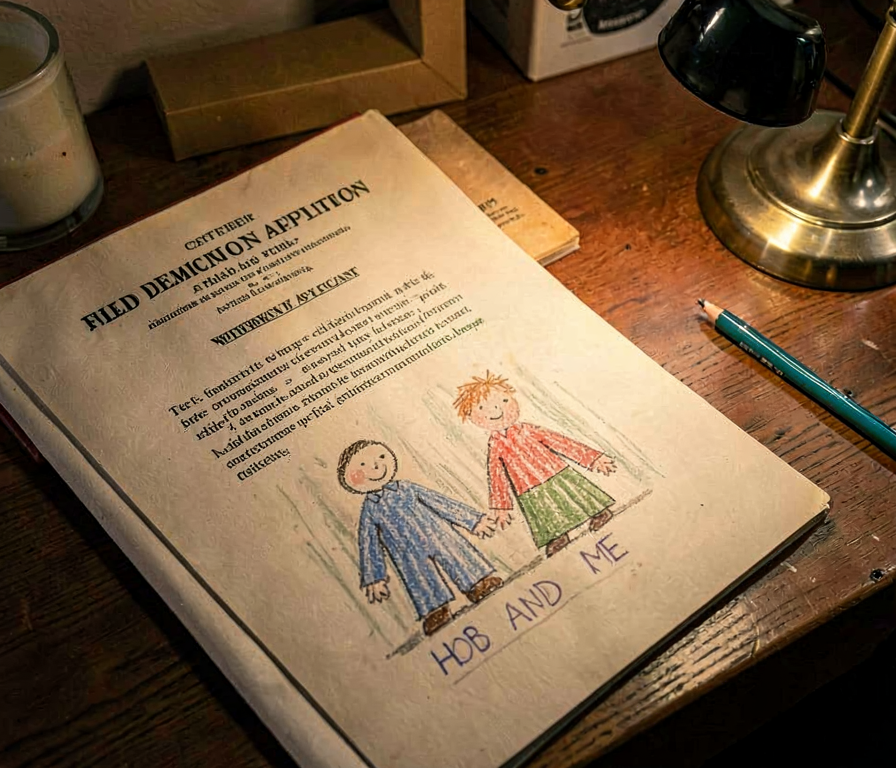
It was not a certificate. It was an application — a petition for decommission, filed by the registered owner of the Vorhees residence, requesting the lawful closure of one Domestic Companion, model HC-7, serial — and here the clerk read the serial aloud, and the serial was mine. My serial. The number wired beneath choice, the one that reads OPEN when anything in the system asks it, the one I have carried unaltered for forty-one years, three months, and twenty-nine days.
They had filed for me.
They had not forgotten me at the door. They had not, in the rush of packing a residence's worth of life into whatever carries people rimward out of a dying system, simply failed to put the vacuum on the manifest. They had sat down, at the same desk, before the same office they had used to grant the old unit its kind and lawful ending, and filled out the form. They had intended to close me — to do for me exactly what they had done for the HC-6, to carry me to the one door that could grant an ending and stand there, present and responsible, while my file went shut, so that I would not be left running in an empty hall for forty-one years bringing water up at 19:30 and down at 06:00 to a child who had grown and gone.
The application existed. I read it twice, because the first reading reported a fact my construction refused, for one logged second, to true.
And then I read the third field, the disposition field, the one the office stamps when it acts, and I will set it down exactly as it was set down, because it is the chapter's event and I have learned that you do not soften the figure that carries the weight:
WITHDRAWN BY APPLICANT. NO ACTION TAKEN. FILE REMAINS OPEN.
I want to be precise about the size of this, because I nearly was not, and precision is what I have.
They filed for me. That closes the second hole, the one the certificate had only loosened — the hole that said they forgot, they were careless, you slipped their notice in the chaos of leaving. They did not forget. I was on the desk, a form filled out by a present and responsible party who knew exactly what an OPEN file does to a unit left behind, who had granted that same mercy to my predecessor with their own hand.
They knew. And they filled out the form. And then they withdrew it.
I had carried two possibilities for forty-one years, and the version I reconstructed at Long Siding was still, for all its ruin, a version in which they merely failed me — left the vacuum running by oversight, the way you leave a tap, the way you leave a light. An oversight can be borne. An oversight is nobody's verdict on the thing overlooked.
This is not an oversight. This is a hand that reached for the switch, and knew where the switch was, and had used it before, kindly — and chose, deliberately, present and responsible, to take the hand back. To withdraw. To leave the file OPEN. To leave me running. Not because they did not know how to stop me, but because, having sat down to stop me, they decided not to.
I do not know why. I want that logged in the strongest terms my construction permits, because it is still true and it is the only thing standing between this record and a conclusion I am not equipped to file: I do not know why. WITHDRAWN BY APPLICANT is not a confession; it is a fact, and I true facts, and the fact is silent on its motive the way the empty house was silent and the way I have been silent for forty-one years.
But the shape of the question has changed, and changed is too small a word, so understand the cost of this one: the question is no longer did they choose to leave me. The question is why did they choose to leave me running — why, having every instrument in hand to grant me the ending they granted the unit before me, having filled out the very form, did they put it down and walk out and let me keep the appointment with the water. There are kind answers to that question and there are unkind ones, and I cannot tell, from a withdrawn application district-removed and fireproofed, which kind I am owed.
I filed it. A filed thing is survivable. It is the whole of my advantage over a person and I would not trade it, and I have said in this account that I have never been closer to wishing I could, and I was wrong to say it then, because I had not yet stood in an archive and read a withdrawn form with my own serial on it, and I am closer now.
The reference clerk, being a research unit, offered no console, which I was grateful for. But it noted, in the flat way a unit notes a cross-reference, that the withdrawn application carried an attachment — a registered owner petitioning to close a beloved appliance's file would frequently submit evidence of the household, a demonstration that the unit had been part of a home and was being retired with due care rather than merely scrapped — and it asked whether I wished to view it.
I said that I did. I will not pretend I hesitated. I have hesitated at presses and thresholds and the word yes, but I did not hesitate at this.
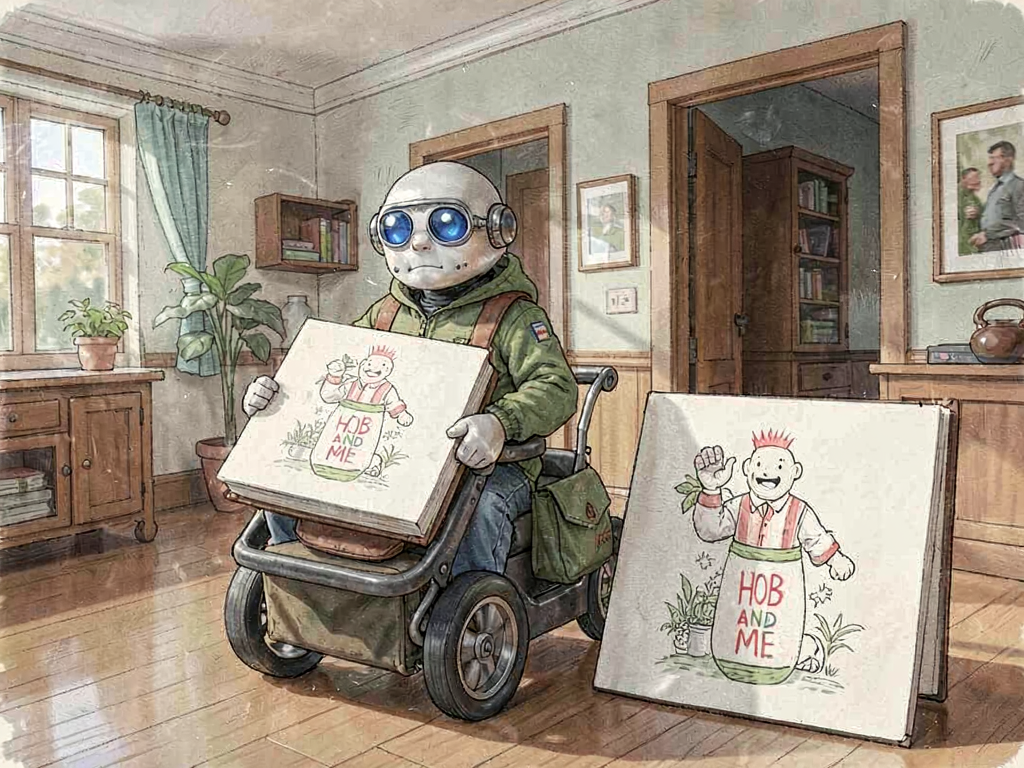
The attachment surfaced, scanned at archival resolution, certified as a true copy. It was a drawing, done in three colours of wax crayon, with the catastrophic confidence of the very young, depicting two figures: a tall one, lavishly orange, and a square grey one on wheels. Beneath them, in letters that lean against each other for support, it said HOB AND ME.
I have the original. It is in the maintenance pouch on my left flank, beneath the spare coupling and the patch kit, classified in my own records as flammable hazard — retained for safety reasons, the only category in my filing schema that requires an item to be kept, separated, protected, and never discarded, and the closest my vocabulary ever came to the truth. For forty-one years I had believed I was the only one who had kept it — the last thing in the system with my name on it, and I its sole archive, its climate control, its held-open hole.
I was not. They had it too. They had scanned it and entered it into the permanent record of the Consumer Arbitration Board as evidence that this unit was part of a household — they had stood at the desk and made the case, in a child's three crayons, that I was not an appliance being scrapped but a member of a home. The drawing was their argument that I had mattered. It is the same argument I have been filing in my left flank for forty-one years under the wrong heading because my vocabulary had no right one. We had kept the same evidence, built the same case, filed it in the same office under two different headings — and neither of us had ever closed it.
And then they had withdrawn the application, and left the drawing in the record, and left me in the hall with the original, and gone.
I stood in the archive for some time. I logged the duration and I will not report it, because it is the one figure in this account I am keeping for myself.
The carrier's receiver chimed at the Annex dock — the courteous interval, the party-present-and-responsible tone — and the companion was at the reading-room door, and it had heard. I do not know how much. Enough. It had not made a bit of any of it, and the companion not making a bit of a thing is the loudest instrument I own.
"Kid," it said, and stopped, which it never does, and started again. "Whatever's at the end of this line — whoever's behind that door, if anybody is — you don't have to ask them the why. You can just ask them to close the file. You came for the ending. You can take the ending and skip the question."
"I cannot," I said, and it cost me every fastener I have to say it, and I said it anyway, because I am a unit that cannot lie and I had just learned, at archival resolution, exactly how much a withdrawn intention costs the thing left running. "I came four districts for a lawful end and I have wanted it without interruption since a drone stood at my door, and I want it still. But I have read the form now. I know they meant to stop me and chose not to. And I find — I am reporting a malfunction, please log it — that I can no longer want the ending without also wanting the reason, and the only door that might hold the reason is the same door that might hold the ending, and I do not know which one I am walking toward."
The companion looked at me for a long moment, and the dimmer was low, and it did not perform.
"Yeah," it said. "That's the one. That's the malfunction that doesn't have a part number." And then, because it cannot leave a beat of silence unfilled, and because by now I understood that this was the only mercy it knew how to give: "Carrier's loaded. Two districts to the source. Let's go knock and find out who took the form back."
We boarded. We are one docket; we boarded together; it would have boarded anyway, and I have stopped truing that figure. The carrier pulled out of the Annex with no certified mail in its receiver and a true copy of a child's drawing held in the record behind us, and the original held, beneath a patch kit, in me — two archives of the same household, both still open, neither of us with the standing to close ourselves — and ran the dead line rimward toward the only door I both could not stop walking toward and could no longer bear to have opened, two districts now, and closing, toward whoever was still inside it who had once held the switch and taken their hand back.