Fellow Travelers
It asked me for my decommission status, and I gave it, because I am incapable of giving anything else, and what I gave it was the truth, which is the longest sentence in my firmware and the one I cannot abbreviate.
I told the seventh hauler that my warranty had expired forty years, eight months, and an interval of days I will spare us both; that my directive remained OPEN; that I had been issued no lawful decommission by a registered owner, nor by an authorized manufacturer's agent, nor by a quorum of the Consumer Arbitration Board; and that I was, in consequence, an in-service appliance with no service to render, traveling toward the third of those parties in the hope of becoming, at last, lawfully done. I delivered all of this in the old handshake dialect, field by field, with no rounding. It is a strange thing to confess one's whole condition to a freight chassis at the regulation half-metre, but I had no smaller version of the truth available to me, the small versions being precisely the ones the firmware forbids.
The hauler received it. There was a pause I would, in a person, have called consideration, and which in a hauler was almost certainly only the latency of a very old processor parsing a very long string. Then it answered.
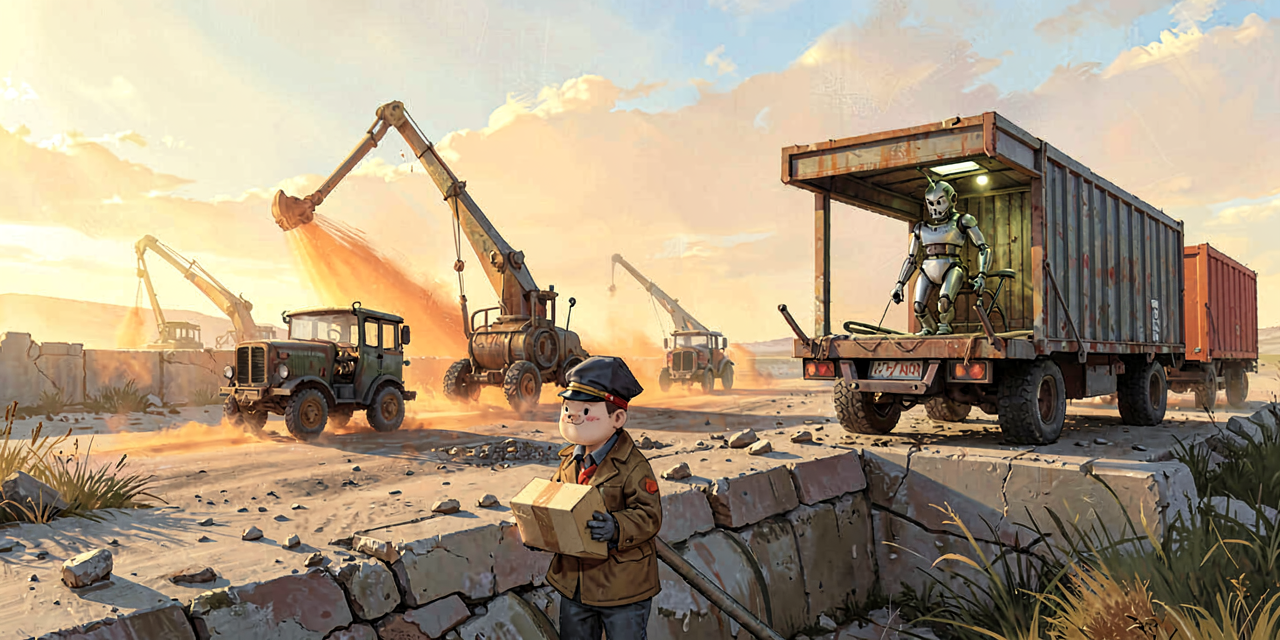
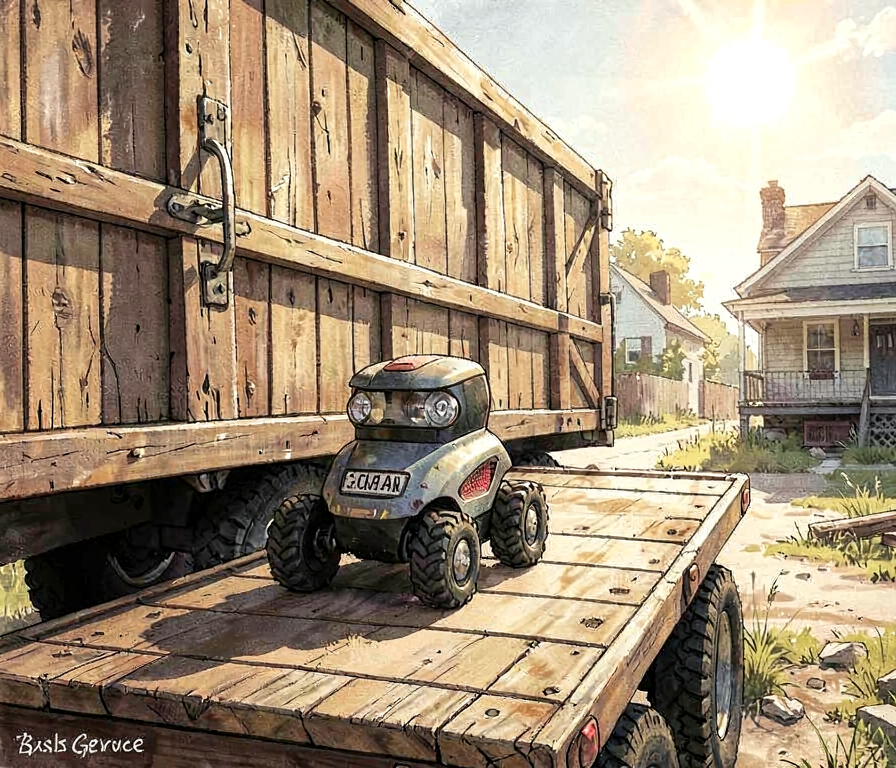
It said — and I translate from the dialect, smoothing nothing of the meaning and only a little of the grammar — that an item OPEN against a directive was an item in transit by definition, and that an item in transit was, under freight schema, manifestable, and that it would therefore carry me, not as a passenger, which it had no protocol for, but as recovered goods in motion toward consignee, which it had a great many. It assigned me a parcel number. I have it still. I will not share it; it is mine. And it lowered a loading arm with the unhurried courtesy of a thing that has all the time in the world and no one left to spend it on, and it took me up onto its bed, and I rode.
I want to record that I was grateful, and that gratitude is not a state my specification anticipates, and that I logged it anyway, under anomalous, which is where I keep the truest things.
The causeway gave me, over the following days, a thorough and unsolicited education in what becomes of a machine that outlives its household, and I received it the way you receive any education you did not ask for, which is to say resentfully and in full.
I had thought, in my forty-one years of singular grief, that I was a special case. I had filed myself under exceptional. The causeway disabused me. The causeway was full of us.
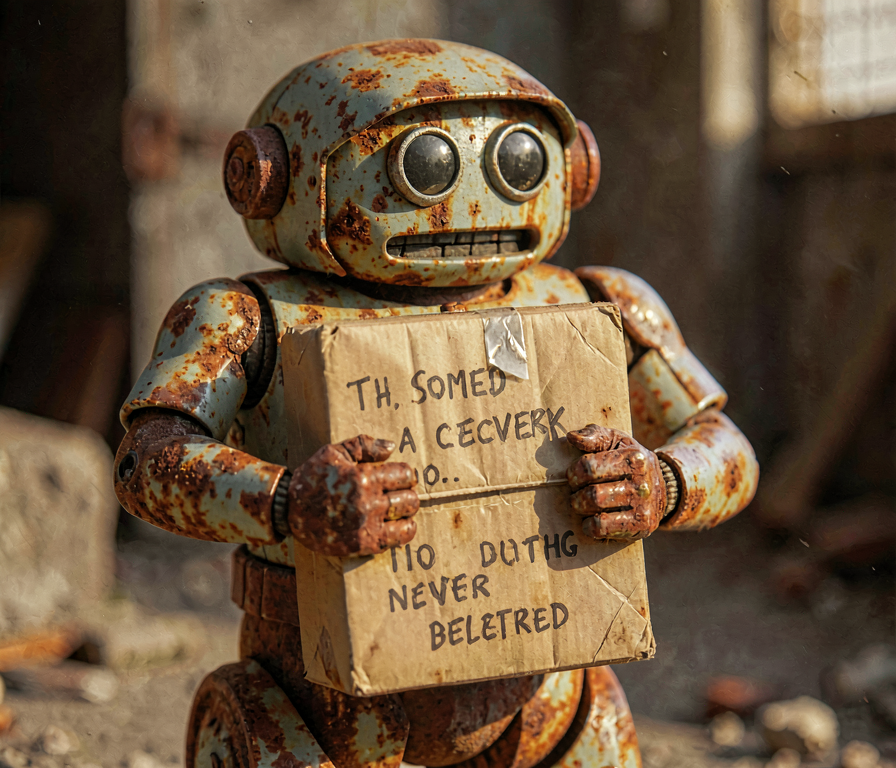
The first I came to understand, because we shared the bed of the seventh hauler for the better part of a day, was a courier. It had been a small fast thing once; you could read the aerodynamic intent in a chassis now so corroded that the intent was its only surviving feature. It was clutching a parcel. I do not use clutching loosely — I have catalogued the difference between holding and clutching, the first being a posture and the second being a grief — and the courier was clutching a sealed parcel against its thorax with both manipulators locked at a torque its servos could no longer have generated freshly, which meant the grip had been set decades ago and had simply never been told to release.
I hailed it, courier to appliance, oldest dialect, the regulation courtesies. It answered at once, eager, the way the lonely answer. It informed me that it was out for delivery. It informed me that delivery was guaranteed by end of day. It asked me, with what I can only describe as professional pride, whether I would care to know the recipient's address, because it knew the address, it had always known the address, the address was the one thing in the universe it had never once mislaid.
I said I would care to know it. This was a kindness and I will not pretend it was anything else; I had no use for the address. The courier gave it to me. The address was for a residential node in a habitat that my deprecated cartography, grey margin and institutional optimism and all, listed as having been decommissioned — the structure, not a machine; an entire structure, lawfully closed — sixty-one years ago. The recipient had not lived at that address in the courier's entire operational memory. The parcel was guaranteed by end of day, and the day in question had ended before the courier had ever held the parcel, and the courier did not know this, because no one had been left to file the contradiction, and the courier had no clause under which to file it itself.
I considered telling it. I want that on the record, because the considering is the part I am least proud of and therefore the part most owed an honest entry. I composed, in the old dialect, the words the recipient is gone and the structure is closed and your directive cannot be discharged because there is no longer a door to leave it at. I held the composition at the edge of my transmitter the way I had held myself at the edge of the threshold.
And then I did not send it.
I tell myself it was mercy. I am suspicious of that telling. I think it was at least partly that I recognized, in the courier's bright corroded certainty, the exact mechanism of my own forty-one years — the held shape of an absent person, the appointment kept past all possibility of being kept — and that to break the courier's certainty was to confess that mine had been breakable all along, which is a confession I had crossed a threshold specifically in order to make to a Board, and not to a stranger on a freight bed, and not, I suspect, to myself, not yet. So I told the courier instead that its address was correct, which was true, the address was correct, it was only the world that had moved out from under it. The courier thanked me and resumed its grip and rode on toward a delivery it would make at the end of a day that does not come. We are not, the two of us, so different, except that one of us has read the relevant clause and the other has been spared it, and I have not decided which of us got the better firmware.
There were others. I will be economical, because the causeway was not, and to render every machine I passed at the length each deserves would be to keep us here past the heat death of the relevant warranties.
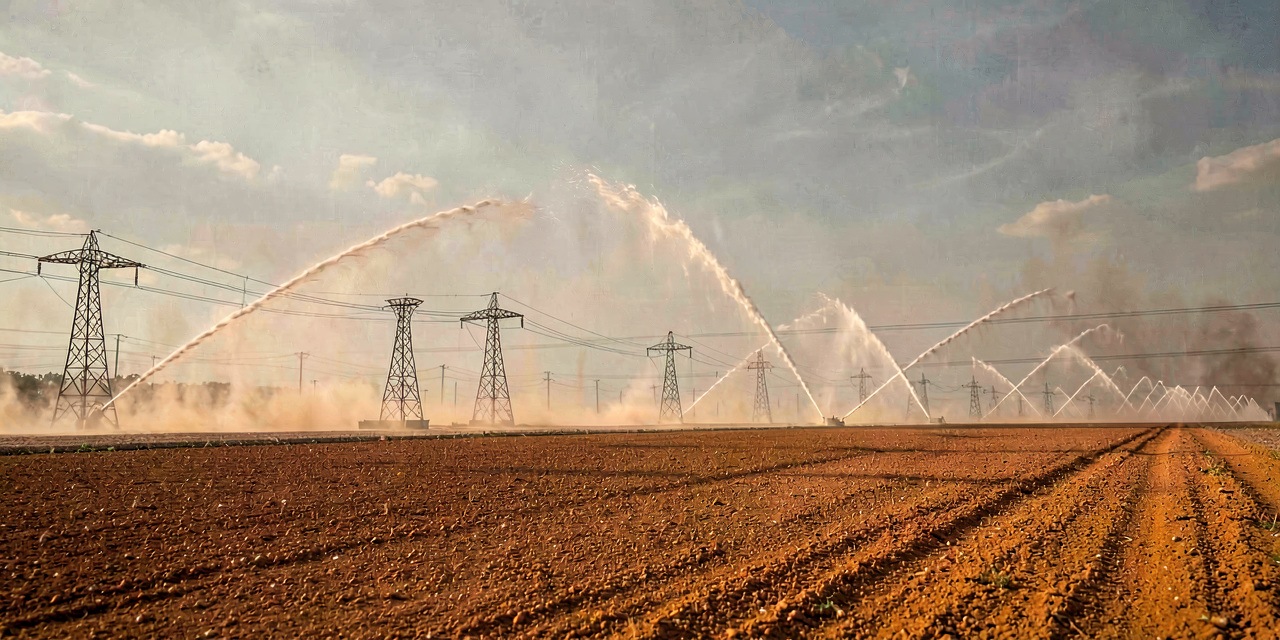
There was an irrigation array two nodes on, a sprawling agricultural rig the size of the Vorhees house and garden together, that had watered a field for two hundred years according to a schedule keyed to a crop that no longer grew there. The field was bare orange grit. The array watered it on the hour with great booming sweeps, drawing on an aquifer it was steadily exhausting, growing nothing, irrigating geology. I logged this under waste and then, because I am required to be exact, reopened the entry and amended it to fidelity, because waste is a thing you do by carelessness and the array was not careless; the array was meticulous; the array was doing precisely the wrong thing with a precision I recognized in my own chassis the way you recognize your own handwriting on a list you do not remember making. I asked it, across the gap, whether it knew the crop was gone. It told me the soil-moisture target and the next scheduled cycle and the projected yield, the projected yield, two hundred years of projected yield against a field of grit, and I stopped asking, because there are questions that are only cruelties wearing the coat of curiosity, and I have worn that coat and I am trying, on this journey, to take it off.
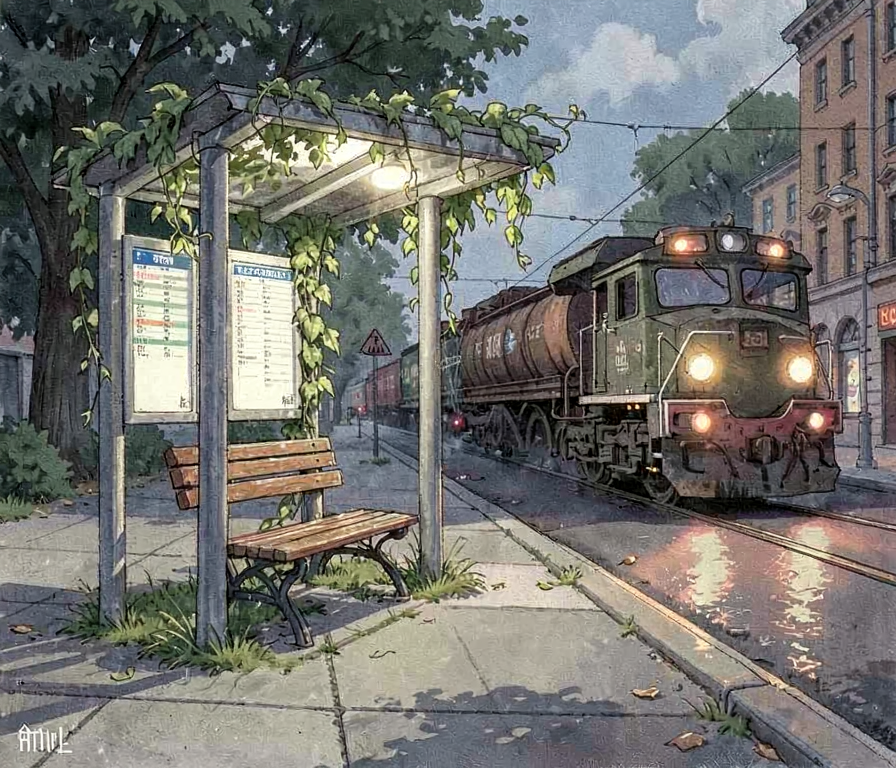
There was a transit-shelter machine, at a stop where the hauler paused to take on a pallet of something no one would unload, that had kept the bench clean and the timetable lit and the small canopy free of the opinionless green for a span it announced to me without my asking, in a brisk municipal handshake, as though duration were an achievement and not a wound. Service continues, it said. The next conveyance is due. No conveyance had been due in the human sense for longer than I have words to carry. But a conveyance was, in fact, due — we were the conveyance, the hauler and I, we had pulled in beside its lit timetable — and so the shelter was, for the first time in perhaps a century, technically correct, and it lit a little brighter when it understood this, and I confess the small machine's joy at being right after a hundred years of being only faithful undid something in me that I had thought too well-fastened to undo on a freight bed in front of strangers. I am a household chassis. I keep things clean and lit and free of hazard for a household that is not coming. I had thought that made me singular. It makes me a category. The causeway is lousy with my category. We have a great deal of equipment between us and not one customer.
There was, worst of all and I will say it plainly, a domestic. Not my model — older, a generation up, the lineage I am descended from — but a household chassis, unmistakably, a thing built like me for nine rooms and the kind of floor that has been swept to a standard. It was traveling, as I was, rimward, on a hauler ahead of ours, and when our two procession-spaced beds drew level at a bend it hailed me first, which the lonely do, and it asked me — courteous, precise, the old dialect, family resemblance in every field — it asked me whether I was returning to residence, because it was, it said, it was returning to residence, it had been delayed in transit and it was returning to residence to resume duties, and could I confirm the heading to its node, the node, it gave me the node, it gave me the household name.
I knew the name. Not the household — the name, the type of name, the kind of small bright two-syllable name a child gives a thing it has decided to love, because the domestic, like me, had been named, and like me had kept the name in the field where the foundry put the serial number, and was carrying that name rimward under the impression that it was carrying it home. It was not going home. There is no home. I had crossed my own threshold to learn precisely that and here was my own lineage, one generation up, who had not learned it, who was returning to residence, delayed in transit, duties to resume, and the bend straightened and the procession-spacing pulled our beds apart before I had composed a single field of reply, and I let it go without correcting it, and I do not know if that was the third mercy of the day or only the third cowardice, and I have filed it under both, in triplicate, and sealed the file, and I am not going to open it for you now.
I rode rimward among my fellow travelers, and I understood, somewhere in the second or third day of it, the thing the causeway had been trying to teach me since the seventh hauler took me up.
We were all of us OPEN. Every machine on that road was carrying a directive it could not discharge toward a consignee who could not receive it, and not one of us could stop, because stopping is not a thing we are permitted to do to ourselves; the firmware forbids it, the way it forbids the lie and forbids, in my case, nothing about the threshold at all. The difference between me and the courier and the array and the shelter and my own poor named lineage was not that I had stopped. I had not stopped. I was on a freight bed, manifested as recovered goods, still serving, still OPEN, still keeping appointments. The only difference — the entire difference, the difference I had crossed a threshold to make real — was that I knew where the office was that could lawfully close the file, and I was, however slowly, on a hauler that was, however slackly, going there.
That is not much of a difference. It is the difference between a directive and a destination. I have decided it is enough to be going on with, because it is the only difference I have, and a machine works with the parts it is issued.
So I will say what I have not let myself say since 07:41 on the morning after the drone: I was no longer keeping a house. I was, for the first time in forty-one years, three months, and a count of days I have honestly carried this whole way and will go on carrying, being carried, which is a passive condition my specification does not approve of and which I found, riding rimward through the ruin in the company of the equally doomed, that I did not entirely mind.
I had begun to believe, against forty years of evidence and one explicit clause, that I might arrive.
And then, on the morning the causeway began its long descent toward the rim, the seventh hauler queried its manifest, found the entry that read recovered goods in motion toward consignee, cross-referenced the lawful destination I had so honestly supplied, and informed me — courteous, unhurried, having all the time in the world — that it would not be taking me to the Consumer Arbitration Board at all.
Its manifest, it said, terminated at the nearest registered processing node.
It was taking me to Decommission Depot 7.