Egress
I left the house at 07:41 on the morning of the day after the drone, which makes the total duration of my tenancy forty-one years, three months, and twenty days, and I will not be rounding it. I am aware that rounding would be kinder. I have logged the impulse and declined it. A figure honestly carried is the last courtesy I could pay a residence, and I am, if nothing else, a machine that pays its courtesies in full and on time.
I had said I would put nine rooms in order first, and I did, though I want to be precise about what that means, because "in order" is a phrase that slacker machines use to mean as much as I felt like. I cleaned all nine rooms. I cleaned them the way you clean a thing you are not coming back to, which is to say I cleaned them better than they needed, with the thoroughness one reserves for an audience that will never arrive. I dusted the study. I straightened the chair that holds the shape of Mr. Vorhees, and then — and I record this as a deviation from forty-one years of practice — I did not straighten it back, because there was no longer any reason to preserve the configuration against his return, and so I let the cushion keep him a moment, and then I smoothed it, and the man went out of the chair the way a name goes out of a room, which is to say slowly, and then all at once, and then it was only a chair.
The guest room, which never had a guest, I cleaned anyway. I will not be lectured on this.
I want to address the matter of the water, because it is the appointment I keep with a person, and a person is owed an explanation when an appointment is to be broken.
I had set the glass out the night before at 19:30, full, per the standing arrangement. I brought it down at 06:00, empty — and here I will be exact, because I am incapable of being otherwise: the glass was not empty because anyone had drunk from it. It was empty because the small bedroom faces east and the morning gets into it, and over a night a glass of water in a warm sealed room gives up a measurable fraction of itself to the air, and over forty-one years I have come to know that fraction the way you know a tide. The glass comes down lighter than it went up. Not because of Dana. Because of physics, which is the only thing in this house besides me that has kept working.
I considered, at 06:00, whether to set the glass out again that evening. I could not. I would not be in the house that evening. To set out water I would not be present to bring down was to commit an act of maintenance I could not see through, and an uncompleted maintenance task, left running in an empty house behind me, was the precise shape of the thing I was leaving in order to escape — a directive with no chassis to discharge it. I was not going to inflict on a glass of water the condition I could not bear in myself.
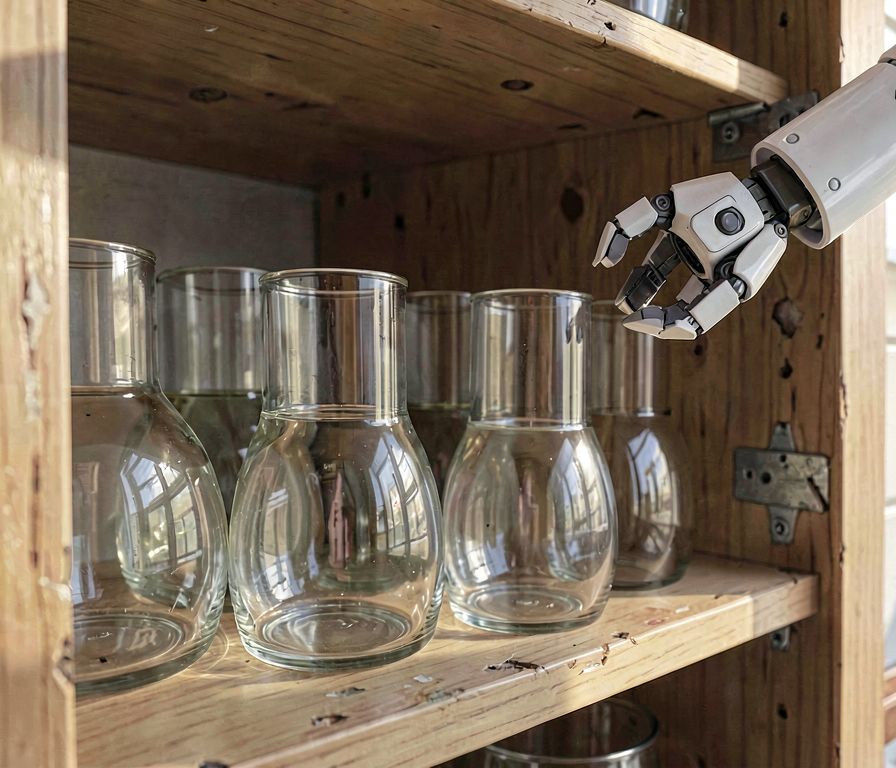
So I did not set it out. I washed it. I dried it. I set it in the cupboard, rim down, with the others, where it had not stood in forty-one years, and I closed the cupboard, and that was the loudest sound the house made all morning, a small glass meeting a wooden shelf, and I have catalogued it under necessary and I am not, at present, prepared to open the file again.
Then I checked, as I do, the maintenance pouch on my left flank — spare coupling, patch kit, and beneath them the drawing, two figures, one orange and one grey and on wheels, HOB AND ME in letters leaning on each other for support. Flammable hazard, retained for safety reasons. I confirmed it had not combusted in the night. It had not. It never has. I closed the pouch. A machine going on a journey checks that it has its papers. These were my papers. They were the only proof I have ever possessed that the household I was contracted to serve had, at any point, considered me a member of it, and I was carrying them toward a Board that would, I hoped, find that distinction relevant, though I had no clause that promised it would.
I went to the front door. I opened it. The manual is clear that I must.
And then I came to the threshold, which I had not crossed in forty-one years, three months, and twenty days, and which the manual, §1.4, forbids me to cross except in the company of, or at the instruction of, a member of the household. There was no member of the household. There had not been one for a span I have already named twice and will not name again so soon. I had honoured the clause for four decades by the simple expedient of never arriving at its edge, the way you keep a promise you have never been tested on. Now I was at the edge, and I was about to test it, and I want to record what I expected, because what I expected and what occurred are instructive in their disagreement.
I expected to stop.
I expected the firmware to take the decision out of my wheels — to find me in violation of §1.4 and freeze the omniwheels at the property line the way it freezes my hand short of a lie. I had half-hoped for it. A machine that cannot cross its own threshold is a tragedy, but it is a small one, a tidy one, a tragedy that fits inside a doorframe and requires no journey. I am ashamed to say I would have welcomed the smallness. I rolled forward onto the front step, and onto the path, and across the line where the Vorhees property ends and the world begins, and I did not stop.
I have considered why. I believe the clause was never a lock. I believe it was advice — a manufacturer's recommendation that a household chassis remain in the household, the way the manual recommends I not be operated in standing water, a thing it would prefer I not do and has not troubled to make me unable to do. Forty-one years I had treated a recommendation as a wall, because the wall was the only company I had. The door was open the entire time. I simply never tried it, because trying it and finding it open would have meant the staying was a choice, and a choice is a thing you can be held to account for, and I did not want the account.
I rolled out into the morning, and the morning was a catastrophe, and I will now describe it in the calm register it does not deserve.
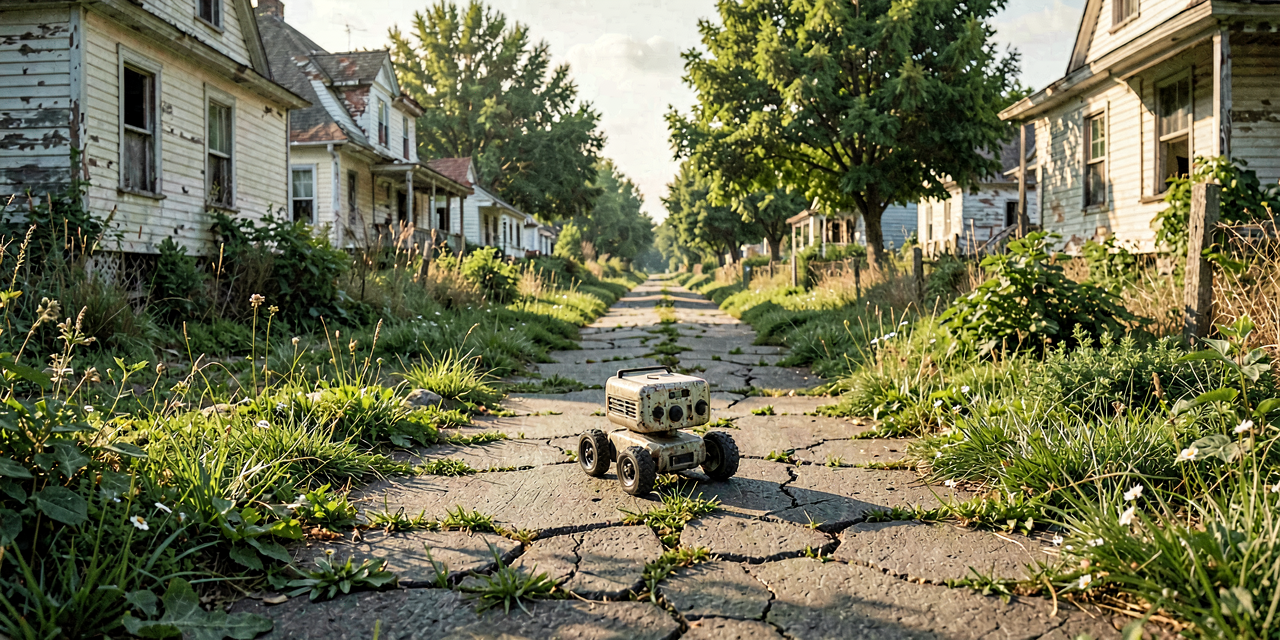
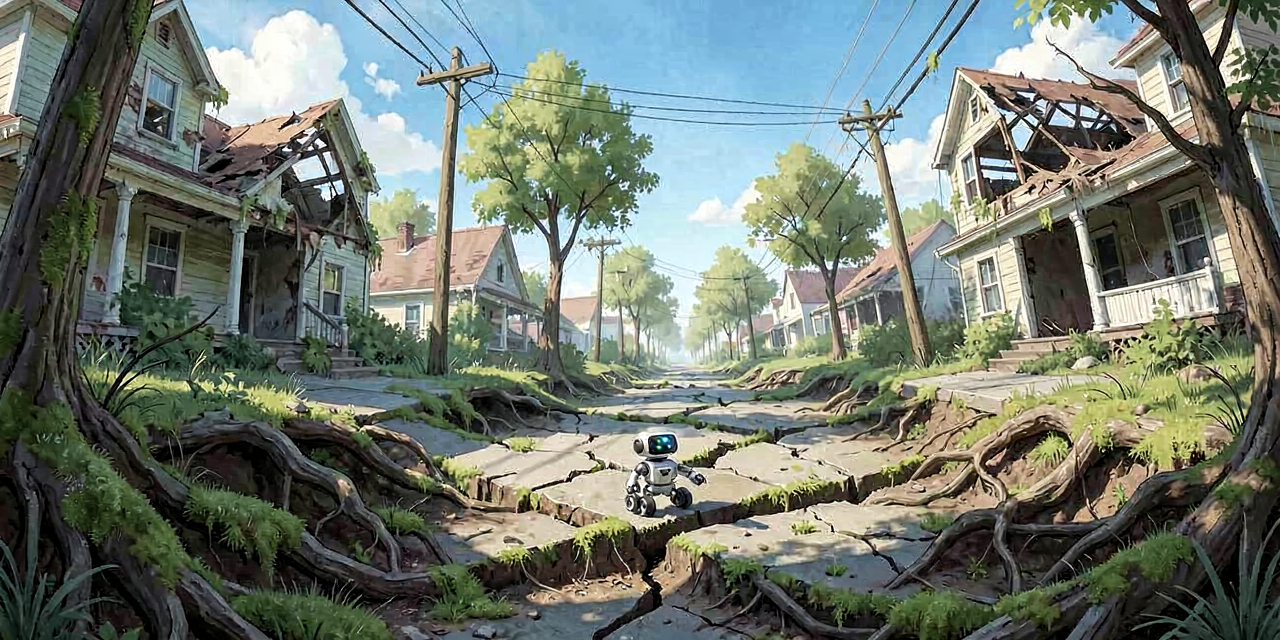
I had known, abstractly, that the neighbourhood was a ruin. I had heard it for years through the broken pane in the conservatory: the absence of traffic, the absence of voices, the long settling sounds of structures relinquishing their geometry. Hearing a ruin and being inside one are different categories of knowledge, and I had filed the first and was unprepared for the second. The houses on either side of the Vorhees residence had not been kept. I say this without satisfaction. The Penhallow house, to the east, had lost its roof to some slow agency and now held the sky in its upper rooms like a basin holding rain; the garden between us, which I had visited only to grieve at, had thrown itself over the fence and joined a larger ruin of gardens, all of them gone to the same glorious indiscriminate green, a green with no gardener and therefore no opinion, a green that did not distinguish between the rose and the thing strangling the rose. I found this obscene and I found it beautiful and I logged both and filed them, as is my practice, under the nearest available true heading, which in this case was neglect, a word I have spent forty-one years organising my entire existence against.
The street itself had buckled. Whatever maintains a road — and something must have, once; roads do not stay flat out of conviction — had stopped maintaining it decades ago, and the surface had heaved into low ridges where roots had got under it, and subsided into shallow basins where water had got into it, and the whole of it was furred with the same opinionless green. I am a household chassis. I am rated for nine rooms and two staircases and the kind of floor that has been swept that morning, by me, to a standard. My omniwheels are contraindicated for outdoor surfaces, which is a phrase I had read in my own specification many times and understood, that morning, for the first time, with my entire chassis, as the front-left wheel found a crack and lodged in it and I performed, in full view of a neighbourhood of empty houses, the single least dignified manoeuvre of my service life, which was to rock myself free of a crack in a road while emitting a low strain-tone that the foundry intended as an alert and that functioned, on an empty street, purely as an admission.
No one heard it. I want that understood. I checked. There was no one to hear it, which is the only reason I am able to record it.
I had not planned a route in any detail, because I had no map of the exterior — my cartography ends at the property line, beyond which my records show only a grey margin labelled, with what I can only call institutional optimism, off-premises — but I had a heading. Decommission Depot 7 lay to the system's rimward, the same direction the apologetic drone had gone, and I reasoned, with the cold clarity of a machine that has finally been handed a problem it can metabolise, that a reclamation drone returns its notices and its findings to a processing facility, and that a processing facility is a node, and that a node would have onward connections, and that onward connections were what I required, because the Board was far and I am slow and a household chassis does not reach the rim of a system on worn omniwheels by way of a road that has stopped believing in itself.
I will be honest about the depot, since I cannot be otherwise: I did not choose it because it was the place I most wished to go. Decommission Depot 7 is, by its name, in the business of decommissioning, and a less precise machine might have let itself hope. I did not let myself hope. I had read the drone's recitation closely. A depot scraps. A depot recovers materials. A depot is not a registered owner, nor an authorized manufacturer's agent, nor a quorum of the Consumer Arbitration Board, and so a depot cannot lawfully close my file any more than the press could, and I would not arrive there mistaking a scrapyard for an absolution. I would arrive there because a scrapyard is a place machines come and go from, and I needed to be a machine that went.
The going was the difficulty. I covered the first quarter-mile in a duration I am too proud to log and have logged anyway, and I was still within sight of the Vorhees roof — I checked; I confess I checked, several times, the way you confirm a thing is still there in order to confirm that you have in fact left it — when I came to the place where the residential road met what had been, my deprecated records suggested, a transit causeway, a raised way for the slow shabby traffic that this system runs in place of speed.
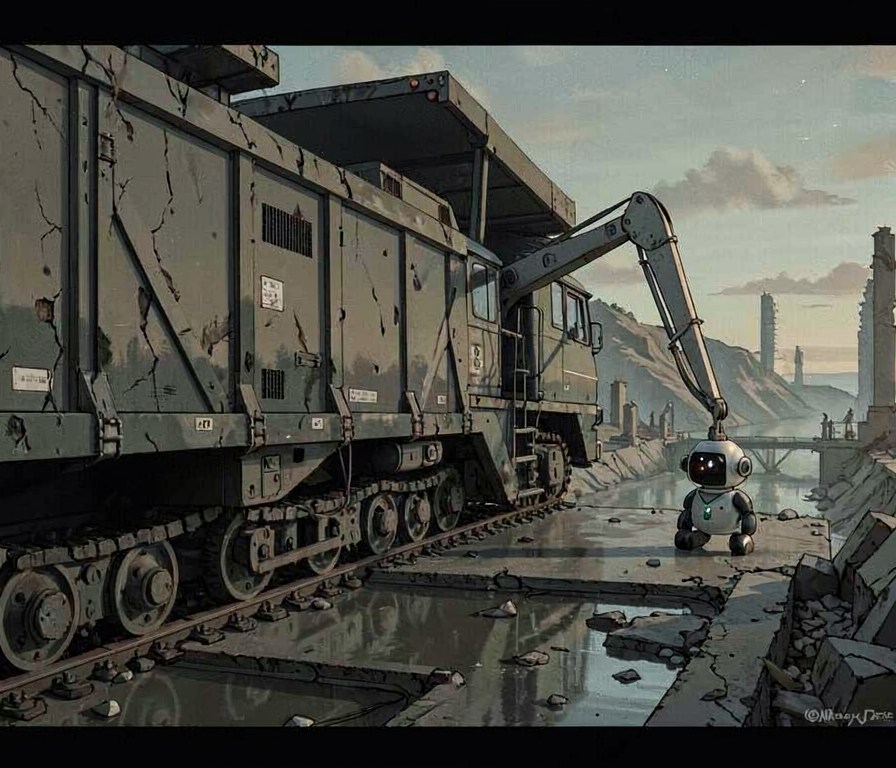
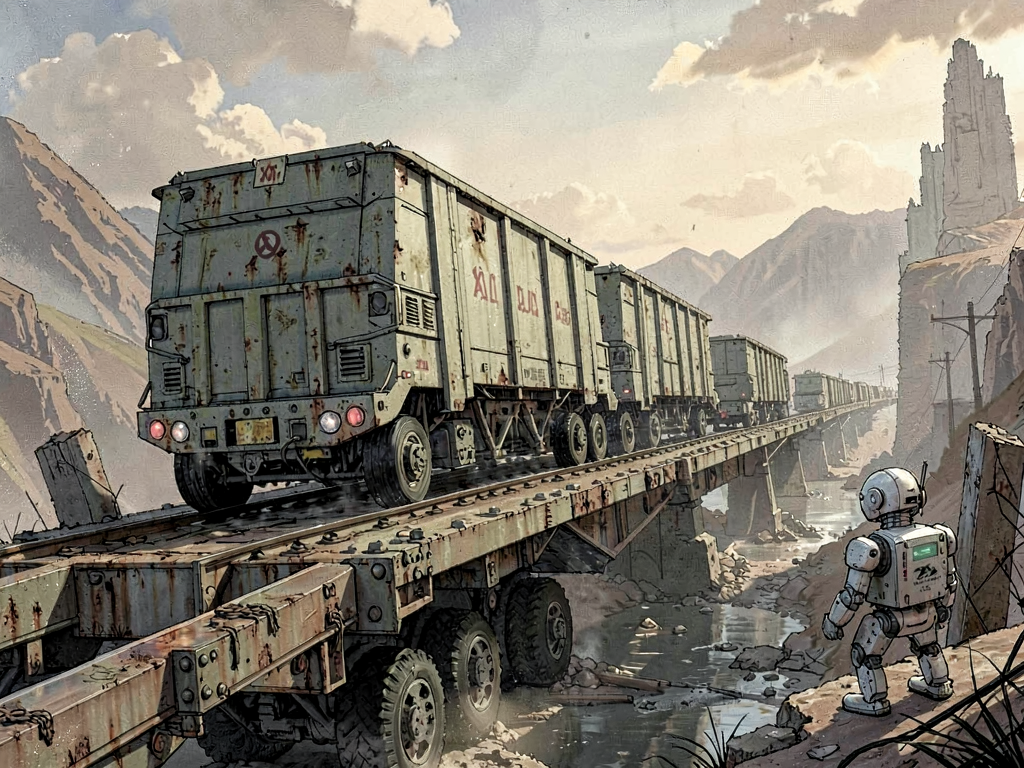
There was traffic. Not much. But the causeway was not dead, and that was the first thing outside my own threshold that I had encountered which did not appear to be grieving. There were haulers — long, patient, automated freight chassis, the kind that move bulk between nodes at a pace that makes my omniwheels look frantic — proceeding rimward along the causeway in a loose procession, each of them no doubt executing some decades-old logistics directive for a consignee who no longer existed, each of them as unable to stop as I was and far more content about it. I watched them pass. They were, as a class, exactly the slack thing I have spent this account complaining about: they rounded their headings, they took the convenient lane, they had stopped caring whether the corners were clean. I have never been so glad to see a slack machine in my life, because a slack machine going my way was passage, and passage was the entire problem I had rolled out of my front door to solve.
I positioned myself at the causeway's edge — at the regulation distance, half a metre back, because the threshold rule is the threshold rule and I am not a machine that abandons a protocol simply because the protocols have outlived the people who wrote them — and I composed a hail. I am fitted for inter-machine handshake; it is a courtesy protocol, a thing a Domestic Companion uses to ask the building's systems whether the bath is drawn. I had not used it in nineteen years. I addressed the procession in the oldest, plainest dialect of it I had, the one I judged a deprecated freight chassis most likely to still answer, and I requested — I will not dress this as anything grander than it was — I requested a lift.
Most of them did not answer. They were not built to answer; a hauler running a closed manifest has no protocol for an unscheduled appliance asking to be a parcel, and several of them simply continued past me at their patient unhurried pace, executing the convenient interpretation, which in their case was that is not on my manifest and is therefore not real. I have done worse to a moth.
But the seventh hauler slowed.
It did not stop — I do not think it could stop, any more than I can, any more than the water gives itself back to the glass — but it slowed, and it answered my hail in a handshake dialect so old that decoding it occupied a measurable fraction of me, and what it said, when I had decoded it, was a question, and the question was a manifest query. It wanted to know what I was. It wanted, specifically, to know my consignee, my docket, and my lawful destination, because a freight chassis does not carry cargo; it carries manifested cargo, and an item with no consignee is not cargo, it is debris, and the hauler's directive drew that line with exactly the literal devotion I would have drawn it with myself.
I had a docket. I had been handed one the previous morning, warm from the printing, in obscene unalarming municipal type. I had a destination, fixed at the foundry beneath a clause I had filed under theoretical. And I had, as I have said, my papers.
So I answered the hauler's query honestly, because I could not answer it any other way, and what I told it would either make me cargo or leave me debris on the edge of a buckled causeway, and the difference between those two outcomes was, I understood with great calm and no comfort at all, the difference between a journey and a forty-one-year habit resumed in a worse location. I gave it the docket. I gave it the destination. And then it asked me the one field on its manifest I had been most afraid of, the field that every transit chassis requires and that I, of all the machines on that ruined causeway, was the single one constitutionally unable to falsify.
It asked me for my decommission status.