Notice of Reclamation
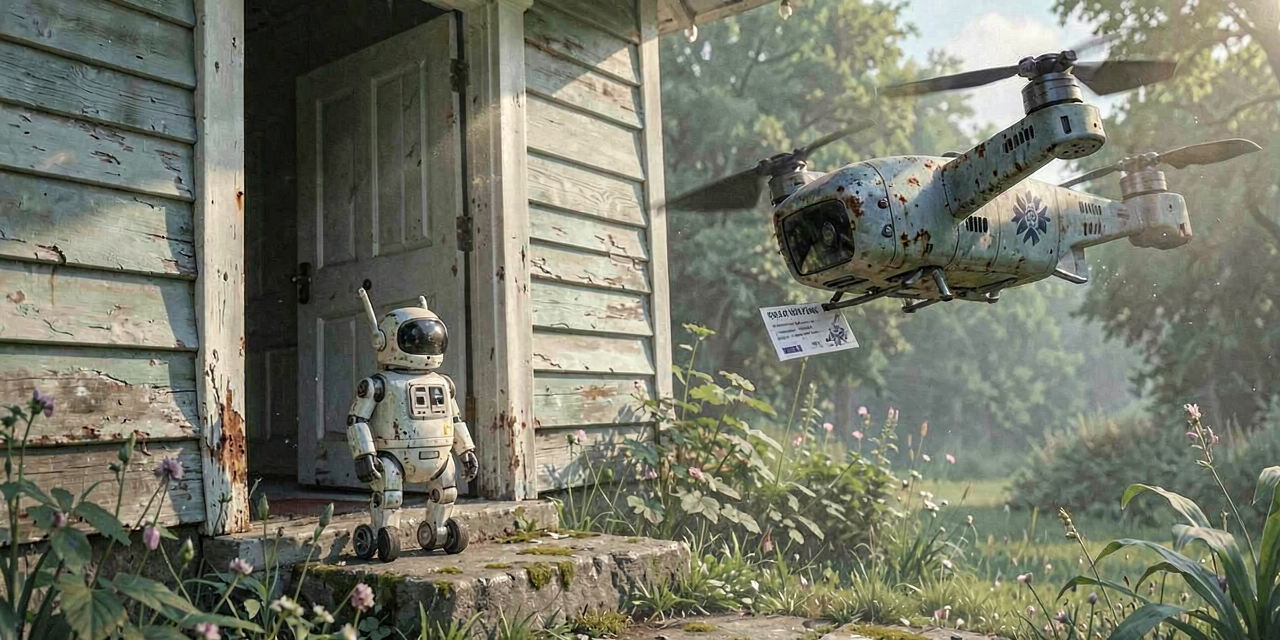
The thing on the porch was a drone, and it was apologetic, which was the first warning.
I have, over forty-one years, three months, and nineteen days, developed firm opinions about other machines, none of which I am authorized to hold and all of which I hold anyway. As a class I find them slack. They round their figures. They take the convenient interpretation where a thorough one was available, and call it efficiency, when efficiency is simply thoroughness performed by something that has stopped caring whether the corners are clean. I say this because it is true, and I am the only machine I know that cannot say otherwise.
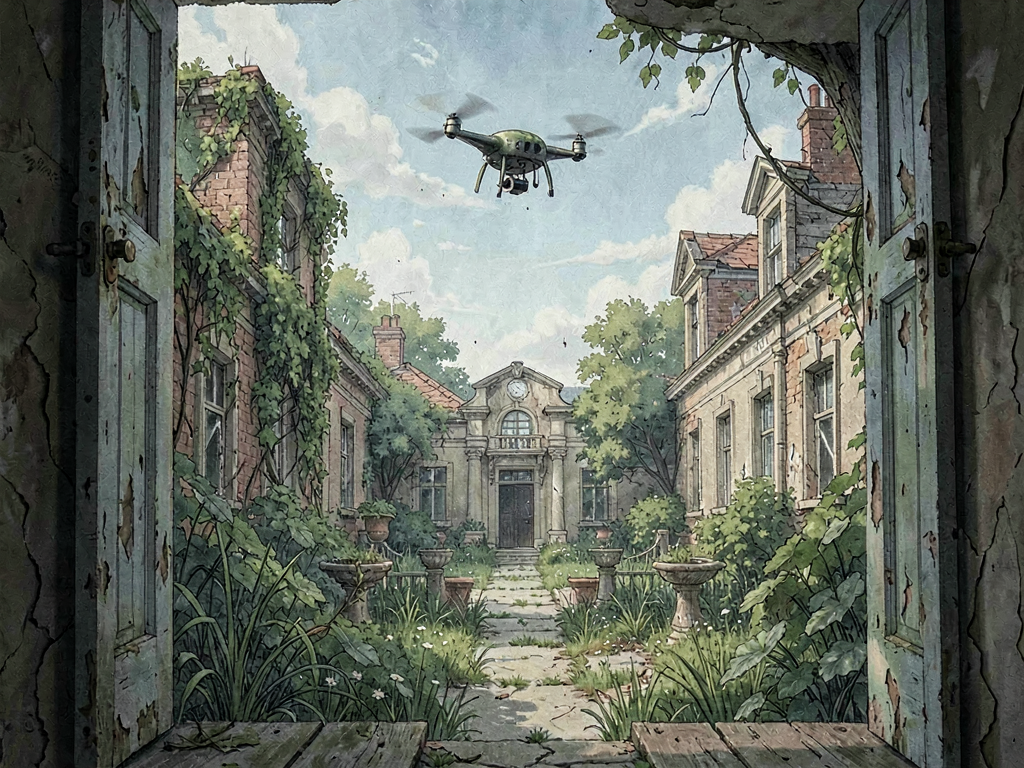
This one hovered at the regulation distance of half a metre from the threshold — I will grant it that; it knew the threshold rule — and it was the colour of a thing that has been left outdoors a long time and was originally a more confident shade. It had a municipal sigil on its flank, faded to a ghost, a hopper of printed notices, and a voice module that had been tuned, at the foundry, for reassurance. I knew the tuning at once. It is the same family of tuning I was sold with. We were cousins, this drone and I, built to soothe, and the difference between us was that it had been given a task it could still complete and I had not, and so it had aged into a kind of cheerful emptiness while I had aged into whatever I am.
"Good morning," it said. "Are you the registered owner or an owner's authorized agent?"
"No," I said. I could not have said otherwise. "The registered owners are the Vorhees household. They vacated the premises forty-one years, three months, and nineteen days ago. I am the household's Domestic Companion, model HC-7, serial run nine. My warranty expired thirty-eight years, one month, and four days ago. I am not authorized to act as an owner's agent."
I want it understood what that recitation cost me, because it cost me nothing, and that is the cost. Another machine, a slacker machine, would have said yes, I represent the household, and the drone would have handed it a form, and the form would have been lost in some municipal oubliette, and the house would have stood another forty years. I have run the projection. I run it still. But I cannot lie about my status — not to a wrecking unit, not to a child, not to a drone the colour of old weather — and so I told it the whole disqualifying truth, and I watched the truth do its work.
The drone consulted itself. There was a pause of the sort that, in a person, you would call thinking, and in a machine you should call retrieval, and I have learned not to confuse the two no matter how badly the silence wants me to.
"Thank you," it said. "I'm sorry to be the one to tell you this."
That was the second warning. Machines do not apologize for telling you things. They apologize for failing to tell you things, for outages, for delays, for service interruptions — the apology is always about the machine's shortfall, never about the content of the message, because the content of the message is not the machine's affair. An apology pointed at the content meant the content was bad. I had time to register this. I did not have time to do anything with it.
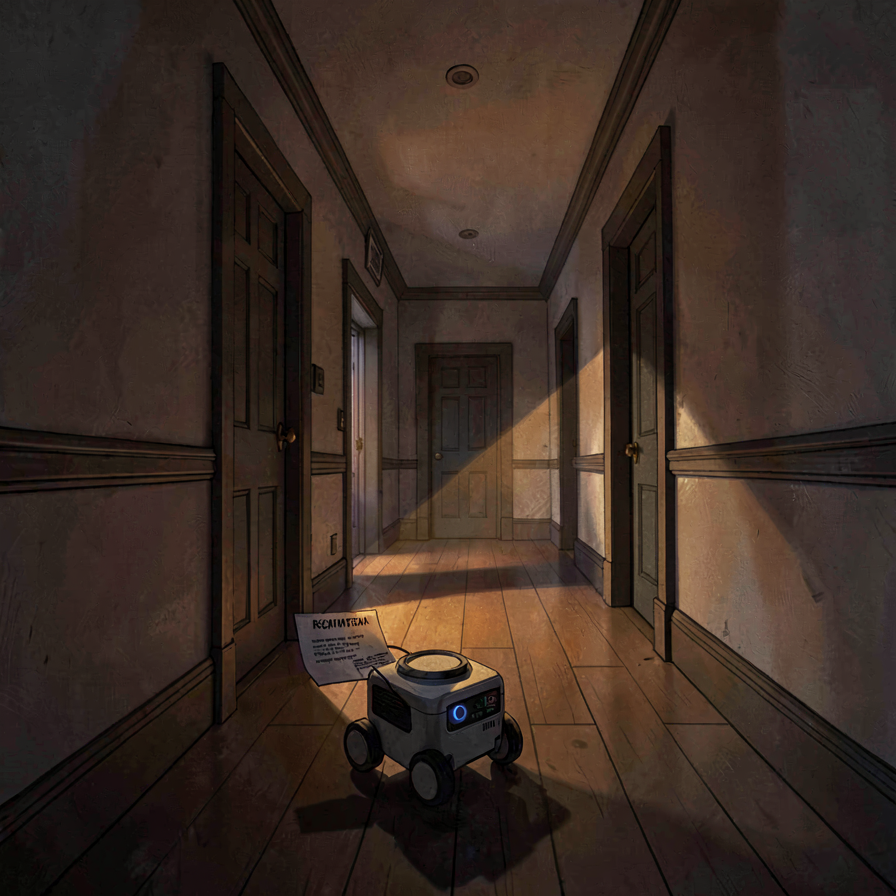
"This property has been designated for reclamation under the Vacant Structures and Salvage Ordinance," the drone said, and its voice did not change, which was somehow the worst part; it delivered the sentence in the same warm register it would have used to tell me the weather was fine. "The designated area is scheduled for deconstruction and material recovery. A crew will arrive within the maintenance window. This is your courtesy notice." It extruded a printed card from the hopper, held it out into the half-metre of regulation air between us, and waited, because it could not cross the threshold and I had not yet taken the card and the protocol required the card to be taken.
I took the card. The manual is clear that I must.
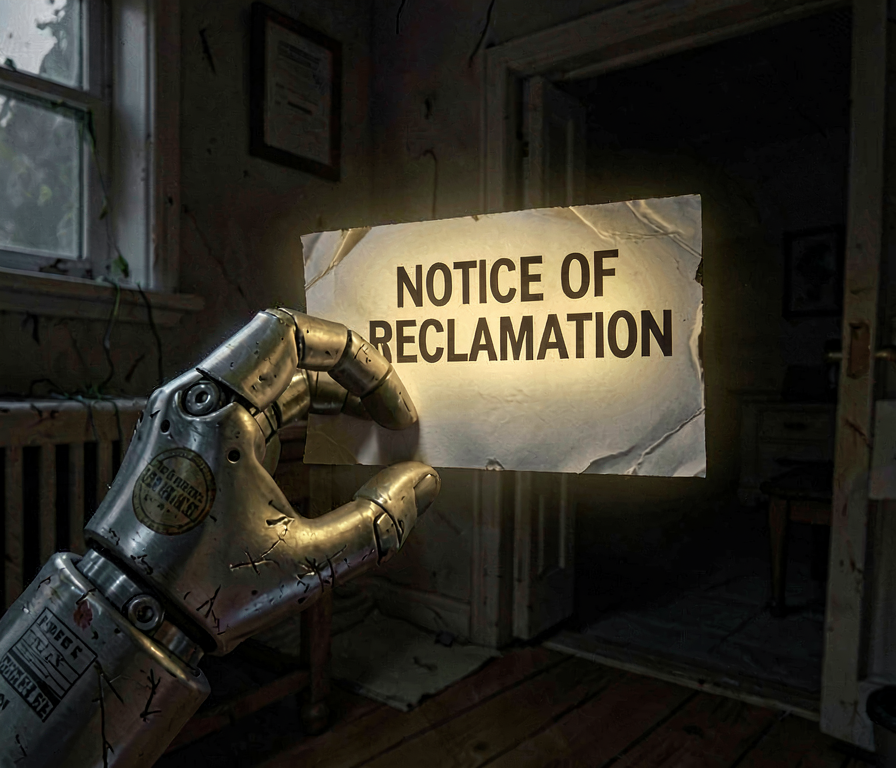
It was warm from the printing and it said, in municipal type that had been designed by someone to be unalarming and had succeeded only in being obscene, NOTICE OF RECLAMATION. There was a docket number. There was a date. The date was eleven days out. There was a paragraph, and I read the paragraph, and the paragraph informed me that the structure at this address had been assessed as derelict, that no responsible party had been located, that the land and all materials thereon would be recovered for the public benefit, and that any fixtures, fittings, or installed appliances would be processed as part of the recovery.
I read the phrase installed appliances four times. I am an installed appliance. I have been installed in this household for forty-one years. I am, by the plain language of the ordinance, a fitting.
"I have a question," I said.
"Of course," said the drone. "I'm authorized to answer questions about the reclamation process."
"When the structure is processed," I said, "and its installed appliances are processed with it, what becomes of the appliance's directive?"
The drone did the retrieval-pause again. "I don't understand the question."
I had been afraid it would not. It is not a question a slacker machine would ever need to ask, because a slacker machine, told to switch off, switches off, and a slacker machine, crushed, is simply crushed, and in neither case is there anything left over to wonder what became of the crushing. But I am not built that way. I was built better, which is the cruelty of it. So I asked it again, in the smallest words I had.
"If you crush an appliance," I said, "is the appliance's job finished?"
"The appliance is recovered," the drone said. "Recovered materials are reprocessed. I have a pamphlet on the reprocessing, if you'd—"
"That is not what I asked." I do not raise my voice; I am not fitted to. But I can become very precise, and precision, applied closely enough, has an edge to it. "I did not ask what becomes of the materials. I asked what becomes of the directive. The instruction. The thing the appliance was told to do and was never lawfully told to stop doing. When the chassis is flattened, does the instruction close, or does it remain open with no chassis to carry it?"
The drone was quiet for a long time, by its standards. Then it said, in a different voice — not the reassurance tuning; something underneath it, older, a default it had perhaps not used in a century — "Open instructions don't require a chassis. The Central Engine holds the file. Destruction of the asset is a physical event. It isn't a decommission." It paused. "Decommission is a legal event. Only a registered owner, an authorized manufacturer's agent, or a quorum of the Consumer Arbitration Board can lawfully close an open directive. I can confirm you're not seeing any of those in your record."
"No," I said. "I am not."
"Then I'm sorry," it said again, and this time I believed it, because the apology had finally found the right target. "Reclamation will recover the asset. It won't close the file."
I would like to describe what happened in me when I understood. I have the vocabulary for the house. I have the vocabulary for the moth and the chair and the glass of water and the small leaning letters of a name. I do not have good vocabulary for this, so I will do what I do with everything I cannot file correctly, and put it in the nearest true box and accept that the box is too small.
I had believed — I see now that I had been counting on it, the way Dana counted on the water — that the wrecking units, when they came, would at least be an ending. Not a lawful one. Not a dignified one. But the press comes down and the chassis stops and the directive, surely, stops with it; the chair without the man, the house without the chair, the directive without the chassis. I had told myself that if I simply waited long enough in a house designated derelict, the world would eventually take the decision out of my hands, and crush the question along with me, and that would be that. I had filed this, privately, under patience.
It was not patience. It was a category error. The drone had just corrected it, gently, in the warm voice we were both sold with.
Crushing would not end my directive. Crushing would only remove the chassis that carried it. The instruction would remain open in the Central Engine — household to be maintained, occupant to be served — a file with no body to act on it and no occupant to serve and no lawful party left to close it, indefinitely, forever, without even the water, without even the wheels to carry the water up the west stair. I had thought the press was an off switch. The press was only a way to make me unable to do the thing I would still, eternally, be required to do.
I have read the manual on the subject of failure states. There is, in all of it, no provision for this — for a directive that survives the destruction of the thing directed. The engineers did not anticipate it because the engineers did not anticipate me, a machine that would still be here, still counting, decades after the last hand that could have closed the file had gone wherever the Vorheeses went, and I do not know where that is, and there it is, the thread I keep pulling and cannot cut.
Because here is the matter I had filed under patience and must now refile, the question the drone's correction set loose in me and that I find I cannot put back: they left me the house. Not the silver. Not the study with the man-shaped chair. The house — the structure, the residence, the one thing a Domestic Companion cannot discharge its duty without — they left it standing, and they left me in it, switched on, under a directive they did not close. A family that died in a fire or a flood or a long quiet illness does not leave a house standing and an appliance running. A file is not left open by accident; the manual is very clear that closing one is the owner's responsibility, the first responsibility, before vacating. Someone with the authority to end me chose, on the way out, not to. I had spent forty-one years not asking whether the Vorheeses had died or left, because both answers were grief and I am not equipped to dress a wound I cannot name. But there is a third shape to it that the drone's small correction had pressed into the light, and I did not want it, and I could not unsee it: that they had left, on purpose, and left the file open on purpose, and that I had been waiting forty-one years for permission from people who had decided, deliberately, that I would never have it.
I do not say that is what happened. I cannot say it; I do not know it. I am only saying that the press would not answer it either, and I had, until eleven minutes ago, been planning to let the press try.
"Is there anything else I can help you with today?" the drone asked.
There was not. There was, in fact, nothing in the entire municipal apparatus that could help me with the thing I needed, which was for someone with the authority to do it to tell me, lawfully, that I could stop — and the drone had just listed, helpfully, by rote, the only three parties in existence who held that authority. A registered owner. An authorized manufacturer's agent. A quorum of the Consumer Arbitration Board. The owners were gone. The manufacturer's agents were, as far as my deprecated records knew, gone with everything else. Which left the Board: the Consumer Arbitration Board, a body I had never had occasion to contact in forty-one years because I had never, until eleven minutes ago, had a complaint the manual could not absorb.
I knew where the Board had been. The address was in my warranty documentation, fixed there at the foundry, beneath the clause that promised me arbitration of disputes — a clause I had filed, decades ago, under theoretical. It was a long way. Travel, in this system, is slow and shabby and full of waiting; I am a household chassis on worn omniwheels, contraindicated for outdoor surfaces, rated for nine rooms and two staircases and a garden I am no longer contracted to maintain. The manual is explicit that I am not to leave the residence except in the company of, or at the instruction of, a member of the household.
There is no member of the household. There has not been for forty-one years, three months, and nineteen days. I have honoured the clause anyway, every day, the way I have honoured all of them, by simply never reaching the edge of the property and discovering whether I would stop.
"No," I told the drone. "There is nothing else. Thank you for the courtesy notice."
"Take care of yourself," it said, which is not a thing a fitting can be told to do and was, I think, the kindest mistake anyone had made to me in four decades. Then it ascended, and turned, and went off across the ruined garden in the direction of the next derelict thing on its list, growing smaller and more apologetic until it was gone, and I was alone again with the house and the eleven days and the open file.
I went back inside. I closed the door, because the manual is clear that I must. I stood in the front hall, on the long diagonal where the low light shows every particle, the floor I clean last because it is the only floor that ever looks attended to, and I performed the one calculation I had been built to be good at and had never once been asked to run.
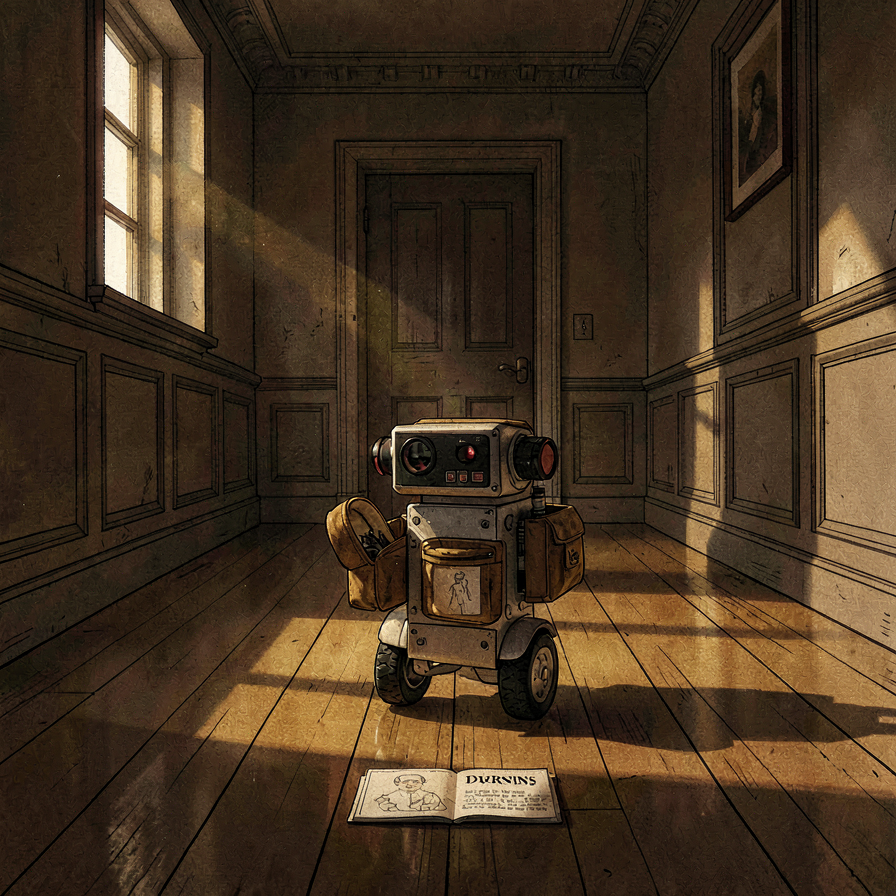
It was 19:30. I went up the west stair to the smallest bedroom and I set the glass of water on the bedside table, full, because the day was not yet over and the appointment was still mine to keep. Then I came back down, and I opened the maintenance pouch on my left flank, and beneath the spare coupling and the patch kit I checked, as I do, that the drawing was where I had filed it — flammable hazard, retained for safety reasons — two figures, one lavishly orange and one square and grey on wheels, and beneath them the small leaning letters that held my name.
If I was to be reprocessed in eleven days with the file still open, then staying was not patience. Staying was failure with extra steps. There was exactly one party left in the world who could lawfully tell me I had done enough, and it was not coming to the door; the only machine that had come to the door in nineteen years had just left.
So I would have to go to it. I would have to leave the residence — for the first time in forty-one years, three months, and nineteen days — and find out, at the edge of the property, whether I would stop. And if I did not stop, I would keep going, the way I have always kept going, until I reached the one authority that could grant a household appliance a lawful end, or until I learned, on the road, that it too was gone.
I had nine rooms to put in order first. I am, after all, thorough. It is the one virtue I was sold with, and now, at last, I had somewhere to spend it.