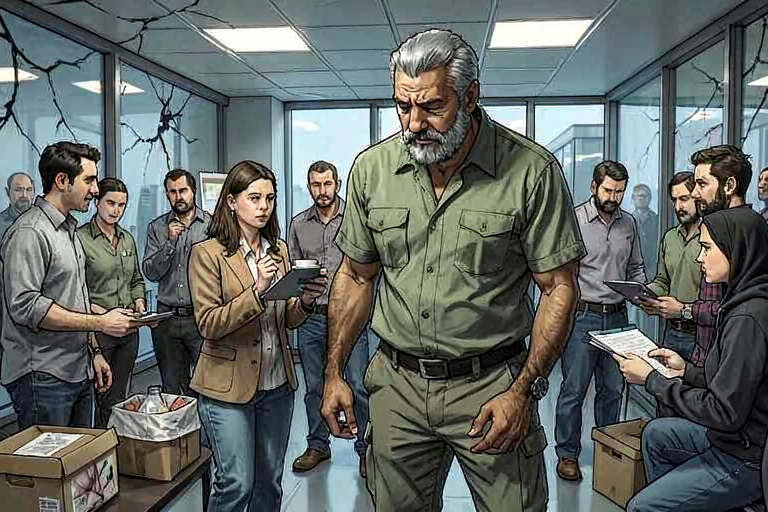
The meeting wasn't planned. That's what made it powerful.
People just showed up in Building 7's common area on a Tuesday evening, drawn by the shared weight of corporate's squeeze and the instinct that suffering alone was worse than suffering together. By 19:00, sixty people had gathered—more than had ever come to anything organized.
Marcus stood up not because anyone asked him to, but because someone had to.
"In my experience," he said, voice carrying across the room, "systems want you isolated. Want you competing with your neighbors for scraps. Because together, we're dangerous."
People listened. Chen near the front, arms crossed, still angry about the maintenance fees. Sarah Kim with her meditation group. Yuki sketching but paying attention. Mrs. Okafor, seventy-two and tired, leaning on her cane. Parents with kids who'd been charged fees at the clinic. Workers who'd quit jobs and were now being punished for it.
All of them squeezed. All of them still here.
"Corporate thinks they're teaching us we need them," Marcus continued. "That without their approval, without their prosperity systems, we'll break. Return to our jobs. Accept exploitation as the cost of survival." He paused. "They're wrong."
"But they're making everything more expensive," someone called out. "Even with the increased money, it's getting harder."
"So we share," Marcus said simply. "We pool resources. We take care of each other. We build systems that don't require corporate approval."
"Like what?" Yuki asked.
"Like everything. Food. Healthcare. Childcare. Repair work. Education. All the things corporate gates behind prosperity scores and fees—we make them available through cooperation instead of currency."
Chen stood up. "I've been running the repair collective. Teaching basic maintenance. But we could expand that. Make it formal. Anyone who knows a skill teaches it. Anyone who needs that skill learns it."
"I can teach coding," someone said. A young person Reed didn't know. "I worked in programming before I quit. I could teach anyone who wants to learn."
"I know hydroponic gardening," Mrs. Okafor offered. "My generation grew up with it before corporations monopolized food production. The community garden could feed us if we expand it."
Ideas started flowing. Sarah Kim volunteered to teach meditation and basic mental health care. Someone else knew how to repair recycling equipment. Another person had medical training from before they'd been forced into unrelated work to maintain their prosperity score.
Reed sat in his corner, watching the room transform. People who'd spent years in isolated survival mode suddenly connecting. Offering skills. Asking for help. Building networks of mutual support.
He opened his notes and documented:
Month 11, Day 20: First community organizing meeting. 60+ attendees. Spontaneous proposal of mutual aid systems. Corporate squeeze creating opposite of intended effect—instead of desperate individualism, building collective resilience. Skills exchange forming. Food sharing network proposed. Healthcare cooperative discussed.
Query: What if scarcity isn't natural but enforced? What if cooperation is human default when artificial competition is removed?
Within three days, Building 7 had a physical skills board mounted in the common area. People could list what they offered and what they needed. The board filled immediately:
*OFFERED: Basic electrical repair (Chen)
NEEDED: Help with math homework, grade 8 level*
*OFFERED: Childcare, evenings (Sarah Kim)
NEEDED: Someone to teach me to cook real food*
*OFFERED: Medical knowledge, basic diagnostics (Liu Chen, former nurse)
NEEDED: Help moving furniture, bad back*
*OFFERED: Teaching art to kids (Yuki)
NEEDED: Nothing, just want to help*
That last one made Reed smile despite himself. Yuki had gone from apologizing for existing to offering labor freely, asking nothing in return. The transformation was complete.
People started helping each other without tracking debts. Chen fixed someone's door, they watched his neighbor's kids. Sarah Kim taught meditation, someone taught her to cook. Liu Chen provided basic medical consultations, people brought her groceries in thanks.
Gift economy emerging organically from imposed scarcity.
Reed documented it all. Took photos of the skills board. Recorded interviews with participants. Built case studies of how mutual aid networks formed when people had enough security to help but faced enough pressure to need help.
Corporate had meant to prove that people needed hierarchy and competition and prosperity scores.
Instead they were proving that people naturally cooperated when given the chance.
The food cooperative formed week two of the organized response.
Mrs. Okafor led it, teaching hydroponic gardening to anyone who'd listen. The community garden expanded from decorative to functional. People contributed initial credits to buy seeds and equipment, then volunteered time to maintain the growing systems.
"Food grown by the community belongs to the community," Mrs. Okafor explained at the second meeting. "You work the garden, you eat from the garden. No one tracks hours. No one calculates worth. We all contribute what we can."
"That's not sustainable," someone argued. "People will take advantage. Not contribute but still eat."
Mrs. Okafor smiled. "In my seventy-two years, I've found that when people have enough, they're generous. It's only scarcity that makes us selfish. We have enough now. We'll be generous."
She was right.
The garden became a communal project. People worked it during free time—an hour here, an afternoon there. Kids helped after school. People who couldn't do physical labor contributed other ways: planning, organizing, teaching.
Within two weeks, they were harvesting real vegetables. Not enough to feed everyone, but enough to supplement the nutri-paste and processed food from sector shops. Enough to feel like abundance instead of mere survival.
Reed ate fresh tomatoes for the first time in five years and felt something crack open in his chest. Tasted like hope. Like cooperation. Like the future corporate said was impossible.
He documented: Community garden producing food. 40+ regular volunteers. Operating on gift economy principles. No tracking. No debt. No prosperity scores. Just people growing food and sharing it. Corporate would say this can't work. The tomatoes disagree.
The healthcare cooperative was harder.
Corporate had weaponized medicine deliberately, making it expensive and conditional. Liu Chen was a former nurse, but practicing without corporate approval could get her arrested for "unauthorized medical services."
The community meeting about healthcare got tense.
"I can help with basic stuff," Liu explained. "Diagnose common illnesses. Provide first aid. Teach people to recognize when they need actual hospital care. But I can't prescribe medication. Can't do surgery. Can't replace real doctors."
"Can you do wellness checks?" Marcus asked. "Monitor chronic conditions? Help people manage existing prescriptions?"
"Yes. That's more education than practice. Teaching people to care for themselves."
"Then that's what we need. Corporate charges 200 credits just to see a doctor. But most of what doctors do is tell you to rest, drink fluids, monitor symptoms. We can teach each other that."
Liu agreed. Started running a weekly clinic—free, no prosperity score checks, no fees. She taught people to take blood pressure, recognize warning signs, manage common ailments. Created a library of medical information that had been gatekept behind professional barriers.
"I'm not replacing doctors," she emphasized constantly. "I'm teaching you to know when you need one. And how to take care of yourselves when you don't."
People came. Asked questions. Learned. The clinic became another node in the mutual aid network.
Reed documented: Liu Chen's healthcare education sessions. 30+ attendees. Teaching basic diagnostic skills and self-care. Demystifying medicine. Corporate profits from medical ignorance—keeps people dependent. Community response: spread knowledge. Make healthcare literacy accessible. Can't replace all medical care but can reduce unnecessary dependence.
The childcare collective emerged from parents' desperation and became something beautiful.
Before the squeeze, parents could afford childcare or manage with reduced work hours. But corporate's fees were straining budgets again. Professional childcare was expensive. Family members worked their own jobs. Kids were falling through gaps.
Sarah Kim proposed a rotation: parents would take turns watching a group of kids. Two parents, eight kids, rotating shifts. Everyone contributed time, everyone got time.
"But my kid is difficult," one parent worried. "Special needs. I can't ask others to deal with that."
"You're not asking," Sarah said gently. "We're offering. That's what community means."
The collective started small—five families. Quickly grew to fifteen. Parents discovered they liked caring for each other's children. Kids thrived in mixed-age groups, learning from each other.
And parents had time. Time to work if they wanted. Time to rest if they needed. Time to exist as people instead of just caretakers in isolated family units.
Reed watched a parent cry with relief when they dropped their three kids off and realized they had an afternoon. Just an afternoon. To sleep. To read. To be alone.
Corporate had meant to grind people down with fees and barriers.
Instead people were building systems that cared for each other better than corporate ever had.
Reed documented: Childcare collective serving 15 families, 32 children. Parents rotating shifts. No payment, just reciprocity. Kids happy. Parents getting rest. Someone said: 'It takes a village.' Corporate tried to eliminate villages, make everyone compete in isolation. Community rebuilding village despite them.
Three weeks into the organized response, Building 7 had fundamentally changed.
The skills board was covered in offerings. The community garden was producing food. Liu Chen's healthcare education was preventing unnecessary clinic visits. The childcare collective was thriving. Chen's repair team was maintaining the building better than corporate ever had.
People still paid the fees. Still dealt with degraded air quality and transit costs and all the ways corporate squeezed them. The pressure was real.
But they weren't alone in it. Weren't competing for scarce resources. Weren't isolated in desperation.
They were together. Taking care of each other. Building alternatives.
Reed sat in the common area during the third community meeting—now a weekly event with 80+ attendees—and listened to people share updates.
Chen reported the repair collective had fixed 94 work orders corporate had ignored.
Mrs. Okafor announced the garden harvest had provided fresh vegetables to 73 families.
Liu Chen said her healthcare education had reduced clinic visits by 40%.
Sarah Kim reported the childcare collective was expanding to a second building.
Someone proposed a clothing exchange. Someone else suggested a tool library. Ideas kept flowing.
Marcus stood and smiled. Actually smiled. "In my experience," he said, "corporate thinks money is power. But this is power. People cooperating. Taking care of each other. Building systems that serve humans instead of profits."
Applause. Not polite applause. Real applause. The sound of people recognizing their own strength.
Reed felt tears on his face before he knew he was crying. Wiped them away quickly. Kept documenting.
Because this was it. This was what he'd been trying to prove since the beginning.
That people weren't broken. The system was broken.
That given security and community, people didn't become lazy or selfish or entitled.
They became generous. Creative. Cooperative.
They became human.
Reed wrote: Month 11, Day 35: Community response to corporate squeeze fully operational. Mutual aid networks functioning. Gift economy emerging. People teaching, sharing, helping without tracking debts or demanding payment. Corporate wanted to prove UBI made people dependent. Instead proving people thrive when freed from artificial scarcity. They meant to crush us. They made us stronger.
Note to self: The money matters. Security matters. But this—the community, the cooperation, the solidarity—this is what survives when the money runs out. Corporate can drain my fund. Can't drain this.
Marco: We did it. We proved they're wrong. People are good. When given the chance, people are so fucking good.
Reed closed his notes. Sat in the warm chaos of community meeting. Listened to people planning their collective future.
And for the first time in ten years, felt something uncomplicated by despair or Leveler or ironic detachment.
Felt proud.
Of them. Of himself. Of what they'd built together.
Corporate could squeeze all they wanted.
This wouldn't break.