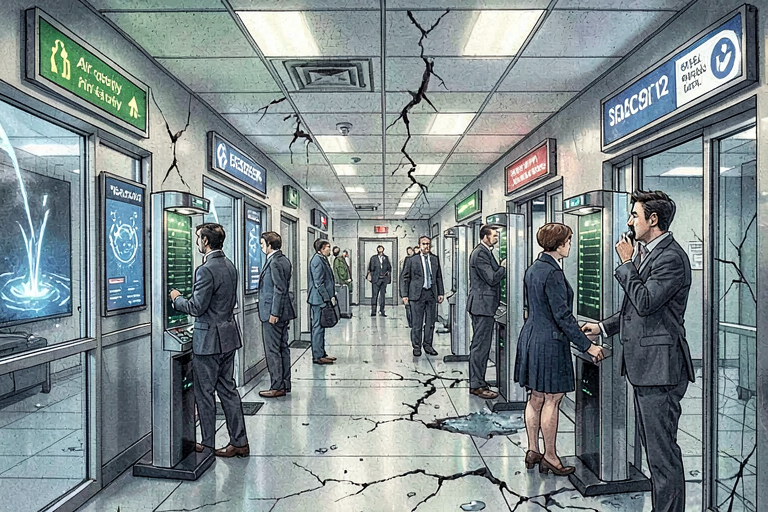
The air quality dropped first.
Not dramatically—corporate was too smart for that. Just a gradual degradation from "optimal breathing environment" to "baseline regulation standard." The kind of change you might not notice if you weren't paying attention. If you weren't already suspicious that every small discomfort was deliberate.
Reed noticed.
He stood in Building 7's main corridor on the first day of the new policies and felt the difference in his lungs. Slightly stale. Slightly harder to breathe deeply. Nothing dangerous—corporate would never risk actual violations—but definitely worse.
A notification appeared on every resident's tablet simultaneously:
PROSPERITY OPTIMIZATION UPDATE: Effective immediately, Sector 12 will transition to baseline environmental standards to better align with traditional prosperity metrics. Enhanced air quality, water purification, and maintenance services will be available through individual subscription. Visit your Prosperity Portal to explore upgrade options!
Reed pulled up the pricing. Enhanced air quality: 150 credits per month. Advanced water filtration: 100 credits per month. Priority maintenance: 80 credits per month. Temperature regulation beyond baseline: 120 credits per month.
450 credits total for what had been standard last week.
Multiply that by 200 units in Building 7. That was 90,000 credits monthly. Corporate was deliberately increasing his burn rate, forcing him to either let people suffer or spend more to maintain what they'd already achieved.
Reed increased the monthly transfer to 3,200 credits.
Sent a message to all recipients: Cost adjustments incoming. Don't let them grind you down. Keep breathing.
Then he opened his financial projections and did the math he'd been avoiding.
At 3,200 credits per month per unit, he was burning through 640,000 credits monthly. 7.68 million annually. The fund had started at 500 million. After eleven months of increasing payments, he'd spent approximately 63 million.
437 million remaining.
At current burn rate: 68 months until depletion. Five and a half years.
Unless corporate escalated again. Which they would.
Reed closed the projection file. Took a hit of Leveler. Watched his hands stop shaking.
Five and a half years wasn't forever, but it was enough. Enough to prove the point. Enough to document the transformation. Enough for Amara to publish her research and make the data unkillable.
Enough to matter.
The maintenance cuts came next.
A notification on day three of the new regime:
MAINTENANCE SERVICE OPTIMIZATION: Sector 12 maintenance will transition to request-based service to encourage resident agency and prosperity initiative. Submit work orders through your Prosperity Portal. Priority handling available with premium subscription!
Translation: Nothing gets fixed unless you pay extra.
The building started degrading immediately in small ways. A light flickering in the common area. A door that stuck. The water temperature in the showers fluctuating wildly. The recycling chute jamming.
None of it dangerous. All of it grinding.
Reed watched residents get frustrated and start filing work orders. Watched the work orders sit in "pending review" status for days. Watched people realize that corporate wasn't going to fix anything unless they paid the 80-credit monthly "priority maintenance" fee.
Most people paid. The UBI covered it. But Reed saw what corporate was doing—death by a thousand fees. Make survival technically possible but increasingly expensive. Force the benefactor to spend more or watch quality of life erode.
Chen organized a repair collective. People who knew basic maintenance teaching others. Fixing what they could themselves. Building independence from corporate's deliberate neglect.
Reed documented it: Month 11, Day 7: Community organizing mutual aid maintenance. Chen leading training in basic repair. 23 people attended. Systems that create artificial scarcity create conditions for cooperation. Corporate thinks they're punishing us. They're actually building solidarity.
The medical restrictions hit the hardest.
Week two of the squeeze, new policy:
HEALTHCARE ACCESS OPTIMIZATION: To ensure efficient resource allocation and encourage preventive prosperity practices, Sector 12 healthcare will require enhanced prosperity score verification. Residents with declining scores may experience adjusted service tiers.
The free clinic in Sector 12 started turning people away. Not everyone—that would be too obvious—but enough to send a message. People whose prosperity scores had dropped because they'd quit exploitative jobs. People whose scores flagged them as "voluntarily reducing workforce participation."
Marcus's daughter Aisha got sick. Just a fever, probably nothing, but Marcus took her to the clinic anyway. Better safe than sorry.
The receptionist checked her prosperity score. Checked Marcus's score. Both had dropped since they'd stopped prioritizing work hours over everything else.
"I'm sorry," the receptionist said, and actually sounded sorry. "Aisha Ibrahim is flagged for adjusted service access. She can be seen, but there's a 200-credit consultation fee. Or if you'd like to enroll in the healthcare priority program, that's 180 credits monthly and waives most fees."
Marcus stared at her. "She's fourteen and has a fever."
"I understand. I don't make the policies. I'm just—"
"Following orders." Marcus's voice was flat. "In my experience, that's what people say when they know what they're doing is wrong."
He paid the 200 credits. Aisha got seen. She was fine—virus, rest, fluids. But Marcus left the clinic shaking with rage.
Reed found him in the common area that night, staring at nothing.
"They're making our kids pay for our choices," Marcus said quietly. "She's fourteen. She didn't quit any jobs. She's just trying to go to school. But because I stopped destroying my body for their prosperity metrics, she gets punished."
Reed sat down. Didn't say anything. What was there to say? Marcus was right. The cruelty was the point. Corporate was using children to pressure parents back into compliance.
"I can cover the healthcare fees," Reed said finally. "Increase transfers again. Make sure everyone can afford—"
"That's not the point." Marcus cut him off. "The point is they're weaponizing medicine. Making healing conditional on obedience. That's..." He trailed off. Looked at Reed directly. "That's evil. I know corporate doesn't think of it that way. They've got fancy words for it. But taking healthcare from kids to punish their parents for wanting dignity—that's just evil."
Reed nodded. Thought about Marco, dead at twenty-five because healthcare was gated behind prosperity scores. Thought about how the system had always weaponized survival. Had always used the threat of death to maintain control.
The only difference now was that Sector 12 had briefly escaped that threat. And corporate was working hard to re-impose it.
"I'll increase the transfers," Reed said. "3,500 per month. That should cover the healthcare fees and the other escalations."
"How long can you sustain that?"
Reed did the math in his head. 3,500 times 200 units. 700,000 monthly. 8.4 million annually. "Four years. Maybe five if they don't escalate again."
"They'll escalate again."
"Yeah. Probably."
They sat in silence. Around them, Building 7 hummed with the muted stress of people being systematically ground down. The air quality was worse. The maintenance was failing. Healthcare was becoming unaffordable. All the progress of the last eleven months being slowly strangled by corporate policy.
But people hadn't broken. Hadn't given up. Hadn't rushed back to exploitative jobs just to restore their prosperity scores.
They'd organized. Formed repair collectives. Started healthcare sharing programs. Created support networks. Found ways to take care of each other that didn't require corporate approval.
Corporate thought they were teaching Sector 12 a lesson about the necessity of work.
Instead, they were teaching them about the necessity of solidarity.
Reed increased the transfers to 3,500 credits monthly. Sent another message: They're trying to make you desperate again. Don't let them. We're in this together.
Then he updated his documentation:
Month 11, Day 14: Corporate escalation in full effect. Air quality degraded. Maintenance request-only. Healthcare gated behind prosperity scores. Clear pattern: weaponize survival to force compliance.
Expected response: people break, return to jobs, experiment proves unsustainable.
Actual response: community organization accelerates. Repair collectives. Healthcare sharing. Mutual aid networks. People angrier but stronger. Corporate thinks they're proving UBI doesn't work. They're actually proving we don't need them.
New burn rate: 700,000 monthly. 52 months until depletion at current rate. Corporate will escalate. Timeline compressing. But the data is solid. Four years of transformation documented. Even if it ends tomorrow, we proved it works.
They can make us uncomfortable. They can't make us wrong.
Reed saved the file. Encrypted it. Backed it up.
Looked around the common area. At Chen teaching repair skills. At Sarah Kim leading a meditation session for stressed parents. At Yuki painting a mural on the wall—beautiful and defiant and unauthorized.
At people living despite corporate's best efforts to make living conditional on submission.
The squeeze was real. The pressure was building. But so was something else.
Resistance.
Community.
The stubborn insistence on remaining human.
Reed took another hit of Leveler. Felt the chemical distance settle over everything. Still here. Still watching. Still documenting.
Still burning through millions of credits to prove that people deserved security without strings.
Still worth it.
Even as the walls closed in.
Week three of the squeeze, and the small cruelties accumulated into crushing weight.
Transit costs increased. "Dynamic pricing to optimize station-wide mobility." Getting to work, getting to school, getting anywhere—suddenly twenty percent more expensive.
Food prices rose in sector shops. "Market-based adjustments reflecting current prosperity equilibrium." The same meals, the same nutri-paste, suddenly tagged with "prosperity-adjusted pricing."
Even water—baseline water, the minimum required for survival—had a new line item on monthly bills: "Hydration infrastructure maintenance fee."
Each fee was small. Twenty credits here. Thirty there. Fifty for the other thing. None of it enough to break anyone by itself.
All of it designed to bleed people. To make the UBI insufficient. To force choices: pay the fees or return to work. Maintain dignity or maintain comfort.
Reed calculated the total impact: approximately 600 additional credits monthly across all the new fees and increases.
He raised the transfer to 4,000 credits per month.
At that rate: 800,000 monthly. 9.6 million annually. Four and a half years until the fund ran dry.
Unless corporate escalated again.
They would escalate again.
Reed understood he was in an arms race he'd eventually lose. Corporate had infinite capacity to make life harder. Could impose endless fees, reduce infinite services, create unlimited barriers.
He had 437 million credits. Finite. Exhaustible.
The math was simple.
But four and a half years was enough time for Amara to publish. For the data to get out. For other sectors to see what was possible. For the idea to spread.
The money would run out eventually.
The idea wouldn't.
Reed opened his messages. Sent one to Amara: They're escalating. Weaponizing everything—healthcare, transit, water. Making me burn through funds faster. Timeline compressing. How long until you can publish?
Her response came back within minutes: Conference in 3 weeks. Paper submission next week. I'm ready. The data is undeniable.
Publishing will end your career, Reed wrote.
I know.
Why do it?
A long pause. Then: Because you're right. Because they're wrong. Because someone has to say it out loud even if it costs everything. Same reason you started this.
Reed smiled despite himself. Despite the squeeze. Despite the inevitable.
Yeah, he wrote. Same reason.
Three weeks until the data went public. Three weeks until corporate couldn't bury the truth anymore.
Reed just had to keep Sector 12 alive that long.
Had to keep burning money to prevent the suffering corporate was deliberately creating.
Had to watch the timer count down toward either vindication or collapse.
Probably both.
He looked at his financial projections one more time. The curve of spending. The projected depletion date. The slow-motion catastrophe of trying to fight a system with infinite power using finite resources.
Then he closed the file and went back to documenting.
Because that's what mattered. Not winning—he couldn't win, not permanently. But proving. Showing. Creating a record that would survive even if he didn't.
Even if Sector 12 didn't.
Even if the whole experiment collapsed under corporate pressure.
The data would remain.
The truth would persist.
And somewhere, someone would read it and know: for eleven months in Building 7, Sector 12, people had security without strings.
And they'd bloomed.
Before the system crushed them for it.