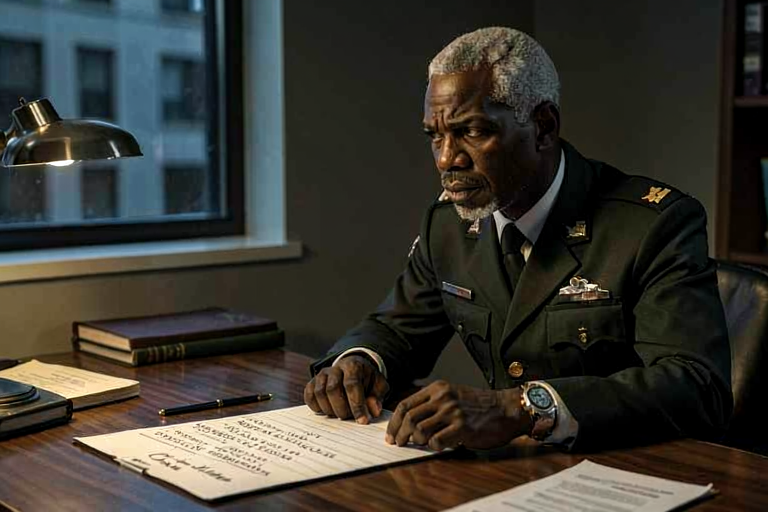
Commander James Wright stared at the casualty report and felt nothing.
That was the problem.
Forty-seven civilians dead. Hundreds injured. Property damage in the millions. Three SSS officers killed, fifteen wounded.
The numbers should have meant something. Should have hurt.
Instead, they were just data. Metrics in a report. Outcomes of tactical decisions.
When had he stopped feeling it?
"Sir?" Lieutenant Mboto stood in his doorway. "The Council wants an updated threat assessment on Level 8."
"Tell them it's contained. Chen's in hiding, the operation's disrupted, cooperatives are disorganized. No immediate threat."
"Is that accurate?"
Wright looked up sharply. "You questioning my assessment?"
"No sir. I'm questioning whether you believe it."
The two men stared at each other.
"Dismissed, Lieutenant."
Mboto left. Wright returned to his reports.
Except he couldn't focus.
I'm questioning whether you believe it.
Did he?
The data said Level 8 was contained. Chen hadn't been seen in weeks. No major incidents since the riot. SSS patrols reported compliance.
But Wright had been doing this job long enough to know the difference between submission and strategy.
Level 8 wasn't beaten. It was organizing.
That evening, Wright did something he hadn't done in years: he went home early.
His apartment in Level 3 was empty. Professional. Sterile. A place to sleep, nothing more.
He poured a drink. Sat by the window looking out over the station's central axis.
From here, he couldn't see Level 8. Could barely see Level 7. Just the gleaming upper tiers, spinning in their careful rotation.
His comm unit chimed: his sister.
Wright almost didn't answer. Teresa lived in Level 7. They'd grown up together in the same cramped housing block. He'd climbed out through military service and brutal work. She'd stayed, raising three kids on sanitation wages.
He answered.
"James. Haven't heard from you in months."
"Been busy."
"I saw. The riot made news even up here." A pause. "Did you have to kill them?"
"They were armed. Attacking officers. It was defense."
"They were throwing bottles and you authorized live rounds. That's not defense, James. That's massacre."
"You don't understand the tactical situation—"
"I understand you killed Mrs. Huang. Remember her? Used to watch us when Mom worked doubles? Seventy years old and you let her get trampled in a riot you started."
Wright's hand tightened on his glass. "We didn't start it. Chen did. His illegal operation—"
"His illegal operation fed people, James. Including my kids. Last year when I couldn't make rent and food in the same month, Chen's restaurants kept my children from starving. And you shut him down for it."
"He was breaking the law."
"The law that says feeding people without a license is criminal? That law?" Teresa's voice hardened. "You used to be one of us. Now you're one of them. And you can't even see the difference."
"I'm trying to maintain order—"
"You're trying to maintain a system that crushes people like us to comfort people like you. And you've convinced yourself that's righteous." A long pause. "Mom would be ashamed."
The line went dead.
Wright sat with his drink and his sister's words.
Mom would be ashamed.
Their mother had died in Level 7. Couldn't afford medical care for a treatable infection. Wright had been twenty-two, just accepted into SSS training. He'd promised to send money back.
But by the time his first paycheck cleared, she was already gone.
He'd told himself he'd make it mean something. Rise high enough to change things. Fix the system from inside.
Thirty years later, he was enforcing the system that had killed her.
And calling it duty.
The next day, Wright requested files he'd been avoiding: background on the forty-seven casualties.
Mrs. Huang: Retired factory worker. Three grandchildren. Volunteered at Chen's restaurant because she wanted to feel useful.
Terrence Rodriguez: Nineteen. Tech student. Teaching coding to kids at Chen's youth center. No criminal record.
Marcus Liu: Sixty-eight. Widower. Lived alone. Chen's meal program was his only social contact.
On and on. Forty-seven lives reduced to paragraphs.
None of them were criminals. Not really. Just people trying to survive in a system designed to keep them struggling.
People like his mother.
Like his sister.
Like he'd been, once.
Wright closed the files.
His comm chimed: Volkov.
"Wright. The Council's planning next phase operations against Level 8. We need your tactical assessment."
"Level 8 is contained."
"I know what you reported. I'm asking what you actually think."
Wright was quiet for a long moment. "I think we're making martyrs. Every person we arrest, every asset we seize, every utility we cut—we're proving Chen's narrative. That Corporate crushes people for trying to survive."
"That's a political analysis, not a tactical one."
"Politics is tactics on a longer timeline."
"Are you saying we should back off?"
"I'm saying the raid killed forty-seven people and Chen's more influential now than before. We're losing even when we win."
Volkov was silent. Then: "What would you recommend?"
Wright thought about his mother. His sister. The forty-seven names he'd memorized.
"Let it burn out on its own. Chen's money is nearly gone. In a few months, the operation collapses naturally. We look magnanimous, he looks like a failure, and no one else dies."
"And the cooperatives? The organizing?"
"Are legal. Annoying, but legal. We can't arrest people for sharing resources."
"We can make it difficult."
"We can. Or we can let them organize and fail on their own. Most cooperatives collapse within a year. Time is on our side."
Another silence. "I'll consider it. But Wright? If you're losing your edge for this work, tell me now."
"I'm not losing my edge. I'm gaining perspective."
"That's the same thing in this line of work."
The call ended.
Wright sat in his sterile apartment and wondered when he'd become the villain in his own story.
When had he stopped being the kid from Level 7 trying to protect people?
When had he become the boot crushing them instead?
He didn't have an answer.
But he was starting to suspect it mattered.
And that scared him more than anything else.