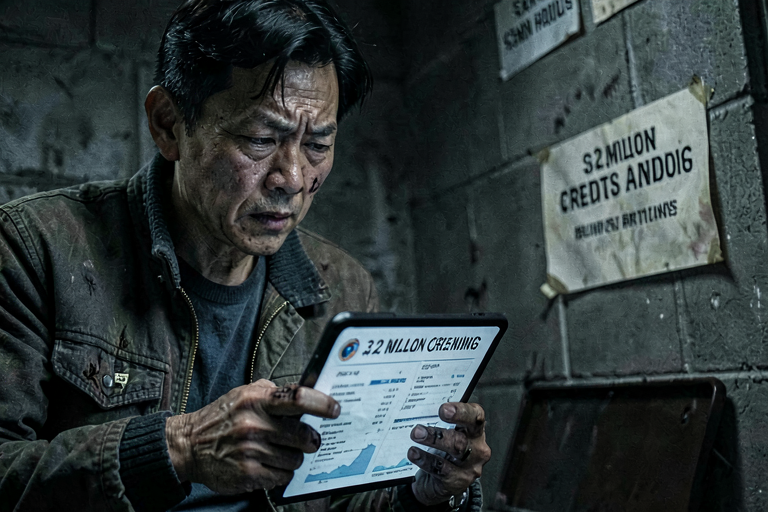
The accountant's message was blunt: You have 3.2 million credits left. At current burn rate, that's 19 weeks. Four and a half months. After that, you're broke.
Nico stared at the number.
3.2 million.
Once, that would have seemed like a fortune. Enough to live on for decades.
Now it was nineteen weeks until everything collapsed.
"We need to cut costs," Maya said, reviewing the same data.
"I've cut everything I can cut. The cooperatives are mostly self-funding now. We're only covering emergency cases and startup capital for new organizations."
"Then we need new revenue."
"From where? I can't exactly get a job. I'm a fugitive."
"What about fundraising? People who've been helped—many of them have resources now. Maybe they contribute back?"
Nico pulled up the cooperative data. Maya was right—some of the early cooperatives were generating surplus. Small amounts, but surplus nonetheless.
"You want me to ask the people I've been helping to fund the operation?"
"I want us to build sustainability. Right now, money flows one direction: from you to them. If it flowed both ways—even a little—we could extend the runway."
It made sense. Economically, it made perfect sense.
But it felt wrong. Like betraying the whole point of what he'd built.
"The moment I start asking for money back, it stops being charity and starts being... what? A protection racket? Pay Uncle Nico or the help stops?"
"Or it starts being a mutual aid network," Maya countered. "People who've been helped helping others. Isn't that what we've been trying to build?"
"By asking them to fund me?"
"By asking them to fund the network. You're not the network anymore, Nico. You're just part of it."
The truth of that stung.
He'd been trying to make himself unnecessary. Apparently it had worked.
That afternoon, Nico met with representatives from twelve established cooperatives. All of them had been seed-funded by his money. All of them were now self-sustaining.
Lin facilitated the meeting from a secure location. Nico attended via encrypted video, face obscured.
"Thank you for coming," he started. "I'm going to be direct: the money's running out. Nineteen weeks, maybe less. After that, there's no more startup capital. No more emergency funds. Nothing."
The representatives exchanged glances. Some looked worried. Others looked... ready?
"We knew this was coming," said Maria Chen, head of Food Cooperative #4. "You told us from the start this was temporary. That we needed to build sustainability."
"Right. And you have. But there are still new cooperatives forming. Still people needing emergency help. Still—"
"Still you playing benefactor instead of letting the network mature," Lin interrupted. "Let them speak, Nico. You called this meeting to listen, not lecture."
Nico shut up.
Jorge Rivera, Housing Collective #7: "We've been discussing this. The established cooperatives. We can contribute. Not a lot—we're still building reserves. But maybe... five percent of monthly surplus back into a general fund? For emergencies and new startups?"
"That's not enough to—"
"It's not supposed to be enough," Maria said. "It's supposed to be the start. More cooperatives establish, more contribution flows in. Eventually, the network sustains itself without you."
"Eventually I'm bankrupt and the whole thing collapses."
"Or eventually you step back and the network you built continues without you," Lin said. "Isn't that the goal?"
Was it?
Nico had said it was. Had pushed for sustainability. For teaching people to organize themselves.
But he'd never actually believed they'd get there before the money ran out.
"Five percent of surplus across twelve cooperatives is maybe 8,000 credits monthly," Nico said. "I'm burning through 200K weekly. The math doesn't work."
"Not yet," Jorge agreed. "But we're recruiting new cooperatives. The propaganda war made people angry. They're organizing faster. By next month, we project twenty cooperatives contributing. By the month after, thirty-five."
"That's still not enough."
"No. But it's a start. And it means when your money runs out, the network doesn't collapse entirely. It shrinks, stabilizes, then grows from internal resources instead of external charity."
Maya leaned forward. "What you're describing is exactly what we've been trying to build. Nico, this is success. Painful, insufficient, imperfect success. But success."
"It's failure with extra steps. Nineteen weeks until I'm broke. However many people still need help at that point just... what? Go without?"
"No," Maria said firmly. "They get absorbed into the network. We help them start cooperatives. Pool resources. Build collective power. It's slower than Uncle Nico writing a check. But it lasts."
The meeting continued for two hours. By the end, the plan was clear:
Twelve established cooperatives would contribute 5% of monthly surplus.
They'd recruit and train emerging cooperatives to do the same.
The fund would prioritize emergency aid and startup capital.
Nico would continue funding for nineteen more weeks.
After that... the network would have to survive on its own.
It probably wouldn't. Not entirely. Some people would fall through cracks. Some emergencies wouldn't get covered. Some suffering would go unhelped.
But maybe—maybe—enough of the structure would survive to rebuild.
Maybe.
That night, Nico updated his financial projections:
Current: 3.2M credits
Weekly burn: 200K (decreasing as cooperatives become self-sufficient)
Cooperative contributions: 8K monthly (increasing as network grows)
Projected depletion: 19 weeks
Best case scenario: 22 weeks if cooperative growth accelerates
Worst case: 16 weeks if Corporate escalates again
No case ended with him still having money.
Every case ended with the question: what survives when the King goes broke?
Nico closed the spreadsheet.
Pulled out his vape pen.
Took five hits before his hands stopped shaking.
Nineteen weeks.
Four and a half months.
To build something that lasted beyond his bank account.
To prove that what he'd started mattered more than the money that started it.
To become unnecessary.
The hardest goal he'd ever faced.
And the only one that mattered.