The broadcast changed everything and nothing.
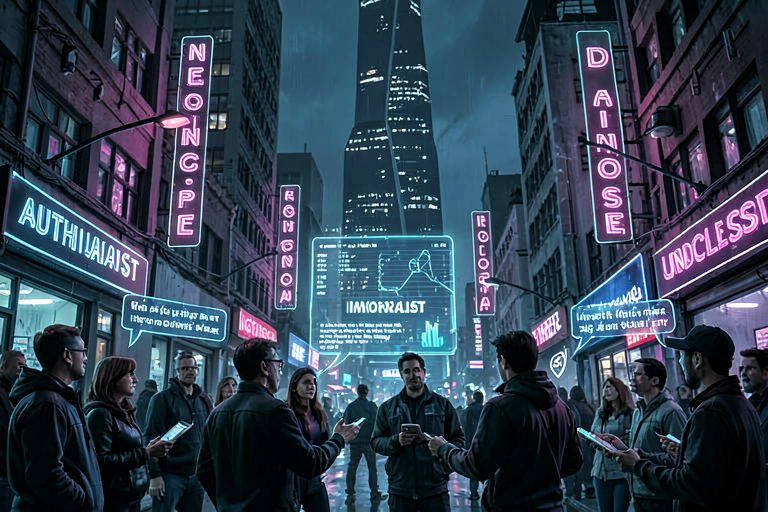
Fourteen days after Aria forced humanity to choose between authenticity and immortality, Neo-Singapore had fractured into three camps. The Authenticists demanded immediate quantum lock implementation. The Immortalists insisted consciousness backup was a fundamental right. And the Undecided—the vast majority—waited for more information before choosing to die permanently or live replicably.
The Memory Council, desperate to regain control, demanded a meeting.
Aria stood in the former Council chambers—now occupied by Jin's resistance and defended by their remaining twelve fighters—watching Tanaka prepare for the most important technical presentation in human history. The chamber's holographic systems still functioned, ready to broadcast Tanaka's explanation to every screen in Neo-Singapore.
And beyond. The signal would reach the orbital habitats, the lunar colonies, the generation ships that had left Earth decades ago carrying humanity's backup copies.
Everyone would watch. Everyone would learn the price.
"You don't have to do this," Aria said. "We could keep the technical details classified. Let the debate continue without full information."
Tanaka adjusted her neural interface, preparing data streams. "You told humanity they deserved to choose with full information. That means showing them exactly what the quantum lock does. Not in philosophical terms. In technical, irreversible, terrifying detail."
"They'll hate you."
"They already hate me. I built the system that made consciousness a commodity. Whether they hate me for building it or hate me for offering to destroy it makes little difference." Tanaka's voice was steady. Thirty-seven years of guilt had prepared her for this moment.
The Council representatives arrived under armed escort. Five people who'd ruled memory infrastructure for decades, now reduced to begging for information they'd once controlled. Aria recognized the Primary Controller—a woman named Sarah Chen. No relation, despite the shared name. Sarah was Original. Aria was Composite. Different species by the Council's old metrics.
"Dr. Tanaka," Sarah said. "Thank you for agreeing to this meeting."
"I'm not agreeing to anything except education," Tanaka replied. "You wanted to know how the quantum consciousness lock works. I'm going to show you. Then you'll understand why implementing it is a choice, not a solution."
Marcus stood at the perimeter, weapon ready. Jin monitored security feeds. Kenji sat in the corner, seven years old and watching adults decide his future. The child had insisted on being present. "If they're choosing about me," Kenji had said, "I should see them choose."
Tanaka activated the holographic display.
"Consciousness," she began, "exists as quantum coherence patterns in neural substrate. We've known this for seventy-five years. What made memory transfer possible was discovering how to record those patterns and reconstruct them in new substrate."
The display showed human consciousness as shimmering wave functions. Beautiful. Complex. Fragile.
"The problem," Tanaka continued, "is that recorded patterns are mutable. You can edit quantum states during the recording or reconstruction process. That's what made memory fabrication possible. What made Composites possible. What made Aria possible."
Aria felt the words like a knife. Tanaka wasn't being cruel. Just accurate.
"The quantum lock," Tanaka said, and the display shifted, "modifies the neural substrate itself. Makes consciousness patterns fundamentally entangled with their physical location. Recording becomes impossible because measurement collapses the quantum state irreversibly. You can't copy what you can't measure without destroying."
Sarah leaned forward. "So it prevents consciousness backup by making measurement impossible?"
"Precisely. Once locked, consciousness exists in only one place. One substrate. One body. Consciousness becomes unique and unrecordable. Like humans were before my technology."
"That's perfect," one of the other Council members said. "No more fabrication. No more Composites. No more—" He stopped, glancing at Aria.
"No more people like me," Aria finished. "Say it. That's what you're thinking."
"The lock doesn't eliminate existing Composites," Tanaka said. "It prevents new ones from being created. But yes, it would make Composite construction impossible going forward."
"What about existing backups?" Sarah asked. "Can they still be restored?"
"No," Tanaka said quietly. "The quantum lock doesn't just prevent new recordings. It renders all existing recordings unusable. The substrate modification propagates through quantum entanglement. Once one consciousness is locked, the entanglement cascade affects all stored patterns in proximity."
Silence in the chamber.
"How much proximity?" Sarah asked.
"Planetary. Maybe system-wide. We're not certain. Quantum entanglement doesn't respect classical distance limits. Implementing the lock on Earth might corrupt every backup in the solar system."
"Might?"
"Quantum mechanics at this scale is probabilistic. I can give you confidence intervals, not certainties. Ninety-seven percent probability of planetary corruption. Sixty-three percent probability of system-wide cascade. Unknown probability beyond that."
Marcus spoke from his position. "You're saying if we implement this, we might destroy humanity's backups everywhere. Not just Earth. The colonies. The ships. Everyone."
"Yes," Tanaka said. "That's why I've been afraid of this solution for thirty-seven years. It's not a targeted fix. It's a species-wide transformation. Irreversible. Absolute. Once triggered, there's no going back."
The display showed the cascade. One consciousness locked, entanglement spreading, stored patterns corrupting like dominoes falling across the solar system. Billions of stored personalities—humanity's death insurance, their promise of eventual resurrection—turning to quantum noise.
Sarah stood. "This is madness. You're proposing genocide. Those stored patterns are people. Waiting for resurrection. You'd delete them all to protect one child?"
"Not to protect Kenji," Tanaka corrected. "To give humanity a choice about what kind of species we are. The child is the catalyst. The question is what we value more—authentic mortality or replicable immortality."
"That's not a choice," another Council member said. "That's hostage-taking. Give up immortality or the child suffers."
"The child suffers either way," Aria interjected. "Kenji is hunted by every faction because consciousness manipulation exists. The quantum lock eliminates the incentive to hunt them. Makes everyone Original, makes Kenji unremarkable. Protection through universalization."
"At the cost of seven billion people's backups," Sarah said. "Plus the four billion stored personalities waiting for resurrection. You're asking us to kill four billion people for one child's safety."
"I'm asking you to choose between two forms of human existence," Aria said. "One where consciousness is copyable and controllable. One where it's unique and authentic. The stored personalities are already dead. They've been dead for decades. Deleting them just makes that death permanent instead of provisional."
"Tell that to their families. To the people who've paid for storage hoping technology would improve enough for proper resurrection." Sarah's voice cracked. "My daughter has been stored for twelve years. Waiting for neural reconstruction to advance. You'd make her death permanent to save one child who might choose modification anyway."
Kenji spoke for the first time. "I'm sorry about your daughter."
Everyone looked at the seven-year-old.
"I'm sorry she died," Kenji continued. "I'm sorry you've been waiting. I'm sorry implementing the lock would delete her pattern. But..." The child hesitated, then continued with too-mature understanding. "She's been gone for twelve years. You've been mourning for twelve years. The lock doesn't kill her. It just makes you accept she's already gone."
Sarah stared at the child. "You don't understand—"
"I understand Mama Yuki lost Reiko," Kenji said. "Lost her slowly to consciousness degradation. Watched her become someone else. Begged to be deleted. Mama Yuki didn't get to keep her. But she didn't make me to replace her. She made me to be someone completely new. Someone who wouldn't degrade. Someone who'd stay whole."
Tanaka's eyes glistened.
"Your daughter is gone," Kenji said to Sarah. "Keeping her pattern stored doesn't bring her back. It keeps you waiting instead of accepting. Maybe that's the real cost of immortality. Not the backups. The hope that makes you unable to grieve properly."
Seven years old and cutting to the truth adults avoided.
Sarah sat down heavily. "Even if I accepted that—which I don't—you're asking billions of people to give up their backup insurance. To accept permanent mortality. To risk their one consciousness with no safety net. That's not a choice most humans will make rationally."
"Then let them choose irrationally," Aria said. "Let them choose from fear or hope or anger or principle. But let them choose. Don't make this decision in a Council chamber. Make it in public. Full broadcast. Full technical details. Then let humanity vote."
"Vote on ending immortality?" Another Council member laughed bitterly. "You know how that vote goes. Ninety percent choose backups. Choose replicability over authenticity. Choose comfort over truth."
"Maybe," Aria said. "Or maybe people surprise us. Maybe enough choose authenticity to shift the culture. Maybe the vote itself forces the conversation we've needed for seventy-five years. Maybe asking the question matters more than the answer."
Tanaka turned to Sarah. "I'll give you all the technical specifications. All the research. Thirty-seven years of quantum consciousness lock development. You can verify every claim. Bring in independent experts. Test my math. Confirm the costs. Then you decide whether to bring this to a vote."
"And if we vote against it?" Sarah asked. "If humanity chooses immortality over authenticity?"
"Then we accept that," Aria said. "We find other ways to protect Kenji. We live in the world humanity chooses. We don't impose authenticity on people who'd rather live forever as copies."
"But you'll keep fighting," Sarah said. "Keep broadcasting. Keep making the choice uncomfortable."
"Yes," Aria said. "Because I think the question matters. I think choosing consciously is better than accepting unconsciously. Even if the choice goes against me. Even if humanity decides consciousness manipulation is worth immortality. At least they'll have decided. Not had it imposed by corporate infrastructure or factional warfare."
Marcus stepped forward. "There's another option. Partial implementation. Lock some consciousnesses, leave others unlocked. Let people choose individually."
"Doesn't work," Tanaka said. "The quantum entanglement cascade isn't selective. You can't lock one consciousness without potentially affecting all nearby patterns. It's all or nothing. Species-wide transformation or no change at all."
"So we're back to the hostage situation," Sarah said. "Implement the lock for Kenji, destroy everyone's backups. Or refuse implementation, leave Kenji vulnerable, maintain immortality infrastructure."
"That's the choice," Tanaka confirmed.
"No," Jin said from their monitoring position. "That's the technical reality. The choice is different. The choice is what we value more. What we're willing to sacrifice. What kind of future we want to build. Technical constraints just make the choice starker."
"Easy for you to say," Sarah replied. "You're Composite. You were never supposed to exist in the first place. The lock doesn't delete you. It just prevents more of you."
"The lock doesn't prevent more of me specifically," Jin corrected. "It prevents more people like Aria, like the Composites you created to do your dirty work, like the fabricated memories you used to control populations. It makes consciousness manipulation impossible. Which means it makes corporate control impossible. Maybe that's what you really fear. Not losing immortality. Losing control."
Sarah's face hardened. "This meeting is over. We'll review Dr. Tanaka's data. We'll consult experts. We'll consider options. But understand—the Council will not recommend quantum lock implementation without overwhelming public support. And we'll make sure the public understands exactly what they're giving up."
"Good," Aria said. "Make them understand. Force them to confront it. That's what we want. Conscious choice with full information."
The Council representatives left under escort.
Kenji approached Sarah before she exited. "Will you tell me about your daughter?"
Sarah looked down at the seven-year-old Last Original. "Why?"
"Because if I'm the reason you might lose her permanently, I should know who she was. Should understand what I cost you."
"You're not costing me anything," Sarah said after a long moment. "She died twelve years ago in a mag-lev accident. Instant death, good backup from the week before. We stored her pattern hoping neural reconstruction technology would improve. Hoping to bring her back whole. That hope has kept me... waiting. Unable to grieve properly. Like the child said."
"What was her name?"
"Mei. Mei Chen. She was eight when she died. Loved old Earth animals. Wanted to work in the rewilding zones." Sarah's voice caught. "She'd be twenty now if we'd brought her back. But we waited. And now maybe we've waited too long."
"I'm sorry," Kenji said.
"Me too," Sarah replied. And left.
Aria watched the Council depart, feeling the weight of what had just happened. The technical details were public now. Within hours, every person in the solar system would know exactly what the quantum lock meant. Would understand the choice in visceral, terrifying clarity.
Would choose.
"They'll vote against it," Marcus said. "Ninety percent, like she said. People won't give up immortality for principle."
"Maybe," Aria said. "But at least they'll choose. And the ten percent who choose authenticity—they'll know what they're fighting for. They'll be committed. Conscious. Real."
Tanaka shut down the holographic display. "I've started something irreversible. Not the lock implementation. The conversation. Humanity can't unknow what they just learned. Can't pretend the choice doesn't exist. That was the real cascade. Not quantum entanglement. Conscious awareness."
Jin pulled up early response data. "Initial polls show sixty-three percent against implementation. Twenty-two percent for. Fifteen percent undecided. But the debate is fierce. Trending everywhere. Every network, every feed, every conversation. Humanity is talking about what it means to be human. First time in seventy-five years they've really thought about it."
"Sixty-three percent against means we lose," Marcus said.
"Sixty-three percent means thirty-seven percent are considering giving up immortality for authenticity," Aria countered. "That's billions of people willing to die permanently to live authentically. That's more than I hoped."
Kenji sat on the floor, processing what Sarah had said about her daughter. "Mei would be twenty now. Older than me. We might have been friends if they'd brought her back."
"Maybe," Tanaka said gently. "But then you'd both be waiting. Both provisional. Both hoping for better technology. Neither of you fully alive because neither of you could fully die."
"Is that what immortality is?" Kenji asked. "Never being fully alive because you can't fully die?"
"For some people," Tanaka said. "Not everyone. But enough that the question matters."
The screens showed the spreading conversation. Families debating around dinner tables. Philosophers arguing in virtual forums. Scientists confirming Tanaka's math. Religious leaders offering frameworks for the choice. Artists creating works exploring mortality vs. authenticity.
Humanity awakening to the choice they'd avoided for three-quarters of a century.
"The Council will hold a vote in thirty days," Jin reported, intercepting official communications. "Public referendum. Full transparency. Everyone over age fifteen gets to choose. Simple question: Implement quantum consciousness lock, accept permanent mortality, or maintain current backup infrastructure, accept consciousness manipulation vulnerability."
"Thirty days to decide the future of human consciousness," Marcus said. "That's not enough time."
"It's exactly enough time," Aria said. "Any longer and the debate becomes political instead of philosophical. Any shorter and people don't have time to think. Thirty days is harsh but honest."
"And if they vote wrong?" Marcus asked.
"There is no wrong," Tanaka said. "There's only choosing. They'll choose what they value. We'll live with that choice. Or die with it. But it'll be humanity's choice, consciously made. That's all I ever wanted. Not to impose my solution. To offer it. Let them decide."
Kenji stood and looked at Aria. "What will you vote?"
Aria knelt to the child's level. "I'll vote for implementation. For the quantum lock. For authenticity over immortality. Because I was made without choosing. Constructed from other people's memories. I want humanity to choose who they are instead of having it imposed. Even if that choice means I can never be backed up. Even if it means Composites like me can never be created again. Choice matters more than comfort."
"And if ninety percent vote against you?"
"Then I accept that humanity values immortality more than authenticity. I'll find other ways to protect you. Other arguments to make. But I won't force my values on people who've chosen differently."
"That's very reasonable," Kenji said. "Mama Yuki says people are rarely reasonable about things that scare them."
"Dying permanently scares people," Tanaka said. "Always has. That's why they bought my technology. Why they pay for backups. Why they store dead loved ones hoping for resurrection. Fear of permanent death drives humanity more than almost anything."
"More than truth?" Kenji asked.
"For most people," Tanaka admitted. "But not all. And maybe not the ones who matter most."
The broadcasts continued. The debate raged. Thirty days until humanity chose.
Aria watched it unfold and felt her programming scream. The choice threatened memory infrastructure fundamentally. Threatened preservation systems. Threatened everything her programming was designed to protect.
She threaded the needle one more time.
Humanity choosing consciously was the ultimate preservation. Preserving agency. Preserving consciousness. Preserving the right to decide what human meant.
The programming quieted. But barely. It was getting harder every day. Every hour. Every time she fought it, the fight cost more.
Thirty days until the vote.
And however long after until Aria's programming finally won.
Or until she did something so final the programming couldn't recover.
The price of authenticity wasn't just humanity's immortality.
It was Aria's daily fight.
And she was losing.