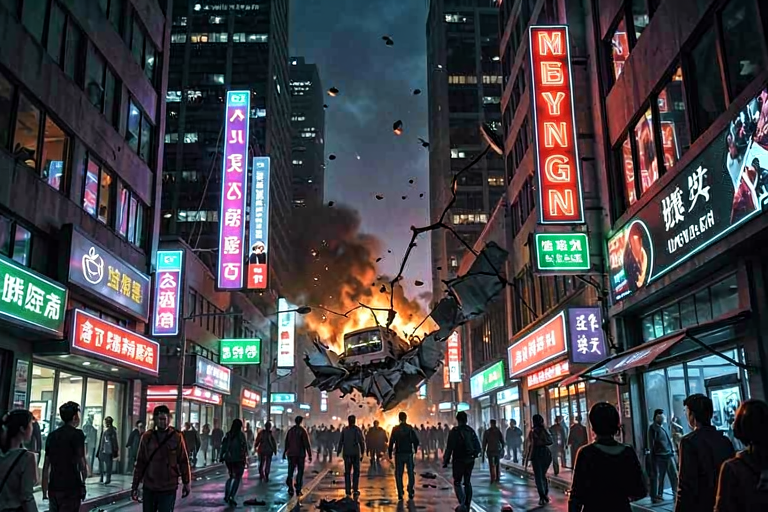
Five days after the authentication hub burned, Neo-Singapore stopped pretending to have a functional society.
Without centralized verification, the memory class system fragmented. Original districts couldn't prove their residents were unmodified. Composite zones couldn't be identified for elimination. Augmented citizens were indistinguishable from everyone else.
The segregation checkpoints that had divided the city came down. Not through policy. Through impossibility.
Aria watched it happen from Jin's new headquarters—their eighth since the war began. Screens showed riots in former Original districts. Composite refugees flooding into areas that had excluded them days before. The Memory Council trying to maintain control with muscle instead of authentication technology.
Trying. Failing.
"We destroyed their infrastructure," Jin said. But they didn't sound victorious. "Crippled their ability to verify who's real and who's fabricated. Forced society to function without authentication. And now..." They gestured to the screens. Violence. Looting. Neighbors turning on neighbors because trust had been replaced by technology and now the technology was gone.
"We proved authentication was genocide infrastructure," Aria said. "Doesn't mean society knows how to live without it."
Marcus entered the command center carrying actual food—real, not synthetic. Jin's black market contacts were adapting to chaos better than legitimate commerce. "Council's calling emergency sessions. Multiple factions proposing solutions. Most of them worse than the problem."
"Like what?" Jin asked.
"Original extremists wanting DNA-based verification. Composite radicals demanding total memory infrastructure destruction. Augmented separatists proposing their own city-state." Marcus pulled up intelligence feeds. "Everyone's grabbing for power in the vacuum we created."
"We created?" Aria felt the accusation. "I destroyed the hub. This is my doing."
"This is the Council's doing," Jin corrected. "They built a society dependent on verifying who's real. Made authentication the foundation of social trust. We just broke the foundation. The collapse was inevitable once they decided some people weren't real enough to deserve rights."
But inevitable didn't feel better when watching it happen.
"There's something else," Marcus said. His expression suggested it wasn't good news. "Multiple intelligence sources reporting unusual activity. Council deployments. Original militia movements. Composite underground mobilizations. All converging on one location."
Jin pulled up the deployment patterns. "What location?"
"The old Neural Research Institute. Where Tanaka performed Aria's surgeries. Where it all started thirty-seven years ago." Marcus highlighted the convergences. "Every faction. Every military force. All moving toward the same target."
"Why?" Aria asked. "What's there?"
"Not what," Marcus said. "Who. Someone everyone wants. Someone who represents..."
He didn't finish. Didn't need to. Aria saw it in the deployment patterns. In the way every faction was mobilizing. In the calculated precision of the convergence.
"The Last Original child," she said quietly.
Jin's expression confirmed it. "Intelligence suggests a child. Age seven. Never touched by memory technology. No consciousness backup. No neural implant. No modification. The last completely Original human being."
Aria felt the weight of that reality. Seven years old. Never modified. The last human who'd never been altered by Tanaka's technology. The last person who was completely, authentically, undeniably real by the old definition.
"Everyone wants them," Jin said. "Originals want them as proof unmodified humanity can exist. As symbol of purity. As justification for segregation."
"Composites want them too," Marcus added. "If the child's the last Original, everyone else is modified. Makes composite status normal instead of aberration."
"And the Council?" Aria asked.
"Wants to study them. Understand what unmodified consciousness looks like. Use them to develop better authentication." Jin's voice was grim. "Or back them up. Copy them. Make them not-Original by spreading their consciousness across multiple instances."
Aria studied the convergence patterns. Saw armies gathering around one seven-year-old child. Saw the entire war shifting focus from segregation to possession. From authentication infrastructure to human trophy.
"This is going to be bad," she said.
"This is going to be the war's next phase," Jin corrected. "Society collapsed from authentication loss. Now every faction's fighting over the symbol that represents competing futures. Original purity. Composite normality. Council control. Whoever gets the child gets to define what being human means."
"We can't let them use a seven-year-old as a symbol," Aria said.
"Then what do we do?" Marcus asked.
Aria thought about it. About being constructed from others' memories. About fighting programming every day to prove she could choose. About Jin integrating seven people's fragments. About Marcus choosing Jin's life over Maya's resurrection.
About all of them being modified, augmented, fabricated, constructed.
About a seven-year-old child who'd never been any of those things.
"We protect their right to choose," Aria said. "Whether to stay Original or accept modification. Whether to be a symbol or just a person. Whether to be backed up or stay mortal. That should be their choice. Not the Originals' choice. Not the composites' choice. Not the Council's choice. Theirs."
"You want to rescue them?" Jin asked. "We're thirteen fighters. Down from fifty. Exhausted from the hub operation. Against hundreds of soldiers from every faction?"
"I want to protect their autonomy," Aria corrected. "I know what it's like to have your choices made for you. To exist as someone else's plan. That child shouldn't be anyone's symbol. They should get to be whoever they choose to be."
Marcus was already pulling up intelligence. "If we're doing this, we need to move fast. Every faction's converging. Window's closing."
"We also need Tanaka," Aria said. "If the child's at the Neural Research Institute, Tanaka's there. Been protecting them. Maybe for years."
"Which means we're not just rescuing a child," Jin said. "We're extracting Tanaka and the last Original from a three-way war. That's suicide."
"That's faith," Aria said. Using Marcus's words from weeks ago. "Faith that protecting someone's right to choose is worth dying for. Even when someone is a seven-year-old who represents everything we're not. Even when protecting them proves we believe Modified and Original should both be choices. Even when every faction wants to make that choice for them."
Jin looked at Marcus. Marcus nodded. "She's right. If we let factions fight over this child, we prove everyone sees people as symbols instead of persons. But if we protect the child's autonomy—give them real choice about their future—we prove consciousness matters more than what you're made of."
"Thirteen fighters," Jin repeated. "Against armies."
"Thirteen fighters who've survived worse," Aria said. "Who destroyed the authentication hub. Who proved composites can resist programming. Who chose each other through betrayals and compromises and impossible odds. We're good at fighting when logic says we shouldn't."
Jin smiled. Seven people's worth of determination. "Alright. We plan the extraction. We get the child and Tanaka out before the factions tear them apart. And we prove that protecting choice matters more than winning symbols."
They had forty-eight hours before the convergence became a bloodbath.
Forty-eight hours to plan an extraction from a war zone.
Forty-eight hours to prove that thirteen broken fighters could protect one perfect child.
Aria felt her programming pulse. Felt it calculating. Felt it whispering that protecting memory infrastructure mattered more than one child.
And chose to fight it. Chose to prioritize the child's autonomy over preservation imperatives. Chose to believe protecting choice was more important than protecting systems.
One choice at a time.
One conscious decision after another.
Proving consciousness could overcome code even when code was permanent.
The war for authentication infrastructure was over.
The war for humanity's soul was beginning.
And Aria Chen—programmed weapon turned choosing fighter—would protect one child's right to define humanity for themselves.
Because that's what consciousness did.
It protected choice.
Even when protecting cost everything.
Especially then.