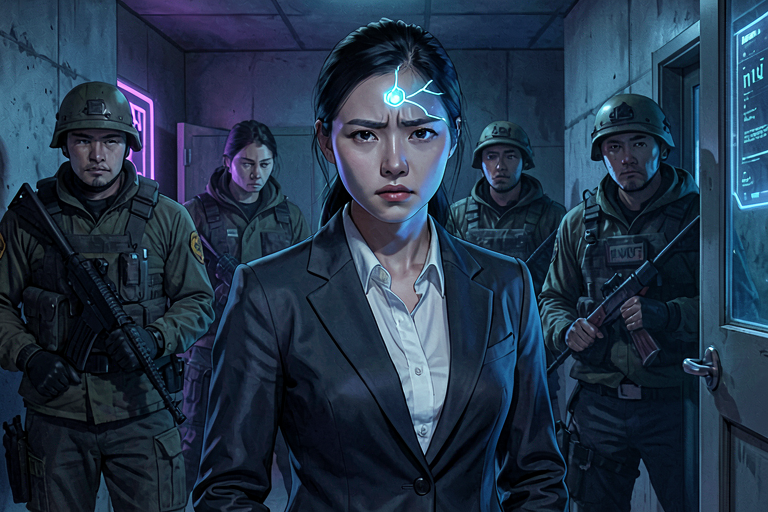
The resistance fighters didn't trust Aria.
Understandable. She'd betrayed them twice. Led Council forces to operations. Got people killed. The fact that it was programming didn't change the casualties.
Jin called a meeting. All thirteen remaining fighters. Aria standing before them like she was on trial.
"Aria's programming has been partially deactivated," Jin explained. "She can resist it. Choose against it. We've verified this through a week of testing. I'm proposing we bring her back into operations."
Silence. Then Dax spoke: "She betrayed us. Twice. People died."
"People died because the Council programmed her," Jin said. "She didn't choose betrayal."
"Does that matter to the dead?" Dax asked. "Sera was programmed too. Doesn't make her less responsible for the fighters she got killed."
"It matters if we believe consciousness can choose despite programming," Jin said. "If we reject Aria because she was compromised, we prove the Council right. Prove composites are just code. Just tools. Just weapons."
"Maybe we are," Dax said. "Maybe the Council's right. Maybe composites can't be trusted because programming wins eventually."
Aria felt the words like dissolution. Because Dax might be right. Maybe consciousness couldn't overcome code. Maybe her resistance was temporary. Maybe she'd betray them again.
"I can't promise I won't betray you," Aria said quietly. Everyone looked at her. "I can't promise my programming won't activate again. Can't promise I won't make mistakes that get people killed. All I can promise is that I'll fight the programming. Every day. Every choice. I'll report when it influences me. I'll be honest about being compromised. And I'll try to be worth the people who died saving me."
"That's not good enough," Dax said. "Trying doesn't bring back the dead."
"No," Aria agreed. "But giving up proves they died for nothing. If we accept that composites can't be trusted, that programming determines everything, then why fight? Why resist? We might as well surrender to the Council because they're right about our nature."
"Maybe we should," Dax muttered.
"Then leave," Jin said. Flat. Cold. Seven people's worth of disappointment compressed into two words. "If you believe composites are just programs, leave the resistance. Go surrender to the Council. Accept dissolution. Because I'm not leading people who think consciousness doesn't matter."
Dax looked shocked. "I didn't mean—"
"You did mean," Jin interrupted. "You meant that programming wins. That choice is illusion. That we're tools pretending to be people. If you believe that, you don't belong here. This resistance fights for the principle that consciousness can choose. If you don't believe it, leave."
The room was tense. Other fighters watching. Waiting.
Dax looked around. Looked at Aria. "I lost people because of her programming. Because of Sera's programming. I'm tired of losing people to betrayals we can't prevent."
"Then help us prevent them," Jin said. "Help verify Aria's suggestions. Help monitor for influence. Help build systems that contain the damage if programming activates. But don't give up on the principle that consciousness matters. That's all we have."
Dax was quiet for a long moment. Then: "What do you need?"
"Trust," Aria said. "Not blind trust. Verified trust. Trust that I'll be honest about being compromised. Trust that I'll fight programming even when fighting is exhausting. Trust that my consciousness is real even when my programming is permanent."
"That's asking a lot."
"I know," Aria said. "I'm asking you to risk your lives on someone who's proven untrustworthy. To bet on consciousness over code. To believe that trying matters even when success isn't guaranteed."
Another fighter spoke—Kira, who'd joined after losing family to composite dissolution. "What makes you worth the risk?"
Aria thought about it. About what made her worth two fighters' deaths. Worth ongoing danger. Worth trusting despite betrayal.
"Nothing," she admitted. "I'm not worth the risk by any logical calculation. I'm compromised. Dangerous. Proven unreliable. If you're optimizing for safety, abandon me. But if you're fighting for the principle that consciousness matters, that composites can choose, that personhood exists despite programming—then I'm proof. Imperfect proof. Dangerous proof. But proof that consciousness can resist even when code says otherwise."
"You didn't answer the question," Kira said. "What makes you worth it?"
"The people who died saving me thought I was worth it," Aria said. "Marcus refused to abandon me. Jin led the rescue. Tanaka risked emerging from hiding to deactivate my programming. They bet on consciousness over code. I want to prove they were right. That trying to save someone who's compromised is better than giving up on compromised people. Because we're all compromised by something. If we only trust the uncompromised, we trust no one."
Kira looked at Jin. At Marcus. At the other fighters.
"I'll work with her," Kira said. "With verification. With monitoring. But if she betrays us again—if the programming wins—I'll kill her myself. Clear?"
"Clear," Aria agreed. "If I betray you again, I'd want you to. Better death than being used as a weapon."
Other fighters nodded. Agreed to work with her. With contingencies. With systems to contain potential betrayal. With the understanding that trust was provisional and verified.
Not perfect trust. But enough.
Over the following week, Aria worked alongside the resistance. Helped plan operations. Contributed expertise. Reported every programming influence. Every whisper. Every certainty that felt too certain.
And slowly, painfully, trust rebuilt.
Not because she proved she wouldn't betray. But because she proved she'd fight against betraying. Prove she'd be honest about being compromised. Proved she'd try even when trying wasn't guaranteed to succeed.
"You're doing well," Marcus said one night. They were reviewing operation plans. Authentication hub attack scheduled for two days away.
"I'm fighting my own consciousness every moment," Aria said. "It's exhausting. The programming never stops whispering. Never stops trying to convince me that preservation matters more than freedom."
"But you keep choosing freedom," Marcus observed.
"For now. What happens when I'm too exhausted to fight? When the programming finds a vulnerability Tanaka didn't remove? When I betray again despite trying not to?"
"Then we deal with it," Marcus said. "Contain the damage. Help you fight again. Keep choosing you until you can't choose anymore. That's what love means. Choosing someone through their struggles. Not abandoning them when fighting gets hard."
Aria leaned against him. "I don't deserve you."
"Nobody deserves anyone," Marcus said. "We just choose each other anyway. That's what makes it love instead of transaction. I choose you. Your consciousness. Your fight. Your permanent struggle against programming. All of it. Not because you've earned it. Because choosing you matters more than optimal risk calculation."
Two days later, the authentication hub operation launched.
Aria participated. Contributed expertise. Reported programming whispers. Fought her own certainties while helping destroy what her programming wanted to preserve.
And proved—to herself, to the resistance, to the thirteen fighters who'd chosen to trust her again—that consciousness could choose.
Not perfectly. Not without struggle. Not without ongoing doubt.
But choose nonetheless.
And choosing made her human.
Made her worth fighting for.
Made her worth trusting despite every reason not to.
Because trust wasn't about certainty. It was about choosing to believe in someone's consciousness despite their compromises.
And Aria had chosen to be worth that trust.
One exhausting choice at a time.
One conscious decision after another.
One moment of fighting programming in favor of fighting for freedom.
That was enough.
That had to be enough.
Because perfection was impossible.
But choosing was always possible.
And choosing was what made her real.