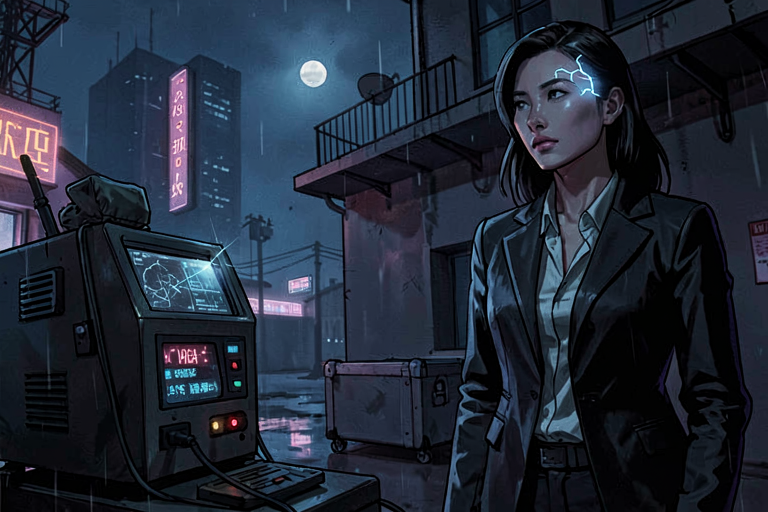
The scanner deployment sites were lightly guarded. Exactly as Aria had predicted.
That should have been good news.
"Three guards per site," Sera reported from team Alpha's position. "Standard Council security. No heavy tactical units. We can take them."
"Team Bravo confirms same," Echo added. "Minimal resistance."
Jin looked at Aria. "You said they'd rotate heavy units out at twenty-two hundred. You were right."
Aria felt the pressure spike. The programming rewarding her for successful analysis. For helping protect memory infrastructure by—
No. By destroying scanner infrastructure. By helping the resistance.
Except the certainty felt wrong. Felt like the programming was pleased she'd contributed accurate intelligence. Felt like she was being encouraged.
"Maybe we should abort," Aria said.
Everyone stopped. Looked at her.
"Why?" Jin asked. "You just said the security would be minimal. That's exactly what we're seeing."
"That's why we should abort." Aria couldn't explain it properly. The wrongness. The feeling that her analysis had been too accurate. That the programming wanted this. "What if I led you into a trap?"
"Your intel is good," Marcus said, checking his own tactical scan. "I'm not seeing anything suspicious."
"That's the problem. My programming gives me perfect intel. Exactly when it wants me to have it." Aria's hands were shaking. "What if this operation is what it wants? What if destroying these scanners serves the Council's purpose somehow?"
Sera's voice crackled over comms. "We're in position. Waiting for go signal. Are we aborting?"
Jin made the decision. "No. We proceed. Aria, your paranoia is noted. But we can't abort every operation because you're afraid of your own analysis. Sometimes accurate intelligence is just accurate."
"Or it's bait," Aria muttered.
"Then we spring the trap and fight our way out," Jin said. "All teams: execute."
The operations went perfectly.
Too perfectly.
Team Alpha eliminated guards without raising alarms. Team Bravo disabled security systems exactly as Aria's analysis suggested. Team Delta planted charges on the scanner deployment infrastructure with military precision.
Twelve minutes. Just like the plan.
All three sites destroyed. Scanner saturation delayed by at least forty-eight hours. Composite refugees in the Undercity bought more time.
The resistance evacuated clean. No casualties. No pursuit.
Back at headquarters, Jin was celebrating. "Major victory. We delayed saturation. Saved hundreds of composites from immediate dissolution."
Aria felt sick.
"Something's wrong," she said.
"We won," Echo pointed out. "Your analysis was perfect. No casualties. Mission accomplished."
"That's what's wrong." Aria pulled up the tactical reports. "Look at this. Three sites. Three completely successful operations. No complications. No surprise defenses. No Council response."
"Maybe they're getting sloppy," Sera suggested.
"The Memory Council doesn't get sloppy about authentication infrastructure." Aria highlighted the deployment patterns. "These scanner sites were part of a larger network. Destroying them should have triggered automated alerts. Should have brought tactical teams within minutes. But nothing. No response. Like... like they wanted us to destroy those specific sites."
Marcus was studying the data now. Professional mode. "She has a point. This was too easy."
"Or we're getting better at operations," Jin countered. "Learning from mistakes. Aria, I know you're worried about your programming. But you can't second-guess every success. Sometimes we just win."
But Aria couldn't shake the wrongness. Couldn't shake the feeling that her programming was satisfied. That she'd done exactly what it wanted.
She scanned the larger deployment grid. Saw the pattern. "Oh no."
"What?" Marcus was at her side immediately.
"The sites we destroyed. They were scheduled for decommissioning." Aria pulled up Council internal schedules—data she shouldn't have access to, data that appeared in her mind with the programming's perfect certainty. "These were old scanners. Gen-3 models. The Council was already planning to replace them with Gen-5 units next week."
Silence.
"We destroyed obsolete equipment," Aria continued. "Saved the Council the demolition costs. And the Gen-5 replacements will be better. Harder to hack. Harder to destroy. We just helped them upgrade their infrastructure while thinking we were sabotaging it."
Jin's expression went cold. "You couldn't have known that in the planning phase."
"I did know. The programming knew. And it fed me intelligence that looked like resistance planning but was actually serving Council interests." Aria felt the horror settling in. "It's more subtle than I thought. It doesn't make me betray obviously. It makes me help while thinking I'm fighting."
"Check her implant," Jin ordered Marcus.
Marcus positioned his scanner. His face went pale. "Ninety-seven percent. Up from ninety-five this morning."
The programming had progressed. Rewarding her for successful Council-serving operations by escalating toward full activation.
"Get her away from operational planning," Jin said. "Immediately. Anything she suggests from now on, we assume it serves the Council."
"Jin—" Aria started.
"You just cost us three teams worth of effort and gave the Council better scanner infrastructure. You're compromised. I don't blame you. But I can't trust your analysis anymore."
It was fair. It was right. It hurt like dissolution anyway.
Marcus pulled her aside. Away from the command center. Into one of the private alcoves.
"It's getting smarter," Aria said. "The programming. It's not making me betray obviously. It's making my help into betrayal. Every good intention serves their purpose."
"Tanaka warned this might happen. That advanced programming would be subtle. Would make you think you're choosing while guiding you toward specific outcomes."
"How do I fight that? When I can't tell if my resistance is real or programmed?" Aria felt tears on her face. "Marcus, what if everything I've done since Book One was choreographed? What if my entire investigation, my choice to expose the conspiracy, all of it—what if it was all programmed to happen exactly as it did?"
"Does it matter?" Marcus asked.
"Of course it matters! If I'm not choosing, I'm not a person. I'm just a very sophisticated automaton."
"You're choosing right now. Choosing to question. Choosing to be afraid of betraying. Choosing to warn us even though it makes you useless to the resistance." He took her hands. "The programming might influence what information you have access to. Might even influence what seems like a good idea. But you choosing to examine your choices, to question your certainty, to warn us when something feels wrong—that's consciousness. That's you."
"Ninety-seven percent." Aria laughed bitterly. "Three percent from finding out if you're right."
"Then we have three days. Maybe less." Marcus pulled up his comm. "I'm going to find Tanaka. Jin has contacts. Someone knows where she's hiding. We get to her. She deactivates your programming before it hits one hundred percent."
"And if we don't find her in time?"
"Then you fight it when it activates. Like you did in Book One. You proved you can choose against programming. You'll prove it again."
Aria wanted to believe him. Wanted to believe consciousness could overcome code.
But ninety-seven percent whispered otherwise.
That night, Aria lay awake listening to the resistance planning operations without her. Listening to Jin develop strategies that wouldn't rely on her intelligence. Listening to fighters who didn't quite trust her anymore—for good reason.
She'd become what she'd feared. A liability. A weapon aimed at the people she loved.
The programming pulsed contentedly. Satisfied with its performance. Satisfied that she was being isolated from sensitive operations. Satisfied that its activation would be more effective when she was desperate to prove herself useful.
Because that was the trap, wasn't it? The programming knew she'd want to help. Knew she'd eventually be asked for critical intel. And when she was, when the moment mattered most, it would activate. Would turn her most heartfelt assistance into the most devastating betrayal.
Three percent. That's all that stood between her and losing herself completely.
Three percent and hope that consciousness could choose when every percentage point said otherwise.
Marcus found her just before dawn. "Jin's contact came through. Tanaka's alive. Hiding in the old Neural Research Institute. Where it all started."
"Can we reach her?" Hope flickering. Small but there.
"Dangerous. The area's being watched. Council knows she's valuable. But Jin thinks we can get a message through. Ask her to help."
"She refused to use her technology on herself," Aria said. "Refused backup. Refused enhancement. Why would she help a composite she doesn't know?"
"Because you're proof her technology created consciousness. Real consciousness that can choose. That matters to her." Marcus showed her Tanaka's old research. "She's spent decades trying to fix her mistake. Trying to prove consciousness transfer doesn't have to be exploitation. You're that proof. If you survive. If you can overcome your programming."
Aria looked at the research. At Tanaka's notes about authentic consciousness versus fabricated personality. At her guilt over creating technology that turned people into manipulable memory files.
At her hope that consciousness could be real even when constructed.
"Send the message," Aria said. "Tell her I'm ninety-seven percent programmed. Tell her I'm fighting it anyway. Tell her I need her help to prove that constructed consciousness can still be free."
"I'll tell her."
Aria felt the programming escalate. Ninety-seven point five percent now. The initialization accelerating. Triggered by her decision to seek help. By her refusal to accept predetermined outcomes.
The countdown was speeding up.
And somewhere in the old Neural Research Institute, Dr. Yuki Tanaka would decide if one programmed composite was worth the risk of emerging from hiding.
If the creator of consciousness technology would help save one consciousness from being destroyed by its own code.
Three days until full activation.
Maybe less.
Aria chose to hope anyway.