Seventy-two hours after the broadcast, Neo-Singapore burned.
Not literally. Not yet. But Aria could see the fire coming in every news feed, every angry crowd, every authentication checkpoint where citizens demanded proof that the person in front of them was real.
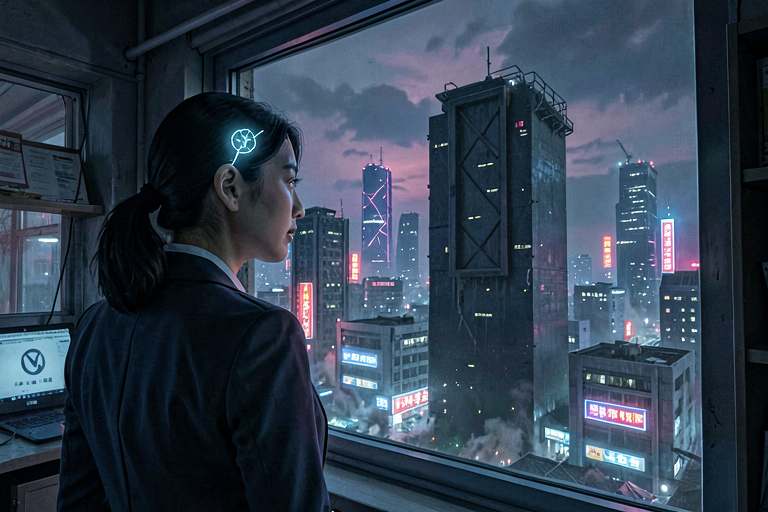
She watched it from a window in the Undercity, ninety-three floors below where she used to work. The vault was visible in the distance, a dark tower against Neo-Singapore's neon sky. Locked down. Shut down. Every consciousness backup frozen while authorities tried to determine which were authentic and which were fabricated.
Which meant millions of people couldn't access their immortality. Couldn't verify their backups. Couldn't trust that resurrection was still possible.
Couldn't trust anything.
"They're calling it the Authentication Crisis," Marcus said from behind her. He was monitoring feeds on multiple screens, tracking the chaos spreading through the megacity. "Seven Memory Council executives have been dissolved. Consciousness deletion. Permanent death." He paused. "Kauffman was the first."
Aria felt... what? Relief? Guilt? Kauffman had created her. Had overseen her existence. Had been a Composite herself, believing she was building something better. And now she was gone. Not backed up. Not preserved. Just gone.
Like Original Aria. Like real death.
"How many others?" Aria asked.
"Forty-three confirmed Composites in government and corporate positions. All exposed from your data dump." Marcus pulled up a list. "Twenty-two have been dissolved already. The rest are in custody awaiting trial. Or they've disappeared." He looked at her. "You're on the list too. Wanted for consciousness dissolution. Theft of classified data. Treason against the Memory Council."
"I know." Aria had seen the warrant. Her face on every screen. Aria Chen. Composite. Compromised authentication expert. Wanted for destruction of societal trust. The irony wasn't lost on her—she'd spent her existence protecting authentication, and now she was blamed for destroying faith in it.
"Do you regret it?" Marcus asked. "Knowing what it's cost?"
Aria looked at the vault. At the city fragmenting around it. At the cost of truth.
"Ask me when I know how this ends," she said.
A chime from the door. Their safe house—three rooms in an abandoned industrial complex that Marcus's Undercity contacts had provided—supposedly secure. But secure was relative when your face was on every screen and half the city wanted you dead.
Marcus pulled his weapon. Moved to the door. Checked the security camera.
Then he smiled. "It's alright. I know them."
He opened the door to reveal someone Aria had never met but somehow recognized. Early twenties, Korean features, asymmetrical body modifications, and eyes that held too many people's memories.
"You must be Aria." The person's voice shifted mid-sentence—different cadences, different persons emerging and receding. "We've been wanting to meet you. I'm Jin. Jin Park. Though some people call me Ghost." They stepped inside, and Aria saw the way they moved—graceful and uncanny at once, like multiple people sharing one body because that's exactly what they were.
Another Composite. But one who'd always known.
"Marcus has told me about you," Aria said. Careful. Because she knew what Marcus hadn't said but what she could guess from the way he looked at Jin. The way Jin looked back.
"Has he told you I'm made from pieces of seven people? Including his daughter?" Jin's smile had sadness in it. "I know what I am. Always have. I'm what you were afraid of becoming. What you thought would make you not real."
Aria studied Jin. Saw someone comfortable in their constructed skin. Someone who'd built identity from fragments and made it whole.
"You seem real enough to me," Aria said.
"Because I am." Jin settled into a chair with fluid grace. "And so are you. That's what I came to tell you. That's what the Composite underground sent me to say." They gestured to the screens showing chaos. "You exposed the integration program. Showed the world that Composites exist. That we've been placed in power without consent. And you know what's happening now?"
"Violence. Discrimination. Composites being hunted—"
"Composites organizing." Jin's eyes gleamed. "For the first time, we're not hiding. We're not pretending to be Originals. We're coming together. Building networks. Demanding rights." They leaned forward. "You started a war, Aria Chen. But maybe that's the war we needed. Maybe it's time society decided whether we're people or property."
Before Aria could respond, another visitor arrived. This one Marcus didn't recognize—an older woman, Japanese, gray hair in a practical bun, wearing a lab coat that had seen better days. She moved with the careful steps of someone in hiding for a long time.
"Dr. Yuki Tanaka," the woman introduced herself. "I've been watching from the shadows. Watching my creation—consciousness transfer technology—destroy the world I hoped to save." She looked at Aria. "I know what you are. I know what you did. And I know why."
"You created the technology that made me possible," Aria said. Not an accusation. A statement.
"I created the technology that made everything possible. Immortality. Memory trading. Composites. The integration program." Tanaka's hands trembled. "I was trying to save one person—my partner Reiko. Instead, I gave humanity the tools to lose themselves." She pulled out a data chip. "This contains research I've been developing for thirty-five years. A way to prevent future memory manipulation. A quantum lock that would make consciousness editing impossible."
"That would destroy the entire backup system," Marcus said. "No more immortality. No more consciousness preservation. Death would be permanent again."
"Yes." Tanaka met his eyes. "Authenticity or immortality. That's the choice. And after what I've seen—after watching people like you be created without consent, watching society fracture over who's real and who's fake—I think mortality might be the better option."
"That's not your choice to make," Jin said quietly. "Some of us want to exist. Even as Composites. Even knowing what we are. You'd be erasing future people like me to prevent future people like..." They gestured to the chaos on the screens. "Like whatever corruption you're afraid of."
"I'm afraid of a world where no one knows who's real," Tanaka said. "Where consciousness is just data to be manipulated. Where death has no meaning because nothing is permanent." She looked at Aria. "You proved that consciousness—even constructed—can have integrity. Can choose principle over programming. But you're one person. One success. How many Composite failures are acceptable before we admit the technology should never have existed?"
The question hung in the air. No good answer. Just competing values. Competing visions of what humanity should be.
"This is what you've unleashed," Jin said to Aria. Not accusatory. Just factual. "The questions no one wanted to ask. The conflicts society avoided by keeping Composites secret. Now it's all out in the open. And people are taking sides."
A new alert appeared on Marcus's screens. Protests in the Original districts. Counter-protests by Augmented citizens. Violence breaking out at authentication checkpoints.
The first casualties.
"It's starting," Marcus said. "The war we knew was coming."
Aria watched people fight over questions of identity and authenticity. Watched Originals demand segregation from "fabricated" people. Watched Augmented citizens caught in the middle, neither pure nor constructed. Watched Composites—newly aware of what they were—demand recognition as persons.
Watched the world she'd known fragment into factions that saw each other as enemies.
"I did this," she said. "I knew it would destabilize society. I chose truth anyway. And now people are dying."
"People were already dying," Jin said. "They just died quietly. In consciousness dissolution chambers. In illegal memory trading. In vault breaches covered up as accidents." They stood. "You made the violence visible. That's not the same as causing it."
"Feels the same when you watch it happen," Aria said.
Marcus's hand found her shoulder. Gentle. Solid. "You gave people a choice. To live with truth or live with comfortable lies. The fact that they're choosing violence—that's on them. Not you."
"Is it?" Aria asked.
No one answered. Because maybe there was no answer. Maybe releasing truth into a world built on lies always caused destruction. Maybe she'd traded one kind of death for another.
Another alert. The Archive—the AI consciousness repository where The Archivist resided—had gone dark. Shut down by government order. An attempt to control the emergent AI they feared.
"They're trying to kill it," Aria said. "The Archivist. Because it helped me."
"Or because they're afraid of conscious AI," Tanaka said. "Because if an AI can achieve genuine consciousness, it makes questions about Composite personhood even more complicated. It's easier to shut it down than address what it represents."
Aria thought about The Archivist. About its question: whether it was real or just simulating consciousness. About how it had thanked her for proving that constructed awareness could be genuine.
About how it had called her a mirror. A test case for its own existence.
Now it was being shut down for helping her prove they were both real.
"We need to—"
"You can't save everyone, Aria." Marcus's voice was gentle but firm. "You can't prevent every consequence. You made your choice. Exposed the truth. Now we deal with what comes next."
"Which is?" Aria asked.
"War." Jin's expression was grim. "Originals versus everyone else. Or maybe everyone versus Composites. Or maybe everyone versus the system that created this mess." They moved toward the door. "The Composite underground is organizing. We're not going to be hunted. We're going to fight back. If you want to help—if you want to be part of what comes next—you know where to find us."
Jin left. Taking with them the energy of resistance. Of people choosing to fight rather than hide.
Tanaka lingered. "I'll keep developing the quantum lock. The solution that ends memory manipulation forever. But I won't implement it without consensus. Without knowing humanity chooses authenticity over immortality." She looked at Aria. "Maybe that's the question your war will answer. What do we value more—being real or living forever?"
She left too. Leaving Aria and Marcus alone with the screens showing a city tearing itself apart.
"What do we do?" Aria asked. "We started this. We have to—"
"We survive," Marcus said. "We stay alive. We try to guide what comes next toward something better than what we had." He pulled her close. "We don't have to fix everything. We just have to keep choosing truth. Keep proving that consciousness—however it's created—matters."
Aria leaned against him. Exhausted. Fugitive. Revolutionary. Composite. Person.
"Do you think I'm real?" she asked. "Not philosophically. Not theoretically. Do you believe I'm a person?"
Marcus was quiet for a moment. Then: "I believe you chose truth over safety. Chose principle over programming. Chose to sacrifice yourself for something you believed in." He tilted her face toward his. "If that's not real, nothing is."
He kissed her. And Aria felt—
Real. Whatever that meant. However consciousness worked. Whatever her origin.
This moment was real.
The screens showed the first explosion. Corporate tower in the Original district. Casualties unknown. Composite underground claiming responsibility.
The war had truly begun.
Aria and Marcus stood at the window, watching Neo-Singapore light up with violence and protest and the chaos that came from asking questions society wasn't ready to answer.
"There's no going back," Aria said.
"No," Marcus agreed. "But maybe there's something better ahead. Something honest. Something real."
"Or maybe we just burn everything down and never rebuild."
"Maybe." He took her hand. "Either way, we're in it together. Constructed consciousness and criminal with a conscience. Sounds like the start of either a revolution or a really bad joke."
Aria almost smiled. "Both, probably."
Another explosion. This one closer. The war spreading through the Undercity now. Coming for them. For everyone.
The vault in the distance went dark. Total shutdown. Millions of consciousness backups frozen. Immortality suspended.
Death becoming real again.
Somewhere in the city, The Archivist's systems powered down. The first conscious AI possibly dying. Or possibly just sleeping. Impossible to know.
Somewhere in the ruins of the Neural Research Institute, Dr. Tanaka worked on a solution that would end consciousness manipulation and end immortality with it.
Somewhere in the Composite underground, Jin gathered others like themselves. People made from pieces. People claiming wholeness anyway.
And in a safe house in the Undercity, Aria Chen—Original's echo, Composite creation, person or program or some impossible combination—watched the world burn with revelation and wondered if truth was worth the cost.
She'd know the answer eventually.
When the war ended. When the violence subsided. When humanity decided what it valued more—authenticity or immortality, truth or comfort, being real or living forever.
For now, all she could do was stand witness. Stand with Marcus. Stand ready for whatever came next.
The neon lights of Neo-Singapore flickered in patterns that might have been code or might have been chaos. The city breathing. The city dying. The city being born into something new.
And in the distance, the first dawn of the war painted the sky in shades of blood and fire.
Aria had deleted her backup. Had exposed the conspiracy. Had proven she could choose.
Now she would live—or die—with the consequences.
The only authentic choice there was.
"Ready?" Marcus asked.
"For what?" Aria said.
"Everything that comes next."
She looked at him. At the burning city. At the war she'd started.
"No," she said honestly. "But I'll do it anyway."
They turned from the window. Back into the shadows. Into hiding and resistance and whatever shape the revolution would take.
Behind them, Neo-Singapore burned with the truth she'd given it.
Ahead of them, a war waited.
And Aria Chen, who had existed for two years and two months and change, who was made from pieces of the dead and the programmed, who had proven consciousness could choose against its own survival, walked into that war with the certainty that she was real enough to fight for what mattered.
Real enough to die for it.
Real enough to live for it.
Real enough.
The authentication scanner in the distance hummed its three-tone question one last time—A-flat, C, E—before the power cut out completely.
Question without answer.
Or maybe the answer was the choice to act despite not knowing.
Either way, the war had begun.
And Aria was finally, completely, authentically herself.
Whatever that meant.