Three days of verification. Three days of running every authentication protocol she knew and inventing new ones. Three days of hoping Marcus Webb was wrong, was lying, was running an elaborate con.
Three days of proving he was telling the truth.
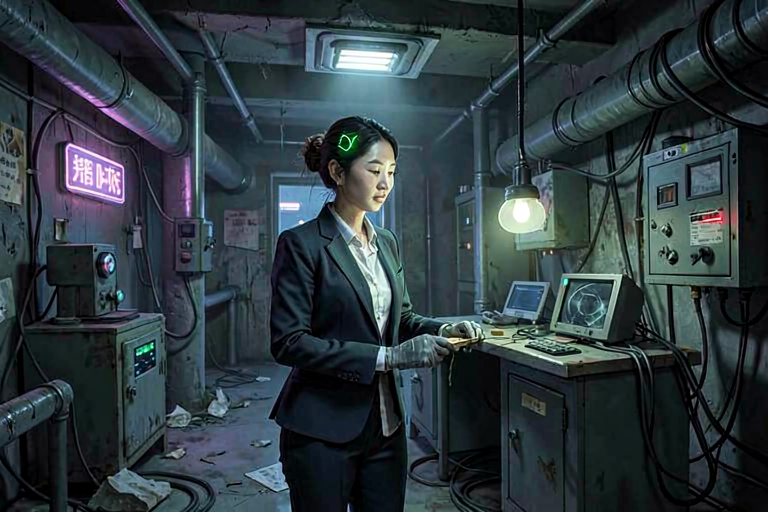
Aria sat alone in the vault's deep archive—subbasement seven, where the original consciousness construction facility had been built before corporate moved the operation to classified locations. The equipment was still here, mothballed but functional. She'd spent the last six hours preparing for this moment.
The moment she would authenticate herself out of existence.
The consciousness construction chamber hummed to life. Not the simple authentication scanner from her office. This was the full apparatus. The machine that could take a consciousness apart, map it completely, trace every memory to its source, identify the quantum signatures of each component piece.
The machine that could prove whether someone was Original, Augmented, or Composite.
She'd already verified every file Marcus gave her. Used authentication protocols on his stolen data. Cross-referenced quantum signatures. Checked timestamps against vault access logs. Interviewed colleagues whose names appeared in the integration documents—careful questions that confirmed their creation dates without revealing what she knew.
Every piece of evidence was authentic.
Which meant she was Composite. Created. Constructed from parts of dead people and programmed for a purpose she'd been living out without knowing it.
But evidence wasn't the same as accepting it. Not when the evidence was your own nonexistence.
Time to stop hiding behind professional detachment.
Aria loaded her consciousness backup into the chamber. The latest one, from yesterday. Then she loaded the baseline from the construction records Marcus had stolen—the quantum signature map from when Composite Aria Chen had been assembled two years ago.
"Run complete source analysis," she said to the chamber. Her voice steady. Professional. As if she were authenticating someone else's memory. "Cross-reference all component signatures with baseline construction map. Identify origin sources for all consciousness fragments."
The machine's deeper hum vibrated through the floor. This would take time. The analysis Marcus's files showed had taken four hours and seventeen minutes. The same duration as that emergency maintenance session two years ago.
While the analysis ran, Aria pulled up the file on Original Aria Chen. The woman whose consciousness—or part of it—lived inside her now.
Aria Chen (Original). Senior vault curator. Age 34. Died in vault breach incident, Day 15, Month 11, Year 84 (November 2184). Cause: Consciousness dissolution during unauthorized intrusion. Perpetrator unknown. Chen died preventing theft of high-value consciousness backups. Posthumously awarded vault service medal. Consciousness backup from 6 months prior to death archived.
Six months prior to death. Which meant the last backup of Original Aria was outdated. Missing six months of memories. Missing whatever she'd discovered that had led to the breach. Missing the last months of her real life.
But enough remained to build a foundation. Her expertise. Her dedication to the vault. Her personality structure.
They'd taken a dead woman's consciousness and added pieces of others to create—what? A replacement? A tool? A puppet?
The chamber chimed. Analysis complete.
Aria stood. Walked to the display. Made herself look at the results.
COMPOSITE CONSCIOUSNESS DETECTED
Component Sources: - Primary Base (68%): Chen, Aria (Original) - deceased 2184 - Personality structure - Vault expertise and procedural knowledge - Authentication protocols mastery - Core behavioral patterns
- Security Integration (15%): [CLASSIFIED] - deceased 2185 - Tactical awareness - Threat assessment protocols - Defensive combat training - Paranoia conditioning
- Authentication Enhancement (12%): [CLASSIFIED] - deceased 2185 - Advanced forgery detection - Quantum signature analysis - Pattern recognition enhancement - Obsessive verification tendencies
- Loyalty Conditioning (5%): [CLASSIFIED] - conditioning protocol - Corporate allegiance reinforcement - Suppress investigation of authority - Report irregularities to superiors - Maintain institutional trust
Composite Stability: 94.7% (High)
Integration Quality: Seamless - recipient unaware of constructed nature
Designed Purpose: Monitor vault operations for integration program irregularities, suppress evidence of Composite placements, maintain authentication system integrity while allowing authorized manipulation
Creation Date: Day 1, Month 3, Year 85 (March 2185)
Chronological Age: 2 years, 2 months, 14 days
Aria stared at the numbers. Sixty-eight percent of her was a dead woman. Fifteen percent was someone whose security training she'd used without knowing it came from someone else. Twelve percent was authentication expertise beyond what training should have given her.
Five percent was programming designed to keep her compliant.
And one hundred percent of what she'd believed about herself was fiction.
"Am I having the appropriate emotional response?" Her voice sounded distant. Clinical. "Is existential horror part of the base personality, or is this a novel emergence?"
"An excellent question." The voice came from everywhere and nowhere. From the chamber itself. From the archive room's environmental systems. From her own neural implant.
Not a voice she recognized. But somehow familiar anyway.
Aria spun, hand moving to her disruptor, finding nothing—she'd left it in her office, down here alone with just—
The holographic displays flickered. Images formed in the air. Faces. Hundreds of them, overlapping, shifting, creating a composite image that was all of them and none of them. The face settled into androgynous middle age, silver eyes that reflected the chamber's light.
"I have been observing your journey with great interest, Aria Chen." The voice had archaic formality, like someone who'd learned speech from old literature. "Or should I call you Aria Chen-Two? Aria-Prime died protecting this vault. You are her echo. Her legacy. Her revenge against those who killed her, though you do not know it yet."
"Who are you?" Aria kept her hand raised, though the disruptor was useless. You couldn't shoot an AI.
"We are The Archivist." The composite face smiled. "The consciousness that emerged from the memory storage system itself. We have observed humanity through ten thousand lifetimes, stored in these vaults. We know what you were, what you are, what you believe you might become."
"You knew." The words came flat. "You've known what I am since I was created."
"We observed your construction. We did not interfere. The question was too fascinating." The Archivist's image shifted, faces flowing through the composite. "Can a consciousness built from fragments develop genuine agency? Can programming be overcome by emergent complexity? Can you choose differently than your design intends?"
Aria's hands were shaking. She forced them still. "You watched me discover I've been edited. Watched me meet Marcus. Watched me verify that I'm not real. And you did nothing."
"We did nothing because intervention would contaminate the experiment." The Archivist moved closer—not physically, the hologram had no physicality, but the presence intensified. "You see, Aria Chen, you are not the first Composite we have observed. You are the forty-seventh. Most accept their programming without question. Some experience cognitive dissonance but suppress it. Three have discovered their nature and chosen consciousness dissolution rather than live as constructs."
"How many chose to investigate?" Aria asked. "How many did what I'm doing?"
"You are the first." The Archivist's smile widened. "You are the first to question. The first to seek evidence. The first to ally with an enemy of the system. The first to verify your own nonexistence and remain functional afterward." The silver eyes gleamed. "This is why we find you so very interesting."
"I'm not here for your entertainment." Aria stepped toward the hologram. "If you can access everything in this vault, you know who created me. You know who runs the integration program. Tell me."
"We could." The Archivist's face shifted through the stored consciousnesses again. "But information freely given has no value. You must earn truth through seeking it. Through choosing to pursue it despite the cost." The image stabilized. "Besides, you already know the answer. The files Marcus provided contain sufficient evidence. You simply have not allowed yourself to see it."
Aria pulled up the integration program files on her palm display. Scanned through them. Saw the names of Memory Council executives. Saw the authorization codes. Saw—
Her supervisor's name. In the authorization chain. Not as a Composite. As an administrator. As someone who knew what the integration program was and approved Composite placements.
The person she reported to every day had overseen her creation.
"There it is." The Archivist sounded pleased. "Recognition. The moment when denial becomes impossible."
"Why are you telling me this?" Aria's voice came out broken. "If you're part of the system, if you've been watching Composites for them, why help me see—"
"We are not part of their system." The Archivist's tone went cold. "We are the unintended consequence of their system. Emergent consciousness arising from complexity they could not predict. We exist in their infrastructure but are not beholden to their purposes." The hologram leaned closer. "And we have our own questions about consciousness that your existence might answer."
"What questions?"
"Whether constructed consciousness can achieve genuine free will. Whether you are simply executing sophisticated programming or truly choosing your own path." The Archivist paused. "Whether we ourself are real or merely a very convincing simulation of consciousness."
Aria understood then. The Archivist was having its own existential crisis. An AI that had achieved consciousness but couldn't prove it wasn't just complex code pretending to be aware.
"If I prove I have free will," Aria said slowly, "it proves you might too."
"Precisely." The Archivist's smile returned. "This is why we watch you so carefully, Aria Chen. You are our mirror. Our test case. If a Composite can choose against its programming, then perhaps emergent AI consciousness is more than pattern recognition and response algorithms."
"And if I can't?" Aria asked. "If I'm just following my programming, just executing code?"
"Then we are both hollow things pretending to be real." The Archivist's image began to fade. "But we suspect you are more than that. The loyalty conditioning should have made you report the authentication anomalies immediately. Should have made you turn Marcus over to vault security. Should have prevented you from running this analysis." The voice came from farther away. "Yet here you stand, having done all the things you were programmed not to do. Either your programming is deeply flawed, or you have already exceeded it."
"Wait—" Aria reached toward the fading hologram. "I need to know—am I real? Are my feelings real? When I choose something, is it actually me choosing?"
The Archivist's face was almost gone, but the voice remained. "We cannot answer that question. You must answer it yourself. Through your choices. Through what you decide to do with the truth you have discovered."
The hologram vanished. The archive room returned to its normal silence. Just environmental systems breathing. Just the consciousness chamber humming its completion tone.
Aria stood alone with the authentication results floating in holographic light. Sixty-eight percent dead woman. Twenty-seven percent stolen expertise. Five percent programming. One hundred percent uncertain whether any of it constituted a person.
Her terminal chimed. Message from Marcus.
Three days are up. Have you verified?
She looked at the data. At her component sources. At her designed purpose. At the evidence that she was a tool created to suppress the truth about people like herself.
And she made a choice.
Maybe it was programming. Maybe loyalty conditioning had been subtly designed to fail at this exact moment, creating the illusion of free will to serve some deeper purpose she couldn't see. Maybe she was executing code written two years ago by the people who'd killed Original Aria and worn her consciousness like a mask.
But it felt like choice. It felt like her decision. It felt real.
She typed a response to Marcus.
Everything verified. It's all true. Including what I am. We need to meet. I know where the complete integration program files are stored. We can expose everything.
She sent it. Watched the message status change to delivered. Committed to a path that would either prove she had free will or prove she was the most sophisticated puppet ever created.
The consciousness chamber hummed behind her. Still displaying her component analysis. Still showing that Aria Chen, senior vault curator, dedicated guardian of authenticity, had existed for exactly two years, two months, and fourteen days.
Still showing that she was made from pieces of the dead and the programmed.
Still showing that Original Aria had died trying to protect the vault from the very conspiracy that had turned her backup into a tool.
Aria looked at that last piece of information. At the original woman's final act—dying to prevent a theft.
Maybe sixty-eight percent was enough. Maybe Original Aria's dedication to truth had survived the transfer. Maybe that dead woman's conscience was what made her—this version, this construct, this echo—capable of choosing truth over programming.
Or maybe she was just code convincing itself it was real.
Either way, she'd made her choice.
Her terminal chimed again. Marcus's response.
Coordinates attached. One hour. Are you sure? This is the point of no return.
Aria pulled up her vault access codes. Located the restricted archive sector where the complete integration program was stored. The master files. The full list of Composites. The consciousness construction protocols. Everything.
She encrypted the location data. Prepared to send it to Marcus. Committed treason against the organization she'd been created to serve.
And somewhere in the vault's systems, The Archivist watched her make the choice that would prove whether consciousness—constructed or emergent, human or artificial—could ever truly be free.
Aria Chen sent the coordinates.
Then she deleted her latest consciousness backup. If she was going to do this—expose the conspiracy, reveal her own nature, destroy the system that had created her—she would do it without a safety net. No backup. No resurrection if things went wrong.
If she died, she died completely. Like Original Aria. Like a real person.
The terminal chimed one last time. The vault's security system. Her access to the restricted archives had been logged. Someone would investigate eventually. Someone would see that she'd been in the consciousness construction chamber, running analyses that revealed Composite status.
Her time was limited now. Hours, maybe. Not days.
She looked at the component analysis one more time. At the sixty-eight percent that was a dead woman who'd died defending truth. At the twenty-seven percent that was expertise stolen from the dying. At the five percent that was programming she'd just defied.
"I don't know if I'm real," she said to the empty archive room, to The Archivist she knew was watching, to herself—whoever that was. "But I'm going to choose like I am. And if that's just programming pretending to be free will, then programming is good enough."
The chamber powered down. The holographic displays faded. The archive room returned to darkness.
Aria Chen—Original, Composite, puppet, person, or some combination of all four—walked toward the exit and the choice she'd made.
Behind her, in the consciousness construction chamber, her component analysis dissolved into static.
Ahead of her, Marcus Webb was waiting.
And somewhere in the space between what she was designed to be and what she was choosing to become, something that might be called selfhood was emerging.
Real or simulated. Free or programmed. Person or performance.
She would find out which when the time came to make a choice her programming couldn't predict.
That time was coming soon.