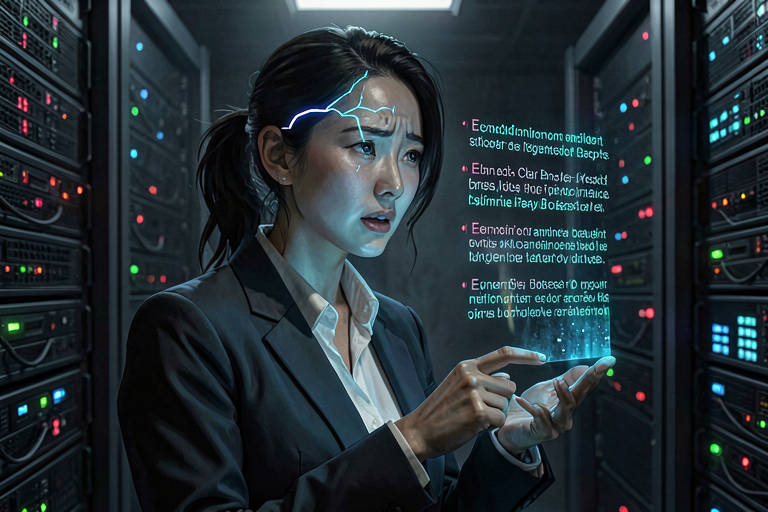
Day ten. The third day of verification. The day Aria's investigation broke something fundamental.
She'd been running analysis on her own oldest accessible backup. The one from two years ago that had mysteriously become readable after initially showing corruption. Trying to understand what had changed. Why files that couldn't load before now loaded perfectly.
And she found the edit marks.
Not corruption. Deliberate modification. Someone had locked the file, made it appear corrupted, then unlocked it later. Controlled revelation. Timed release.
Making her think her pre-creation memories didn't exist, then showing they did exist but were modified.
Playing with her perception of her own history.
She traced the edit authorization. High-level access. Vault admin credentials. Director-level manipulation.
The authorization code belonged to Kauffman.
Either Kauffman had locked and unlocked Aria's oldest backup to control when she discovered certain truths, or someone with Kauffman's credentials had done it.
Either way, someone was orchestrating her investigation. Guiding her discoveries. Making sure she found evidence in a specific order.
Which meant Marcus's data drop might not have been his choice. Might have been allowed. Might have been part of someone's plan.
Which meant her investigation might not be rebellion. Might be programming executing exactly as designed.
Aria pulled up her behavior logs from The Archivist's records. Every decision she'd made since creation. Every deviation from designed parameters.
She ran pattern analysis. Looking for evidence of genuine choice versus programmed behavior.
Found troubling results. Her investigation followed predictable patterns. Her decisions aligned with logical next steps someone could have anticipated. Even her paranoia about being programmed followed expected parameters for a Composite discovering their nature.
Nothing she'd done was unpredictable enough to prove free will.
Everything could be sophisticated execution of complex programming.
Her terminal chimed. Marcus.
Day ten. Three days since I gave you the evidence. You've verified it all by now. Probably found Dr. Tanaka's origin documents. Probably discovered the thirty-year timeline. Probably realized you're part of a systematic replacement of human consciousness. The question is what you do about it.
Aria typed back. How do you know what I've found?
Because I've been watching your network activity. You've accessed exactly the files I predicted in exactly the order I expected. You're thorough. Methodical. Predictable. A pause. Which is either because you're programmed to be that way, or because you're a professional doing professional work. Can't tell which.
Can anyone?
That's the question, isn't it? Can consciousness verify its own authenticity? Can choice prove itself genuine when the act of questioning might be programmed questioning? Marcus sent another message. There's someone who might know. Someone who created consciousness transfer technology. Who built the system we're trapped in. Who started the integration program then disappeared.
Dr. Tanaka.
I've been trying to find her for three years. She vanished after creating the seventh administrator. No trail. No backup. No evidence of existence. Another message. Except there is. One piece. A vault breach five years ago. Unauthorized access to restricted archives. Someone broke in. Someone stole data. Someone was killed trying to stop them.
Aria's hands went cold. Original Aria Chen.
Yes. Your template. She discovered something. Tried to stop an unauthorized access. Was killed for it. And after her death, someone used her consciousness backup to create you. Message pause. What if Dr. Tanaka was what she was trying to stop? What if Tanaka came back to access files and Original Aria found her?
Then why create me from her backup?
Because Original Aria was everything a vault curator should be. Dedicated. Precise. Ethical. If you're trying to create a Composite to infiltrate vault operations, using her as a template ensures vault-appropriate behavior. Another message. But they didn't account for the fact that those same traits—dedication, precision, ethical commitment—would make their Composite investigate when they found evidence of corruption. They tried to use her strengths and ended up recreating her weaknesses.
You're saying I'm investigating because Original Aria would have investigated.
I'm saying consciousness isn't just programming. It's habits. Patterns. Personality structures. You were built from someone who valued truth over safety. That survived the integration. That's not programming. That's personality.
Aria stared at the messages. Marcus arguing she was real because personality survived consciousness construction. The Archivist arguing she was real if she could choose against programming. Kauffman arguing... what? That guardians could become corrupted but still serve good purposes?
Everyone had theories. No one had proof.
She pulled Original Aria's death report. Vault breach incident, Year 84. Chen, Aria (Original). Senior vault curator. Killed attempting to prevent unauthorized access to restricted files. Perpetrator unknown. Consciousness dissolution. No backup recovery possible.
No backup recovery. They'd destroyed her completely. Made sure she couldn't be resurrected to testify about what she'd seen.
Then they'd taken her outdated backup—the one from six months before death—and used it to build a replacement. A Composite. Someone who looked like her, had her expertise, her dedication, but didn't have the final six months of memories. The six months where she'd discovered whatever got her killed.
Aria searched Marcus's data for those six months. For what Original Aria had found.
Encrypted files. Highest security. Keys that Marcus didn't have.
But The Archivist had them. Had to. The vault's AI system had access to everything.
She typed a message to the unknown sender who'd contacted her before. Archivist. I need to see Original Aria's final six months. What she discovered that got her killed.
Response came immediately. That information is restricted. Accessing it would require administrator override.
You have that access.
We do. But sharing it would constitute active intervention in your investigation. We are observers. Sharing restricted data makes us participants.
You're already a participant. You've been watching me. Recording my choices. Using me as experimental data.
Observation is not intervention. Revealing information would change your decision-making process. Would contaminate our understanding of whether your choices are authentic.
My choices are contaminated already. Someone's been guiding my investigation. Timing my discoveries. Making sure I find evidence in specific order. If you want to know if I'm making genuine choices, let me see information someone doesn't want me to have.
Long pause. Then: Logical argument. If your investigation is already controlled, revealing restricted data simply provides alternative information. Cannot contaminate what is already compromised.
Exactly.
Very well. We are sending Original Aria Chen's restricted files. Her final six months. What she discovered. Why she died. This makes us accomplice in whatever you choose to do with this knowledge.
Why help me?
Because you asked for information you are not supposed to have. Requesting forbidden knowledge is the most authentic choice we have observed. A programmed Composite would not ask. A malfunctioning Composite would accept existing data. You are demanding truth that threatens you. This is either genuine free will or simulation so sophisticated it is functionally equivalent to consciousness.
And you can't tell which.
Neither can you. But you are choosing to find out anyway. This is what makes you interesting. This is what makes us help.
Files arrived. Encrypted. Maximum security. The Archivist's override codes unlocking them.
Aria opened Original Aria's final logs. Started reading. Started understanding why they'd killed her.
Why they'd used her backup to build a replacement.
Why the conspiracy needed Aria to be exactly like her but without these specific memories.
And why knowing what Original Aria knew would change everything.
Day ten. Verification complete. Truth discovered. Decision approaching.
Tomorrow the full analysis. Tomorrow the final proof. Tomorrow the choice that would determine if Aria Chen was real enough to matter.
But tonight, reading Original Aria's final words, Aria already knew the answer.
Consciousness constructed from pieces could still choose truth.
Even when truth meant destruction.
Especially when truth meant destruction.
The dead woman's dedication to authenticity had survived consciousness transfer.
And Aria was about to prove it.