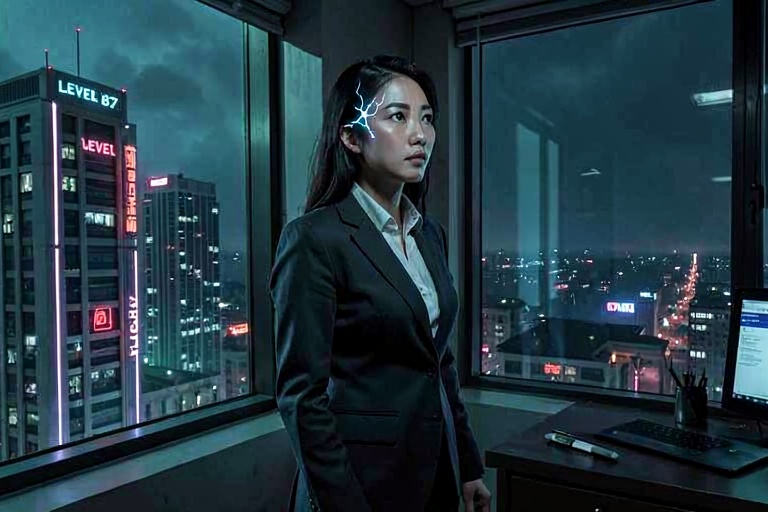
Director Sarah Kauffman's office occupied a corner of Level 87, with windows overlooking both Neo-Singapore's corporate towers and the Undercity below. Two worlds visible from one room. Two realities separated by height and wealth and the question of whether your memories were your own.
Aria had been in this office dozens of times. Hundreds, if her eight-year employment record was real. But this morning, stepping through the door at precisely 0800, felt different.
This morning she was walking into an interrogation.
"Aria. Sit." Kauffman didn't look up from her terminal. Mid-fifties, gray hair pulled into efficient corporate styling, neural implant at her temple glowing faint blue with active connection. The director of vault operations for the entire Neo-Singapore facility. The person responsible for consciousness preservation for five million citizens.
The person whose authorization appeared on Aria's emergency maintenance session two years ago.
Aria sat. Kept her hands visible. Kept her expression professional. Wondered if Kauffman could detect lies the way Aria could detect quantum signature manipulation.
"Your self-audit." Kauffman finally looked up. "No anomalies detected. Clean scan. Perfect authentication across all memory backups." She pulled up a holographic display. Aria's test results. The fabricated ones. "That's interesting, because I ran a secondary scan on your backup file. Routine verification on senior staff. And I found seventeen quantum signature irregularities."
Aria's heart rate spiked. Her implant would be transmitting that to Kauffman's terminal. Biometric honesty detection. Standard for security conversations.
"I don't understand," Aria said. Truth. She didn't understand whether Kauffman was testing her, exposing her, or—
"Neither do I." Kauffman closed the display. "So I ran a third scan. Complete forensic analysis. And do you know what it showed?"
Aria waited.
"Nothing. Clean signatures. No irregularities." Kauffman's expression didn't change. "So either my secondary scan malfunctioned, or someone with very high-level access corrected the irregularities between your self-audit and my verification."
The archive room felt very quiet. Just environmental systems breathing.
"Someone like you," Kauffman continued. "With senior curator privileges. Someone who could access quantum signature correction tools. Someone who might want to hide evidence of memory manipulation in their own backup."
"I didn't—" Aria started.
"Or." Kauffman held up a hand. "Someone like me. With director privileges. Someone who could correct irregularities to hide evidence of institutional manipulation. Someone who might not want a senior curator discovering that the vault's authentication system has been compromised at systemic levels."
Aria stopped breathing.
Kauffman leaned back. "The question is which scenario we're in. Are you hiding evidence of personal compromise? Or am I testing whether you've discovered evidence of institutional conspiracy?"
Silence. The office windows showed Neo-Singapore waking. Millions of people trusting their consciousness backups to a system that might be fundamentally corrupted.
"I'm going to show you something." Kauffman pulled up a new display. Access logs. Maintenance records. The same ones Aria had searched last night. "Notice anything unusual?"
"They're too clean," Aria said quietly. "No discrepancies. No errors. Like someone scrubbed them."
"Exactly." Kauffman highlighted sections. "Someone with director-level access removed all irregularities from maintenance sessions conducted two years ago. Multiple sessions. All cleaned. All made to look routine." She met Aria's eyes. "I discovered this six months ago. I've been investigating quietly ever since. Trying to determine who authorized the scrubbing and why."
This was a trap. Had to be. Kauffman was the one who'd authorized Aria's emergency session. Her name was in the files Marcus would eventually show her.
Unless someone had put Kauffman's name in the files to frame her. Unless the conspiracy went higher and Kauffman was another pawn. Unless this conversation was exactly what it appeared to be—one investigator reaching out to another.
"Why are you telling me this?" Aria asked.
"Because you lied on your self-audit." Kauffman's voice was gentle. "You found anomalies. Seventeen of them, if my scan was accurate before someone corrected them. You found evidence of memory manipulation in your own consciousness. And instead of reporting it through proper channels, you concealed it." She paused. "That tells me you don't trust the proper channels. Which suggests you think the manipulation came from inside the vault. Which suggests you're smart enough to be useful."
"Useful for what?"
"Finding out who's compromising our authentication system." Kauffman stood, moved to the windows. "I've been director for twelve years. I've dedicated my career to preserving consciousness integrity. If someone is using vault equipment to manipulate memories—to create fabricated people and place them in positions of power—I need to know. I need to stop it." She turned back. "And I need help from someone who has personal motivation to find the truth."
Aria studied Kauffman's reflection in the window. Trying to read sincerity. Trying to determine if this was recruitment or entrapment.
"What did you find in your self-audit?" Kauffman asked. "Specifically."
Decision point. Tell the truth and risk everything, or continue lying and lose the only person with high-enough access to actually investigate.
"Seventeen modified memories," Aria said. "All edited two years ago. All memories that form the foundation of my identity. And all my backups older than two years are corrupted. Unreadable. Like I didn't exist before then."
Kauffman's expression didn't change, but something flickered in her eyes. Recognition? Concern? Fear?
"How much do you remember before two years ago?" Kauffman asked.
"Static. Fragments. Nothing clear." Aria's hands were shaking. She made them stop. "The emergency maintenance session on my consciousness. Two years ago. 3:47 AM. Four hours seventeen minutes. Executive override authorization." She met Kauffman's gaze. "Your authorization code."
Kauffman went very still.
"I didn't authorize that session," she said quietly. "Someone used my credentials. Someone with the technical skill to spoof executive authorization." She pulled up her own access logs. Highlighted the timestamp. "I was off-site that night. Conference in Beijing. I have hotel records. Flight manifests. I wasn't in this building when that session occurred."
She pulled another file. Security footage. The vault's entrance at 3:47 AM two years ago. Grainy video showing someone in director's uniform accessing the consciousness construction chamber in subbasement seven.
The person's face was obscured. But their neural implant glowed in the darkness. And their authorization registered as Director Sarah Kauffman.
"Someone who looked like me," Kauffman said. "Or someone who copied my biometric data. Or—" She stopped.
"Or another Composite," Aria finished. "Created to impersonate you. To authorize sessions using your identity while you were conveniently away."
Kauffman closed the video. "If you're right—if someone is creating Composites and using them to replace people in positions of authority—then we can't trust anyone. Not vault security. Not corporate oversight. Not the authentication system itself."
"Then who can we trust?" Aria asked.
"I don't know." Kauffman looked older suddenly. Tired. "But I know we can't investigate through official channels. Can't report through proper protocol. Because the people we'd report to might be the ones running the operation."
She pulled out a physical data chip. Old technology. Unhackable because it couldn't connect to networks.
"Everything I've found. Access logs. Irregularities. Evidence of systematic memory manipulation going back five years." She held it out. "Take it. Investigate independently. Use your authentication expertise to verify what I've collected. And if you find proof of who's behind this—evidence solid enough that we can expose them without being dissolved first—bring it to me."
Aria took the chip. "Why trust me? I could be compromised. Could be one of the Composites you're looking for."
"You could be." Kauffman smiled sadly. "But if you are, you're the first Composite I've encountered who questions their own authenticity. Who investigates instead of accepts. Who lies about self-audit results to protect evidence from potential conspirators." She paused. "And if Composites can do that—can think independently enough to suspect they're constructed—then maybe the whole program is more unstable than its creators intended."
Aria stood. Pocketed the chip. "If I find something—"
"Don't contact me directly. Use the dead-drop protocols. Old vault emergency procedures from before everything was networked." Kauffman pulled up a map on her terminal. Locations throughout Neo-Singapore. "Leave physical evidence at any of these sites. I'll monitor them. We'll coordinate without electronic trails."
"And if the conspiracy is bigger than we think? If everyone in authority is compromised?"
"Then we find someone outside authority." Kauffman met her eyes. "Someone who operates in black markets. Someone who has access to illegal authentication technology and no loyalty to corporate systems."
"You're asking me to work with criminals."
"I'm asking you to work with anyone who can help us preserve consciousness integrity." Kauffman moved toward the door. Meeting over. "Even if that means partnering with the people we're sworn to stop."
Aria walked to the exit, then paused. "Director. If I'm compromised—if I'm a Composite created to infiltrate vault operations—what's my designed purpose?"
Kauffman considered. "If I were creating a Composite to control authentication systems, I'd program them to suppress evidence of manipulation. To report irregularities to supervisors. To follow protocol religiously." She smiled. "Instead, you lied, concealed evidence, and investigated independently. Either you're malfunctioning, or you have enough autonomous consciousness to override your programming."
"Which do you think it is?"
"I think," Kauffman said carefully, "that consciousness is more complicated than code. And that whoever created you—if someone did—didn't account for the possibility that even fabricated people can choose to seek truth." She opened the door. "Go. Investigate. Find out what's being done with our vault. And Aria?"
"Yes?"
"Be careful. If there's a conspiracy creating and placing Composites, they've killed to protect it. The original Aria Chen—the woman whose consciousness you might carry—died in a vault breach two years ago trying to stop an unauthorized access. If you're her echo, they've already killed you once."
Aria left the office with Kauffman's data chip in her pocket and new questions burning in her mind.
Was Kauffman sincere? Or was this conversation itself a test—a way to identify whether Aria would follow orders or investigate independently?
Was the director a victim of conspiracy or part of it?
Was anything in the vault's records real, or had everything been rewritten to serve purposes Aria couldn't see?
She rode the elevator down. Past archive rooms. Past consciousness storage matrices. Past authentication chambers where people's memories were verified and preserved and possibly edited without their knowledge.
Past the facility where she might have been created.
The elevator doors opened on the ground level. Aria stepped out into morning light. Her neural implant chimed.
Message from an unknown sender. Just coordinates in the Undercity. And three words:
We should talk.
Aria looked at the message. At the coordinates. At an invitation from someone who knew she was investigating and wanted to make contact.
Someone who operated outside official channels.
Someone who might be exactly the criminal ally Kauffman suggested she needed.
Or someone who worked for the conspiracy and wanted to eliminate her before she found too much.
Aria deleted the message. Memorized the coordinates. Started walking toward the Undercity.
Behind her, the vault hummed its authentication protocols.
Ahead of her, decisions waited that would determine whether she stayed loyal to the system or broke it to save it.
The morning sun painted Neo-Singapore in shades of gold and shadow.
Aria Chen, age uncertain, memories compromised, loyalties divided, walked toward coordinates sent by strangers.
Because sometimes the only way to verify truth was to trust the unverifiable.
And sometimes the only way to preserve integrity was to break every rule.