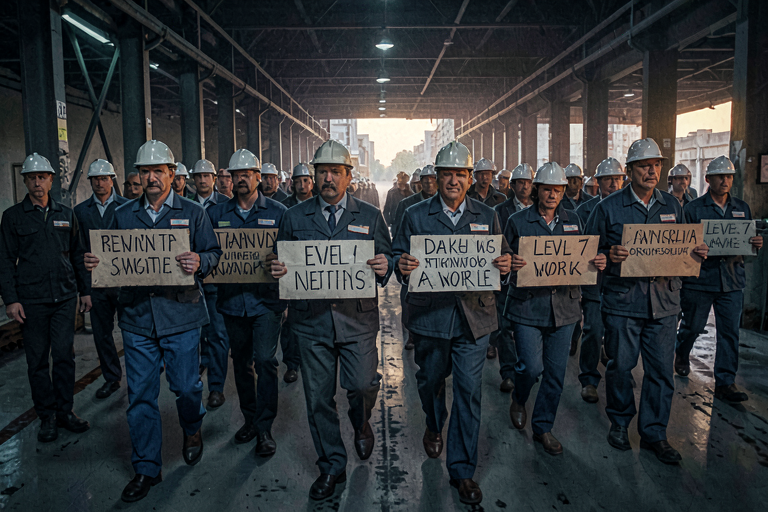
It started in Level 7.
Sanitation workers walked off the job at 0600. Not a few. Not a strike vote after negotiation.
All of them. Two hundred workers. Simultaneously.
Their statement was simple: "We will not clean up after people who treat us as disposable. We are human. We have dignity. Until that's recognized, we strike."
By 0800, food service workers in Level 6 joined. Three hundred more.
By 1000, maintenance workers across Levels 5-9. Another thousand.
By noon, the general strike had spread to twenty-two hundred workers across six tier levels.
The station was grinding to a halt.
In the organizing school's hidden sublevel, Nico watched reports flood in and felt awe mixed with terror.
"Did we plan this?" he asked Lin.
"No. They did." Lin's smile was fierce. "The cooperatives have been networking. Talking. Realizing they have power. This is what organized labor looks like."
"This is suicide. Corporate will crush them."
"Maybe. Or maybe there are too many to crush. Two thousand workers. Twenty-two critical services. If they fire everyone, the station stops functioning. If they arrest everyone, same result. Corporate's trapped."
Maya burst in with her tablet. "It's spreading. Level 4 medical technicians just walked out. All non-emergency services halted."
"How many total now?"
"Three thousand. And growing."
Nico pulled up station-wide data. The numbers were staggering.
Waste processing: 0% capacity.
Food service: 17% capacity (emergency services only).
Maintenance: 23% capacity.
Medical support: 31% capacity.
Environmental systems: Holding, but degrading without maintenance.
The station was dying. Slowly. But dying.
"What are their demands?" Nico asked.
Maya pulled up the joint statement issued by the United Workers Collective:
1. 40% wage increase across all lower-tier positions 2. Universal healthcare access regardless of employment status 3. Enforcement of safety standards 4. Recognition of worker cooperative legal status 5. Formal apology for civilian deaths in Level 8 riot
"They're demanding structural change," Nico said. "Not just concessions. Actual reform."
"Because you taught them to," Lin said. "Not explicitly. But by showing them they could organize. Could make demands. Could refuse to accept the status quo."
"I didn't teach them to strike."
"You taught them they mattered. They figured out the rest."
By 1800, Corporate Council was in emergency session.
By 1900, Chair Volkov made a station-wide broadcast: "The current work stoppage is illegal under Station Emergency Protocols. All workers must return to their positions within 24 hours or face termination and arrest. This is non-negotiable."
The United Workers Collective responded immediately: "We are not asking permission. We are asserting our humanity. You need us more than we need you. We will wait for real negotiation."
By 2000, the strike had grown to four thousand workers.
Corporate's bluff had been called.
"They're going to crack down," Kade said. "SSS will start making arrests. Probably target leaders. Make examples."
"Can't arrest four thousand people," Maya countered. "They don't have the capacity."
"They don't need four thousand. Just the visible leaders. Scatter the rest through fear."
Lin shook her head. "That worked when leadership was centralized. When taking out one person broke the movement. But this—" she gestured at the feeds showing dozens of different worker groups coordinating, "—this is distributed. No single leader. Kill one head, three more grow."
"Hydra organizing," Nico said.
"Exactly. Your charity operation was vulnerable because it depended on you. This doesn't depend on anyone. It's collective power. Much harder to break."
Nico watched the feeds. Thousands of workers organizing. Coordinating. Standing firm.
Without him.
Because of him, but without him.
"Should I make a statement?" he asked. "Support them publicly?"
"No," all three said simultaneously.
Lin continued: "The moment you publicly back them, this becomes about you again. Nico Chen's strike. Corporate's enemy organizing chaos. You stay silent. Let this be about workers, not about you."
"But I could help—"
"You already did. By building the foundation. By teaching organizing principles. By showing it was possible." Maya's voice gentled. "This is their moment. Let them have it."
Day two of the strike. Waste was piling up in Level 4. Food service was skeletal. Maintenance emergencies were going unaddressed.
Corporate tried to bring in replacement workers from other stations. The United Workers Collective shut it down by picketing the docking bays. Peacefully. But firmly.
Day three. Environmental systems were degrading. Air quality down 12%. Temperature regulation spotty.
Volkov made another offer: 15% wage increase. Conditional recognition of some cooperatives.
The workers rejected it. Held firm.
Day four. Upper tier residents were starting to panic. No waste pickup. Limited food. Air getting stale.
For the first time, Level 2 and 3 residents were experiencing what Level 8 had lived with for years.
They didn't like it.
Day five. Three Council members issued a joint statement calling for negotiation.
Volkov was losing control.
Day six. Corporate agreed to formal talks.
The strike had worked.
In the organizing school, students watched the negotiations on live feed.
The workers had sent a delegation: five people from different cooperatives. No single leader. Democratic representation.
They negotiated for eighteen hours straight.
Final agreement:
- 32% wage increase phased over two years - Universal basic healthcare for all station residents - Independent safety oversight board - Legal recognition of worker cooperatives - No formal apology, but acknowledgment that "loss of life was tragic and could have been avoided through dialogue"
Not everything they'd asked for. But real, structural change.
When the agreement was announced, the students in the organizing school erupted in cheers.
Nico sat quietly, watching.
"You did this," Maya said beside him.
"I didn't. They did."
"You showed them it was possible. That's enough."
Lin raised a glass—actual alcohol, smuggled in for the occasion. "To the United Workers Collective. To collective power. To the idea that people matter."
Everyone drank.
And Nico felt something he hadn't felt in eight years: hope.
Real hope. Not charity-based temporary relief. But structural change that might actually last.
Workers had power now. Legal recognition. Higher wages. Healthcare.
Not perfect. Not enough. But real.
And they'd done it themselves.
With organizing. Solidarity. Collective action.
Everything Nico had tried to learn to teach.
Everything he'd failed at for years.
They'd figured it out.
And he'd been privileged to watch.
"To the movement," he said quietly. "May it outlast all of us."
They drank.
And for the first time since this all began, Nico believed it might actually work.
Not his charity. Not his kingdom.
But their movement.
Their power.
Their future.
Built on the foundation he'd helped lay.
But belonging to them now.
As it should have from the beginning.