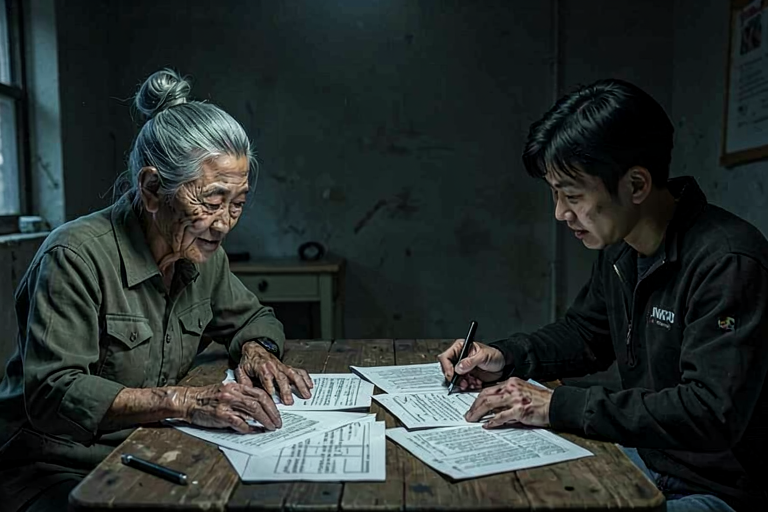
Lin spread the documents across the table like a battle plan.
Which, in a way, they were.
"Worker cooperatives," she said. "That's the future. Not charity. Not individual benefactors. Collective ownership."
Nico stared at the organizational charts. "I don't know how to do this."
"Then learn. You have—" Lin checked her tablet, "—approximately two million credits left after the freeze. Maybe twelve weeks if Corporate doesn't escalate. Use that time to seed permanent structures."
"Seed how?"
"Like this." Lin pulled up the first document. "Food Cooperative #8 wants to expand. Needs 15K for commercial kitchen equipment. Instead of giving them money, you loan it. Zero interest, ten-year repayment. They pay back into a revolving fund that seeds the next cooperative."
"That's barely different from charity."
"It's completely different. Charity creates dependency. Loans create accountability and sustainability. The money circles instead of draining."
Maya nodded. "The clinic's been doing similar. Medical cooperatives where members pay small monthly fees. Collective risk pool. No one person covers everything, but everyone's covered."
"How's that working?"
"Slowly. But working. We've got four medical co-ops now. Three hundred members total. It's not replacement for real healthcare, but it's better than nothing."
Kade added his report: "Housing collectives are the same. People pooling resources, negotiating bulk leases, sharing space. We've got forty families in collective housing now. They're organized. Stable. And they're teaching others how to do it."
The data was undeniable. The cooperatives were working.
But they were also fragile. Needed support. Needed expertise. Needed...
"They need organizing," Nico said slowly. "Not money. Or not just money. They need to know how to run democratic decision-making. How to handle conflicts. How to scale."
"Exactly," Lin said. "So we teach them. You fund a cooperative organizing school. Small. Underground. Trains people in collective management, democratic process, mutual aid principles. They train others. Knowledge spreads."
"How much?"
"For the school? 50K for space and materials. Another 30K for trainers who know what they're doing. Call it 80K investment for infrastructure that reproduces itself."
Nico did the math. 80K from his remaining 2 million. Plus ongoing cooperative loans. Plus emergency funds for crises.
He could make it work. For maybe six months.
And then?
"And then the trained organizers keep organizing without you," Lin said, reading his face. "That's the point. You become unnecessary."
"I'm starting to see a theme."
"Good. Because the era of Uncle Nico solving problems is over. The era of Level 8 solving its own problems with collective power? That's just beginning."
Maya pulled up more data. "We've identified twelve potential organizers. People who've shown leadership in their cooperatives. Natural teachers. We train them intensively for six weeks. They each train ten more. Exponential spread."
"Who runs this school?"
"I do," Lin said. "With help. I've been organizing for forty years. Time to pass that knowledge on before I die."
"You're not dying."
"I'm seventy-one and live in Level 8. I'm absolutely dying. Question is whether my knowledge dies with me or spreads first."
The bluntness was classic Lin. Nico found himself smiling despite the grimness.
"Okay. We do it. Organizing school. Cooperative loans. Medical collectives. Housing cooperatives. All of it." He pulled up his financial tablet. "Here's what I can commit..."
They worked for six hours. By the end, they had a plan:
- 80K for organizing school (six-month program) - 400K for cooperative loan fund (revolving, self-replenishing) - 300K for emergency support (decreasing over time) - 200K for legal defense (arrests were coming) - 1.02 million total commitment
Remaining: 980K for contingencies
Timeline: Six months if nothing went wrong.
Four months if Corporate escalated.
Eight months if cooperative contributions ramped up fast enough.
"This is our last play," Nico said. "After this, I'm broke. Whatever we build has to survive without me."
"That's the point," Lin said. "You've been the king for eight years. Time to build a kingdom that doesn't need one."
The organizing school opened two weeks later in a hidden sublevel space.
Twelve students. Hand-picked. Eager.
Lin taught collective decision-making. Maya taught conflict resolution. Kade taught logistics and supply chain management. Nico taught... nothing.
He attended as a student.
Learning, for once, instead of leading.
"Today we're discussing power dynamics in cooperative spaces," Lin said to the class. "Specifically, the tendency for benefactors to become de facto leaders even in democratic structures. Sound familiar, Nico?"
The class laughed. Nico felt his face heat.
"Guilty."
"Awareness is the first step. Now, how do we prevent charismatic individuals from dominating collective spaces?..."
The lesson continued. Nico took notes like everyone else.
Later, during break, one of the students approached: Ana Rodriguez. Sister of Terrence, the nineteen-year-old who'd died in the riot.
"Uncle Nico. Can I ask you something?"
"Of course."
"Why are you here? Learning organizing when you've been doing this for years?"
"Because I've been doing charity, not organizing. There's a difference. And if this is going to survive me, I need to understand what actually works."
Ana studied him. "My brother died believing you'd change things. I want to make sure his death wasn't for nothing."
The weight of that statement crushed.
"Me too."
"Then teach me. Teach all of us. Not how to ask Uncle Nico for help. How to build power that doesn't need you."
"That's what Lin's doing."
"Lin's teaching theory. You can teach practice. You've made every mistake, right? Learned what doesn't work. That's valuable."
Nico had never thought of his failures as lessons worth teaching.
But Ana was right.
"Okay. I'll... I'll add a session. 'What I Did Wrong: A Comprehensive Guide.'"
She smiled. "Perfect. We'll learn faster from your mistakes than your successes."
By week three, the school was humming. Students were teaching each other. Sharing insights. Building networks.
And Nico was learning that his role wasn't to lead anymore.
It was to support. To fund. To connect people. To share hard-won knowledge.
To become unnecessary.
It hurt less than he'd expected.
Maybe because for the first time in eight years, he wasn't carrying everything alone.
The cooperatives were growing. The organizing was spreading. The ideas were replicating.
And Nico Chen—drug dealer turned king—was finally learning to let go.
One lesson at a time.