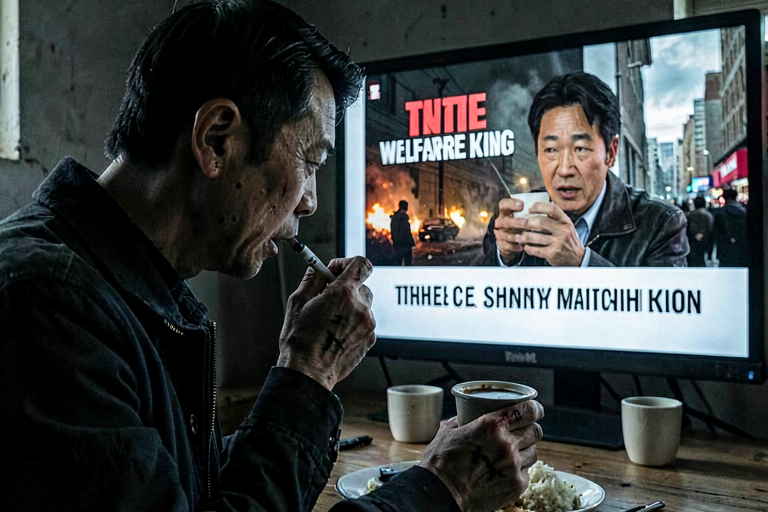
The first hit piece ran on Station News Network at 0700.
"THE WELFARE KING: How One Man's Charity Created a Dependent Underclass"
Nico watched it over breakfast, vape pen in one hand, coffee in the other.
The report was slick. Professional. Devastating.
Interview with a former restaurant employee: "He makes you feel like you owe him. Like without Uncle Nico, you're nothing. It's not help—it's control."
The employee's face was pixelated. Voice distorted. Nico didn't recognize them, but that didn't mean they weren't real.
Interview with an economist: "Charity without structure creates permanent dependency. These people will never learn to stand on their own if someone's always catching them."
Cut to footage of the food lines. Hundreds of people waiting for free meals. The camera lingered on faces—tired, poor, desperate.
The narrator: "This is Level 8, where thousands have given up looking for work. Where Uncle Nico's generosity has created a culture of expectation. Where productivity has plummeted and an entire district has learned to wait for handouts instead of earning their way."
"Fuck," Kade said from the doorway.
"Yeah."
The report continued: "But who is Nico Chen? A former drug dealer with a suspicious financial windfall. A man who claims to help people while building his own empire. Sources close to the operation suggest Chen lives lavishly while his so-called beneficiaries struggle."
Cut to his room above the noodle house. Someone had gotten inside, filmed it. The setup was modest—a bed, a desk, a window—but the camera caught the expensive tablet, the quality clothes, the full vape pen collection.
The narrator: "While Level 8 residents share cramped housing, Chen maintains private quarters. While children eat rationed meals, Chen enjoys unlimited access to premium supplies. Is this charity—or exploitation?"
Nico's coffee went cold in his hand.
"They're framing you as a warlord," Kade said. "Making it look like you're profiting off poverty."
"I'm spending millions helping people."
"They don't show that part."
The report ended with a call-to-action: "Station Administration urges anyone with information about Nico Chen's operation to come forward. Together, we can help Level 8 return to self-sufficiency and dignity."
Dignity.
They were using his own language against him.
By noon, three more hit pieces had run.
One focused on "welfare queens" in Level 8 who chose handouts over work.
One interviewed business owners struggling to find employees, blaming "Chen's culture of dependency."
One featured Commander Wright himself, looking grave and professional: "We want to help Level 8. But first, they need to help themselves. Charity that replaces work isn't compassion—it's enabling dysfunction."
Nico's comm unit exploded with messages:
They're saying you're keeping us down.
People are believing it. My coworker said we're lazy.
They interviewed my landlord. He said you made me entitled.
Is it true? Are you profiting off us?
That last one hit hardest.
Lin found him in the back room, watching the fifth report of the day.
"Turn it off," she said.
"I need to see what they're saying."
"You need to respond." Lin sat beside him. "They're controlling the narrative. Every hour you stay silent is an hour they spend convincing people you're a tyrant."
"I'm not a tyrant."
"Then tell them that. Tell your story. Show them the truth."
"The truth is complicated," Nico said. "Yes, I'm helping people. But am I creating dependency? Maybe. Am I living better than the people I help? Yeah. Am I funding this with stolen money while claiming to be righteous? Absolutely."
"So you give them that? You let them win?"
"I let them have the truth. Which happens to make me look bad."
Lin grabbed his face, forced him to meet her eyes. "You've fed thousands. Housed hundreds. Saved lives. That's the truth. Yes, it's complicated. Yes, you're flawed. But the alternative to your help wasn't noble self-sufficiency—it was starvation."
"They're not showing that part."
"Then you show it. Get in front of a camera. Tell people why you do this. Make them see past the propaganda."
Nico pulled away. "I can't. The moment I go public, I'm arrested. Wright's been waiting for me to break cover."
"Then someone else goes public. Maya. Me. The people you've helped."
"They'll just interview the one person I turned away. The one time I failed someone. They'll find the cracks."
"Everyone has cracks, child. The question is whether your cracks matter more than your work."
The sixth hit piece started playing. This one featured a woman Nico recognized—he'd refused to help her three months ago because she'd wanted money to buy Veil for resale.
On camera, she was crying: "I asked Uncle Nico for medicine for my sick daughter. He turned me away. Said I wasn't worth helping. That's when I realized—he's not a saint. He's a king who picks favorites."
The lie was brazen. But it would play.
It was already playing.
"They're going to destroy me," Nico said quietly.
"They're going to try," Lin corrected. "Whether they succeed depends on whether you fight back."
By evening, Nico had a decision to make.
Option one: Stay silent. Let the propaganda spread. Hope people who'd been helped would defend him.
Option two: Go public. Make a statement. Risk arrest but control his own story.
Option three: Have someone else be his voice. Safer but less powerful.
He was leaning toward option three when Maya burst in with her tablet.
"You need to see this."
The screen showed a video. Shaky. Amateur. But spreading fast across social networks.
A young woman speaking directly to camera: "My name is Ana Rodriguez. My brother Terrence was killed in the riot. Station News says Uncle Nico created dependency. They're wrong. Uncle Nico gave Terrence a job when no one else would. Taught him to code. Gave him hope. My brother died defending that hope. Not dependency. Hope."
Cut to another video. An old man: "I'm Marcus Liu. I've lived in Level 8 for forty years. Before Uncle Nico, I was starving. After? I ate. That's not dependency—that's survival. And anyone calling it lazy can go fuck themselves."
Another video. A mother with three kids: "Judge me all you want. My children eat now. That's all that matters."
Dozens of videos. Hundreds. People defending Nico without being asked. Telling their own stories. Fighting back against the propaganda with truth.
"They're organizing," Maya said. "Not because you told them to. Because they want to. Because the hit pieces pissed them off."
Nico watched video after video. Imperfect testimonials. Shaky camera work. Raw emotion.
Truth, messy and complicated and real.
"We can't win the propaganda war," Kade said. "Corporate controls the media."
"But we can fight it," Lin said. "Story by story. Person by person."
"That's not enough," Nico said.
"It's all we have."
Nico looked at the faces on the screen. People he'd helped. People defending him because they believed in what he'd built.
Not because he was perfect.
Because what he'd done mattered.
"Then we fight," he said. "One story at a time."
The propaganda war had begun.
And Nico Chen, despite everything, wasn't fighting it alone.