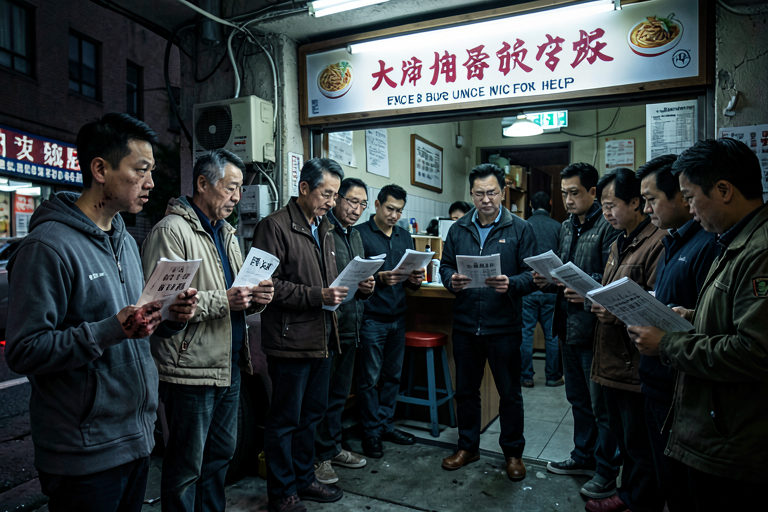
The line started forming at 0800.
By 0900, when Nico finally emerged from the back room of Chen's Noodle House, there were thirty-seven people waiting to see him. Each one clutching a problem they believed only Uncle Nico could solve.
"Mr. Chen, my daughter needs medicine. The clinic says—"
"Uncle Nico, our heat exchanger broke and the landlord won't—"
"Please, my son lost his job and we can't make rent—"
Kade stood at the door like a bouncer, managing the flow. "One at a time. Everyone gets five minutes. No exceptions."
Nico sat at his usual table—the one by the window, where he used to plan deals back when he was just a dealer—and tried not to look like a king holding court.
He failed.
The first petitioner approached: An older woman, hands twisted with arthritis.
"Uncle Nico, thank you for seeing me. It's about my grandson. He's sixteen, smart kid, but he got caught with Veil last week. Not dealing, just using. Now he's got a record and—"
"And he can't get legitimate work with a record," Nico finished. "I know. What do you need?"
"Can you talk to someone? Get it expunged? You know people in SSS, and—"
"I know exactly one person in SSS and he wants to arrest me." Nico rubbed his face. "But I know someone who knows someone. Give Kade your grandson's ID number. I'll make some calls."
The woman's face lit up. "Thank you! Bless you, Uncle Nico. You're a saint."
"I'm really not."
But she was already leaving, making room for the next petitioner.
A young couple, both looking exhausted: "Our baby needs formula. The subsidized program shut down when—when you had to close things. We can't afford market prices."
Nico pulled out his tablet, made a note. "How much do you need?"
"Enough for two weeks? Maybe three if—"
"I'll have someone deliver a month's supply to your housing unit by tonight. What's your address?"
They gave it. Thanked him profusely. Left.
Next: A man whose landlord was illegally charging for repairs. Next: A teenager who needed school supplies. Next: A family facing eviction. Next: Someone's medical debt. Next: Job placement. Next: Another problem, another need, another person looking at Nico like he was their only hope.
By noon, he'd seen twenty-three people and granted twenty-three requests.
Maya brought him water and a protein bar he didn't eat.
"You're doing it again," she said.
"Doing what?"
"Playing savior. These are systemic problems, Nico. You can't fix them one case at a time."
"I can fix these twenty-three cases."
"Until tomorrow when there are forty more. And next week when there are a hundred." Maya sat across from him. "You're creating dependency."
"I'm helping people."
"You're helping people in a way that makes them dependent on you personally. What happens when you can't help anymore? When the money runs out or you're arrested?"
"Then someone else will help." But even as he said it, Nico knew it was a lie. There was no one else. Just him and his stolen millions and his inability to say no.
"You look tired," Maya said gently.
"I am tired."
"Then take a break. Close court for the day. Rest."
"There are still fourteen people waiting."
"There will always be people waiting, Nico. You can't save everyone."
"I can save these fourteen."
Maya stood. "You're going to burn out. Burn through the money. And when you're gone, all these people you've made dependent on you will have no one. Is that really helping?"
She left before Nico could answer.
Because she was right. Of course she was right.
But the next petitioner was approaching, and Nico couldn't bring himself to send them away.
By 1800, he'd seen all thirty-seven.
Granted thirty-five requests. Two he couldn't help with—one was asking him to kill someone (declined), another wanted him to overthrow the Corporate Council (declined, but sympathetic).
His tablet was full of notes. His head throbbed. His hands shook from needing a hit.
Lin Zhao had watched the entire procession from her corner table, silent as a judge.
When the last petitioner left, she approached.
"You know what this looks like, child?"
"Helping people?"
"Feudalism." Lin's voice was sharp. "Lords and vassals. You grant favors, they owe you loyalty. That's not community. That's hierarchy with you at the top."
"I don't want to be at the top."
"Then stop acting like a king."
"I'm just—"
"You're granting audiences. Taking petitions. Solving problems through personal intervention rather than systemic change. You're one man with money playing god." Lin leaned forward. "And what happens to gods when their power runs out?"
"I don't know."
"They get torn apart by the people who needed them. Or they become tyrants to maintain control. There's no third option."
Nico closed his eyes. "What do you want me to do? Say no? Let that baby starve because I'm worried about dependency?"
"I want you to teach that baby's parents how to organize a food cooperative. How to demand fair wages. How to build systems that don't require a benefactor." Lin's hand on his shoulder was surprisingly gentle. "Individual charity is a band-aid on a bullet wound. Sometimes you need the band-aid. But if that's all you do, the patient still dies."
"I'm not a community organizer. I'm just—"
"A drug dealer who got lucky and found some money. Yes. I know." Lin smiled without warmth. "But you're also The King now. And kings have responsibilities beyond granting wishes."
She left him alone with his tablet full of requests and his head full of doubts.
That night, Nico sat in his small room above the noodle house and reviewed the day's commitments:
Baby formula: 200 credits. Medical records expungement: 500 credits in bribes. Repair fund: 1,000 credits. School supplies: 150 credits. Legal fees: 2,000 credits. Emergency housing: 3,000 credits.
Plus the regular expenses: the clinic, the food program, the housing subsidies.
Total weekly burn rate: 165,000 credits.
He pulled out his vape pen, took a long hit of Veil. The chemical warmth spread through his chest, dulling the sharp edges of panic.
Dependency.
Maya was right. He was creating dependency. Not just the petitioners depending on him—him depending on the feeling of being needed. Of mattering. Of being Uncle Nico instead of just Nico the junkie.
Another hit.
What would happen when the money ran out?
What would happen to these thirty-seven people—and the hundreds more like them—when there was no more court to petition? No more Uncle Nico to solve their problems?
They'd survive. Somehow. They always had.
But they'd remember. They'd remember that for a few years, life was better. That someone had cared enough to help.
Was that better than nothing? Or was it worse, like Wright had said—showing them something beautiful and then taking it away?
Nico didn't know.
He took another hit and tried not to think about it.
Downstairs, the noodle house was serving dinner. Two hundred people would eat tonight. Not because of cooperatives or organizing or systemic change.
Because of him.
Uncle Nico.
The King.
The addict playing savior, one petition at a time.
Tomorrow there would be more. There were always more.
And Nico would see them all.
Because he didn't know how to stop.