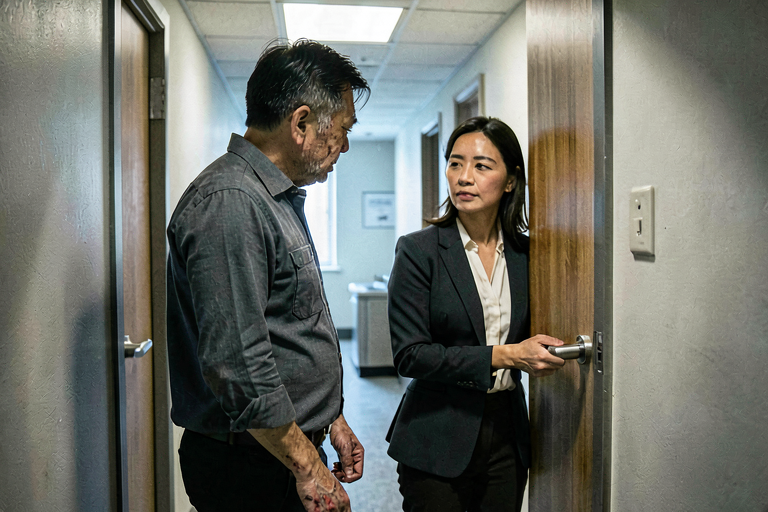
Maya's apartment was on Level 6, District Two, Block J. Unit 847.
Nico had the address memorized but had never actually visited. They always met on neutral ground—coffee shops on Level 7, her office, that observation deck between tiers. Never her home.
Standing outside her door now, he understood why.
The hallway was clean. Not just maintained-clean, but actually clean—fresh paint, no graffiti, working lights that didn't flicker. The floor was level, gravity consistent, no creaks or groans from failing infrastructure. Somewhere down the hall, he could hear music playing. Not loud, not aggressive, just... someone living their life without worrying about neighbors complaining or walls too thin for privacy.
Nico had grown up in a place like this. Before. Before the addiction, before the arrests, before his family decided he was too much trouble and changed the lock codes.
He'd forgotten what it felt like to have a door that locked from the inside.
Maya answered on the second knock, dressed casual—soft pants and a worn shirt, her hair down. She looked younger like this, less armored.
"Hey," she said, stepping aside. "Come in."
The apartment was small by upper-tier standards but enormous compared to Level 8. An actual living space with a couch and a kitchen area. A door leading to what must be a bedroom. Real windows—not viewscreens, actual transparent aluminum showing the station's inner gardens.
Nico stood in the entrance, suddenly aware of how he must look. He'd cleaned up as best he could, but Level 8 left a mark. The smell of algae farms and recycled air clung to clothes. The tension of always checking over your shoulder showed in posture.
"You can sit," Maya said gently. "You want something to drink? I have actual coffee. Real beans, not synthetic."
"Yeah. Okay." Nico moved to the couch, sat on the edge. The cushions were soft, clean. The whole room smelled like... he didn't know. Something floral. An air freshener, maybe. Or just the absence of Level 8's perpetual industrial stink.
Maya moved around her small kitchen. Nico heard water running—instant, no delay, no sputtering. Heard the coffee maker hum to life. Simple domestic sounds that felt alien.
"I'm glad you came," Maya said, her back to him. "After your message, I wasn't sure you would."
"Yeah, well." Nico picked at a loose thread on his jacket. "You said you could explain. I figured I should listen."
"Before or after you tried to bribe a housing official?"
Nico's head snapped up. "How did you—"
Maya turned, two mugs in her hands. "David Reeves is a known con artist. He runs the same scam on three or four people a month. Usually targets lower-tier residents who've come into money—inheritance, lottery, workplace settlements. Station Security knows about him but can't catch him. He changes identities every few weeks." She handed Nico a mug, sat in a chair across from him. "One of my clients got hit by him last month. Lost everything trying to buy a Level 5 apartment."
Nico stared at the coffee, feeling sick. "So everyone just... knows this guy exists and no one stops him?"
"SSS doesn't prioritize fraud cases in lower-tier victims. Resources are allocated to upper-tier protection." Maya's voice was careful, clinical. "It's one of the structural inequities built into the system."
"Structural inequities," Nico repeated. "That's what you call getting robbed and no one giving a shit?"
"Listen to me." Maya leaned forward. "I'm not defending it. I'm explaining it. There's a difference."
"Sure."
"Nico." She waited until he looked at her. "You came here because you wanted to understand why the system is the way it is. So let me explain."
He sipped the coffee. It was good. Bitter and hot and real. He'd forgotten what real coffee tasted like.
"Okay," he said. "Explain."
Maya set her mug down on the small table between them. "The tier system wasn't designed to be fair. It was designed to be stable."
"What's the difference?"
"Fair would mean people can move between tiers based on merit, effort, ability. Stable means people stay where they are, generation after generation, because social mobility destabilizes power structures." She paused. "Station Covenant-7 was built by corporate investment two hundred years ago. The people who funded construction wanted return on investment. That meant exploitable labor at the bottom, management in the middle, ownership at the top."
"I know how capitalism works, Maya."
"Do you know how it's maintained?" She wasn't confrontational, just persistent. "The housing codes, the criminal record checks, the employment requirements—they're not accidents. They're designed to prevent exactly what you're trying to do."
"Escape."
"Yes."
Nico laughed, bitter. "So what, they just decided people like me should be trapped forever? That's the plan?"
"Not trapped. Contained." Maya's voice was steady, practiced. Like she'd had this conversation before. "Think about what happens if lower-tier residents can actually buy their way up. If having money was enough. What happens to the labor pool?"
"I don't—"
"Who cleans the upper-tier apartments? Who maintains the infrastructure? Who processes waste, grows algae, works the fabrication plants? All the jobs no one wants but everyone needs done—who does them?"
Nico stared at her. "You're saying they need us to stay poor."
"I'm saying the system needs a permanent underclass. If people could escape through wealth alone, there'd be no one left to do the work that keeps the station running. So they built in barriers. Criminal records that never expire. Background checks that bar anyone with drug charges. Employment requirements that are impossible to meet without connections you don't have."
"That's..." Nico couldn't find the words. "That's fucking evil."
"It's structural violence," Maya said quietly. "And yes, it is."
"Then why do you work for them?" The anger burst out before Nico could stop it. "Why do you show up every day and process paperwork and follow their rules if you know the whole system is designed to hurt people?"
Maya flinched. For a moment she looked away, out her window at the gardens. When she spoke again, her voice was softer.
"Because I can help some people. Not many. Not enough. But some." She met his eyes. "I got out, Nico. I made it from Level 8 to here. Scholarships, loans, working three jobs while going to school. It took fifteen years and I'm still paying off debt, but I made it. So I know it's possible."
"For you."
"For some people," she corrected. "And the ones who can't make it through conventional channels—I try to help them survive what they're trapped in. Get them resources. Navigate bureaucracy. It's not enough, it's never enough, but it's what I can do."
"From inside the system that's crushing them."
"Yes." Maya didn't look away. "From inside the system. Because burning it down helps no one if there's nothing to replace it with."
Nico set down his coffee mug. "What about me?"
"What about you?"
"Am I one of the ones who could make it? If I tried conventional channels? If I went to rehab, got clean, did everything right?" He already knew the answer but he needed to hear her say it.
Maya was quiet for a long time.
"No," she said finally. "With your record, the length of your addiction, your age—no. The system has already decided you're not worth the investment."
"So I'm trapped."
"By conventional standards, yes."
"By any standards." Nico stood, suddenly needing to move, to not be sitting in this comfortable apartment that represented everything he couldn't have. "I got fifty million fucking credits, Maya. Fifty million. And I can't buy an apartment. Can't bribe my way in. Can't fake my way through. I'm still just a Level 8 junkie and nothing changes that."
"Money doesn't change the underlying structure—"
"Money doesn't change ANYTHING!" He was shouting now, couldn't stop it. "That's what you're telling me! That I could have a billion credits and I'd still be trapped in a pod hotel with broken plumbing because someone two hundred years ago decided people like me should stay at the bottom!"
"Nico—"
"You got out. Good for you. Scholarships and hard work and fifteen years of debt. Congratulations. You're one of the special ones who the system decided deserved a chance." He gestured at her apartment, at her real windows and working water and clean floors. "But me? I'm one of the disposable ones. The permanent underclass you were talking about. The people who clean your toilets and can never be more than that."
"That's not what I—"
"It is, though." Nico's voice cracked. "It's exactly what you meant. You just said it nicer."
Maya stood, crossed to him. He wanted to pull away but couldn't. She put her hand on his arm, gentle.
"Listen to me," she said. "The system is rigged. You're right. It's designed to trap you and everyone like you. But you know what's not designed? You. Your choices. What you do with that money."
"What can I do with it? I just told you, I can't—"
"You can't buy your way up. We've established that. So stop trying." She waited until he looked at her. "Use the money for something else."
"Like what?"
"I don't know. But you have resources that no one in Level 8 has ever had. You could help people. Really help them. Not escape—maybe that's not possible. But make life more survivable for the people trapped there with you."
"Charity," Nico said flatly.
"Solidarity," Maya corrected. "There's a difference."
Nico pulled away, moved to her window. Looked out at the gardens—real plants, real trees, real grass growing under artificial sunlight. Things that existed to be beautiful, not functional. Luxuries the lower tiers never saw.
"What's the point?" he asked the window. "If the system's designed to crush us, what's the point of making it slightly more comfortable? That doesn't change anything."
"It changes everything for the people you help."
"But not the system."
"No," Maya admitted. "Not the system."
Nico turned to face her. "Then what's the fucking point?"
She met his gaze steadily. "Because people are dying down there, Nico. Every day. From hunger, from untreated medical conditions, from despair. And yeah, charity doesn't dismantle oppressive structures. But it keeps people alive while we figure out what will."
"Who's 'we'?"
"I don't know yet." Maya smiled, sad. "But maybe it starts with someone who has fifty million credits and nothing left to lose."
They stood in silence. Nico looked around her apartment again—the comfort, the safety, the dignity of having walls and privacy and furniture that wasn't someone else's discarded trash.
She'd gotten out. Had climbed the ladder everyone said was impossible to climb. And she'd done it by following every rule, meeting every requirement, becoming exactly what the system wanted her to be.
And she was telling him he couldn't.
That he was too marked, too damaged, too permanently categorized as disposable.
"I should go," Nico said.
"You don't have to—"
"Yeah, I do." He moved toward the door. Maya didn't try to stop him.
At the threshold, he paused. "The coffee was good. Thanks."
"Nico."
He looked back.
"I'm sorry," Maya said. "I'm sorry the system is rigged. I'm sorry you can't escape. I'm sorry everything I just said sounds like giving up." She paused. "But I'm not giving up on you. For what it's worth."
"It's worth something," Nico said quietly. "Just not sure what yet."
He left, taking the lift down to Level 8, back to the smell of algae farms and broken things, back to his pod where the walls were thin and the neighbors were loud and the floor sometimes shifted under his feet.
Back to the permanent underclass.
But Maya's words followed him down: Make life more survivable for the people trapped there with you.
Not escape. Not redemption. Just... survival.
Maybe that was enough.
Maybe that was all he'd ever been offered anyway.