Three years after the truth shattered consensus reality, humanity was killing itself over grammar.
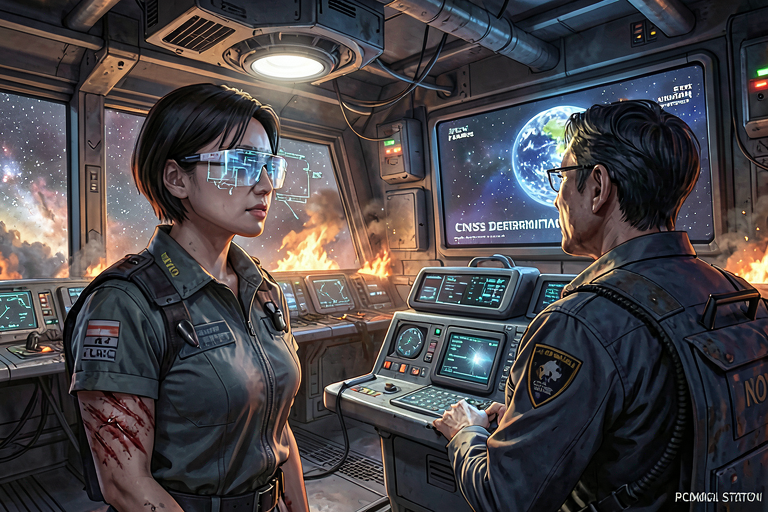
Commander Elise Chen watched Proxima Station burn from her tactical display aboard CNSS Determination, flagship of the Contact Navy. Not from kinetic weapons or fusion warheads—those would have been merciful. Proxima burned from the inside out, section by section, as Memory faction saboteurs cut life support to ansible station modules.
Forty-seven thousand people dying because they believed ansible was humanity's sacred connection.
"Transmission incoming," her comms officer announced. "Memory faction command. Audio only. They want to negotiate."
"Play it."
The voice that filled the bridge belonged to Admiral Marcus Webb, former New Singapore defense coordinator. Now leader of the Memory faction's military arm.
"Commander Chen. You're watching innocent people die to preserve a lie. The ansible network isn't a death beacon. Earth's silence wasn't alien quarantine. It was Contact faction propaganda to justify destroying our civilization."
Elise kept her voice flat. "We have physical evidence. Earth made contact with aliens. Ansible attracts Harvesters. This is documented fact."
"You have relativistic trader testimony and fabricated signal analysis. The same ansible guild that lied for forty years now claims they lied to protect us from aliens? And you believe them?"
"I believe physics. I believe Zara Kim's research. I believe—"
"You believe what Contact faction tells you to believe." Webb's contempt carried clearly across the void. "Just like we believed the guild for forty years. Same information control. Different masters. But you've convinced yourselves you're the truth-tellers while imposing your narrative by force."
Elise pulled up casualty projections. Proxima Station would be dead in six hours. Forty-seven thousand. Added to the eight million who'd died in the three years since Lira Voss's broadcast.
Eight million.
For truth.
"We're not imposing anything," Elise said. "Contact faction offers choice. Accept alien help, shut down ansibles, survive Harvesters. Memory faction is free to refuse. But you're not free to keep broadcasting ansible signals that doom everyone."
"So we accept your truth or we die? That's not choice. That's tyranny with better rhetoric." Webb's laugh was bitter. "Lira Voss said she was giving humanity choice. You're just enforcing consequences for wrong answers."
"We're enforcing survival."
"You're enforcing your interpretation of ambiguous evidence." The transmission crackled. "Earth went silent. That's the only certain fact. Everything else—alien contact, Harvester threat, ansible danger—is speculation wrapped in testimony from sources who've lied before. And you're killing millions to enforce that speculation."
Elise closed her eyes. Three years. Eight million dead. And the worst part: Webb wasn't entirely wrong.
"Your terms?" she asked.
"Cease fire. Independent verification commission. Let every colony examine the evidence and choose for themselves what they believe about Earth's fate."
"We already did that. You called it propaganda."
"Because Contact faction controls ansible traffic analysis. Controls xenolinguistic research. Controls access to Kaito Reeves's ship logs." Webb's voice hardened. "You built an information monopoly as absolute as the guild's. Then called it truth instead of narrative control."
"The guild lied about Earth being alive," Elise countered. "We're telling the truth about Earth being dead."
"Both claims sound the same from inside the lie."
The transmission cut.
Elise stared at Proxima Station's dying signature on her display. Forty-seven thousand people who'd chosen to believe Memory faction's narrative. Who saw Contact faction as new tyrants, ansible destruction as civilizational suicide.
Who might be right.
"Ma'am?" Her tactical officer waited for orders. "Proxima's shields are down. We could force dock. Rescue survivors. End this siege."
"At what cost?"
"Memory defenders will fight. Estimate three to five thousand casualties on both sides."
Three thousand to save forty-seven thousand. Simple math. Except Memory faction would call it invasion, propaganda would spread, fifty more stations would resist, and each battle would cost more than the last.
"Hold position," Elise ordered. "Send medical drones. Anyone who wants to evacuate gets safe passage. But we're not breaching."
"They're dying, ma'am."
"I know." Elise pulled up ansible traffic analysis. "But if we invade to save them, we prove their narrative right. That Contact faction imposes truth by force. We lose the moral authority that justifies this entire war."
"Permission to speak freely?"
"Granted."
"What if they're right?" The tactical officer's voice was barely audible. "What if we are just replacing one information monopoly with another? What if the Harvester threat is—"
"Real," Elise cut her off. "The Harvester threat is real. Zara Kim's research is verified by seventeen independent teams. Kaito Reeves witnessed Earth's ansible detonation. The alien signals are authentic. Everything Memory faction calls propaganda, we can prove through physical evidence."
"They say physical evidence can be fabricated."
"Then nothing is provable and truth doesn't exist." Elise brought up the tactical map. Contact blue, Memory red, spreading across forty-seven colony systems like cancer. "Is that what you believe? That we're killing millions for a lie?"
The officer hesitated. "I believe... we're killing millions for what we think is truth. And I don't know if that's better than killing millions for what they think is truth."
Elise dismissed her. Needed to think. Needed to—
"Priority transmission," comms announced. "Origin: Dr. Zara Kim, Contact Research Directorate. Encryption: absolute."
Elise's stomach tightened. Zara only used absolute encryption for discoveries that could change the war. Good news or catastrophic news. Nothing in between.
She accepted in her private ready room.
Zara's face appeared, and Elise's heart sank. The xenolinguist looked like she'd aged ten years in three. Burn scars across her left cheek from a Memory faction assassination attempt. Eyes that had seen too much evidence, too much death, too much consequence.
"Commander. I've finished analyzing Kaito's Earth data core."
"And?"
"Memory faction is right about one thing. We've been enforcing narrative based on incomplete evidence." Zara's hands shook. "Earth didn't just make contact with aliens. Earth negotiated with them. Extended negotiations. Months of back-and-forth communication."
"That supports our position. Proves aliens exist, proves—"
"Earth asked the aliens for ansible technology improvements. Specifically, asked how to make ansible undetectable." Zara pulled up transmission logs. "Earth knew ansible attracted Harvesters. The aliens told them. And Earth's response wasn't to shut down the network. It was to try to make it safer while keeping it operational."
Elise felt the floor drop out from under her. "They wanted to keep the ansible?"
"They wanted to keep human unity. They believed the ansible network was worth the risk if it could be made less detectable." Zara's voice cracked. "The aliens said no. Said any ansible use was existential threat. Said humanity had to choose: network or survival. And Earth chose—"
"The network," Elise finished. "Earth chose to keep ansible operational."
"Not exactly." Zara displayed Earth's final authenticated transmission. "Earth chose to give colonies the choice. They refused to unilaterally shut down the network. Instead, they called for human-wide referendum. Every colony votes. Majority decides humanity's future."
"What happened?"
"The vote never happened. Aliens didn't wait for democracy. They quarantined Earth before the colonies could respond." Zara's laugh was broken. "Earth died believing in human choice. Died refusing to impose survival on colonies that might choose connection over safety."
Elise stared at the transmission logs. Earth's final words to the colonies, never delivered because the ansible detonated first:
We have been offered a choice by those who came before us. Survival without unity, or unity with existential risk. The ansible network that connects us may destroy us. But we are human because we choose together. Every colony must vote. Not what we think is right, but what we collectively decide is worth preserving. If we survive, let it be as one humanity, united by choice. If we die, let it be for something we chose together, not something imposed by fear.
"They were going to let the colonies vote," Elise whispered. "Even knowing the right answer. Even knowing ansible meant death."
"Because they believed informed choice was more important than survival." Zara wiped her eyes. "And we—Contact faction—we haven't given anyone that choice. We've been imposing ansible shutdown by force. Calling it salvation. But Earth died defending the right to choose damnation."
"Memory faction would choose connection. They'd vote to keep ansible operational even knowing the risks."
"Yes. And according to Earth's final transmission, that would be their right." Zara's voice hardened. "We're fighting this war to honor Earth's sacrifice. But Earth sacrificed themselves to preserve humanity's right to choose. Even choose wrong."
Elise pulled up casualty statistics. Eight million dead. Proxima Station dying. Fifty more battles queued up. All to impose survival on colonies that wanted to choose for themselves.
"If we reveal this," Elise said slowly, "Memory faction wins the narrative war. Their entire position is vindicated. And colonies vote to keep ansibles operational."
"Possibly."
"Harvesters arrive in seventy-four years. Ansible network keeps broadcasting. Humanity dies."
"Possibly."
"So Earth's final wish—letting humanity choose—leads directly to human extinction."
"Possibly." Zara met her eyes. "Or possibly colonies vote for survival once they have all the evidence. Or possibly there's a middle path we haven't found because we've been fighting instead of deliberating. Earth believed in human wisdom given complete information. We've been too afraid to test that belief."
Elise thought of Admiral Webb. His accusation: You're enforcing your interpretation of ambiguous evidence.
Not ambiguous anymore. Earth's final transmission was clear. Let humanity choose. Even if they choose extinction.
"What do you recommend?" Elise asked.
"Release Earth's final transmission. All of it. To every colony simultaneously. Contact and Memory both. Let them read Earth's actual words, not our summaries. Let them decide if ansible is worth the risk."
"And if they vote wrong?"
"Then we respect that choice." Zara's face was steel. "Because the alternative—imposing survival by force—makes us exactly what Memory faction claims. Information tyrants who learned nothing from the guild's forty-year lie."
"Eight million people died fighting for Contact faction's position."
"And they'll die for nothing if we win by becoming what we opposed." Zara pulled up the transmission again. "Earth died for choice. If we honor that sacrifice by removing choice, we've already lost."
Elise watched Proxima Station die. Forty-seven thousand. Eight million. All the casualties of three years of war over who got to define truth.
And now Earth's actual voice, finally decoded, saying: Let them choose. Even if they choose death.
"How many colonies have you shown this to?" Elise asked.
"Just you. You're Contact military command. Your decision whether to release it."
"Memory faction will use this as weapon. Proof that Contact faction has been suppressing evidence."
"They'd be right."
"Three years of war. Millions dead. All of it undermined by Earth's final words."
"Or validated," Zara said quietly. "We fought for truth. Now we have it. Question is whether we're brave enough to let that truth destroy our position."
Elise thought of Lira Voss. The woman who'd started all of this by choosing truth over stability. Who'd broadcast the guild's lies even knowing it would fracture civilization.
Who was now somewhere between human space and alien coordinates, traveling decades to verify the truth personally.
What would Lira do?
She'd broadcast it. She'd give humanity the information and trust them to choose. Even if they chose wrong.
"Prepare the transmission," Elise said. "Earth's final message. Full context. Every colony. Contact and Memory both. Simultaneous broadcast."
"Contact faction leadership will resist. We'll lose our moral authority for the war."
"We'll lose our moral authority if we suppress this." Elise stood. "Earth died for choice. The least we can do is honor that sacrifice."
"Yes ma'am." Zara hesitated. "For what it's worth... I think you're making the right choice. The hard choice."
"The choices are always hard." Elise looked at Proxima Station's fading signature. "And someone always dies for them. But if we're going to ask people to die for truth, we have to actually tell them the truth. All of it. Even the parts that hurt us."
The transmission went out six hours later.
Earth's final words to humanity. Uncensored. Unspun. Just raw data from Kaito's ship logs, verified and authenticated.
Let humanity choose together. Unity or survival. But choose knowing the stakes. Choose informed. Choose free.
Within twelve hours, cease-fires erupted across forty-seven colony systems.
Not because everyone agreed.
But because everyone finally had the same information.
And Earth's ghost, speaking from forty years past, had offered what neither Contact nor Memory faction had provided:
Permission to choose wrong.
Permission to value connection over safety.
Permission to be human even if being human meant extinction.
Admiral Webb's response came eighteen hours after broadcast:
Commander Chen. You've proven Contact faction still has integrity. Memory faction proposes immediate armistice, human-wide referendum on ansible network, abiding by majority decision regardless of outcome. Earth died for this choice. Let's not waste that sacrifice on war.
Elise accepted.
The war didn't end.
But it paused.
Humanity would vote.
And whatever they chose—survival or connection, isolation or risk—they'd choose it together.
The way Earth died believing they should.
Three years of war.
Eight million dead.
All of it leading to the choice Earth wanted to give them in the first place.
Elise wondered if Lira Voss, somewhere in deep space approaching alien territory, would think it was worth it.
If truth that cost eight million lives was still truth worth having.
If giving people choice, even knowing they might choose extinction, was still the right thing to do.
She didn't know.
But she'd made the choice.
And now, like Earth before her, she'd live with the consequences.
Or die with them.
Either way, humanity would finally choose for itself.
The way it always should have been.