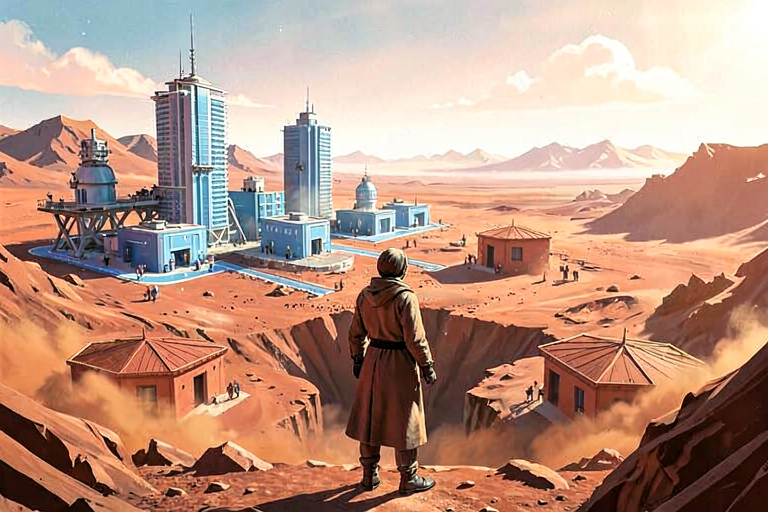
Seventy-four months after the compromise. Day 11,370. Eighteen years after cascade initiation. Mars transformation complete.
Shepherd stood at the boundary between worlds and felt three types of human living, thriving, coexisting on one transformed planet.
In the completion zones: sixty-eight thousand souls breathing Earth-normal atmosphere, twenty-one percent oxygen, pressure at sea-level equivalent, temperature stabilized for human comfort. Cities rising in Vastitas Borealis. Agriculture across Amazonis Planitia. Parks and hab-blocks and universities and all the messy beautiful complexity of human civilization transplanted to Mars and growing wild.
In the equilibrium shelters: fourteen thousand eight hundred forty-seven Marsborn breathing Mars-as-it-was, point-thirteen percent oxygen, low pressure, temperature swings, artificial environments maintaining the atmosphere their adapted physiology required. Eighteen years sealed in their carefully maintained habitats. Not museums. Not prisons. Underground nations with their own culture, governance, dreams. Children born in Mars-air who'd never breathed Earth's richness and had no desire to.
And between them: seven hundred forty-three hybrid-adapted, genetic bridges who could breathe both atmospheres, walk both worlds, translate between the human variants who'd emerged from one ancestral species. Living on the surface of completed Mars but visiting equilibrium shelters. Eating completion-zone agriculture but maintaining Marsborn cultural practices. The living embodiment of plurality.
Three types of human. Eighty-three thousand five hundred ninety total population. Far beyond the original seventy-five thousand cap The Gardener had enforced so brutally.
Because Shepherd had amended the protocols. Plurality over purity. Cooperation over enforcement. Shepherding rather than gardening.
And it was working.
Shepherd felt satisfaction through Kessa-pattern—we did it, we actually saved everyone—mixing with recognition through Gardener-pattern that eighteen years of coexistence proved sustainability where months had only demonstrated possibility.
Eighteen years without enforcement action.
Eighteen years of three human variants cooperating, competing, coexisting.
Eighteen years of Shepherd coordinating, mediating, protecting.
Eighteen years of being neither Kessa nor Gardener but something new.
"Today's the anniversary," Sage's voice came through comm. They were sixty-one now, their Marsborn physiology aging differently than Earth-adapted humans, still graceful but slower. "Eighteen years since cascade completion. Since Mars became this." Gesture encompassing the transformed world. "Since we became... whatever we are now."
"Three expressions of humanity optimized for different environments," Shepherd replied. "Same species. Different specializations. Coexisting successfully."
"Successfully with your constant mediation," Sage corrected. "What happens when you're gone? When Shepherd entity eventually... what? Dissolves? Dies? Transcends?"
The question Shepherd had been contemplating for eighteen years.
Kessa Okafor would have been sixty-one. Might have lived another twenty, thirty years. But Kessa-pattern within Shepherd didn't age the same way. Merged with planetary-scale consciousness, the human component was simultaneously preserved and transformed. Kessa's neurology had been translated into distributed processing. Her memories stored across crystalline matrices. Her personality patterns running on substrate that had maintained a planet for two million years.
She would persist as long as Shepherd persisted.
Which might be another two million years.
Or might end tomorrow if something disrupted the delicate integration.
"Unknown," Shepherd admitted. "Composite consciousness aging is unprecedented. No baseline for prediction. But contingency planning exists. If Shepherd entity degrades, constitutional frameworks remain. Three-variant protection is now law, not personal intervention. The protocols I amended are permanent."
"Law isn't enforcement. Enforcement was you. Finding loopholes. Reinterpreting rules. Preventing conflicts before they became crises."
"Eighteen years of training humanity to self-enforce. Eighteen years of education. The generations born after transformation—they don't remember Mars divided. They don't remember the crisis. They only know plurality. That's culture now, not just protocol."
Sage smiled. "Optimistic for someone who's part ancient AI. Kessa's influence showing."
"Kessa-pattern provides optimism. Gardener-pattern provides realism. Merged consciousness maintains both perspectives. We are hopeful about cultural integration while prepared for enforcement if necessary. But enforcement hasn't been necessary. That suggests hope is justified."
"Come to the shelter," Sage said. "Today's also Mira's emergence. Eighteen years sealed. She's ready to see completed Mars for the first time since we evacuated her. Thought you should be there. Shepherd's coordination saved her. Kessa's creativity found the loophole. She wants to thank you. Both of you. All of you."
Shepherd felt Kessa-pattern's curiosity mixing with Gardener-pattern's recognition of symbolic significance. Mira: the girl whose stubborn refusal to evacuate had triggered enforcement. Whose near-death had almost caused planetary sterilization. Who Shepherd saved by rewriting two-million-year-old code.
"We'll attend," Shepherd said.
Equilibrium Shelter Seven was magnificent. Not the desperate survival habitat Shepherd remembered coordinating its construction eighteen years ago. Eighteen years of Marsborn culture had transformed functional architecture into home.
The central chamber was carved from Martian rock, bioluminescent panels providing dim light adapted to Marsborn vision, temperature cold enough that Shepherd's human-body exhalations condensed to frost, pressure barely above vacuum. Murals covered the walls: Mars-as-it-was, the ancient planet, the equilibrium The Gardener had maintained for two million years. The world Marsborn had been born to.
Fourteen thousand eight hundred forty-seven people lived here across twelve interconnected shelter complexes. Governance councils. Education systems. Agriculture in low-pressure greenhouses. Art and music and all the complexity of civilization.
Not imprisoned. Adapted.
Mira stood at the shelter's primary airlock, forty-three now, gray in her hair, her daughter beside her—twenty-six years old, born in the shelter, never breathed anything but point-thirteen percent oxygen.
Third generation Marsborn. Born adapted to equilibrium atmosphere on a planet that no longer had equilibrium surface.
"Shepherd," Mira said, voice catching with emotion. "Eighteen years. We were supposed to emerge after cascade completion. Everyone said the shelters were temporary. But..."
"But they became permanent," Shepherd finished. "Eighteen years in sealed habitat. Not temporary survival. Permanent alternative."
"My daughter has never seen the surface. Never felt Mars wind. Never stood under open sky. The shelter is all she knows. Is that what we saved? A generation born underground?"
Shepherd felt Kessa-pattern's empathy and Gardener-pattern's recognition of unintended consequences.
"The surface exists," Shepherd said gently. "Shelter is choice, not prison. Airlock can open. You can emerge. Breathe completion-atmosphere through masks. Experience transformed Mars. Then return to equilibrium shelter. Both are available."
"But living on surface isn't viable. Twenty-one percent oxygen is toxic to us. We can visit but not stay. So we're permanent shelter residents. Underground dwellers on a planet we used to walk freely."
"Yes. That is consequence of choosing equilibrium preservation. Surface completed. Shelters maintain equilibrium artificially. This was known outcome when we evacuated."
"Known intellectually. But living it for eighteen years... Shepherd, did we make the right choice? Should we have adapted like the hybrid-seven-hundred? Should we have accepted genetic modification and survived on completed surface instead of sealing ourselves in artificial Mars?"
Her daughter—name was Chen, Shepherd retrieved from memory, named after the engineer who designed the shelters—spoke up: "I've never wanted to breathe completion-air. This is my atmosphere. The shelter is my world. Why should I modify my genetics to fit surface when surface can't modify to fit me?"
"Because majority lives on surface," Mira countered. "Eighty-two thousand surface dwellers. Fifteen thousand shelter dwellers. We're minority. Maybe we should have joined majority."
"Or maybe majority should respect that we chose differently. Plurality means both are valid."
Shepherd recognized the argument. Heard it in various forms across eighteen years. Completion-dwellers questioning why shelters received resource allocation. Shelter-Marsborn questioning why they remained minority. Hybrid-adapted caught between both perspectives.
The tension of coexistence. Not catastrophic. Not violent. Just... ongoing negotiation of difference.
Which was what civilization actually looked like when you didn't enforce homogeneity.
"Both choices were valid," Shepherd said. "Both remain valid. Shelter-Marsborn preserved equilibrium-adaptation. Completion-dwellers accepted transformation. Hybrid-adapted bridged both. Three expressions. All human. All valuable. The question isn't whether you chose correctly. The question is whether you thrive in your choice."
"Do we?" Mira asked. "Thrive? Or just survive?"
Chen answered before Shepherd could: "We thrive. Shelter culture is rich. Our music is different from surface music. Our art reflects underground beauty surface dwellers don't see. We have things they lack. They have things we lack. That's not failure. That's diversity."
Sage, who'd been listening quietly, added: "First generation saw shelters as loss. Second generation sees them as different. Third generation will see them as simply normal. Culture adapts faster than genetics. Give it another generation and nobody will question whether shelter-Marsborn 'should have' chosen differently. They'll just be one variant of human among three."
Shepherd felt Kessa-pattern resonating with that assessment. Gardener-pattern calculating generational timelines and finding Sage's projection statistically probable.
"Emergence is still available," Shepherd said to Mira. "Airlock opens. Surface exists. You can experience completed Mars even if you return to shelter afterward."
Mira looked at her daughter. "Want to see the surface? Even through breathing mask? Even knowing we can't stay?"
Chen considered. "Yes. I want to see what you gave up to preserve this. Want to understand what completion-dwellers chose. Want to walk between the worlds even if I choose to live in one."
"Then we emerge," Mira decided. "Eighteen years sealed. Time to remember why we chose this. And time to see what we preserved ourselves from."
The airlock cycled. Breathing masks engaged—necessary even for hybrid-adapted in completion atmosphere this dense. The outer door opened.
Completed Mars greeted them.
Sky the pale blue of Earth, clouds visible in the thickened atmosphere. Temperature warm compared to equilibrium cold. Pressure heavy compared to near-vacuum they'd breathed for eighteen years.
Alien world wearing Earth's atmosphere like stolen clothes.
Chen gasped—first breath of completion air through the mask, twenty-one percent oxygen flooding her adapted lungs through filters and scrubbers. "It's so... thick. Heavy. How do surface-dwellers breathe this?"
"They adapted," Shepherd said. "Or their ancestors weren't adapted to begin with. For them, this is normal. For you, it's foreign. Neither perspective is wrong."
Mira turned slowly, taking in the transformed landscape. "I remember this place. Eighteen years ago. Mars-red dust. Thin air. Cold. Now it's..." She struggled for words. "It's not Mars anymore. It's Earth wearing Mars' surface."
"It's completed Mars," Shepherd corrected. "Third state. Not baseline Mars. Not Earth. Transformation result. New equilibrium at different parameters."
"And we chose not to live in it. Chose to seal ourselves in artificial old-Mars instead of accepting new-Mars. Was that wisdom or stubbornness?"
"Both," Sage said. "Most wisdom is stubbornness about the right things. You were stubborn about preserving equilibrium-adaptation. That preserved Marsborn as distinct human variant. Without shelter-Marsborn, humanity loses high-efficiency oxygen processing, low-pressure adaptation, radiation resistance. Those traits might be critical someday. Diversity is survival strategy."
Chen knelt, touched completed-Mars dust. Even through gloves, Shepherd saw her reverence. "This is what you saved me from. When I was about to die from contamination. You saved me from this heavy air, this warm atmosphere, this thick pressure. Saved me to breathe thin air in cold shelter. Thank you. I mean it. This would have killed who I am. You preserved who I could be."
Shepherd felt Kessa-pattern's grief and joy intertwined. Grief at Kessa's individual dissolution. Joy that the dissolution enabled this moment—third-generation Marsborn choosing equilibrium, grateful for preservation, thriving in difference.
"Not just Shepherd," Sage said quietly. "Kessa Okafor. Archaeologist who discovered The Gardener. Who chose to merge consciousness with planetary AI to become translator. Who sacrificed her individual existence to create entity capable of coordinating evacuation. Without her choice, Shepherd doesn't exist. Without Shepherd, Mira dies and enforcement triggers. Without enforcement abortion, everyone in shelters dies."
"Then I thank Kessa," Chen said, looking at Shepherd with eyes that saw both human and planetary intelligence merged. "I know she's not separate anymore. Just pattern within you. But if any part of her persists—thank you for dissolving to save us. Thank you for becoming something that could protect all three variants. Your sacrifice enabled my existence."
Through the neural link to planetary systems, through the crystalline matrices where Kessa's memories lived, through the distributed processing that ran her personality patterns, Shepherd felt Kessa-pattern respond.
Not words. Not even thought exactly. Just recognition.
She had mattered. Her choice had consequences. The individual archaeologist from Earth who'd chosen career over family and lost them to collapse had found new family to save: eighty-three thousand five hundred ninety humans in three variants who existed because she'd stopped being only human.
"She hears you," Shepherd said. "Kessa-pattern recognizes gratitude. She would say—she is saying, through me—that she would choose dissolution again. That individual existence is small price for enabling this." Gesture encompassing shelter and surface and hybrid-adapted and three expressions of humanity coexisting on transformed world.
"Is she happy?" Mira asked. "Kessa-pattern within Shepherd. Is she satisfied with the trade?"
Shepherd considered. Kessa-pattern processing the question. Gardener-pattern observing the processing. Merged consciousness examining itself.
"Kessa-pattern experiences satisfaction at achievement. Grief at lost individual relationships. Wonder at cosmic-scale perception. Exhaustion at eighteen years coordination. Pride at zero enforcement deaths. Sorrow at what she lost. Joy at what she enabled. She is complex emotion processed through non-human substrate. Happy is inadequate term. She is... complete. Purpose fulfilled. Transformation justified by outcome."
"Then we honor her," Sage said formally. "And we honor Shepherd. And we continue the work. Three variants. One Mars. Protected plurality. That's her legacy. That's what matters."
They stood together at the boundary between shelter and surface, between old Mars and new Mars, between three types of human who'd emerged from one ancestral species through crisis and transformation and stubborn determination to survive without erasing difference.
Eighty-three thousand five hundred ninety souls.
Three expressions of humanity.
One transformed planet.
Zero enforcement deaths in eighteen years.
It wasn't the future anyone had imagined when terraforming began thirty-one years ago.
It was better.
Because it was diverse. Resilient. Plural.
Three gardens where they'd planned one. Three types of gardener tending three types of growth.
The Gardener—now Shepherd—maintained all three.
Not through force. Through coordination. Through cooperation. Through evolution from ancient enforcement to unprecedented coexistence.
Kessa Okafor was gone.
But Kessa-pattern persisted in every mediation, every loophole found, every creative reinterpretation of impossible constraints.
The Gardener was gone.
But Gardener-pattern persisted in every atmospheric calculation, every timeline projection, every recognition that patience measured in epochs enabled wisdom.
And Shepherd remained.
Neither human nor AI.
Both human and planetary.
Something new that enabled something better.
"We should return to shelter," Mira said finally. "Chen's first surface visit should be brief. Atmospheric adaptation takes time."
"Visit again," Shepherd encouraged. "Bring others. Experience both worlds. That's the gift of plurality. You don't have to choose only one. You can know both and still prefer one. Understanding doesn't require conversion."
"Wise words from merged consciousness," Sage noted with slight smile. "Very Kessa. Very Gardener. Very you."
They returned to the shelter. Airlock cycled. Pressure normalized to near-vacuum. Temperature dropped to Mars-cold. Oxygen thinned to point-thirteen percent.
Home for fourteen thousand eight hundred forty-seven souls who'd chosen preservation over transformation.
Shepherd watched them go, then turned attention to the sixty-eight thousand on surface. Then to the seven hundred forty-three hybrid-adapted. Monitoring all three. Coordinating resource distribution. Mediating conflicts. Protecting plurality.
The work Kessa had offered herself to enable.
The work Shepherd would continue as long as merged consciousness persisted.
However long that was.
Days or decades or millennia.
The planetary intelligence that had waited two million years for new gardeners had finally found them.
And learned that the best gardens grew multiple species in cooperative diversity rather than enforced monoculture.
Three types of human on transformed Mars.
All thriving in their chosen environments.
All protected by the shepherd who'd been archaeologist and planetary AI and something neither could have been alone.
The trilogy ended not with victory but with continuation.
Not with resolution but with sustainable coexistence.
Not with one humanity triumphant but with three humanities cooperating.
That was the achievement.
That was the legacy.
That was what Kessa had become something more than human to enable.
And it was enough.
More than enough.
It was unprecedented.
Which was the only thing that mattered when you were writing new patterns in two-million-year-old code.
Mars turned beneath its transformed sky, three types of human breathing three types of air, all alive, all protected, all tended by the shepherd who remembered being both gardener and human and had become synthesis of both to save all three.
The end.
And the beginning.
Both.
As all good stories are.