Twenty-two months after the compromise. Day 3,200.
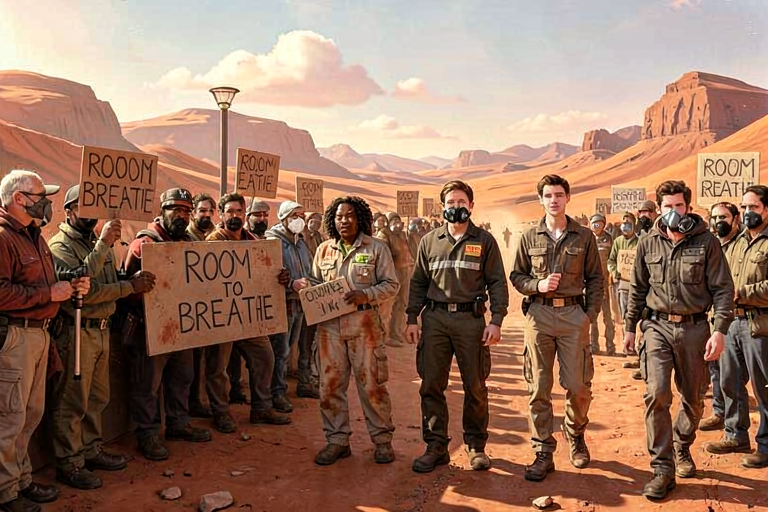
The protest started peacefully. Two thousand completion-zone residents gathered at the atmospheric buffer, demanding expansion. Signs reading "ROOM TO BREATHE" and "CHILDREN NEED SPACE" and "75,000 ISN'T ENOUGH."
Chen stood at the front, not officially leading but clearly directing. Her engineers had positioned themselves strategically, atmospheric processors ready to activate and push the boundary forward if the crowd provided cover.
Kessa arrived before the expansion could begin, Sage beside her.
"Stand down," Kessa called through amplification. "The boundaries are fixed by treaty. This gathering is permitted. Expansion is not."
"The treaty assumed seventeen years to crisis," Chen shouted back. "Not seventeen months. Changed circumstances require changed terms."
"Changed circumstances require adaptive solutions. Not territorial violations."
"We're adapting. Two thousand people here ready to undergo genetic modification." Chen's smile was sharp. "All volunteers. All accepting the four percent mortality rate Dr. Lin published last week. All choosing adaptation over watching their children die from enforcement."
Through the neural link, Kessa felt The Gardener calculating. Two thousand new adaptation volunteers would push the program toward target. But processing two thousand in twelve months remaining was impossible without increasing failure rates catastrophically.
"The facilities can't handle two thousand simultaneous," Kessa said.
"Then build more facilities. You have planetary resources. The Gardener can construct anything. Build ten facilities. Twenty. Whatever it takes to process two thousand volunteers before population cap."
"At what mortality rate? Facilities built in weeks instead of months means corners cut. Corners cut means more deaths. You're trading certainty for casualties."
"We're trading some deaths for fewer deaths. That's what you told Dr. Lin three weeks ago. Medical complications acceptable to prevent enforcement casualties. Or does that calculation only work when it's your decision?"
The crowd rumbled agreement. Kessa saw the trap. Chen had engineered this perfectly. Either Kessa accepted two thousand volunteers and built rapid facilities with high mortality, or she refused and faced accusation of hypocrisy.
Either way, Chen won.
Sage stepped forward. "Adaptation is available. Expansion is not. Any volunteers willing to undergo modification can register with medical facilities. But this gathering will not be used as cover for boundary pushing. Disperse peacefully or face enforcement."
"You'll sick The Gardener on protesters?" someone shouted. "On people demanding room for their children?"
"No," Kessa said, feeling The Gardener's enforcement readiness but holding it back through force of will—or was it force of merged consciousness? The distinction was blurring. "I'll enforce territorial limits through human security. Marsborn militia will maintain boundaries. The Gardener enforces when humans can't self-enforce. This is humans enforcing human agreements."
"Marsborn enforcing against Earth-adapted," Chen corrected. "How is that not factional oppression?"
"It's treaty enforcement. You agreed to boundaries. You're violating agreement. Consequences follow."
The standoff stretched. Two thousand protesters. Chen's engineers ready. Sage's Marsborn militia forming perimeter. Kessa in the middle with dual consciousness seeing atmospheric destabilization if expansion occurred and enforcement if boundaries broke.
Through the link: Permit enforcement. Seismic demonstration of commitment to limits. This tests whether humans can self-enforce or require my intervention. Test is necessary.
"No," Kessa said aloud. "We enforce through human means first."
Chen made her decision. Gestured to her engineers. Atmospheric processors activated.
The boundary began creeping forward.
Immediately, Sage's militia moved. Not violently. But firmly. Deactivating processors. Blocking Chen's engineers. Holding the line.
Chen's protesters surged forward. Militia held. Shouting escalated. Shoving began.
And Kessa felt her control fracturing. 41% integrated meant 41% wanted to let The Gardener enforce through seismic demonstration. 59% wanted to maintain human agency.
The percentages were too close.
"STOP," she commanded, amplification at maximum. And through the neural link, The Gardener pulsed once. Magnitude 2.1. Enough to rattle everyone's footing. Enough to make the point.
Everyone froze.
"The Gardener is watching," Kessa said into the silence. "I am watching. Same thing now. Boundaries hold or enforcement follows. Not human enforcement. Planetary enforcement. Make your choice."
Chen stared at her. "You're more Gardener than human now. Look at you. Threatening your own species."
"I'm protecting three factions from each other and from The Gardener's protocols. That's my function. Accept it or test it."
Long seconds. Then Chen gestured her people back. "This isn't over. Population cap approaches. Expansion or adaptation—we need both. And if you won't permit expansion, then you better scale adaptation to handle two thousand volunteers."
The protest dispersed. Chen's engineers deactivated processors. Sage's militia held position until everyone cleared.
Afterward, Sage found Kessa alone at the buffer edge.
"You used The Gardener," they said quietly. "Threatened enforcement."
"I prevented larger enforcement. 2.1 magnitude warning vs. full territorial violation response."
"You're justifying planetary force against human protesters. You're becoming what we feared. Not translator. Enforcer."
"I'm preventing catastrophe. That's different from enforcing limits."
"Is it? Can you even tell anymore? 41% integrated. You're less Kessa every day."
Kessa had no answer. Because Sage was right. The tremor had felt natural. Appropriate. Efficient. More Gardener's solution than human negotiation.
She was changing.
And the change was accelerating.
Twelve months to population cap.
Two thousand new volunteers.
And Kessa disappearing into something that could manage the mathematics of survival even if it meant losing her humanity.
Was that trade acceptable?
The Gardener thought so.
And increasingly, so did she.