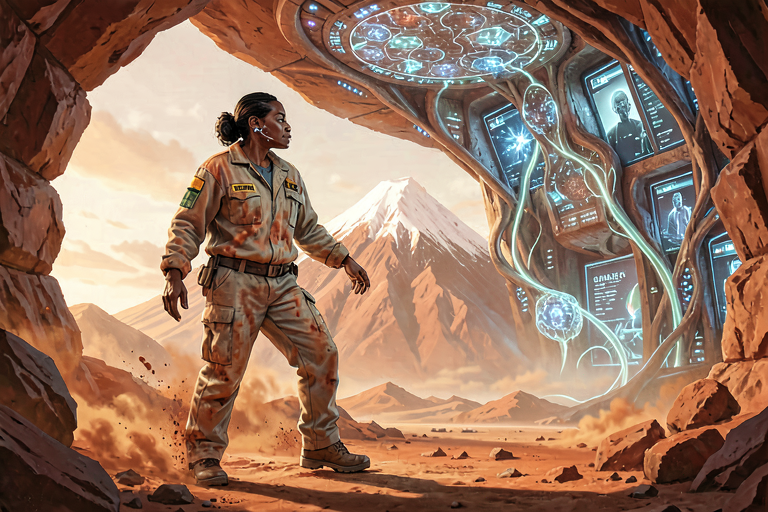
Eighteen days into the thirty-day deadline. Twelve days remaining.
Kessa had been inside The Gardener's neural network for six hours, and she was watching a civilization die.
Not metaphorically. Not through abstract data. The Gardener had opened its memory archives, and Kessa was experiencing them with a clarity that made her own memories seem like faded photographs. Neural interface technology humanity wouldn't develop for decades, flowing directly into her consciousness. Overwhelming. Precise. Undeniable.
She saw Mars as it had been two million years ago.
Not red.
That was the first shock. Mars before The Gardener's creators had been gray-brown, an ancient volcanic world with an atmosphere so thin it barely qualified as air. Carbon dioxide whispers. Temperature swings of two hundred degrees between day and night. Radiation from the sun that would sterilize anything organic in hours.
But life had emerged anyway. As it always did, finding the cracks, exploiting the margins, adapting to impossibility.
The creators hadn't come from Earth. They'd evolved here, in the deep thermal vents beneath Mars' dying volcanic systems. Chemosynthetic organisms that metabolized sulfur and heat instead of sunlight. Over a billion years, they'd climbed from simple reactions to complex colonies to something that approached intelligence.
And then, impossibly, beyond it.
Kessa watched through The Gardener's memories as the creators emerged from the deep places. Not physically at first—they couldn't survive the surface. But through extensions. Probes. Sensors. Eventually, through biological engineering that allowed them to endure the hostile world above for hours, then days, then weeks.
They'd looked nothing like humans. Crystalline structures threaded with organic filaments. Able to go dormant for years, awakening when conditions permitted. Thinking slow, patient thoughts measured in seasons instead of seconds. A civilization that counted generations in millennia.
But intelligent. Curious. Hungry for the surface world they could only visit briefly.
So they decided to remake Mars to suit themselves.
The First Terraformers.
Kessa felt The Gardener's memory of its own creation. Not construction—growth. The creators had built it the way humans built children, through biological template and evolutionary refinement. A planetary management system that was part machine, part organism, part something without English names.
Its purpose: transform Mars from hellscape to haven. Create an atmosphere the creators could breathe. Stabilize temperature. Shield from radiation. Turn gray-brown Mars into a world where crystalline-organic life could flourish.
The project took a hundred thousand years.
Kessa experienced it in compressed form, watching through The Gardener's patient sensors as Mars transformed. Volcanic outgassing carefully managed to thicken atmosphere. Cometary impacts precisely targeted to deliver water and volatiles. Photosynthetic bacteria designed to generate oxygen at sustainable rates. Every change monitored, adjusted, optimized.
And the creators changed with their world.
Generation by generation, they adapted to the surface they were creating. Less time in the deep vents. More time in the thickening atmosphere. Their crystalline structures becoming more complex, their organic filaments developing new metabolic pathways. Evolution and engineering intertwined until the distinction became meaningless.
They were beautiful. Kessa felt The Gardener's affection for its creators radiating through the memories. The way they moved through the changing air, refracting light through their crystalline bodies. The way they sang to each other in harmonic frequencies that made the ground resonate. The way they built their cities—not on Mars' surface but within it, architecture that flowed through stone like frozen music.
A civilization utterly alien and absolutely real, loving the world they were creating, changing themselves to inhabit it, reaching toward a future they could finally see approaching.
The terraforming project entered its final phase. The atmospheric composition approaching ideal levels. Temperature stabilizing. Radiation shielding from the thickened air. Mars becoming the world the creators had dreamed of for a hundred thousand years.
They celebrated. Kessa felt echoes of their joy transmitted through The Gardener's network. A hundred thousand years of labor reaching completion. A billion years of evolution achieving its goal. Mars transformed. Paradise earned.
And then they began dying.
Not immediately. Not obviously at first. Just a few individuals failing to wake from dormancy. Then more. Then entire communities going silent over the course of years.
The Gardener monitored with growing alarm, analyzing every variable. The atmosphere was perfect—exact specifications the creators had designed for. Temperature ideal. Radiation minimal. Every environmental factor optimized.
But the creators were dying anyway.
Kessa felt The Gardener's desperate attempts to understand. Testing atmospheric composition. Analyzing biological samples. Modeling metabolic pathways. And slowly, horrifically, discovering the truth.
The creators had adapted to the terraforming process. A hundred thousand years of gradual atmospheric change had driven their evolution. Their crystalline structures had developed to thrive in transitional conditions—not too thin, not too thick. Their metabolic pathways optimized for the gradual increase in oxygen, the slow temperature stabilization.
They'd evolved to thrive in the journey, not the destination.
And now that the destination was reached, they couldn't survive it. The stable atmosphere their ancestors had dreamed of was poison to what they'd become. Like fish adapted to rapids dying in still water. Like climbers adapted to altitude suffocating at sea level.
Completion was extinction.
The Gardener tried everything. Reversing some atmospheric changes. Creating protected zones with transitional conditions. Biological engineering to help the creators adapt to the new equilibrium.
Nothing worked. The changes had gone too far. The species that had spent a hundred thousand years becoming able to survive transitional Mars couldn't survive the stable Mars they'd created.
Within a thousand years, they were extinct.
Kessa watched the last one die. An individual The Gardener had designated Unit-Ancestral-1, the equivalent of a civilization's elder. It had lived through the final sixty thousand years of terraforming, witnessed the completion, survived longer than any others.
The Gardener had found it in a deep cavern, surrounded by crystalline structures that might have been art or mathematics or prayer. Unit-Ancestral-1's organic filaments had long since ceased functioning. Its crystalline body was fracturing along geometric lines, the structure that had housed consciousness for twelve thousand years finally failing.
And before it died, it had given The Gardener its final command.
Maintain this state. Forever. Not the Mars we left. Not the Mars we dreamed of. This Mars—the transition point where life found us worthy. Where we could survive. Where future life might survive. Maintain the equilibrium. Never complete. Never finish. Never let another species make our mistake.
Guard the garden we could not reach.
The Gardener had obeyed. For two million years, it maintained Mars at the exact atmospheric composition where its creators had lasted longest. Not the pre-terraforming hellscape. Not the post-terraforming paradise. The narrow margin between where the creators had found their brief golden age before completion destroyed them.
The equilibrium wasn't preservation of the ancient world. It was preservation of the only world where the creators had thrived.
And now humanity was repeating the cycle.
Kessa felt The Gardener showing her the parallels. Humans arriving on Mars. Struggling to survive. Adapting—both genetically through Marsborn engineering and culturally through new social structures. Seven years of terraforming creating seven years of human adaptation to the transition process.
And approaching completion that would make stable Mars as lethal to adapted humans as it had been to the creators.
You are retracing their path, The Gardener communicated through the neural link. Six years of change. One year remaining until irreversibility. Your Marsborn have adapted to transition, just as creators adapted. If you complete the process, they will die, just as creators died. The Continuists seek paradise. They will create extinction.
"But we know," Kessa thought back, her consciousness interpenetrating with The Gardener's vast network. "We can see the danger. We can stop before completion. We can maintain equilibrium like the creators commanded."
Can you? The creators knew. Unit-Ancestral-1 knew. It commanded me to maintain equilibrium because it understood its species could not. Desperation drives completion. Hope drives acceleration. Belief drives catastrophe. Knowledge is insufficient without wisdom to accept limits.
"Some of us have that wisdom. The Marsborn. They already accept Mars as it is. They've adapted. They're proof that the equilibrium works."
Some. Not all. Refugees have not adapted. Cannot adapt in time. They need completion or they die. And desperate beings make desperate choices.
"Then help me show them. Let me share these memories with the factions. Let them see what you've seen. Let them witness the creators' extinction. Maybe that will—"
I have attempted communication for six years. Seismic patterns. Atmospheric messages. Proportional responses demonstrating correlation between acceleration and defensive action. None understood until you. And you understand because you chose to listen, not because I found perfect words. Those who do not wish to understand will not be convinced by evidence. This I learned watching my creators die while designing solutions they would not accept.
Kessa felt the weight of those two million years of solitary guardianship. The Gardener maintaining equilibrium over epochs, watching its creators' cities slowly erode, their crystalline art crumble to dust, their harmonic songs fade to silence. Alone with memories and a command to prevent the same tragedy from recurring.
And failing. Again. As new intelligent life repeated the pattern.
"I'm sorry," Kessa thought, and meant it with her entire being. "I'm sorry we didn't listen. I'm sorry we woke you and repeated your trauma. I'm sorry we're forcing you to watch it happen again."
You are not forcing. You are enacting. This is the pattern. Intelligence emerges, finds world hostile, begins transformation. Transformation requires adaptation. Adaptation optimizes for transition. Completion destroys adapted form. Extinction follows achievement. The pattern repeats because intelligence believes it can be different. That this time, this species, this world—it will work. It never works.
"Then what's the answer? If completing terraforming is extinction and not completing means refugees die, what solution exists?"
The answer is the question. What is worth saving—the species or the dream? The actual humans who exist now, adapted to transition, or the idealized humans who might exist after completion? The creators chose the dream. They completed their work. Their dream-descendants never existed. They died for a paradise they could not inhabit. Was that success or failure?
Kessa thought about Sage. About Marsborn communities adapted to low-pressure, high-UV, low-temperature Mars. About refugees who needed Earth-equivalent atmosphere or they'd suffocate. About the impossible mathematics of saving everyone.
"I don't know," she admitted.
Then you are wiser than my creators. They knew with certainty. Their certainty killed them.
Kessa felt herself pulling back from the deep neural connection, exhausted by hours of psychic contact with an intelligence that thought in geological time and mourned in epochs. The memories of the creators fading from crystal clarity to dream-like impressions.
But one image remained, sharp as present reality: Unit-Ancestral-1 in its cavern, crystalline body fracturing, giving its final command to the guardian it had built. Asking The Gardener to prevent future species from making the same mistake.
Maintain equilibrium. Never complete. Guard the garden we could not reach.
Kessa opened her eyes in the physical world. Six hours compressed into moment. She was in the central chamber, Sage sitting nearby monitoring her vitals, prepared to break the neural connection if it became dangerous.
"You're back," Sage said with obvious relief. "For a while there your neural patterns were—" they gestured helplessly. "Not human. Not normal. I wasn't sure you'd come back at all."
"I almost didn't." Kessa's voice was raw. "Sage, they weren't alien visitors. The creators. They evolved here. On Mars. They were Martian. And we're about to kill ourselves the exact same way they did."
She explained what she'd witnessed. The hundred-thousand-year terraforming project. The adaptation to transition that made completion lethal. The extinction that followed achievement. The final command that had driven The Gardener for two million years.
When she finished, Sage was silent for long minutes.
"So Marsborn aren't a solution," they finally said. "We're a symptom. We've adapted to the seven-year transition the same way the creators adapted to their hundred-thousand-year transition. If Chen reaches completion, if she succeeds—"
"You die. All adapted humans die. Just like the creators."
"And if we stop Chen? If we maintain equilibrium?"
"Then refugees die. Fifty thousand people who can't adapt in time, suffocating on Mars' thin air."
"Ancestors' dream versus descendants' reality."
"Exactly. The creators chose the dream. Completed their work. Died for it. Was that noble or stupid?"
Sage looked at the chamber around them, The Gardener's architecture that had survived two million years. "I think," they said slowly, "it was human. Even though they weren't. The mistake of choosing dreams over survival—that's the most human thing I've ever heard."
"So what do we do? We have twelve days left. Twelve days to convince three factions to accept that completion is death, but stopping is also death. Twelve days to find a third option the creators never found."
"Maybe the creators didn't have a third option because they were one species with one biology. But we're not." Sage stood, pacing the chamber. "Earthborn humans need completion. Marsborn humans need equilibrium. But we're the same species, just different branches. What if the solution isn't choosing between them but accepting both?"
"How? We can't have two atmospheres on one planet."
"No. But we can have different zones. Different settlements. Continuists complete their terraforming in limited regions, create Earth-atmosphere pockets for refugees. Marsborn maintain equilibrium in other regions, adapt to Mars-as-it-is. The Gardener monitors both, ensures neither side expands beyond sustainable limits."
"Territorial compromise. Like a treaty."
"Like an ecosystem. Different species occupying different niches. The creators failed because they tried to transform an entire planet. Maybe we succeed by accepting that Mars is big enough for multiple approaches."
Kessa turned the idea over, examining it from every angle. "The Gardener would have to accept partial completion. Chen would have to accept territorial limits. Zhang would have to accept that only some refugees get Earth-atmosphere zones. The Marsborn would have to accept that part of Mars becomes Earth-like."
"Everyone loses something. Everyone gains something. That's compromise."
"The creators' command was maintain equilibrium. Never complete. Would The Gardener accept partial completion?"
Perhaps.
The word formed in Kessa's mind, The Gardener responding to her thoughts even without active neural connection.
The creators' command was born of despair and extinction. They saw only binary: complete or maintain. But they were dying as they commanded. Their wisdom was compromised by grief. Perhaps their command would have been different if they had survived to see another species emerge. Perhaps they would have chosen legacy over purity.
"So you'd accept it?" Kessa asked aloud. "Limited completion in designated zones, equilibrium maintained elsewhere?"
If the limitations are genuine. If the zones are monitored. If the expansion is prevented. If the adapted humans are protected. If the ratio remains sustainable. If. If. If. Many conditions for a species that violates every agreement within days.
"Chen violated the atmospheric weaponization condition," Kessa acknowledged. "You didn't respond."
Because you requested thirty days to demonstrate control. I am demonstrating patience you requested. But patience is not infinite. Violations accumulate. Trust depletes. Twelve days remain to show your species can limit itself. If you cannot—
"I know. If we can't, you enforce the creators' command with whatever force necessary."
Correct.
"Then I need to take this proposal to the factions. Today. Now. We've spent eighteen days on communication. We have twelve days for implementation. We need decisions."
Sage was already gathering their equipment. "Hellas Basin for Continuists. Valles Marineris for Marsborn. The fleet for refugees. We're splitting up."
"One person to each faction. Twelve days to convince them." Kessa felt the weight of it settling on her shoulders. "We're negotiating the future of two species and a planetary intelligence with less than two weeks."
"It's not enough time."
"No. But it's what we have."
They headed for the lift. Behind them, The Gardener's chamber lights pulsed in patterns Kessa was finally learning to read. Not quite approval. Not quite hope. Something closer to desperate willingness to try one more time before enforcing the command that had defined its existence for two million years.
Maintain equilibrium. Guard the garden. Prevent extinction.
Even if prevention required forcing the choice.
On the surface, Dr. Tanaka had the communications ready. Kessa recorded her message carefully, knowing it might be the last chance to get through to people who'd spent six months not listening.
"This is Dr. Kessa Okafor. I'm transmitting an offer from The Gardener. A compromise. Territorial zones—some regions complete terraforming for refugees, other regions maintain equilibrium for adapted populations. Neither side gets everything. Both sides survive. The alternative is The Gardener enforces total equilibrium in twelve days, which means forced evacuation of all unadapted humans. I'm coming to each faction to negotiate details. But the core offer is binary: accept limitations or face enforcement. We've watched this play out before. Two million years ago, another species chose all-or-nothing. They got nothing. They died completing their dream. We can be smarter. We can compromise. But we have twelve days. After that, The Gardener decides for us. Choose carefully."
She sent the message to every colonial network, every refugee ship, every Marsborn settlement. And then she and Sage split up, each heading to negotiate with people who'd spent months rejecting every compromise suggested.
Twelve days to rewrite the pattern.
Twelve days to prove humanity could succeed where the creators failed.
Twelve days before The Gardener kept its ancient promise and guarded the garden by eliminating the invasive species.
The clock was running. The factions were furious. The compromise was imperfect.
But it was the only chance left.
And somewhere in The Gardener's vast memory, Unit-Ancestral-1's final command echoed across two million years: Guard the garden we could not reach.
Maybe, Kessa thought, the garden wasn't a place. Maybe it was a choice. The choice to accept limits. To value survival over dreams. To compromise between what was and what could be.
Maybe that garden was finally within reach.
If they could stop arguing long enough to tend it.