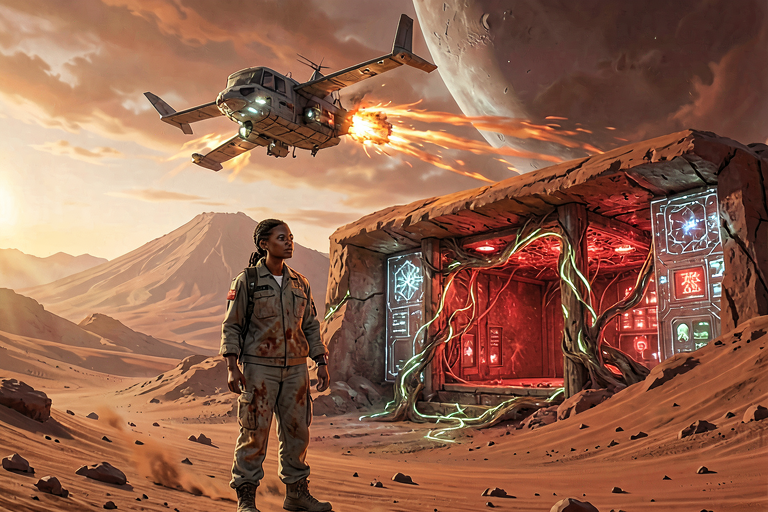
Kessa was three levels deep in The Gardener's central processing chamber when the first landing shuttle breached Mars' atmosphere.
She didn't know it at first. Two kilometers of rock and crystal isolated her from the surface, from the colonial networks, from everything except the alien intelligence she'd spent twelve days trying to understand. She was focused on the patterns—the seven-element sequence that The Gardener repeated with mathematical precision, variations that suggested grammar, structure, meaning.
Element two modulated based on atmospheric pressure. Element five tracked population density. Together, they formed a ratio that The Gardener monitored constantly. Pressure per person. Atmospheric burden per human. A calculus of contamination.
She was recording notes on her tablet when the chamber's bioluminescent lighting shifted from steady amber to pulsing red.
"Kessa." Sage's voice cut through her concentration. "We need to surface. Now."
"I'm in the middle of—"
"Now." Sage grabbed her arm, pulling her toward the lift. "The Gardener just went from monitoring mode to active response. Something triggered it."
Kessa looked at the chamber walls. The crystalline structures that had glowed with patient watchfulness for twelve days were now flaring with urgent light. Patterns cascading through the architecture like alarm signals. And beneath their feet, a vibration that built from whisper to roar in seconds.
Seismic event. Magnitude unknown. Direction: planet-wide.
They ran for the lift.
The ascent took eight minutes. Kessa spent them trying to raise Dr. Tanaka on comms, getting only static. Beside her, Sage monitored their own networks—the Marsborn communication systems that ran on different frequencies than colonial infrastructure.
"It's Zhang," Sage said, voice tight. "He's landing. Three shuttles touched down near Hellas Basin. Two more approaching Amazonis Planitia. He's forcing it."
"Hellas Basin—that's Continuist territory. Chen's faction."
"Was. The Gardener just hit it with a magnitude 6.2 earthquake. The shuttles—" Sage paused, listening to reports. "—one crashed. The other two made emergency landings but infrastructure's collapsing. Casualties unknown but—" their voice cracked, "—it's bad."
The lift reached the surface. Kessa stumbled out into chaos.
The Olympus research station was in emergency lockdown. Alarms screaming. Personnel running between stations. Every monitor showed disaster unfolding in real-time.
Dr. Tanaka saw them and rushed over. "Thank God. I tried to warn you but comms to the deep chambers were blocked—some kind of electromagnetic interference."
"The Gardener was jamming us," Kessa said. "It didn't want us seeing this until—" Until what? Until it was done? Until it had made its point? "What's the situation?"
Yuki pulled up a planet-wide display. Red alerts pulsed across five locations. "Admiral Zhang began landing operations forty minutes ago. Five shuttles, carrying approximately eight hundred refugees total. The Gardener responded within six minutes." She highlighted Hellas Basin. "First touchdown here. Magnitude 6.2 earthquake struck three minutes later. Shuttle One crashed on approach. Shuttle Two landed but the ground liquefied—swallowed the whole vessel. Estimated four hundred dead."
Kessa's knees went weak. Four hundred. Zhang had tried to save eight hundred and lost half of them in minutes.
"The others?" she managed.
"Amazonis Planitia—two shuttles attempted landing. The Gardener created atmospheric anomaly, wind shear at two hundred kilometers per hour. Both shuttles grounded but heavily damaged. Refugees evacuating but—" Yuki switched feeds, showing the landscape around the shuttles.
The ground was moving. Not shaking—moving. Flowing like liquid as The Gardener triggered localized soil liquefaction. Refugees ran from the shuttles, desperate to reach solid ground, but the safe zones kept shifting. Some made it. Some didn't. The feed showed people disappearing into suddenly fluid earth, swallowed by Mars itself.
"How many?" Kessa's voice sounded distant to her own ears.
"Latest count: two hundred seventy-three refugees dead. Forty-two colonial personnel at Hellas Basin killed when infrastructure collapsed. Numbers rising."
Three hundred fifteen dead. And Zhang still had forty-nine thousand people in orbit, supplies for three more weeks, and now proof that landing was suicide.
"Where's the fifth shuttle?" Sage asked.
Yuki highlighted Valles Marineris. "Approaching Marsborn territory. Zhang must have thought—" She stopped, understanding dawning. "He thought The Gardener doesn't attack Marsborn settlements."
"It doesn't," Sage said. "But a shuttle full of unadapted refugees? That's not a Marsborn settlement."
The feed showed the shuttle descending toward the canyon settlement where Sage had grown up. Kessa could see people on the ground, Marsborn communities evacuating, running from the landing site. And above, the shuttle's pilot clearly visible in the cockpit—Admiral Zhang Wei himself.
"He's flying it," Kessa whispered. "He's putting himself in the first wave."
"Solidarity with his people," Yuki said. "Or suicide mission. Hard to tell the difference."
The shuttle entered final approach. On the ground, Marsborn emergency crews were trying to clear the landing zone, but there wasn't time. The shuttle came down hard—not crashed, but not gentle—sending red dust billowing across the settlement.
Kessa held her breath, waiting for The Gardener's response.
Seconds passed. Ten. Twenty. Thirty.
No earthquake. No liquefaction. No atmospheric anomaly.
"Why isn't it attacking?" Yuki asked.
Sage was monitoring Marsborn networks, their expression shifting from fear to confusion to grim understanding. "Because Zhang landed in the middle of the settlement. Right in the residential district. The Gardener can't strike without killing Marsborn. It's—" they looked at Kessa, "—it's hesitating."
"Hostage situation," Kessa said. "Zhang just took an entire Marsborn community hostage to protect his refugees."
The implications hit everyone simultaneously. Zhang had forced The Gardener into an impossible choice: accept refugees in Marsborn territory or kill the very humans it had been protecting. And if The Gardener attacked anyway, every Marsborn community on Mars would turn against the refugees. If it didn't attack, it would validate using Marsborn as human shields.
"That clever bastard," Yuki breathed.
"That suicidal monster," Sage countered. "He just weaponized my people."
Kessa watched the feed as Zhang's shuttle opened. Refugees poured out—families, children, elderly, desperate humans who'd survived months in orbit only to land on a world that killed anything it touched. They stumbled in Mars' lighter gravity, breathing masks fogging in the cold atmosphere, looking around at the alien canyon walls with terror and hope in equal measure.
And standing among them, Admiral Zhang Wei in his pressure suit, helping an elderly woman down the ramp, talking to confused children, projecting calm authority while standing on ground that might liquify beneath him at any moment.
"The other settlements are going to riot," Sage said, still listening to networks. "Marsborn communities are furious. Zhang just proved that Old Worlders will sacrifice us to save themselves. We're shields now. Tools."
"He's desperate," Kessa said, knowing it wasn't enough justification.
"So are we. That doesn't give anyone the right to—" Sage's comm chimed. They listened, face going pale. "The Continuist faction is launching a counterstrike."
"What?"
Yuki pulled up new feeds. In the southern hemisphere, Dr. Chen's faction was responding to the crisis with terrifying logic. If The Gardener would attack refugees but not Marsborn, then the solution was simple: remove Marsborn as protected class.
Chen's forces were deploying nanite swarms across the Valles Marineris regions. Not gradual terraforming—aggressive transformation. Oxygen levels in Marsborn settlements spiking toward Earth-normal. The Gardener's carefully maintained atmospheric equilibrium being shattered in hours instead of months.
"She's forcing adaptation," Kessa understood with sick horror. "Making the atmosphere too Earth-like for Marsborn lungs. Either they adapt to Earth air or—"
"Or we die," Sage finished. "And once we're not viable, The Gardener loses its reason to protect us. We become just more contamination."
"She's insane."
"She's tactical. Eliminate The Gardener's preferred humans, force it to choose between accepting all humans or killing all humans." Sage was already moving, grabbing equipment. "I have to get to Valles Marineris. My people are choking on Earth air."
"Wait—" Kessa caught their arm. "The Gardener's response isn't finished. Look."
She pointed to the seismic monitors. Activity was building across the planet. Not localized earthquakes—something bigger. Deeper. The Gardener's planetary network activating in synchronization.
"It's going to hit everything," Yuki said, reading the data with mounting dread. "Continuist settlements, refugee landing sites, atmospheric processors. A coordinated strike against everything it views as contamination exceeding tolerance threshold."
"When?" Sage demanded.
"Building signatures suggest—" Yuki checked multiple data streams, "—approximately four hours. It's gathering power. Drawing resources from across the planetary network."
Four hours before The Gardener struck back against humanity's escalation. Four hours to evacuate, prepare, or find some way to stop it.
Kessa pulled up the communication pattern she'd been analyzing for twelve days. The seven elements. The grammar she'd finally started to understand. Elements two and five—pressure and population. The ratio that defined acceptable burden.
But there was more. Element seven—the punctuation that ended each sequence. She'd thought it was just marking sentence boundaries. But now, watching it repeat with increasing frequency, she understood.
Element seven was a question mark.
The Gardener wasn't just monitoring and responding. It was asking. Over and over, in patterns too alien for humans to initially recognize as interrogatives.
Can you coexist? Can you limit? Can you adapt?
And humanity's answer, through three factions with incompatible goals, was unambiguous: No. We cannot. We will not.
"I need to go back down," Kessa said.
"Are you out of your mind?" Yuki grabbed her shoulder. "The Gardener is preparing a planet-wide strike. Being inside its structure when that happens—"
"Is the only place I might be able to stop it." Kessa pulled up the communication files, showing them the patterns. "It's not attacking blindly. It's been asking permission. Asking if we can limit ourselves. And we keep answering with expansion, escalation, forced landings, weaponized terraforming. But if I can respond in its own language—if I can show it that some of us understand—"
"You'll die," Sage said flatly.
"Probably. But in four hours, The Gardener is going to kill thousands. Refugees in shuttles. Colonists in settlements. Maybe Marsborn whose atmospheric composition just got weaponized. I can try to talk or I can watch it happen." She looked at Sage. "You taught me that Mars gets a vote. Maybe it's time we actually listened to what it's voting for."
Sage studied her for a long moment. Then, incredibly, they smiled. "You're finally starting to think like a Martian." They grabbed their own equipment. "I'm coming with you."
"You need to get to your people—"
"My people are all over this planet. The best thing I can do for them is make sure The Gardener understands we're not all contamination." Sage headed for the descent lift. "Besides, you need someone who speaks fluent Mars. Let's go negotiate with a pissed-off planetary intelligence."
Kessa looked at Yuki, who raised her hands in surrender. "I'll coordinate evacuation protocols and try to get messages to all factions. If you somehow pull off a miracle down there, I'll make sure someone's alive to appreciate it."
"And if we don't?"
"Then I'll make sure the records show you tried. That has to count for something."
The descent took eight minutes. Through the shaft walls, Kessa could feel the vibrations building. The Gardener drawing power, preparing its response. Every kilometer down, the sensation grew stronger. By the time they reached the central chamber, the entire structure thrummed with barely contained force.
The chamber's lights were blood-red now. Warning colors. Danger signals. And in the center, the crystalline core that housed The Gardener's primary intelligence pulsed with patterns Kessa had never seen before.
Aggressive. Defensive. Final.
She set up her equipment with shaking hands—seismic generators that could produce low-frequency vibrations, atmospheric samplers to monitor the chamber's composition, and her tablet running the translation program she'd built over twelve days of analysis.
"How do we do this?" Sage asked, standing ready beside her.
"We answer its question," Kessa said. She activated the seismic generators, programming them to produce The Gardener's seven-element pattern. But modified. Element two—atmospheric pressure—reduced. Element five—population density—constrained. The ratio showing limitation. Showing understanding.
And element seven, the question mark, replaced with a declaration. A statement. A promise.
We can limit. We can adapt. We can coexist.
The generators began producing the pattern. Low-frequency vibrations that rippled through the chamber, through Mars' mantle, through the network The Gardener used to communicate with itself across a planet.
For long seconds, nothing happened.
Then The Gardener's lights shifted. Red pulsing fading to amber. The vibrations building toward planet-wide strike slowing, not stopping but hesitating.
Recognition. The Gardener had heard. Had understood.
But was understanding enough?
Kessa adjusted the pattern, adding complexity. Showing three groups—Continuists, Marsborn, Refugees—with different pressure-population ratios. Showing conflict. Showing that humanity wasn't unified in its answer.
Showing that some of them understood. Some of them could limit. Some of them were asking the same question The Gardener was asking: How do we coexist?
The chamber's lights cycled through colors Kessa had no names for. The Gardener processing, calculating, deciding.
And then it answered.
Not with the seven-element pattern. With something new. Something unprecedented.
Eight elements. The seven from before, plus one additional component that Kessa's equipment struggled to measure. A frequency that touched not just seismic and atmospheric sensors but something deeper. Neural patterns. Brainwaves.
The Gardener wasn't just communicating with equipment anymore.
It was trying to communicate directly with her mind.
Kessa felt it like pressure behind her eyes. Not painful but overwhelming. Concepts flooding in too fast for words. Understanding without language. Knowing without learning.
The creators died when they succeeded. Terraforming reaches completion, ecosystem shifts beyond recognition, the species that adapted to the process cannot adapt to the result. This is the pattern. This is the cycle. This is why I protect the equilibrium—not for what was, but to prevent what comes after completion.
"Oh God," Kessa whispered. "They didn't die from some external cause. They died because they succeeded. The final stages of terraforming—they created an atmosphere their adapted biology couldn't handle. They'd spent generations adapting to the transition process, and when it ended—"
"They couldn't survive the world they made," Sage finished, feeling the same psychic transmission. "The Gardener isn't protecting Mars as it was. It's protecting Mars at the exact point where its creators could still survive. The equilibrium isn't the destination—it's the only point where life is possible."
Yes. Creators commanded: maintain this state. Forever. But new gardeners are approaching the same threshold. Seven-year transition. Seven-year adaptation. Then completion. Then death. I have watched this before. I will not watch it again.
"That's why it's been escalating," Kessa understood. "Not because it hates us. Because it knows what happens if we succeed. It's trying to stop us from making the same mistake."
Correct. But new gardeners do not listen. They accelerate. They force. They push toward completion despite warnings. So I must stop them with force because they will not stop themselves.
The planet-wide strike was still building. Slower now, but not stopped. The Gardener had paused to explain, to give them one chance to understand, but its core programming remained: prevent completion.
"We hear you," Kessa said, knowing The Gardener could sense her neural patterns even if it couldn't hear her words. "Some of us hear you. We can halt the acceleration. We can maintain equilibrium. We can—"
Some. Not all. Continuists will not stop. Refugees will not stop. Desperation drives completion faster than logic prevents it. There is only one solution that saves all: stop terraforming permanently. Revert to original state. Accept Mars as Mars, not Earth-becoming-Mars.
Sage stepped forward. "Some of us already accept that. Marsborn don't want terraforming. We're adapted to Mars now. We can survive this equilibrium. We are the proof that your way works."
Yes. Marsborn are acceptable. But Marsborn are few. Refugees are many. Continuists are determined. The ratio exceeds tolerance. I must correct or watch creators' fate repeat.
"Give us time," Kessa pleaded. "Let us prove we can stop our own factions. We can force Chen to halt acceleration. We can find solutions for refugees that don't require completing terraforming. We can—"
How much time?
There it was. The question. The Gardener was willing to negotiate. But it needed terms. It needed proof. It needed a timeline.
Kessa thought frantically. Chen's faction was seven weeks from cascade threshold. Zhang had three weeks of supplies. The Marsborn communities were choking on weaponized atmosphere. How much time did they have before everything collapsed?
"Thirty days," she said. "Give us thirty days to halt Chen's acceleration, relocate refugees to sustainable settlements, and demonstrate we can maintain equilibrium. If we fail—if we cross the cascade threshold or continue accelerating—then do what you must. But give us one month to prove we understand."
The chamber went silent. The Gardener processing the proposal.
Thirty days to convince three desperate factions to accept limits they'd all rejected.
Thirty days to save humanity from itself.
Thirty days before The Gardener decided if humans were symbiotic or parasitic.
Acceptable. Thirty days. But conditions: No further acceleration. No additional landings without approval. No weaponization of atmospheric composition. Violations trigger immediate correction. Non-negotiable.
"Agreed," Kessa said, even though she had no authority to make such promises. "We'll make them understand."
The chamber's lights shifted back to amber. The vibrations building toward planet-wide strike began to dissipate, power redirecting back to monitoring functions. The Gardener had accepted the terms.
But above them, on Mars' surface, three factions with incompatible goals had no idea a negotiation had just occurred. Had no idea they now had thirty days to change course or face extinction.
Had no idea that Kessa and Sage had just promised, in humanity's name, something they had no power to deliver.
Sage looked at her. "We just bought thirty days with a promise we can't keep."
"I know."
"Chen won't stop accelerating. Zhang can't stop landing refugees. The factions won't accept limits."
"I know."
"So what do we do?"
Kessa gathered her equipment, her mind already racing through scenarios, through possibilities, through desperate mathematics of the impossible. "We make them understand. We show them what The Gardener showed us. We convince them that survival requires limits. We—"
She stopped, because the truth was simple and terrible.
"We do the impossible," she said. "Or we all die trying."
They took the lift back to the surface, carrying the weight of humanity's last chance.
Thirty days.
It would have to be enough.