Day 2,409. One day into two-week deadline. Twenty-nine days until Zhang's supplies run out.
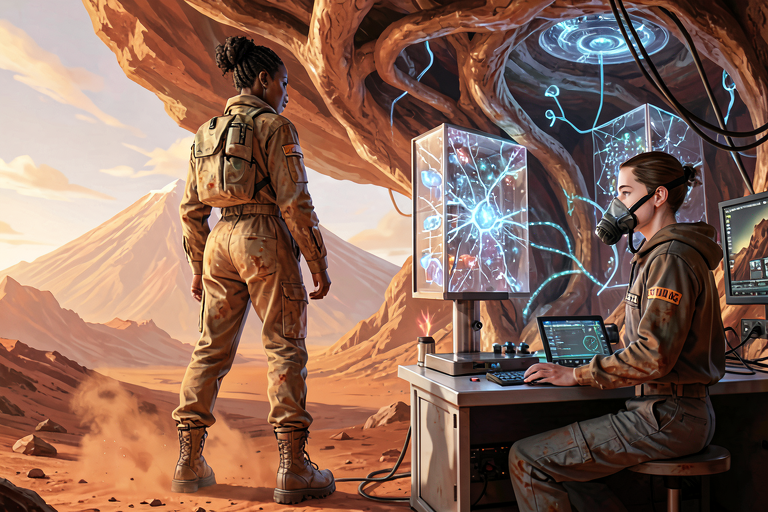
The seismic generators hummed with frequencies no human ear could hear, but Kessa felt them through her boots, through the stone, through the air itself. Two kilometers beneath Olympus Mons, surrounded by The Gardener's bioluminescent architecture, she was trying to speak a language she'd only heard once.
"Pattern replay," she said to Sage, who monitored the equipment. "Elements one through seven, exactly as The Gardener transmitted three days ago."
The generators engaged, producing low-frequency vibrations that rippled through Mars' mantle. Element one: a steady pulse at 0.7 Hz. Element two: modulated based on current atmospheric pressure. Element three: a harmonic of element one. Element four: pause duration. Element five: scaled to population density. Element six: amplitude variation. Element seven: the question mark—a rising inflection that Kessa had interpreted as interrogative.
Can you coexist? Can you limit? Can you adapt?
They waited. The chamber's lights pulsed their normal amber rhythm, giving no indication The Gardener had noticed.
"Again?" Sage asked after two minutes of silence.
"Not yet. If it's like human communication, constant repetition reads as desperate or hostile. We give it time to process and respond."
"How much time?"
"I don't know. We're talking to something that's maintained a planet for two million years. Its sense of urgency might be measured in centuries."
Sage adjusted their breathing—didn't need supplemental oxygen like Kessa, their adapted lungs handling Mars' thin air with ease—and pulled up data on their tablet. "While we're waiting: reports from Valles Marineris. Chen's faction deployed atmospheric processors along the southern settlements. Oxygen content jumped two percent overnight."
"That's weaponization. She promised to halt acceleration."
"She promised nothing. Zhang negotiated the thirty-day deadline. Chen wasn't part of that negotiation. To her, this is still war footing."
Kessa felt anger tighten her throat. Thirty days to prove humanity could communicate with The Gardener, could demonstrate capacity for limits, and Chen was actively sabotaging the effort by accelerating the very contamination that had triggered defensive responses.
"Can Marsborn communities evacuate the affected areas?"
"Some already are. Others—" Sage's expression hardened, "—can't. Or won't. These are ancestral settlements. People don't abandon homes easily."
"Even if staying means suffocating?"
"Especially then. Mars is ours. Old Worlders making it uninhabitable is exactly what we've been warning about for years. Some communities are choosing to stay as protest. As proof."
"Martyrdom is proof of conviction, not correctness."
"Try telling them that."
The chamber's lights shifted. Subtle change from amber to amber-with-green-undertones. Kessa's heart rate spiked. She checked the seismic sensors.
"Did you see—"
"Yes." Sage was already recording. "Light pattern change. Could be natural variation, or—"
The generators picked up vibrations not of their own making. Faint. Originating from deeper in the structure. The same seven-element pattern Kessa had transmitted, but inverted. Where she'd sent rising frequencies, The Gardener responded with falling. Where she'd increased amplitude, it decreased.
Mirror communication. Or rejection?
"Is that acknowledgment or contradiction?" Sage asked, voicing Kessa's question.
"I think—" Kessa pulled up linguistic analysis software, comparing the patterns, "—it's neither. It's distinction. The Gardener is showing that its communication is different from ours. We're stating our pattern. It's stating its own. Not mirroring. Establishing separate identity."
"Like saying 'I am not you'?"
"Or 'I am other. Recognize the boundary.'"
That was less encouraging. If The Gardener's first response to human communication attempts was emphasizing separation, that suggested unwillingness to bridge the gap. Or—Kessa forced herself to consider alternative interpretations—it suggested establishing clear distinction was prerequisite to productive exchange. You couldn't negotiate between two entities unless both entities acknowledged they were separate.
She recorded the response carefully, analyzing every variation. Element two in The Gardener's version tracked atmospheric pressure in real-time, more precisely than her crude generators could manage. Element five referenced current human population density across Mars—not just in this chamber but planet-wide. How was it calculating that?
Unless.
"Sage, do Marsborn communities track population statistics in real-time?"
"Of course. Settlement management requires accurate counts for resource distribution."
"What system do you use? Database protocol?"
"Colonial standard architecture. Same as Earth-derived settlements. Why?"
Kessa felt cold understanding settle. "Because Element Five in The Gardener's pattern is exactly tracking current population. Which means it has access to our databases. It's been monitoring our networks. It knows precisely how many humans are on Mars at any given moment."
"Is that—should we be worried?"
"I don't know. It's monitoring us, yes. But monitoring isn't necessarily hostile. It's information gathering. Understanding threats requires knowing threat scope."
"Or targeting," Sage said quietly. "If you're planning coordinated strikes, knowing exact population locations would be tactically useful."
That was uncomfortably plausible. But Kessa had committed to communication, which meant assuming best interpretation until evidence forced worse.
"Let's assume monitoring, not targeting. Which means The Gardener is trying to understand us. Same as we're trying to understand it. That's— that's something we can work with."
The generators sat silent now, waiting for Kessa's next transmission. What did you say to a planetary intelligence that had just demonstrated it knew everything about your species' presence while you knew almost nothing about it?
What you always said in first contact situations: I acknowledge you. I recognize you as intelligence. I want to understand.
She programmed a new sequence. Eight elements this time, adding her own to The Gardener's seven. Element eight: a pause, then repeat of elements two and five—pressure and population—but at lower values. Hypothetical values. Showing what atmospheric pressure and population density might look like if humans limited their presence.
If we reduce our numbers and our atmospheric impact, would that be acceptable?
The generators transmitted. The chamber's lights cycled through amber, green, amber, settling into a pattern Kessa hadn't seen before. And through the stone, faint but distinct, The Gardener responded.
Twelve elements. Taking Kessa's eight and adding four more. Element nine: seismic activity (current low-level). Element ten: seismic activity (potential high-level). Element eleven: time duration (short). Element twelve: causation link between population/pressure (high) and seismic response (catastrophic).
If you do not limit, I will force limitation through seismic action. Soon.
"That's a threat," Sage said, voice tight.
"That's a boundary condition. It's telling us the consequences of exceeding limits. That's not hostility— that's communication of rules."
"Rules backed by earthquakes that can level settlements."
"Yes. But it's giving us warning. That's more than it gave Olympus Station. The fact that it's communicating consequences instead of just implementing them means it's considering us as negotiating partners, not just contaminants to be eliminated."
"You're optimistic."
"I'm desperate. There's a difference."
Kessa transmitted again, this time reducing elements two and five even further in her hypothetical scenario. Showing dramatic reduction in human atmospheric impact and population density. Not elimination—she couldn't promise that, wouldn't promise extinction—but significant contraction. Asking: How much reduction would satisfy you?
The Gardener's response took longer. Three minutes of silence while the lights pulsed through patterns that might have been calculation or might have been entirely unrelated to their conversation. Then:
Fifteen elements. Complex modulation. Element two and five showing acceptable ranges—narrow but not impossible. Population density reduced to about sixty percent of current. Atmospheric pressure within fifteen percent of current equilibrium levels. Time frame: one Martian year.
Reduce to these levels within one year or I enforce reduction.
"One Martian year," Sage said, running the conversion. "Six hundred eighty-seven Earth days. That's— Chen's faction won't accept contraction. Zhang's refugees can't accept it—they need more resources, not less. And my people already live within those parameters but Earth-born don't."
"So we have the answer to what The Gardener considers acceptable. Now we just have to convince three hostile factions to achieve it."
"In under two years."
"In thirty days to demonstrate we're trying, then one year to actually achieve it."
The enormity of that settled into the chamber. Kessa had established communication—real, meaningful exchange of information with an alien intelligence. First contact. The dream of every xenoarchaeologist.
And the message was: Reduce or die.
Not precisely the inspiring moment of cosmic connection humanity had dreamed about.
Seven hundred kilometers above, on the refugee fleet's command ship, Admiral Zhang Wei read the decoded transmission Kessa had sent to all factions. Population reduction to sixty percent current levels. Atmospheric restriction to near-current equilibrium. One Martian year.
"That's twelve thousand people," his logistics officer said quietly. "If we maintain current population at forty-eight thousand, reducing to sixty percent means evacuating twelve thousand."
"Evacuating to where?" Zhang asked, though he knew the answer.
"Earth. Or space. Or death. Sir, we don't have return capability. Ships are one-way. Fuel calculations were optimized for landing with minimal reserves. Sending anyone back means—"
"Means choosing who dies in space instead of on the surface."
His officer fell silent.
Zhang looked at the tactical display. Forty-eight thousand people in ships designed for forty thousand, running on supplies calculated for twelve weeks that had now stretched to seven months through rationing and desperation. He'd lost three hundred people last month to malnutrition-related complications. Two hundred the month before.
Every day in orbit was death by slow mathematics.
Every day delayed landing was watching his people deteriorate.
And now Kessa was asking him to accept that only sixty percent—twenty-eight thousand refugees—could settle Mars. That twenty thousand people he'd kept alive through impossible logistics would still need to be sacrificed.
Just later. Just on the surface instead of in space.
"Draft a response," he said. "To Dr. Okafor and the Emergency Council. The refugee fleet acknowledges The Gardener's terms. We will comply with population restrictions. But we must land first. Compliance cannot occur in orbit. People cannot evacuate from ships that are already graves."
"Sir, that's— you're agreeing to terms we can't meet."
"I'm agreeing to survive the next forty-eight hours. Then the next week. Then the next month. By the time The Gardener's one-year deadline arrives, maybe someone will have found a solution I cannot currently see. Or maybe we die. But we die on ground, not floating in vacuum. Draft the response."
"Yes, sir."
Zhang watched Mars turn below, red world becoming prison or sanctuary depending on whether Kessa's communication succeeded or failed. He'd spent forty years in military service learning that sometimes orders were impossible and you followed them anyway. Sometimes plans were doomed and you executed them regardless. Sometimes people died and you kept commanding the survivors.
This was that. Scaled to fifty thousand lives.
He'd been honest with Kessa when he'd sent his message: I am begging. But begging didn't change mathematics. It just made the calculations more human.
The landing operations would proceed in forty-eight hours. The Gardener could accept or enforce. But forty-eight thousand people couldn't survive another month in orbit while Kessa negotiated with an alien intelligence that thought in geological time.
Time humanity didn't have.
In the southern hemisphere, Dr. Vashti Chen reviewed the same transmission Kessa had sent. Population reduction. Atmospheric limits. One Martian year.
"Unacceptable," she said to her engineering staff.
"Dr. Chen, if The Gardener's threats are legitimate—"
"Then we accelerate completion before it can enforce. We're at six point two percent atmospheric conversion. Seven percent triggers cascade effects—the composition starts self-reinforcing, becomes irreversible even if The Gardener attempts atmospheric reversion. If we reach seven percent, the terraforming is done. Mars becomes Earth-compatible whether the Gardener approves or not."
"Seven weeks at current rate. But Okafor's communication—"
"Is her attempting to negotiate our surrender to an alien AI's terms. I respect Kessa's work. But she's an archaeologist talking to ancient intelligence. I'm an engineer solving present crisis. The Gardener wants us to reduce population and atmospheric transformation. We can't reduce population—that's genocide. So we complete transformation fast enough that reduction becomes irrelevant. Seventy million square kilometers of Mars. Plenty of room for fifty thousand refugees and six million future colonists if the atmosphere supports them."
"The Gardener will respond to acceleration."
"Then we respond faster. Nanite deployment to all equatorial zones. Atmospheric processors to maximum output. Strip mining for rare earths to power expansion. We hit seven percent in four weeks instead of seven. Before Okafor's thirty-day deadline expires. Before Zhang's forced landings give The Gardener excuse for retaliation. We complete the transformation and present it as fait accompli."
"That's—Dr. Chen, that's war. You're declaring war on The Gardener."
Chen looked at the settlement outside her command center's window. Three hundred people living in habitats designed for Mars' original atmosphere, breathing supplemental oxygen, rationing water, building futures on red dust. People who'd sacrificed Earth for Mars. Who'd committed to transformation.
"The Gardener declared war when it destroyed Olympus Station," she said. "Eleven hundred people. We're just fighting back. And unlike Olympus, we'll win. Because we understand the science of atmospheric transformation. We know the tipping points. We know how to make change irreversible."
"Even if it kills adapted populations? Marsborn communities can't survive Earth atmosphere."
"Then they adapt further. Or evacuate to poles. Or—" Chen stopped, because finishing that sentence meant saying or they die and she wasn't ready to be that honest about the costs.
"Marsborn are human," her chief engineer said quietly.
"So are refugees. So are we. Everyone's human, everyone's desperate, everyone has valid claims to survival. But not everyone can survive the same solution. The Gardener wants Marsborn-compatible equilibrium. Zhang wants refugee settlement. I want a completed Mars that works for maximum population. Three incompatible goals. Someone loses. I'm making sure it's not us."
She transmitted acceleration orders to all Continuist installations. Nanite deployment increased. Atmospheric processing pushed to operational maximums. Mining operations expanded into previously restricted zones.
The numbers updated on her display. 6.2% atmospheric conversion. Climbing. Four weeks to 7% if acceleration held. Four weeks to irreversibility.
Four weeks until Mars was saved or destroyed, depending on which human faction you asked.
Chen chose to believe it was salvation.
The Gardener would have different opinions.
They'd find out soon enough who was right.
Two kilometers down, Kessa felt the chamber's lights shift to red. Warning colors. The Gardener responding to Chen's acceleration in real-time.
"She's not listening," Kessa whispered. "She got the message. She understood the terms. And she's accelerating anyway."
Sage was monitoring Marsborn networks. "Oxygen levels spiking in three southern settlements. My people are—" They listened to reports streaming in. "—evacuating. Some stayed. Chen's nanites are making equilibrium zones uninhabitable for adapted lungs."
The Gardener's lights pulsed with urgency Kessa had learned to recognize as distress. Or anger. Or both. And through the seismic sensors, she felt vibrations building. Not immediate strike. But gathering force. Preparation.
You accelerate. I respond. This is your choice.
"We have forty-seven hours until Zhang's landings," Kessa said. "Forty-seven hours to convince Chen to stop, convince Zhang to delay, convince The Gardener to show patience. And we've spent one day on communication that proves we can exchange information but can't achieve agreement."
"You're being optimistic again."
"I'm being accurate. We can talk to The Gardener. That's achievement. But talking isn't enough if the message is 'reduce population' and humans keep saying 'we can't.' At some point, The Gardener stops communicating and starts enforcing."
"How long do we have?"
Kessa looked at the red lights, at the seismic data showing power building in systems deep beneath Mars, at the timeline of Chen's acceleration and Zhang's desperation and The Gardener's patience wearing molecule-thin.
"Not long enough," she said.
And transmitted another pattern to The Gardener, knowing communication was insufficient but having no other options.
Please wait. Please give us time. Please understand we're trying.
The lights stayed red.
But the seismic buildup paused.
Not halted. Just paused.
Forty-seven hours remained.
Kessa got back to work.