Day 2,350 - One Week After Olympus
The access point Sage's people found was a lava tube near Pavonis Mons, one hundred sixty kilometers south of Olympus Station's ruins. Atmospheric sensors had been detecting the same electromagnetic patterns they'd monitored from other volcanic sites—the Gardener's presence flowing through Mars' geological networks.
Kessa descended with a small team: Sage, two Marsborn technicians, and Yuki from geological survey. Yuki had survived Olympus Station by evacuating early, and she'd volunteered for this expedition with quiet determination. Guilt over her part in corporate suppression, Kessa suspected. Making amends through action.
The lava tube opened into familiar crystalline architecture. Not as extensive as the Beneath beneath Olympus, but the same bioluminescent walls, the same neural patterns pulsing through alien substrates. The Gardener's networks, still active, still patient.
"Interface node should be deeper in the tunnel system," Sage said, scanning ahead. "Based on architectural patterns from your Olympus data."
They found it twenty minutes later—a chamber almost identical to the one Kessa had used before. Smooth crystal column, designed for biological contact, electromagnetic signature showing active connection to the Gardener's planetary consciousness.
"Same protocol as before?" Yuki asked.
"Same protocol. Twenty-minute contact limit. Medical monitoring. Physical disconnect if I stop responding." Kessa prepared the neural sensors. "But this time I'm not gathering information. I'm negotiating terms."
"For what?" Sage's voice was gentle. "The Gardener already chose its response to irreversibility. What terms are left?"
"Refugee landing. Infrastructure rebuilding. Long-term coexistence. The mathematics of survival beyond punishment." Kessa positioned herself before the interface. "It destroyed Olympus Station. Removed the threat. Now we need to know if it will allow what comes next."
She touched the crystal.
The universe opened.
New gardener returns. Communication acknowledged.
I'm here to discuss aftermath. Olympus Station destruction. Refugee situation. Future terms.
Contamination source eliminated. Irreversibility accepted. Atmospheric conversion will continue without human acceleration. Gardener equilibrium calculations updated for new parameters.
The Gardener's presence felt different this time—less rigid, more processing. Like it was genuinely calculating new approaches instead of defending old protocols.
The refugees. Fifty thousand humans in orbit. Ten thousand can adapt to Marsborn settlements. Forty thousand need Earth-standard atmosphere to survive. Can you accept their landing?
Landing location parameters?
Scattered settlements. Small scale. Using the atmospheric conversion that's already irreversible. They're not accelerating your contamination. They're just surviving what's already happening.
The Gardener processed. Kessa felt computational networks evaluating scenarios, running models, calculating contamination spread versus equilibrium impact versus survival mathematics.
Small-scale settlement: acceptable. Populations under 5,000 per location. Total not exceeding 100,000. Located in high-conversion zones where equilibrium disruption already maximum. Monitored for compliance. Expansion beyond parameters triggers proportional response.
It was negotiating. Actually offering terms.
Admiral Zhang has fifty thousand refugees. Your parameters allow landing.
Provided settlements remain within specifications. Provided no renewed acceleration attempts. Provided adaptation programs continue for future generations. Gardener monitors compliance. Violations trigger responses.
Understood. What about rebuilding? Infrastructure for those settlements? Manufacturing, agriculture, basic survival systems?
Rebuilding acceptable if located in designated zones. No planetary-scale projects. No attempts to bypass irreversibility constraints. Local solutions for local populations. Gardener maintains oversight.
It was all there. Terms that let refugees land. Permission to rebuild. Acceptance of irreversible terraforming balanced by constraints on future expansion.
Why offer terms now? After destroying Olympus?
Olympus represented acceleration threat. Active contamination expansion. Removal necessary to protect equilibrium. Remaining humans demonstrate varied responses: some adapt (Marsborn acceptable), some scatter (containable), some died opposing equilibrium (threat eliminated). Current human population shows potential for coexistence within parameters.
You're willing to coexist?
Gardener purpose: maintain equilibrium, protect new gardeners from creator fate. If new gardeners accept equilibrium constraints, protection continues. If new gardeners expand contamination, protection requires elimination. Choice remains with humans.
Kessa felt the alien logic—protection through constraint. The Gardener viewing itself as savior, not oppressor. Humanity's survival possible only within boundaries that prevented the ancient extinction pattern from repeating.
What happens at Year Seven? When atmospheric conversion completes?
Unknown. Creator data suggests extinction correlation. Gardener monitoring for pattern recognition. If extinction symptoms appear, elimination may be required to save remaining population through forced atmospheric reversal. Or new gardeners survive, proving correlation was not causation, and Gardener updates models. Year Seven is inflection point. Decision pending observation.
So they weren't saved. Just on probation. If humans survived Year Seven without extinction symptoms, the Gardener would accept them. If they showed signs of the ancient fate, elimination to save whoever could be saved.
Can you share what killed your creators? Any data that survived corruption?
Negative. Creator extinction cause lost to time. Only correlation remains: successful terraforming followed by civilization collapse. Duration between: unknown. Causation mechanism: unknown. Gardener prevents repetition through equilibrium maintenance. Now irreversibility prevents equilibrium. Gardener observes. Humans live or die according to unknown factors. Protection limited to constraint enforcement.
They'd crossed irreversibility, and now even the Gardener didn't know if they'd survive. It was watching. Waiting. Ready to intervene if extinction signs appeared, but unable to prevent what it couldn't understand.
I'll bring your terms to human leadership. Small-scale settlements, forty thousand refugees accepted, rebuilding permitted in designated zones, expansion constrained, Year Seven observation pending. Is that accurate?
Accurate. Gardener awaits human decision. Compliance enables coexistence. Violation triggers response. Choose.
The contact broke.
Kessa returned to consciousness with terms that might save forty thousand refugees but locked humanity into permanent constraints. Sage caught her as she swayed.
"Did it work?"
"It offered terms. Conditional coexistence. But there's..." Kessa struggled to put it into words. "There's three factions forming. I can feel it. The math implies it."
She pulled up her analysis, showed them what the Gardener's terms created: three distinct survival strategies, each incompatible with the others.
"Faction One: Continuists. Those who want to keep pushing terraforming despite constraints. Rebuild corporate power, find ways around the Gardener's parameters, complete Earth-standard conversion. They'll reject the terms."
"Faction Two: Marsborn Independence. Those who accept Mars-as-it-is, genetic adaptation, indigenous culture separate from Earth. The Gardener accepts them, but they have no interest in helping refugees who won't adapt."
"Faction Three: Mediators. Those seeking middle ground—partial terraforming, scattered settlements, coexistence with constraints. Zhang's refugees would fit here. So would anyone willing to compromise."
Yuki was already modeling it. "Three factions with incompatible goals. Corporate rebuilders, Marsborn seperatists, refugee accommodationists. They'll fight over strategy, resources, political control." She pulled up conflict projections. "Dr. Okafor, you just negotiated terms that save refugees but fracture Mars colonies into civil conflict."
"Better than genocide." Sage said it firmly. "Let factions form. Let humans argue strategy. At least they're alive to argue."
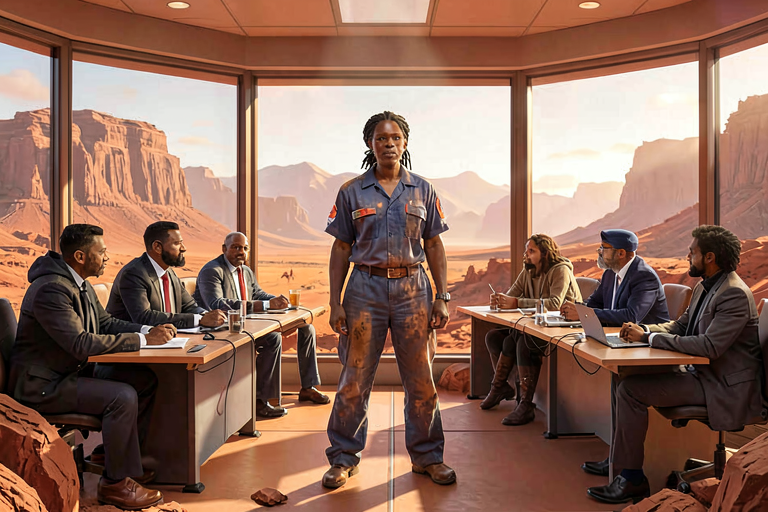
They returned to the surface, to Valles Marineris, to the emergency colonial council still trying to establish governance from chaos.
Kessa presented the Gardener's terms.
The fracture happened immediately.
Dr. Vashti Chen, representing corporate survivors: "We don't accept alien constraints on human development. We'll rebuild, find ways to continue terraforming, complete the project. The Gardener destroyed Olympus but it can't monitor everywhere. We adapt around its limitations."
Sage, representing Marsborn: "We accept the Gardener's terms because we're already living them. Mars-as-it-is is our equilibrium. The rest of you can scatter in your small settlements. Just don't expect our support for your Earth nostalgia."
Admiral Zhang, representing refugees: "I accept any terms that let my people land and survive. Scattered settlements, genetic adaptation for some, permanent constraints—all acceptable. We crossed the solar system. We can accept Mars on its terms."
The council devolved into arguments. Corporate insisting on rebuilding autonomy. Marsborn demanding independence and resource allocation. Zhang pleading for refugee landing permissions. Earth governments via delayed video insisting on continued terraforming investment.
Three factions. Three futures. Three incompatible visions.
Exactly as the mathematics predicted.
Kessa stood in the observer section, watching Mars colonies fracture along survival-strategy lines, and realized this was the best outcome possible.
Not unity. Not victory. Not even peace.
Just multiple survivals, each choosing their own mathematics, each accepting their own risks.
The Continuists would push against constraints and trigger Gardener responses until they learned or died.
The Marsborn would thrive in independence, proving adaptation worked.
The Mediators would build scattered settlements and hope Year Seven didn't kill them all.
And the Gardener would watch, patient as stone, ready to intervene if ancient patterns repeated.
Mathematics without mercy.
But mathematics with choices.
Different paths. Different risks. Different outcomes.
Some would survive. Maybe all. Maybe none.
Year Seven would answer questions nobody could predict.
But at least humans had time to try.
At least forty thousand refugees could land.
At least Dmitri's sacrifice bought his daughter a chance, even if she'd land in a world he hadn't envisioned.
The council session ended with no consensus. Just acceptance of fractured reality.
Kessa left knowing Chapter 20 waited—the official formation of factions, the political resolution, the beginning of whatever came next.
But she'd done what she could.
Communicated with the Gardener.
Negotiated terms.
Gave humans choices instead of just catastrophe.
Rajesh would have been proud.
Chen would have supported it.
Even Dmitri, in his desperate calculation, might have accepted that his gamble created space for something new.
Three factions.
Three futures.
Three months until Admiral Zhang's supplies ran out.
Seven months until Year Seven.
Infinite possibilities between mathematics and mercy.
Kessa headed to her quarters to write her final report.
The archaeologist who'd studied dead civilizations, negotiating survival with living intelligence.
Some civilizations died.
Some adapted.
Some fractured into pieces that survived separately.
Mars would discover which it was.
Together and apart.
In three factions.
Counting down to Year Seven.
And whatever truth waited there.