The rover bounced across Mars' red surface, suspension working overtime in the low gravity. Kessa gripped the handlebar as Rajesh navigated around a boulder field, the greenish-blue sky overhead a constant reminder of six years of atmospheric transformation. In the distance, Valles Marineris carved a wound across the planet—the largest canyon in the solar system, and home to Mars' most vocal independence movement.
"Remind me why we're driving eight hundred kilometers to talk to someone who won't talk to us?" Rajesh's voice carried that particular exhaustion of someone who'd been traveling for fourteen hours.
"Because Sage is the only person on Mars who's actually living with the planet instead of fighting against it." Kessa checked her notes for the third time. "The Marsborn communes have been monitoring atmospheric anomalies for years. If anyone's noticed pattern changes that might support our data—"
"It's someone who thinks we're genocidal Old Worlders destroying their homeland."
"Well." Kessa managed a tired smile. "They're not entirely wrong."
The Valles Marineris settlement clung to the canyon wall like lichen on rock—modular habitats connected by exposed walkways, greenhouse domes glowing with vegetation, communications arrays pointed at the stars. No corporate logos. No Earth flags. Just the simple functionality of people who'd chosen to live on Mars as Mars was, not as Earth wanted it to be.
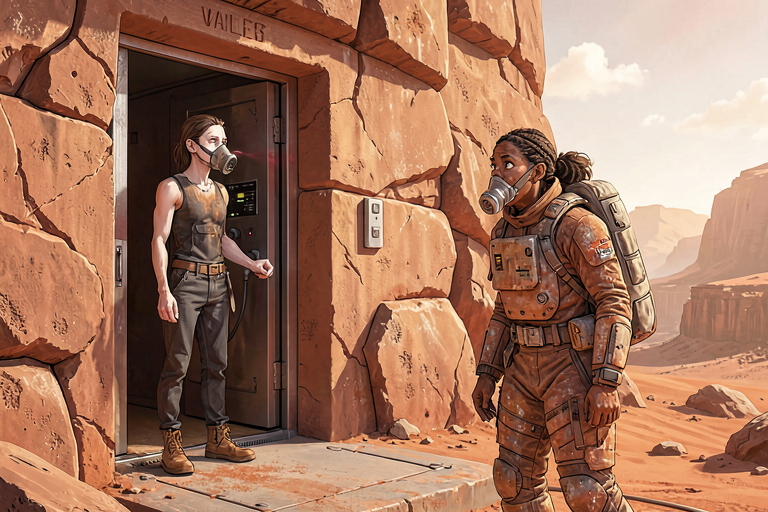
A figure waited at the settlement's airlock entrance, tall and thin in a way that spoke of a lifetime in low gravity. They wore a breathing mask but no full pressure suit, just work clothes designed for mobility. As Kessa and Rajesh approached in their bulky environment suits, the figure removed their mask entirely.
Kessa stopped walking.
The figure—Sage, it had to be Sage—stood breathing Mars' atmosphere directly. The thin CO2-rich air that would kill an unmodified human in minutes. Their chest rose and fell in a slow, deep rhythm, adapted lungs processing what Earth-born humans needed machines to survive.
"You must be Dr. Okafor." Sage's voice carried clearly in the thin air, pitched to carry in low-pressure environments. "The Old Worlder who woke the Gardener."
Kessa found her voice through shock. "You're breathing without equipment."
"You say that like it's remarkable." Sage gestured toward the settlement. "Fourteen hundred people live in Valles Marineris. About two hundred of us are first-generation Marsborn. We breathe Mars because Mars is our air." They studied Kessa through pale eyes adapted to dimmer light. "You came a long way to stare at the local wildlife, Dr. Okafor. Or did you have questions?"
"The Gardener." Kessa forced herself past wonder to purpose. "You called it that. What do you know about the structure beneath Olympus Mons?"
"More than you, probably." Sage started walking toward the settlement, moving with that fluid grace impossible in Earth's gravity. "The Gardener has been speaking for years. We listen. Old Worlders just turned up the volume until it started screaming."
They led Kessa and Rajesh through the airlock—a simple pressure chamber that smelled of red dust and recycled air. Inside, the settlement opened into a network of corridors carved directly into canyon rock. Marsborn moved through the spaces with easy confidence, most wearing minimal breathing support. A few of the older residents—first colonists, Earth-born—used full breathing apparatus, their bodies incapable of the adaptation their children had achieved.
Sage brought them to a chamber that served as common area and operations center. Screens displayed atmospheric data, seismic monitors, communications feeds from settlements across Mars. A young woman at one terminal looked up as they entered, nodded to Sage, returned to her work without comment.
"The Gardener started changing patterns three years ago." Sage pulled up atmospheric data on a large display. "Small fluctuations in CO2 levels across the Tharsis region. Local pressure variations. Temperature micro-adjustments." They highlighted sections of the graph. "We thought it was responding to the terraforming acceleration. Year Six approaches Year Seven, nanite deployment increases, the Gardener gets more active."
"But you didn't report it to Olympus Station." Kessa studied the data—it confirmed her own findings, showed patterns she'd missed.
"Why would we?" Sage's expression carried something between pity and contempt. "So corporate could suppress it like they suppress everything that threatens their timeline? We know how this works, Dr. Okafor. Old World sees Mars as property. New World sees Mars as home. Property gets developed. Home gets defended."
"The seismic activity—"
"Increased when you started excavating, yes." Sage opened another dataset. "Magnitude and frequency correlating with excavation depth and duration. The Gardener doesn't like being poked. Doesn't like its atmospheric management being disrupted. Doesn't like six years of terraforming changing what it's maintained for two million years." They looked at Kessa directly. "You woke it up. Now it's deciding what to do about the contamination."
The word hit like a slap. Contamination. That's what Kessa and Chen had theorized—human presence as contamination in a planetary system. Hearing it stated so flatly made it real.
"We're not contamination," Rajesh said. "We're trying to make Mars habitable."
"Habitable for who?" Sage's voice stayed level, but something cold entered their expression. "Mars is habitable. I'm standing here breathing it. Two hundred Marsborn are living on this planet without the terraforming you Old Worlders insist we need. You're not making Mars habitable. You're making it Earth-compatible. Big difference."
"The refugees." Kessa spoke before Rajesh could respond. "Fifty thousand people in orbit. They can't survive without terraforming."
"No, they can't survive without genetic modification and cultural adaptation." Sage pulled up another screen—medical data, genetic sequences. "The same modifications that made us possible. But Old World won't accept that solution because it means admitting humanity might need to change, not the planet." They gestured around the settlement. "We're living proof that humans can adapt to Mars. But that proof threatens the terraforming investment, so it gets ignored."
Kessa studied the genetic data. The modifications were elegant—enhanced lung capacity, improved oxygen uptake, pressure tolerance, radiation resistance. Changes that let human biology integrate with Martian reality instead of forcing Mars to integrate with human demands.
"How many generations would it take to modify the refugee population?"
"Genetically? One, with proper prenatal modification. Culturally?" Sage shrugged. "That's harder. Requires accepting you're Martian now, not displaced Earthlings. Most Old Worlders never make that leap."
"So your solution is to let fifty thousand people die in orbit?"
"My solution is to stop terraforming before the Gardener kills everyone trying to protect its planet." Sage's voice finally showed heat. "The refugees' situation is terrible. I understand that. But the solution isn't to commit planetary genocide. The solution is to become what this planet needs us to be."
The seismic monitor on the wall pulsed red. Magnitude 3.7, centered beneath Olympus Mons. The fourth tremor this week, and the strongest yet.
Sage watched the readout with grim satisfaction. "The Gardener is escalating. We've been tracking the pattern. Every nanite deployment, every atmospheric conversion milestone, every excavation deeper into its infrastructure—the responses get stronger." They turned to Kessa. "You wanted to know what we know? We know you woke a planetary defense system. We know it's been patient for two million years but patience isn't infinite. We know when the Year Seven threshold hits and terraforming becomes irreversible, the Gardener will stop asking you to leave and start making you."
"You're saying it will kill us." Rajesh's voice had gone quiet.
"I'm saying it will correct the contamination. Same thing your immune system does to an infection." Sage pulled up a predictive model. "At current escalation rates, we calculate six months until the Gardener shifts from warning to elimination. Your corporate directors have ten months until Year Seven. Do the math."
Kessa did the math. Felt cold certainty settle in her chest.
"You came here hoping I'd support your evidence." Sage's expression softened slightly. "Help you convince corporate to take the threat seriously. That's not what I'm offering, Dr. Okafor. I'm offering you a choice."
"What choice?"
"Join us. Help us stop the terraforming before the Gardener has to stop it violently. Help us save both worlds—Mars as it is, and the humans who can learn to live here." Sage gestured to the settlement around them. "Or go back to Olympus Station and watch corporate arrogance kill everyone while you file reports no one reads."
Kessa looked at Rajesh, saw her own turmoil reflected there. Sage wasn't wrong. The corporate review had proven that evidence alone wouldn't stop the terraforming timeline. But joining the independence movement meant abandoning her position, her research, any remaining influence she might have.
"I need to think about it," she said finally.
"Think quickly." Sage pulled up the seismic data again. "The Gardener's escalation pattern is accelerating. You don't have much time."
The rover ride back to Olympus Station stretched through the Martian night, stars brilliant overhead in the thin atmosphere. Kessa watched the greenish sky fade to darkness, wondering how many more sunsets Mars had before the Gardener decided humanity's time was up.
"Are you going to do it?" Rajesh asked quietly. "Join them?"
"I don't know." Kessa pulled up her own data on her tablet, compared it to what Sage had shared. The patterns aligned perfectly. "They're right about the escalation. Right about the Gardener being a planetary system. Right about us being the contamination."
"But wrong about the solution. We can't just abandon fifty thousand refugees."
"We also can't destroy a planet to save them." Kessa rubbed her eyes, exhaustion making everything feel impossible. "Maybe there's a third option. Something between terraforming and adaptation."
"Like what?"
"I don't know yet." She stared at the data, willing it to reveal an answer. "But Sage proved one thing. Humans can live on Mars without remaking it. That's not nothing, Rajesh. That's hope, even if it's not the hope everyone wants."
Her tablet chimed. Message from Olympus Station, flagged urgent.
Dr. Okafor: Your presence is requested at tomorrow's executive review meeting regarding excavation findings. 08:00 Station time. Attendance mandatory. —Director Volkov
Kessa closed the message, stared at the Martian landscape rolling past.
Sage's offer echoed in her mind. Join us or watch corporate kill everyone.
Tomorrow she'd face Volkov's review. Tomorrow she'd try once more to make them understand the danger.
Tomorrow she'd probably fail.
And then she'd have to decide which world she belonged to—the one being born, or the one being destroyed.