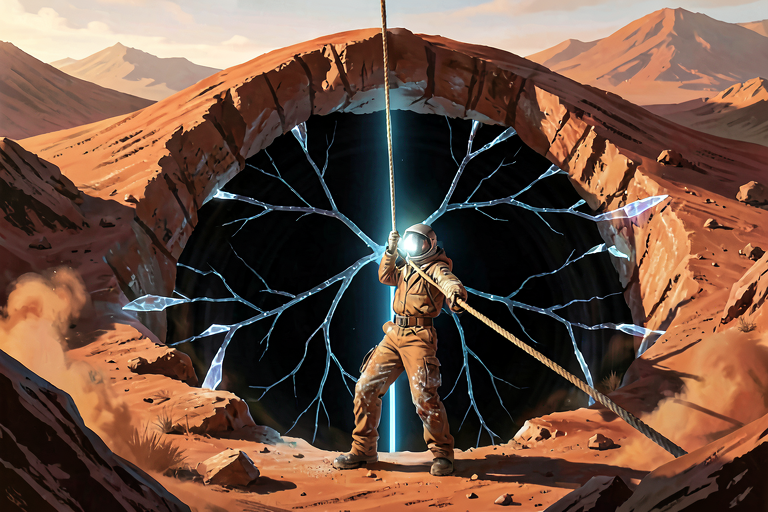
The drill bit screamed as it chewed through basalt two kilometers beneath Olympus Mons.
Kessa Okafor watched the telemetry on her wrist display, dust-stained fingers hovering over the emergency stop. Six years of terraforming had painted Mars' sky a greenish-blue that no human eye had seen in the planet's four-billion-year history, but down here, pressed against ancient stone, the world was still red. Still Mars.
"Density change," she said into her helmet comm, academic precision cutting through the drill's whine. "Dropping to near-zero in three meters."
"Cavity?" Rajesh's voice crackled from the surface hab. "Could be a lava tube."
"Not at this depth. Not with these seismic readings." Kessa studied the data streaming across her display, watching the numbers that had haunted her for six months. The magnetic anomaly. The geometric perfection in the ground-penetrating radar. The way acoustic surveys returned patterns that almost—not quite, but almost—looked like language.
The drill bit punched through.
The shriek cut off. Two kilometers of machinery went silent so abruptly that Kessa's ears rang with the absence. Her display flashed warnings: atmospheric pressure differential, unexpected void space, recommending immediate ascent.
She killed the alerts and triggered the camera feed.
At first, the darkness was absolute. The drill's inspection camera panned through a void so perfectly black it seemed to devour light. Then the automatic floods kicked in, and Kessa stopped breathing.
The cavity was impossible.
She was looking at a chamber that shouldn't exist—not here, not carved from solid basalt by any geological process she understood. The walls curved in geometries that made her eyes ache, surfaces too smooth for erosion, too deliberate for nature. The scale was wrong. The ceiling arched thirty meters above the drill breach, vanishing into shadows that the floods couldn't penetrate. And everywhere, embedded in the black stone like veins in flesh, ran traceries of something that caught the light and held it, crystalline structures that seemed to pulse with their own rhythm.
"Rajesh." Her voice came out steady despite the hammer of her heart. "Log the timestamp. 14:37 local, day 2,247 of the terraforming project. I'm looking at architecture."
Silence from the surface. Then: "You're certain?"
"I'm a xenoarchaeologist, Rajesh. I know the difference between rocks and buildings." She zoomed the camera, focusing on the nearest wall. The crystalline traceries formed branching patterns, fractal networks that reminded her of neural pathways, or roots seeking water. "It's intact. Two million years buried, and it's intact."
She thought of the excavations on Earth that had defined her career. The care required to preserve fragments. The way wind and water and time reduced human ambition to dust. She thought of the family she'd abandoned to stay with those fragments while Earth's climate turned them to refugees.
This structure hadn't been preserved. It had been protected.
"I'm going in," Kessa said.
"Negative. Corporate regs require—"
"Required approval from site director, which I am. Required safety protocols, which I'm following." She was already moving, sealing her suit's auxiliary locks, checking oxygen reserves. "Required documentation, which I'm providing. Tether me in, Rajesh. If I'm not back in two hours, haul me up."
She rappelled down the drill shaft in Martian silence, broken only by her own breathing and the whisper of the cable. At the breach, she clipped her tether and dropped through into the chamber.
Low gravity caught her gently. Her boots touched down on a floor so level it could have been machine-tooled yesterday. The impact sent vibrations humming through the stone, and for a moment—just a heartbeat—Kessa could have sworn the crystalline veins brightened.
She swept her helmet lamp across the space. The chamber extended beyond her light's reach, corridor mouths gaping in three directions. The architecture was nothing like human design, nothing like the mathematical precision of human geometry. These curves followed other rules. Organic rules, perhaps, or rules from a mathematics she didn't speak.
But they were rules. Intentional. Built.
Kessa moved to the nearest wall and ran her gloved hand above the surface, careful not to touch. The crystalline traceries branched and rebranched, forming networks of stunning complexity. She pulled out her portable scanner and pressed it against the stone.
The readings made no sense. The crystalline structures registered as neither purely mineral nor purely organic—something in between, or something for which those categories were insufficient. The scanner detected electromagnetic activity, faint but present. Patterns that might have been decay or might have been something else.
Dormancy.
The thought came unbidden and unwelcome. Not decay. Sleep.
"Kessa?" Rajesh's voice was distant, concerned. "Your biometrics are spiking."
"I'm fine." She wasn't fine. She was standing in an alien megastructure beneath the largest mountain in the solar system, in a chamber that shouldn't exist, touching walls that held power after two million years. "I'm logging everything. The data alone will justify five years of grant applications."
"Corporate won't like this."
Kessa thought of Dmitri Volkov, the terraforming director whose approval she'd needed to excavate here at all. The man who'd made it clear he viewed archaeology as a waste of resources, who'd only granted the permit because public relations demanded it. Who'd spent six years pumping nanites into Mars' atmosphere, transforming the planet toward Earth standard, and who had no interest in evidence that Mars had been transformed before.
"Corporate doesn't have to like it," she said. "They have to acknowledge it. This is proof, Rajesh. Confirmed evidence of alien intelligence. The first in human history."
She moved deeper into the chamber, following the largest corridor. Her lamp beam danced across walls covered in the crystalline networks. The patterns grew denser here, more complex, almost like—
The comparison hit her with physical force. She'd seen networks like this before. In neurobiology texts. In brain scans. These weren't decorations or structural supports. These were information pathways. Computational architecture.
This wasn't a building. It was a machine.
"Rajesh, I need you to pull up every seismic survey we've done of Olympus Mons. Every radar sweep. Everything."
"That's three years of data."
"Do it. I need to know how far this extends."
She walked further, drawn by a light that wasn't her lamp. Ahead, the corridor opened into a larger space—a cavern, a cathedral, she didn't have words for the scale. And at its center, rising from floor to ceiling like a pillar holding up the mountain's weight, was a column of pure crystalline structure. It pulsed with bioluminescence, slow as a heartbeat, painting the walls with shifting shadows.
Kessa approached it with the reverence of standing before Saint Peter's, or the Pyramids, or the first footprint on Luna. Structures built to proclaim: We were here. We were mighty. Remember us.
She reached out, and this time she did touch.
The pulse beneath her glove was unmistakable. Rhythm. Response. Recognition.
"Kessa." Rajesh's voice was urgent now. "I'm seeing seismic activity. Small tremors, magnitude 2.5, epicenter your location."
The crystalline veins in the walls were brightening. Not decay. Not dormancy. Waking.
"I'm coming up," Kessa said, backing away from the column. The light followed her movement, or seemed to. "Rajesh, I need you to close this excavation. Full quarantine protocols. No one else comes down here until we understand what we're dealing with."
"Understood. But Kessa—corporate isn't going to let you shut down excavation."
She looked around at the impossible architecture, at the machine that had slept for two million years and was now waking to the touch of human hands. Thought of Dmitri Volkov's terraforming timeline, the seven-year threshold approaching in months. The point when atmospheric changes became irreversible. The point when Mars would be transformed whether anyone wanted to stop it or not.
"Then corporate is going to have a problem," Kessa said.
She climbed back toward the surface, toward the thin transformed atmosphere and the greenish-blue sky. Behind her, deep in the ancient dark, something that was not a mountain but wore a mountain as camouflage continued its slow awakening. The Gardener had work to do.
Mars was changing. That could not be allowed.
In orbit, fifty thousand refugees watched Mars turn slowly beneath their dying ships and prayed for landing permission that would not come.
At Olympus Station, Dmitri Volkov reviewed the quarterly terraforming metrics and allowed himself a moment of satisfaction. Six years. One more year to the threshold. Then his daughter could come home to a safe world.
In the Valles Marineris communes, Sage breathed the thin Martian air through lungs that evolution had spent three billion years insisting couldn't exist, and wondered what the old worlders would think if they knew Mars was already home to a new species.
And two kilometers beneath the largest mountain in the solar system, an intelligence older than human civilization ran diagnostics on systems that had waited two million years for this moment, and began calculating pressure differentials, atmospheric corruption vectors, and the most efficient response to contamination.
The countdown had started. No one on Mars knew they had already lost.